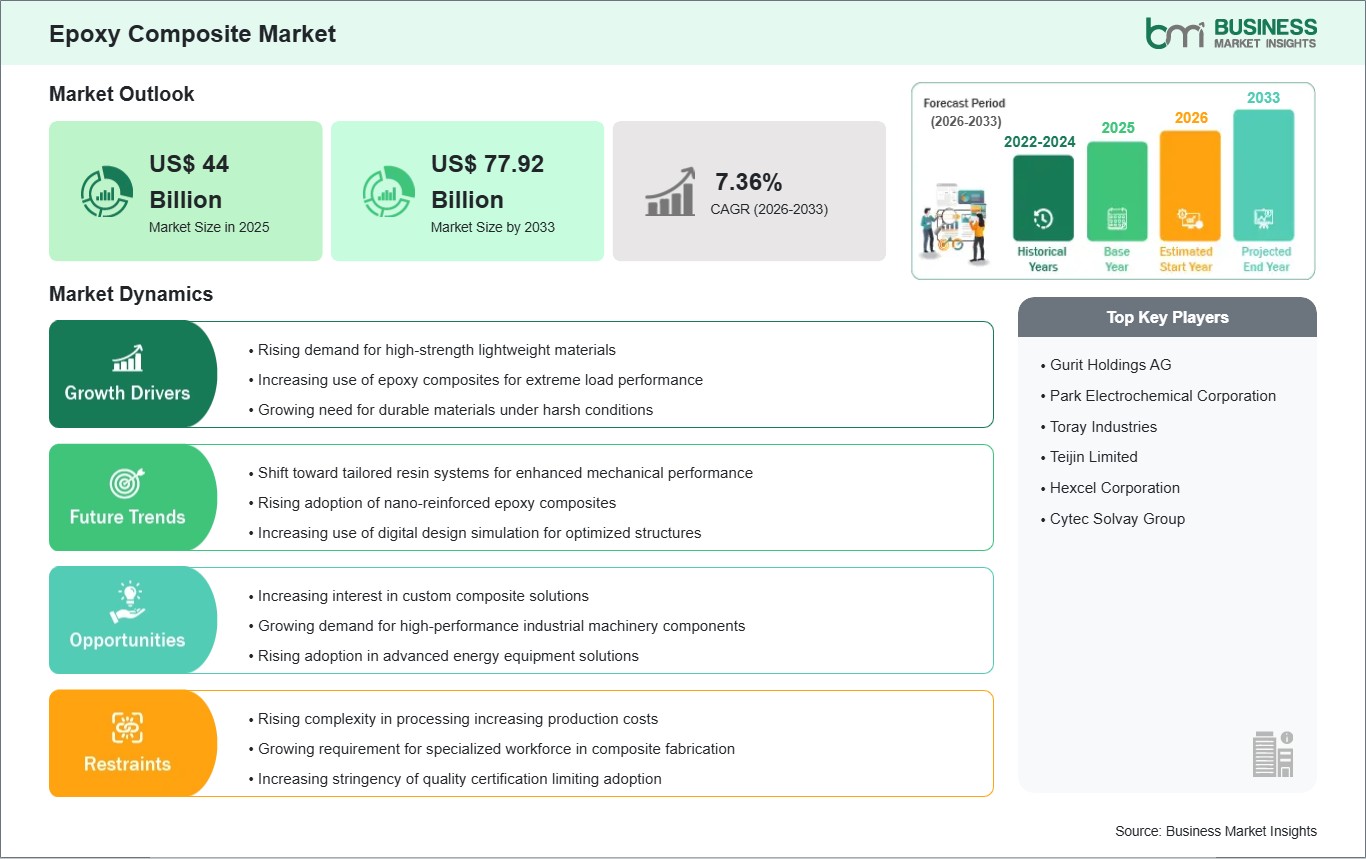
The Epoxy Composite Market size is expected to reach US$ 77.92 Billion by 2033 from US$ 44 Billion in 2025 .The market is estimated to record a CAGR of 7.36% from 2026 to 2033.
The world epoxy composite market is rapidly being characterized by the importance of epoxy composites in facilitating the development of materials with the capability to withstand extreme environmental and mechanical conditions. Epoxy composites, which are essentially a combination of epoxy resin and reinforcing fibers, have come to be used in specialized applications where other materials, such as metal or plastic, cannot perform. A major market driver is the increasing interest in hybrid composite materials, where epoxies are mixed with multiple fibers or nanomaterials to provide unique properties. This enables industries to develop materials with unique properties without compromising their flexibility and lightness. However, a major restraint on this industry is the formulation of these epoxies, which demands a good knowledge of chemistry and processing techniques. Also, there are challenges with maintaining uniform fiber distribution and resin curing over large components. Another major restraint on this industry is the disposal of thermoset-based epoxies at the end of their life cycle. Despite these challenges, innovation in composite materials and their integration with other materials will continue to provide opportunities for this industry to grow and become indispensable in industries requiring unique properties and extreme environments.

Key segments that contributed to the derivation of the epoxy composite market analysis are type, manufacturing process, and end user.
The demand for epoxy composites is being driven by industries that require materials combining strength with reduced weight. Sectors such as aerospace, automotive, and sporting goods are increasingly turning to epoxy composites to replace traditional metals and heavy materials. These composites offer high tensile strength and impact resistance while contributing to overall weight reduction, which is critical for improving fuel efficiency and performance.
High-strength epoxy composites are particularly attractive in applications where safety and durability are paramount. Components exposed to mechanical stress, vibration, or environmental extremes benefit from the rigidity and toughness of epoxy composites, ensuring reliability over extended service periods. This makes them a preferred choice for structural parts, protective casings, and load-bearing components.
The trend toward lightweight yet durable materials also reflects broader industry priorities around efficiency and sustainability. Reducing the weight of vehicles and equipment not only lowers energy consumption but also supports environmental targets. As industries seek materials that meet these dual objectives, epoxy composites continue to gain traction as a versatile and high-performance solution globally.
Custom composite solutions are creating significant opportunities for the epoxy composite market. Manufacturers are increasingly exploring tailored formulations to meet specific performance requirements, such as enhanced thermal resistance, chemical stability, or electromagnetic shielding. This ability to customize composites allows designers to optimize components for specialized applications, from precision electronics to high-performance vehicles.
The opportunity extends to modular and additive manufacturing processes. Epoxy composites can be engineered for 3D printing and complex molding, enabling rapid prototyping and production of intricate parts. This flexibility allows manufacturers to reduce production cycles, minimize material waste, and develop solutions that meet exact performance specifications for a wide range of industries.
Furthermore, the growing interest in lightweight, high-strength solutions in emerging technologies, such as electric vehicles, drones, and renewable energy systems, is driving demand for tailored epoxy composites. By offering bespoke solutions that balance mechanical performance, weight reduction, and environmental considerations, the market for epoxy composites is poised for sustained growth across multiple high-tech and industrial applications.

The epoxy composite market is experiencing steady growth, with market size and share analysis reflecting evolving treatment preferences and competitive dynamics among key players. The report evaluates important subsegments categorized within type, manufacturing process, and end user, highlighting their respective contributions to overall market performance.
By fiber type, the Glass subsegment dominated the Fiber-Reinforced Composites market in 2025. Glass fibers offer excellent strength, lightweight properties, and cost-effectiveness, making them highly suitable for a wide range of industrial and structural applications, which drives their widespread adoption.
Based on manufacturing process, the Resin Transfer Molding subsegment dominated the Fiber-Reinforced Composites market in 2025. Resin transfer molding provides high precision, uniform fiber distribution, and superior mechanical performance, supporting strong demand in advanced composite manufacturing.
In terms of end user, the Aerospace & Defense subsegment dominated the Fiber-Reinforced Composites market in 2025. Aerospace and defense applications require lightweight, high-strength materials for structural components and advanced systems, reinforcing the dominance of this segment.
| Report Attribute | Details |
|---|---|
| Market size in 2025 | US$ 44 Billion |
| Market Size by 2033 | US$ 77.92 Billion |
| Global CAGR (2026 - 2033) | 7.36% |
| Historical Data | 2022-2024 |
| Forecast period | 2026-2033 |
| Segments Covered | By Fiber Type
|
|
Regions and Countries Covered
| |
| North America | US, Canada, Mexico |
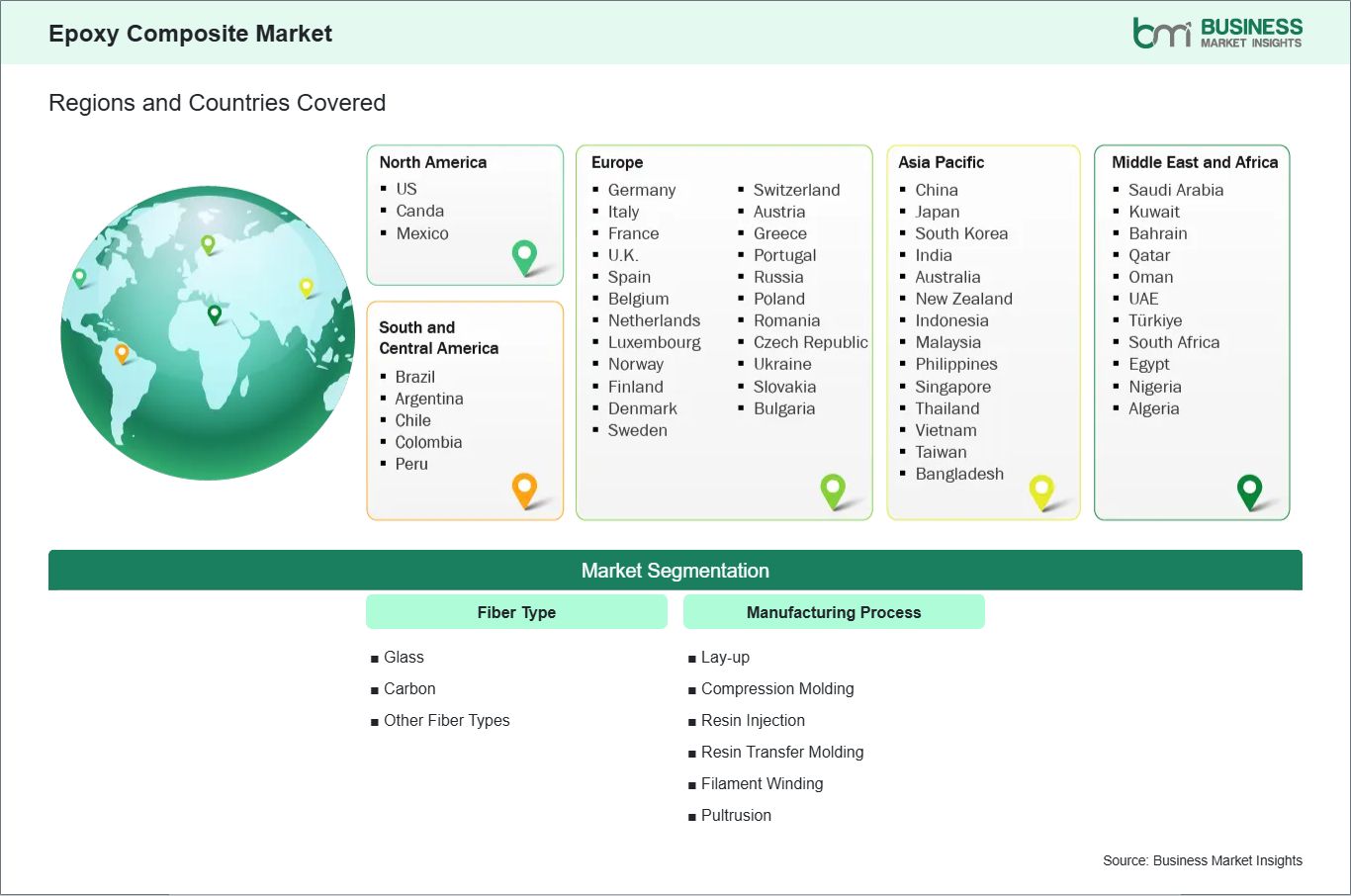
| Europe | Belgium, Austria, Finland, Denmark, Greece, Poland, Romania, Russia, Ukraine, Czech Republic, Slovakia, Bulgaria, Italy, Luxembourg, Germany, Switzerland, France, Netherlands, Norway, Portugal, Spain, Sweden, United Kingdom |
| Asia-Pacific | Australia, China, India, Japan, South Korea, Indonesia, Malaysia, Philippines, Singapore, Thailand, Vietnam, Bangladesh, New Zealand, Taiwan |
| South and Central America | Brazil, Argentina, Peru, Chile, Colombia |
| Middle East and Africa | Bahrain, Kuwait, Oman, Qatar, Saudi Arabia, United Arab Emirates, Turkiye, South Africa, Egypt, Algeria, Nigeria |
| Market leaders and key company profiles |
|
The "Epoxy Composite Market Size and Forecast (2022 - 2033)" report provides a detailed analysis of the market covering below areas:
The geographical scope of the Epoxy Composite market report is divided into five regions: North America, Asia Pacific, Europe, Middle East & Africa, and South & Central America. The Epoxy Composite market in North America is expected to grow during the forecast period.
The global market for epoxy composites is dominated by North America, which hosts many industries requiring precise engineering products with the capability to withstand harsh working conditions. Aerospace, defense, and marine engineering sectors in North America utilize epoxy composites for structural parts, protective enclosures, and vibration-resistant parts. The dimensional stability of these composites over a range of thermal conditions is highly appreciated in the field of advanced transportation and defense. A special feature of the North American market is the focus on hybrid or multi-functional composite materials. Here, manufacturers are increasingly using epoxy resin with carbon, glass, and other special fibers to produce unique combinations of stiffness, impact resistance, and corrosion protection suited to different operational conditions. Sophisticated manufacturing processes such as automated fiber placement and high-pressure molding processes are helping to produce complex, large-scale components with good properties. Although the cost of production and the materials is high, the market is helped by good interaction between research centers, material developers, and users to ensure the continued preeminence of the region in the use of epoxy composite materials worldwide, particularly in industries requiring high-performance, extreme-condition materials.

The epoxy composite market is evaluated by gathering qualitative and quantitative data post primary and secondary research, which includes important corporate publications, association data, and databases. A few of the key developments in the epoxy composite market are:
The Epoxy Composite Market is valued at US$ 44 Billion in 2025, it is projected to reach US$ 77.92 Billion by 2033.
As per our report Epoxy Composite Market, the market size is valued at US$ 44 Billion in 2025, projecting it to reach US$ 77.92 Billion by 2033. This translates to a CAGR of approximately 7.36% during the forecast period.
The Epoxy Composite Market report typically cover these key segments-
The historic period, base year, and forecast period can vary slightly depending on the specific market research report. However, for the Epoxy Composite Market report:
The Epoxy Composite Market is populated by several key players, each contributing to its growth and innovation. Some of the major players include:
The Epoxy Composite Market report is valuable for diverse stakeholders, including:
Essentially, anyone involved in or considering involvement in the Epoxy Composite Market value chain can benefit from the information contained in a comprehensive market report.
Please tell us your area of interest
(Market Segments/ Regions and Countries/ Companies)