
High Performance Elastomers Market Outlook: Size, Share, Trends, Growth Analysis, Competitive Landscape & Forecast, 2026-2033

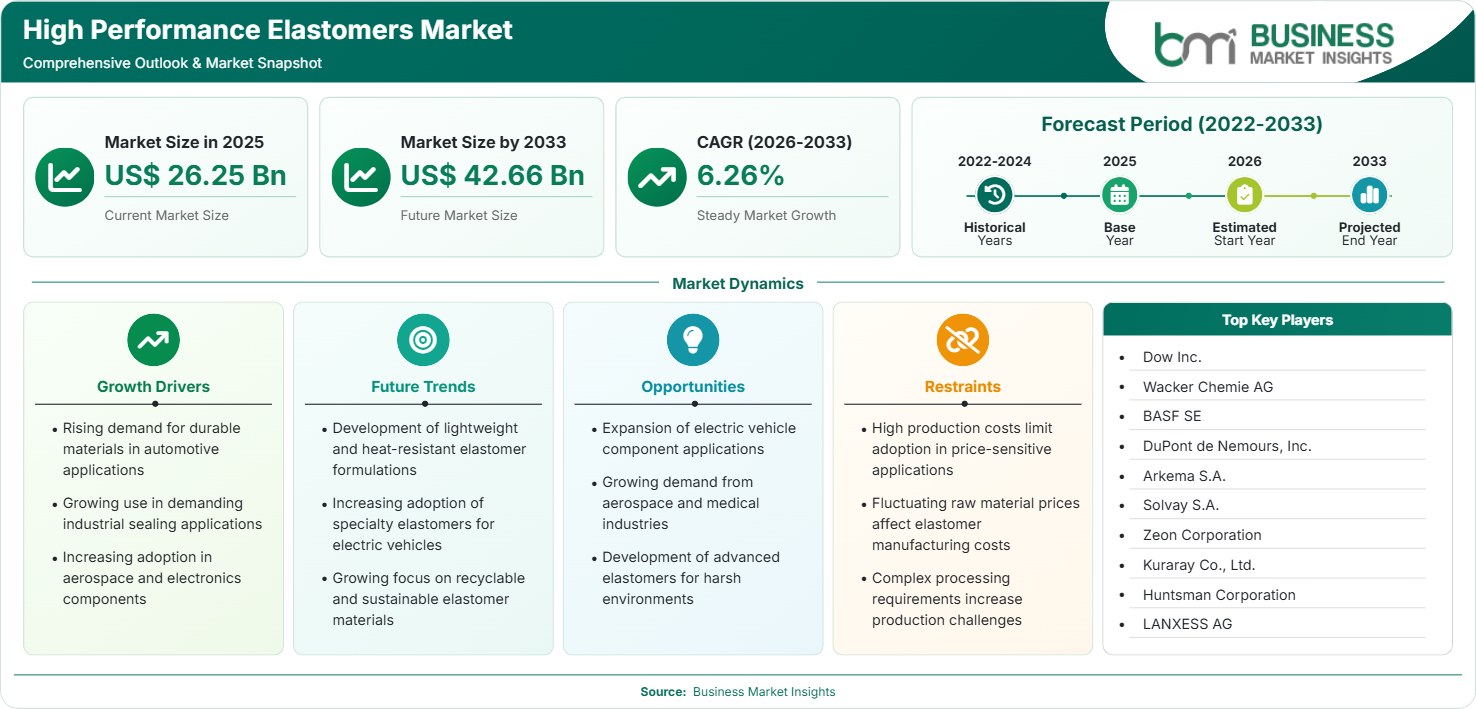
The High Performance Elastomers Market size was valued at US$ 26.25 Billion in 2025 and is projected to reach US$ 42.66 Billion by 2033, growing at a CAGR of 6.26% during 2026–2033. Rising demand for high-temperature resistant materials, increasing automotive electrification, expansion of aerospace manufacturing, growing industrial automation, and rising adoption of specialty elastomers across healthcare and electronics applications are driving market growth globally.

Report Coverage
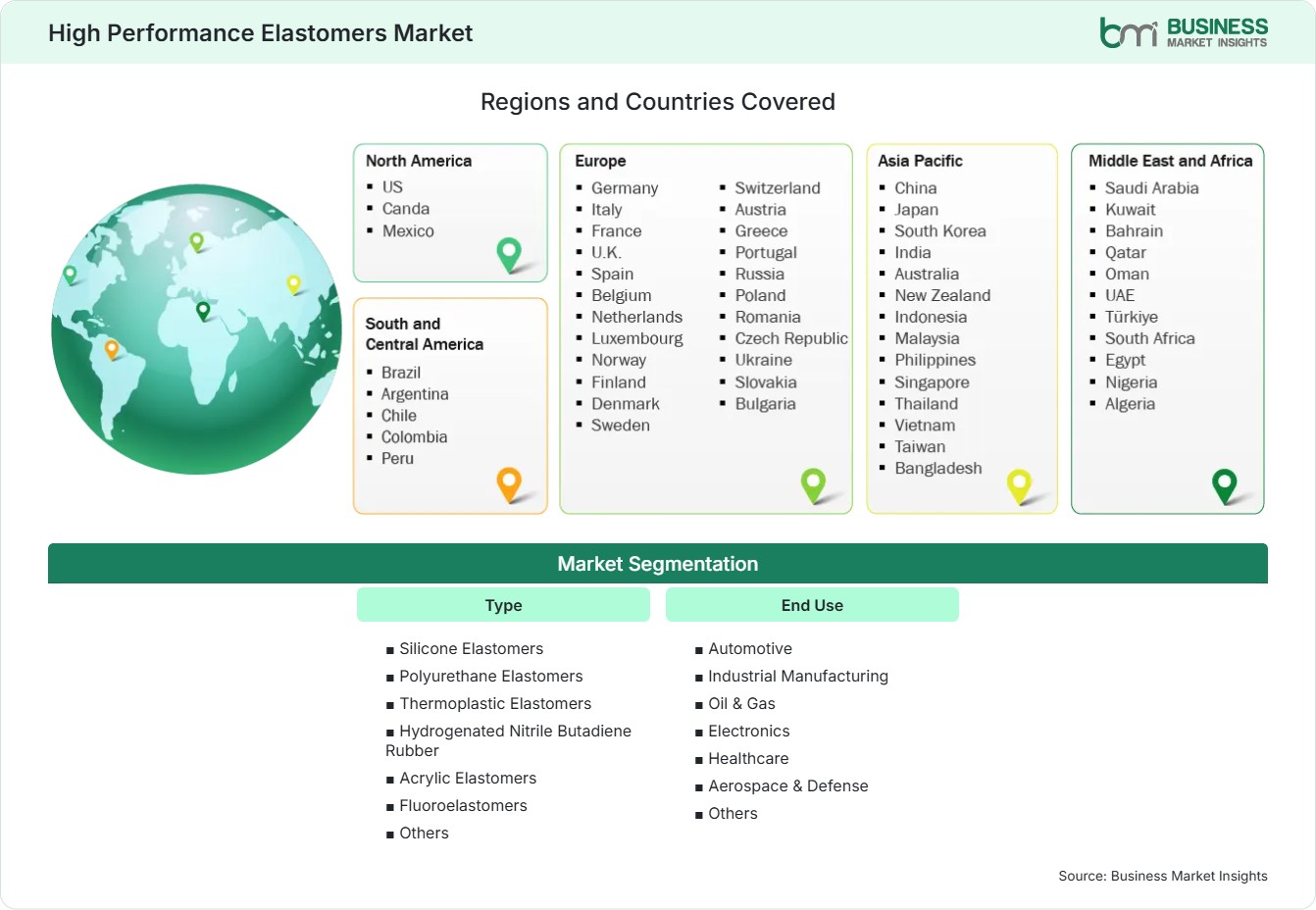
  • Type: Silicone Elastomers, Polyurethane Elastomers , Thermoplastic Elastomers , Hydrogenated Nitrile Butadiene Rubber, Acrylic Elastomers , Fluoroelastomers , Others
  • End Use: Automotive, Industrial Manufacturing, Oil & Gas, Electronics, Healthcare, Aerospace & Defense, Others
US$ 26.25 Bn Market size in 2025
US$ 42.66 Bn Market Size by 2033
6.26% CAGR, 2026 - 2033
2026-2033 Forecast Period

AI Overview

High Performance Elastomers Market Summary

  • North America Region: North America holds a high performance elastomers market share of 24%–28% in 2025 and is projected to grow at a CAGR of 5.8%–6.4% during 2026–2033. Growth is supported by advanced manufacturing industries, increasing aerospace production, strong automotive innovation, expanding healthcare applications, and rising demand for durable specialty materials. The U.S. remains the dominant market, advancing at a CAGR of 5.9%–6.5%.
  • Fastest Growing Region: Asia Pacific accounts for 39%–43% share in 2025 and is expected to register a CAGR of 6.9%–7.6% through 2033. Growth is fueled by industrialization, automotive production expansion, electronics manufacturing growth, rising energy investments, and increasing demand for high-performance materials.
  • Leading Segment: Thermoplastic Elastomers (TPE) represent 25%–29% share in 2025 and are anticipated to grow at a CAGR of 6.5%–7.1% through 2033. Demand is supported by recyclability, lightweight characteristics, design flexibility, and widespread adoption across automotive, consumer goods, and industrial applications.
  • High Growth Segment: Automotive captures 29%–33% share in 2025 and is forecast to expand at a CAGR of 6.8%–7.5% during 2026–2033. Growth is driven by vehicle lightweighting initiatives, electric vehicle adoption, demand for advanced sealing systems, and increasing use of durable elastomer components.
  • Key Market Opportunity: Growing adoption of electric vehicles, renewable energy systems, advanced healthcare devices, and high-performance industrial equipment is creating significant opportunities across the market.
  • Major Market Players: Dow Inc., Wacker Chemie AG, BASF SE, DuPont de Nemours, Inc., Arkema S.A., Solvay S.A., Zeon Corporation, Kuraray Co., Ltd., Huntsman Corporation, and LANXESS AG.
Strategic Insights

High Performance Elastomers Market: Strategic Insights

High Performance Elastomers Market Strategic Framework
FREE PDF
Request your free sample
Request free sample
Stakeholder View

Key Takeaways

  • The high performance elastomers market is witnessing stable growth because of rising demand for high temperature resistant, lightweight, and advanced sealing applications across various industries.
  • TPEs retain their market dominance due to their environmental friendly nature, versatility in processing, durability, and wide range of applications in various industries.
  • The largest and fastest-growing end use application is Automotive due to electric vehicle adoption, lightweighting trend, and increased need for advanced sealing and vibration control applications.
  • The largest and fastest-growing region is Asia Pacific because of increasing automotive production, rising electronics industry, and rapidly industrialized region.
  • Healthcare, Aerospace, and Renewable Energy industries are driving innovation for high performance elastomers products.
  • The manufacturers are still developing polymer technologies to enhance chemical resistance, durability, thermal stability, and sustainability.
Geographic Outlook

High Performance Elastomers Market Regional Highlights

North America High Performance Elastomers Market

North America accounted for 24%–28% of global revenue in 2025 and is projected to grow at a CAGR of 5.8%–6.4% through 2033. The region benefits from advanced manufacturing capabilities, strong aerospace and defense sectors, increasing electric vehicle adoption, and expanding healthcare applications. The High Performance Elastomers Market share remains significant due to increasing demand for specialty materials capable of operating in challenging environments.

  • Elastomers of high performance are being used by automotive industry players to enhance efficiencies and increase component life.
  • Elastomer materials of advanced nature are being employed in the aerospace industry for various purposes such as insulation, sealing, and vibration damping.
  • The medical industry is developing a need for biocompatible and high-performance elastomer products.
  • Elastomers with high resistance are required due to investments in industrial automation.
  • Innovation technology is still facilitating the development of advanced elastomer products.

US High Performance Elastomers Market

The United States represents 82%–86% of North American demand and is expected to grow at a CAGR of 5.9%–6.5% through 2033. Growth is supported by strong industrial activity, advanced healthcare infrastructure, increasing electric vehicle production, and aerospace sector investments.

  • Increased manufacturing of electric vehicles is driving the need for superior sealing and thermal materials that deliver resilience, heat resistance, and dependable performance in tough automobile applications.
  • The aerospace and defense industries continue to be important customers of advanced elastomer technologies due to the need for light weight, toughness, and high performance materials capable of working in harsh environments.
  • The developments in the healthcare sector are fueling the use of specialty elastomers in medical devices and equipment that require flexibility, chemical resistance, biocompatibility, and long-term performance.
  • High level of research and development initiatives have been fueling innovations in material technologies, making it possible for manufacturers to develop high-performance elastomers.

Europe High Performance Elastomers Market

Europe held 25%–29% of global revenue in 2025 and is expected to register a CAGR of 6.0%–6.6% through 2033. Strong automotive manufacturing, increasing sustainability initiatives, and advanced industrial production continue supporting regional growth. Germany remains the leading market, while Poland represents a strong growth market with a CAGR of 6.7%–7.3%.

  • Elastomer solutions are becoming popular among automotive OEMs due to increased fuel efficiency and decreased weight of vehicles alongside the trend towards electric cars.
  • Specialty elastomers are used by the industry in environments where high chemical and heat resistance as well as durability are required.
  • The development of renewable energy projects is stimulating the need for durable materials able to withstand challenging environmental conditions and perform efficiently.
  • Advanced manufacturing operations are increasing the use of high-performance polymers and specialty elastomers in applications demanding strength, flexibility, and resistance.
  • The sustainability initiatives are motivating manufacturers to produce recyclable, bio-based, and environmentally friendly elastomers.

Asia Pacific High Performance Elastomers Market

Asia Pacific accounted for 39%–43% of global revenue in 2025 and is expected to record the fastest CAGR of 6.9%–7.6% through 2033. Rapid industrialization, automotive expansion, electronics manufacturing growth, and increasing infrastructure development are driving regional growth. China, Japan, South Korea, and India remain the key markets.

  • The increase in automotive manufacturing will increase the requirement of elastomeric parts with advanced properties in use for sealings, gaskets, hoses, and vibration dampening systems.
  • The increased electronics manufacturing activities will facilitate the use of elastomers with enhanced thermal and electrical properties.
  • The industrial projects will create a requirement for durable materials that can perform under difficult conditions.
  • Increased investments in renewable energy and electric infrastructure will create opportunities for advanced uses of elastomers.
  • The expansion in manufacturing will continue to facilitate the growth of the market.

Rest of World High Performance Elastomers Market

Rest of World accounted for 6%–10% of global revenue in 2025 and is forecast to grow at a CAGR of 5.8%–6.4% through 2033. Market growth is supported by industrial development, energy sector investments, and increasing adoption of advanced materials across manufacturing industries.

  • Oil & gas operations continue creating demand for chemically resistant and high-temperature elastomer solutions.
  • Industrial modernization initiatives are supporting broader use of advanced materials.
  • Infrastructure and energy projects continue generating opportunities for specialty elastomer suppliers.
  • Global manufacturers are expanding distribution and production capabilities across emerging markets.
  • Rising awareness regarding operational efficiency and equipment durability is driving material upgrades across industries.
Global Market Geography
FREE PDF
Request your free sample
Request free sample
Segment Analysis

High Performance Elastomers Market Segmentation

Type

Thermoplastic Elastomers (TPE) account for 25%–29% share in 2025 and are expected to grow at a CAGR of 6.5%–7.1% through 2033. The segment dominates due to excellent flexibility, lightweight characteristics, recyclability, ease of processing, and widespread adoption across automotive, consumer goods, healthcare, and industrial applications. The High Performance Elastomers Market scope continues to expand as manufacturers increasingly utilize TPE materials to improve product durability, sustainability, and performance in demanding operating environments.

  • Silicone Elastomers: Widely utilized in healthcare, electronics, and automotive applications due to superior thermal stability and weather resistance.
  • Polyurethane Elastomers (TPU): Benefit from excellent abrasion resistance, flexibility, and mechanical strength in industrial and transportation applications.
  • Thermoplastic Elastomers (TPE): Lead the market owing to superior processability, recyclability, and versatility across numerous industries.
  • Hydrogenated Nitrile Butadiene Rubber: Increasingly used in oil & gas, industrial, and automotive applications requiring chemical and temperature resistance.
  • Acrylic Elastomers (ACE): Supported by rising demand for heat-resistant automotive sealing and gasket applications.
  • Fluoroelastomers (FKM): Preferred in extreme operating environments requiring exceptional chemical resistance and thermal performance.
  • Others: Include specialty elastomer formulations developed for niche industrial and advanced engineering applications.

End Use

Automotive accounts for 29%–33% share in 2025 and is projected to grow at a CAGR of 6.8%–7.5% through 2033. Growth is driven by vehicle lightweighting initiatives, increasing electric vehicle production, rising demand for advanced sealing solutions, and growing use of high-performance materials in critical vehicle systems. Current High Performance Elastomers Market trends indicate increasing adoption of advanced elastomer solutions in electric vehicle battery systems, thermal management components, seals, hoses, and vibration-control applications.

  • Automotive: Leads demand due to extensive use in gaskets, seals, hoses, bushings, and thermal management components.
  • Industrial Manufacturing: Supported by increasing automation, machinery upgrades, and demand for durable performance materials.
  • Oil & Gas: Benefits from growing requirement for chemically resistant elastomer solutions capable of operating under extreme conditions.
  • Electronics: Increasingly utilizes advanced elastomers for insulation, sealing, and thermal management applications.
  • Healthcare: Driven by expanding demand for biocompatible medical devices, tubing, seals, and specialty healthcare components.
  • Aerospace & Defense: Relies on high-performance elastomers for critical sealing, insulation, vibration control, and fluid management systems.
  • Others: Include renewable energy, consumer goods, marine, and specialty engineering applications.
Market Forces

High Performance Elastomers Market Dynamics

Key Market Drivers

Growing Demand from Automotive and Electric Vehicle Industries

The automotive sector still remains one of the leading users of premium elastomers. Increasingly, there is a growing need for more sophisticated materials that are capable of withstanding extreme conditions of temperature, chemical attack, and performance requirements while helping achieve weight reduction of automobiles. The emergence of electric cars is generating an extra demand for elastomers, which find applications in battery packs, chargers, thermal management equipment, and insulation for electrical wiring. The growing popularity of electric vehicles worldwide is encouraging greater use of advanced elastomers.

Increasing Industrial Automation and Equipment Modernization

Industries are now using automated systems that require advanced manufacturing tools and materials that can perform in such circumstances. Elastomers are being used for seals, gaskets, hoses, belts, shock absorbing devices, and fluid transfer systems, which have tough operating conditions. Manufacturers need materials that can perform well even when they are exposed to chemicals, pressure changes, wear and tear, and heat. Modernization of the industrial setup along with the focus on efficiency has created a need for advanced technology of elastomers.

Rising Demand for High-Performance Materials in Aerospace and Healthcare Applications

The aerospace and health care sectors have continued to embrace more complex elastomer products as a result of performance and safety requirements. The aerospace sector requires products that can withstand high temperatures and high pressures as well as being durable. On the other hand, the health care sector is also increasingly requiring elastomers that can be used in medical devices, tubing systems, implants, and diagnostic devices. More investments in technologies in the aerospace and defense sectors are also driving the need for more specialized elastomers.

Key Market Opportunities

Expansion of Electric Vehicle and Battery Technologies

The fast growth in electric vehicle manufacturing offers great possibilities to high-performance elastomers companies. Specialized seals, gaskets, connectors, cable insulation, and thermal management components, which would be able to work efficiently in such difficult operating conditions as those faced by electric vehicles, are in great demand. With further investment in batteries and platforms for electric vehicles, the need for advanced elastomers will only increase. Companies that can provide innovative products meeting the needs of electric mobility will be able to take advantage of these possibilities.

Growing Adoption Across Renewable Energy Infrastructure

Renewable energy projects are becoming more reliant on advanced materials that have the potential to ensure performance and longevity for many years to come. Wind turbine blades, solar energy technology, batteries for energy storage, and other systems need elastomers for use in sealing, insulation, vibration damping, and protection purposes. Increased funding for renewable energy production will provide new opportunities for development of innovative materials to help achieve the desired performance levels. The companies that specialize in renewable energy will see increasing benefits as clean energy development progresses.

Increasing Demand for Sustainable and Recyclable Elastomer Solutions

Sustainability factors are playing an increasingly important role in industrial procurement decisions. End-users are demanding materials that have both performance and environmental attributes like recyclability, low emissions, and better lifecycle properties. According to the High Performance Elastomers Market Forecast analysis, the increasing use of sustainable manufacturing processes, recyclable elastomer technology, and environmentally-friendly materials will present significant growth prospects for manufacturers.

Market Restraints and Challenges

Volatility in Petrochemical-Based Raw Material Prices

Factor: Most high-performance elastomers rely on petrochemical feedstocks that are subject to fluctuations in crude oil prices, supply chain disruptions, and geopolitical uncertainties.

Impact: Raw material price volatility can increase production costs, reduce profit margins, and create pricing challenges for manufacturers. Uncertain procurement conditions may also affect long-term planning and investment strategies across the value chain.

Complex Manufacturing Requirements and High Production Costs

Factor: High-performance elastomers often require sophisticated manufacturing processes, advanced formulations, specialized equipment, and stringent quality control standards.

Impact: Elevated production costs can limit affordability and create barriers to adoption in cost-sensitive applications. Manufacturers must continuously balance performance improvements, operational efficiency, and profitability while addressing increasingly demanding customer requirements.

Company Analysis

Competitive Landscape

In the High Performance Elastomers Market analysis stiff competition has been witnessed among the global specialty chemical makers, polymer makers, and performance materials providers. The key market players have been concentrating on high temperature resistant elastomers, innovations in sustainable materials, EV applications, healthcare elastomers, and advanced industrial solutions.

Company Name

Overview

Products and Services Relevant to this Market

Dow Inc.

Global materials science company serving industrial and specialty markets.

Silicone elastomers, specialty polymers, automotive elastomers, and industrial performance materials.

Wacker Chemie AG

Leading manufacturer of silicone-based materials and specialty chemicals.

Silicone elastomers, healthcare-grade silicones, industrial sealing materials, and specialty compounds.

BASF SE

Global chemical company with a diverse performance materials portfolio.

Thermoplastic elastomers, specialty elastomers, automotive materials, and industrial solutions.

DuPont de Nemours, Inc.

Advanced materials company focused on high-performance applications.

Specialty elastomers, sealing solutions, healthcare materials, and industrial polymers.

Arkema S.A.

Specialty materials producer serving automotive, industrial, and electronics sectors.

High-performance elastomers, specialty polymers, advanced sealing materials, and industrial compounds.

Solvay S.A.

Provider of advanced materials for demanding applications.

Fluoroelastomers, aerospace elastomers, industrial sealing products, and specialty compounds.

Zeon Corporation

Manufacturer specializing in synthetic elastomers and specialty materials.

Hydrogenated nitrile rubber, specialty elastomers, automotive materials, and industrial solutions.

Kuraray Co., Ltd.

Specialty chemicals and advanced materials company.

Thermoplastic elastomers, industrial polymers, healthcare materials, and specialty compounds.

Huntsman Corporation

Global producer of specialty chemical products and advanced materials.

Polyurethane elastomers, industrial solutions, automotive materials, and performance polymers.

LANXESS AG

Specialty chemicals company serving transportation and industrial industries.

High-performance elastomers, industrial rubber solutions, automotive materials, and specialty compounds.

Trust & Transparency

Research Methodology

The market analysis combines proprietary research with secondary data from government agencies, company disclosures, regulatory filings, industry databases and expert interviews. Market estimates are validated through data triangulation, cross-market benchmarking and analyst review.

View Full Research Methodology

Questions Answered

Frequently Asked Questions

What does this High Performance Elastomers Market Report evaluate?

The market report evaluates type trends, end-use analysis, regional opportunities, competitive developments, growth drivers, market opportunities, and industry challenges through 2033.

Which end-use segment leads the market?

Automotive leads the market due to extensive use of elastomers in seals, gaskets, hoses, thermal management systems, vibration-control components, and electric vehicle applications.

Why is Asia Pacific the fastest-growing region?

Asia Pacific benefits from expanding automotive production, rapid industrialization, electronics manufacturing growth, infrastructure investments, and increasing demand for advanced performance materials.

Which type segment dominates the market?

Thermoplastic Elastomers (TPE) dominate the market due to their recyclability, lightweight properties, processing flexibility, durability, and broad applicability across multiple industries.

What is driving growth in the High Performance Elastomers Market?

Growth is driven by increasing demand from automotive, aerospace, industrial manufacturing, electronics, healthcare, and renewable energy industries requiring materials with high durability, thermal stability, and chemical resistance.

Access the Full High Performance Elastomers Market Report

Get segment-level forecasts, regional estimates, competitive benchmarking, company profiles and downloadable Excel datasets.

Access the full High Performance Elastomers Market Report
350 pages PDF & Excel | 2026-09-22
Similar Research

Related Market Reports