
Hedge Fund Market Outlook: Size, Share, Trends, Growth Analysis, Competitive Landscape & Forecast, 2026-2033

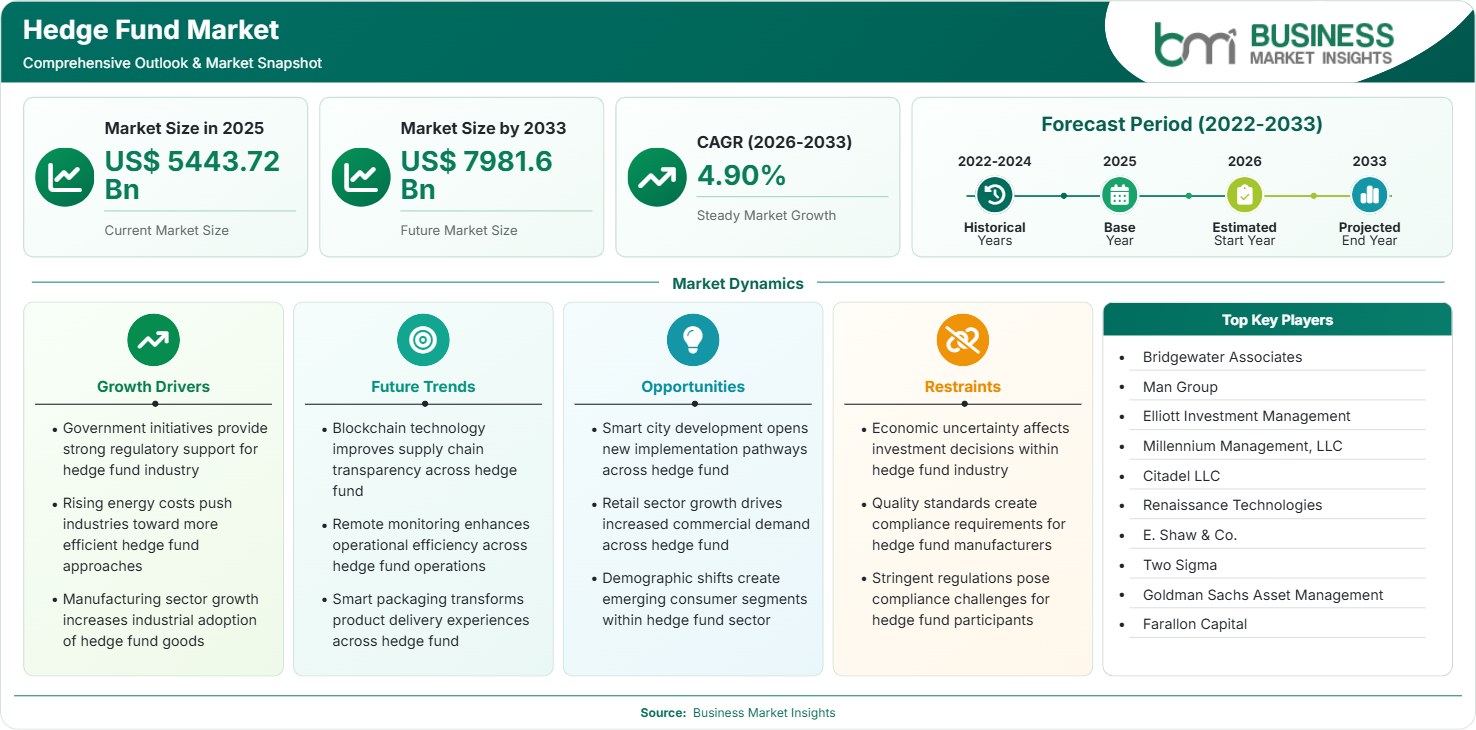
The Hedge Fund Market size was valued at US$ 5443.72 Billion in 2025 and is projected to reach US$ 7981.6 Billion by 2033, growing at a CAGR of 4.90% during 2026–2033. Key growth drivers include expanding institutional allocations, quantitative investing adoption, AI-enabled portfolio strategies, private market exposure, wealth creation among high-net-worth investors, and increasing demand for uncorrelated returns.

Report Coverage
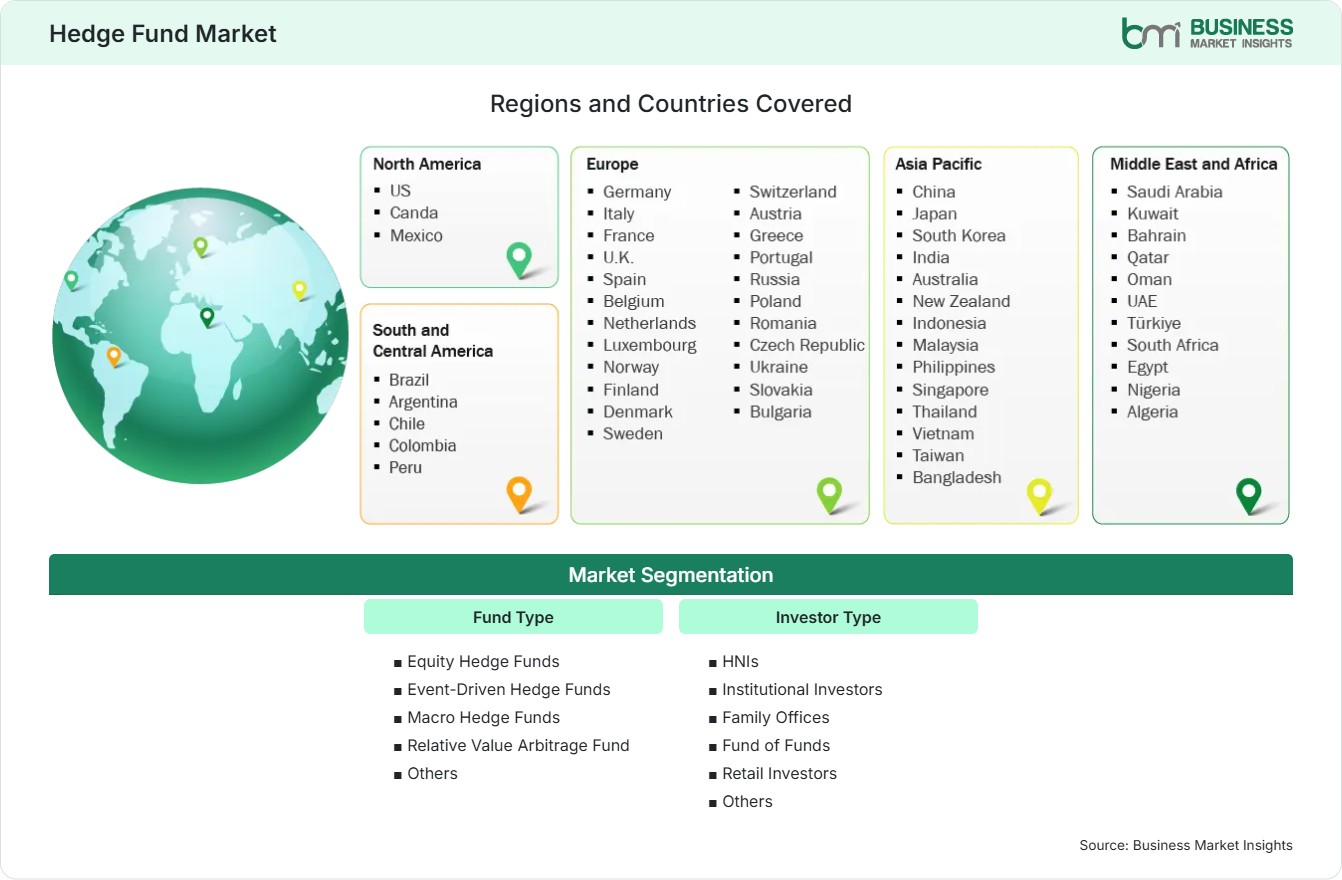
  • Fund Type: Equity Hedge Funds, Event-Driven Hedge Funds, Macro Hedge Funds, Relative Value Arbitrage Fund, Others
  • Investor Type: HNIs, Institutional Investors, Family Offices, Fund of Funds, Retail Investors, Others
US$ 5443.72 Bn Market size in 2025
US$ 7981.6 Bn Market Size by 2033
4.90% CAGR, 2026 - 2033
2026-2033 Forecast Period

01 AI Overview

Hedge Fund Market Summary

  • North America Region: North America holds a market share of 44%–48% in 2025, growing at a CAGR of 4.4%–4.8% during 2026–2033. Institutional capital concentration, sophisticated alternative investment ecosystems, pension fund demand, quantitative strategies, private credit expansion, and regulatory transparency continue to support regional asset growth. The U.S. dominates regional assets and is expected to advance at 4.5%–4.9% CAGR through 2033.
  • Fastest Growing Region: Asia Pacific holds a 21%–25% share in 2025 and is projected to register a 6.1%–6.6% CAGR. Expanding wealth creation, family office formation, cross-border investment liberalization, and rising institutional participation support long-term momentum.
  • Leading Segment: Equity Hedge Funds account for 34%–38% share in 2025 and are forecast to grow at 4.7%–5.1% CAGR. Strong adoption reflects portfolio flexibility, long-short capabilities, alpha generation potential, and broad investor familiarity.
  • High Growth Segment: Institutional Investors represent 48%–52% share in 2025 and are expanding at 5.4%–5.8% CAGR. Pension funds, sovereign wealth funds, insurance companies, and endowments continue increasing alternative asset allocations.
  • Key Market Opportunity: AI-enabled portfolio construction, private credit integration, digital asset exposure, and customized multi-strategy offerings are expanding addressable opportunities for managers seeking differentiated return generation and client retention.
  • Major Market Players: BlackRock, Inc., Bridgewater Associates, LP, Citadel LLC, Millennium Management LLC, AQR Capital Management, LLC, Man Group plc, Two Sigma Investments, LP, Elliott Investment Management L.P., D. E. Shaw & Co., L.P., and Point72 Asset Management, L.P.
02 Strategic Insights

Hedge Fund Market: Strategic Insights

Hedge Fund Market Strategic Framework
FREE PDF
Request your free sample
Request free sample
03 Stakeholder View

Key Takeaways

  • Institutional investors remain the foundation of industry capital flows, accounting for the majority of assets committed to sophisticated alternative investment strategies.
  • Multi-strategy and quant-focused managers are attracting disproportionate inflows due to diversified alpha-generation capabilities and advanced risk controls.
  • Artificial intelligence, alternative datasets, and predictive analytics are transforming research, execution, and portfolio management models.
  • Asia Pacific offers the most attractive expansion opportunity as wealth creation and institutional sophistication continue increasing.
  • Consolidation activity is accelerating among managers seeking scale, technological capabilities, and access to broader investor networks.
  • Private credit, infrastructure-linked strategies, and customized solutions are emerging as important differentiators in investor acquisition and retention.
04 Geographic Outlook

Hedge Fund Market Regional Highlights

North America Hedge Fund Market

North America accounted for 44%–48% Hedge Fund Market share in 2025 and is projected to grow at a CAGR of 4.4%–4.8% through 2033. The region benefits from deep capital markets, institutional investor concentration, and established alternative investment infrastructure. Pension plans, endowments, insurance firms, and sovereign investors continue allocating capital toward active strategies. Strong regulatory frameworks, advanced financial technologies, and a mature prime brokerage ecosystem support competitive industry development.

  • Large pension systems continue increasing alternative allocations to improve diversification and enhance long-term risk-adjusted returns.
  • Quantitative and multi-strategy firms maintain strong fundraising momentum amid volatile macroeconomic conditions.
  • Private credit integration is creating new revenue streams for diversified managers.
  • Wealth management channels increasingly provide access to institutional-style alternative investment products.

US Hedge Fund Market

The United States represents approximately 80%–84% of regional assets and is forecast to expand at 4.5%–4.9% CAGR. New York, Connecticut, Miami, and Chicago remain major operational centers. Institutional asset pools, family offices, and high-net-worth investors continue supporting demand. The country's deep liquidity, financial innovation culture, and concentration of leading investment managers reinforce long-term industry leadership.

  • Family office assets continue growing, creating additional demand for customized hedge fund mandates.
  • AI-enabled investment research is gaining traction among leading managers.
  • Alternative data adoption supports differentiated investment insights and execution.
  • Private market strategies are increasingly integrated alongside traditional hedge fund offerings.

Europe Hedge Fund Market

Europe held a 24%–28% share in 2025 and is expected to record a CAGR of 4.6%–5.0% through 2033. The United Kingdom remains the leading market, while Switzerland and Luxembourg continue serving as important fund domiciles. Regulatory clarity, institutional participation, and expanding ESG-linked alternative strategies support regional development. Cross-border investment activity remains a major growth catalyst.

  • London maintains leadership in hedge fund management and capital formation activities.
  • Switzerland attracts global investors through sophisticated wealth management capabilities.
  • ESG-driven investment mandates are increasingly influencing capital allocation decisions.
  • UCITS-compatible alternative strategies broaden investor accessibility.

Asia Pacific Hedge Fund Market

The Asia Pacific region accounts for 21%–25% of total global assets in 2025 and has the highest growth rate, at a 6.1%–6.6% CAGR. The major markets in this region include China, Japan, Singapore, Hong Kong, and India. Factors such as wealth generation, regulatory changes, and institutional investors continue to fuel growth. Regional financial centers increasingly attract international managers seeking diversification and access to growing capital pools.

  • Singapore strengthens its position as a leading wealth and fund-management hub.
  • India records some of the strongest alternative investment growth rates in the region.
  • Hong Kong remains significant for cross-border capital deployment strategies.
  • Technology-driven investment approaches are attracting younger investor segments.

Rest of World Hedge Fund Market

Rest of World represented 7%–9% of global assets during 2025 and is projected to achieve a CAGR of 5.0%–5.4% through 2033. Middle Eastern sovereign investors and family offices are increasingly active participants. South & Central America benefits from gradual alternative investment adoption and expanding private wealth. Financial market development supports ongoing participation across emerging economies.

  • UAE and Saudi Arabia continue attracting global asset managers and investment platforms.
  • Brazil leads regional activity in South America through institutional capital growth.
  • Sovereign wealth funds remain influential allocators to alternative investments.
  • Regulatory modernization improves international investor participation.
Global Market Geography
FREE PDF
Request your free sample
Request free sample
05 Segment Analysis

Hedge Fund Market Segmentation

Fund Type

The Equity Hedge Funds accounted for the highest market share, 34%-38%, in 2025 and are expected to grow at a 4.7%-5.1% CAGR. The scope of the Hedge Fund Market continues to widen due to investor demand for flexible long-short strategies, risk-mitigation techniques, and alpha-generation approaches amid evolving macroeconomic conditions.

  • Equity Hedge Funds: Long-short strategies support alpha generation across market cycles while offering flexibility in sector and factor positioning.
  • Event-Driven Hedge Funds: Capitalize on mergers, restructurings, acquisitions, and corporate actions, creating pricing inefficiencies and opportunity-driven returns.
  • Macro Hedge Funds: Focus on global economic trends, interest rates, currencies, commodities, and geopolitical developments influencing asset valuations.
  • Relative Value Arbitrage Fund: Exploits pricing discrepancies across related securities using risk-controlled and market-neutral approaches.

Investor Type

Institutional Investors hold a 48% – 52% share, growing at a 5.4% – 5.8% CAGR. Hedge Fund Market trends suggest increased popularity among sophisticated investors as a source of diversification, inflation hedging, risk management, and access to unique investment strategies.

  • HNIs: Continue seeking customized portfolios and differentiated return opportunities beyond conventional financial assets.
  • Institutional Investors: Allocate capital across multi-strategy, quantitative, and private credit-oriented hedge fund structures.
  • Family Offices: Increasingly establish direct relationships with managers to obtain tailored investment mandates.
  • Fund of Funds: Provide diversified exposure and manager selection expertise for investor portfolios.
  • Retail Investors: Expanded access through regulated structures and wealth-management platforms supports participation growth.
06 Market Forces

Hedge Fund Market Dynamics

Key Market Drivers

Growing Institutional Allocation to Alternatives

Institutional investors continue to be the greatest contributors to capital flows into the alternative investments space. Pension funds, sovereign wealth funds, insurance companies, and university endowments continue to increase their allocations as they diversify their portfolios while minimizing correlations among conventional assets. The IMF's insights on long-run portfolio diversification and global asset allocation trends further confirm the rising interest in alternatives among institutions. Market growth continues due to mandates focused on downside protection, inflation immunity, and risk-adjusted performance. Big investors are increasingly drawn to multi-strategy managers who provide institutional-style governance, technology implementation, and liquidity management.

Advancement of Quantitative and AI-Driven Investing

Machine learning, natural language processing, alternative data, and predictive analytics are reshaping portfolio construction. Leading firms continue investing heavily in technology infrastructure to identify market inefficiencies and improve execution quality. Market trends indicate greater alignment between discretionary investment methods and more systematic techniques. The quantitative approach enables managers to analyze large volumes of data, assess risk exposure, and respond quickly to evolving market conditions. With greater competition, sophistication is now playing an important role in fundraising. Investors prefer systems with repeatable investing approaches backed by superior analytical tools and risk management systems.

Increased Demand for Diversified Return Sources

Macroeconomic uncertainty, shifts in interest-rate environments, and geopolitics drive investors to diversify their sources of returns. Alternative investments offer flexibility in asset allocation and in response to the economic environment. The growth of the markets is supported by demand for low-correlated strategies that preserve capital during periods of volatility. Multi-strategy, global macro, and relative value investing remain appealing, as they offer opportunities to exploit inefficiencies at the regional and sector levels. Investors' focus on resilience and liquidity management drives their growing interest in hedge fund vehicles capable of navigating complex global financial environments.

Key Market Opportunities

Expansion of Private Credit Integration

The role of private credit is gaining prominence in the realm of alternative asset management. For managers who can effectively balance liquid and illiquid investments, it can be a strong tool for retaining clients and generating additional income. Hedge Fund Market Forecasts have seen a trend of money flowing into private financing solutions. Institutional investors are drawn to these instruments for yield enhancement and diversification benefits. Managers who develop credit expertise will be able to serve underbanked borrowers, create distinctive product offerings, and form unique portfolios.

Growth of Family Offices Worldwide

Rapid wealth creation across Asia, the Middle East, and North America continues driving family-office expansion. These investors seek customized mandates, direct manager engagement, and flexible portfolio solutions. As family offices become more sophisticated, demand rises for specialized alternative investment strategies. Managers capable of delivering transparency, personalization, and multi-asset expertise can establish long-lasting partnerships. Growing intergenerational wealth transfer also supports increasing participation by younger investors interested in innovation-focused and technology-enabled investment approaches.

Tokenization and Digital Investment Infrastructure

The growth in the digital infrastructure space presents opportunities for fund distribution, fund reporting, and investor access. Tokenization of assets and administrative processes using blockchains may increase efficiencies, enhance transparency, and enable scalability. Although the adoption process is steady yet slow, visionary management teams are looking at new technologies that eliminate inefficiencies in investor onboarding and servicing. Technological modernization could expand access to alternative investments while improving operational efficiency. Firms that adapt early may gain competitive advantages through improved client experiences and streamlined workflows.

Market Restraints and Challenges

Stringent Regulatory Requirements and Compliance Costs

Factor: Expanding regulatory oversight across major jurisdictions increases reporting, governance, and transparency obligations. Impact: Operating expenses rise as managers invest in compliance systems, legal expertise, and risk-management frameworks. Smaller firms may face disproportionate burdens because fixed compliance costs consume a larger share of resources. Regulatory complexity can also create barriers to entering new markets and launching innovative investment products. As supervisory expectations evolve, managers must continuously adapt operational processes while maintaining performance objectives.

Performance Pressure and Investor Scrutiny

Factor: Investors demand consistent alpha generation despite increasingly efficient markets and intense competition. Impact: Fundraising, retention, and fee sustainability become more challenging when performance diverges from expectations. Managers face pressure to invest in technology, talent acquisition, and research capabilities while controlling costs. Extended periods of underperformance can trigger asset withdrawals and operational restructuring. Competitive dynamics therefore require continuous innovation and disciplined portfolio management to maintain investor confidence and long-term asset growth.

07 Company Analysis

Competitive Landscape

Hedge Fund Market analysis highlights a competitive environment led by diversified multi-strategy firms, quantitative specialists, and institutional asset managers.

Company Name

Overview

Products and Services relevant to this market

BlackRock, Inc.

Global asset manager with extensive alternative investment capabilities and institutional client relationships.

Hedge funds, multi-alternatives, private credit, risk management and portfolio advisory services.

Bridgewater Associates, LP

One of the world's largest hedge fund managers specializing in macro strategies.

Global macro funds, risk-parity strategies, institutional investment solutions.

Citadel LLC

Multi-strategy investment firm operating across global asset classes and markets.

Equities, fixed income, commodities, quantitative and multi-strategy hedge funds.

Millennium Management LLC

Global alternative investment platform with diversified portfolio manager structure.

Multi-strategy hedge fund solutions and institutional investment offerings.

AQR Capital Management, LLC

Quantitative investment specialist integrating data science and factor investing.

Systematic strategies, alternative risk premia and diversified hedge fund products.

Man Group plc

Global active investment management company with systematic and discretionary capabilities.

Quant funds, discretionary strategies, multi-asset and alternative investments.

Two Sigma Investments, LP

Technology-focused investment manager utilizing advanced data analytics.

Quantitative hedge funds, AI-driven investment approaches and systematic portfolios.

Elliott Investment Management L.P.

Activist and event-driven investment manager with significant global presence.

Activist investing, event-driven strategies and special situations investments.

D. E. Shaw & Co., L.P.

Quantitative investment firm integrating computational research and trading expertise.

Systematic investing, alternative strategies and diversified hedge fund offerings.

Point72 Asset Management, L.P.

Global investment platform founded by Steven Cohen with multiple strategies.

Fundamental equities, macro, systematic, private credit and venture strategies.

10 Trust & Transparency

Research Methodology

The market analysis combines proprietary research with secondary data from government agencies, company disclosures, regulatory filings, industry databases and expert interviews. Market estimates are validated through data triangulation, cross-market benchmarking and analyst review.

View Full Research Methodology

11 Questions Answered

Frequently Asked Questions

Why are AI and quantitative strategies becoming more important?

They improve data processing, risk monitoring, execution efficiency, and portfolio optimization, helping managers identify opportunities across increasingly complex global markets.

How does the Hedge Fund Market Report evaluate managers?

The Market Report examines assets under management, strategy diversification, technology adoption, investor base composition, operational capabilities, and long-term competitive positioning.

Which region presents the strongest long-term opportunity?

Asia Pacific offers the strongest growth potential due to expanding wealth, regulatory modernization, rising institutional participation, and increasing cross-border investment activity.

How are institutional investors influencing industry evolution?

Institutional investors increasingly demand transparency, technology integration, robust governance, and diversified return sources, shaping manager operating models and investment offerings.

What makes hedge funds different from traditional mutual funds?

Hedge funds employ broader investment strategies, including leverage, short selling, derivatives, and alternative assets, enabling managers to pursue returns across varying market environments.

Access the Full Hedge Fund Market Report

Get segment-level forecasts, regional estimates, competitive benchmarking, company profiles and downloadable Excel datasets.

Access the full Hedge Fund Market Report
350 pages PDF & Excel | 2026-08-17