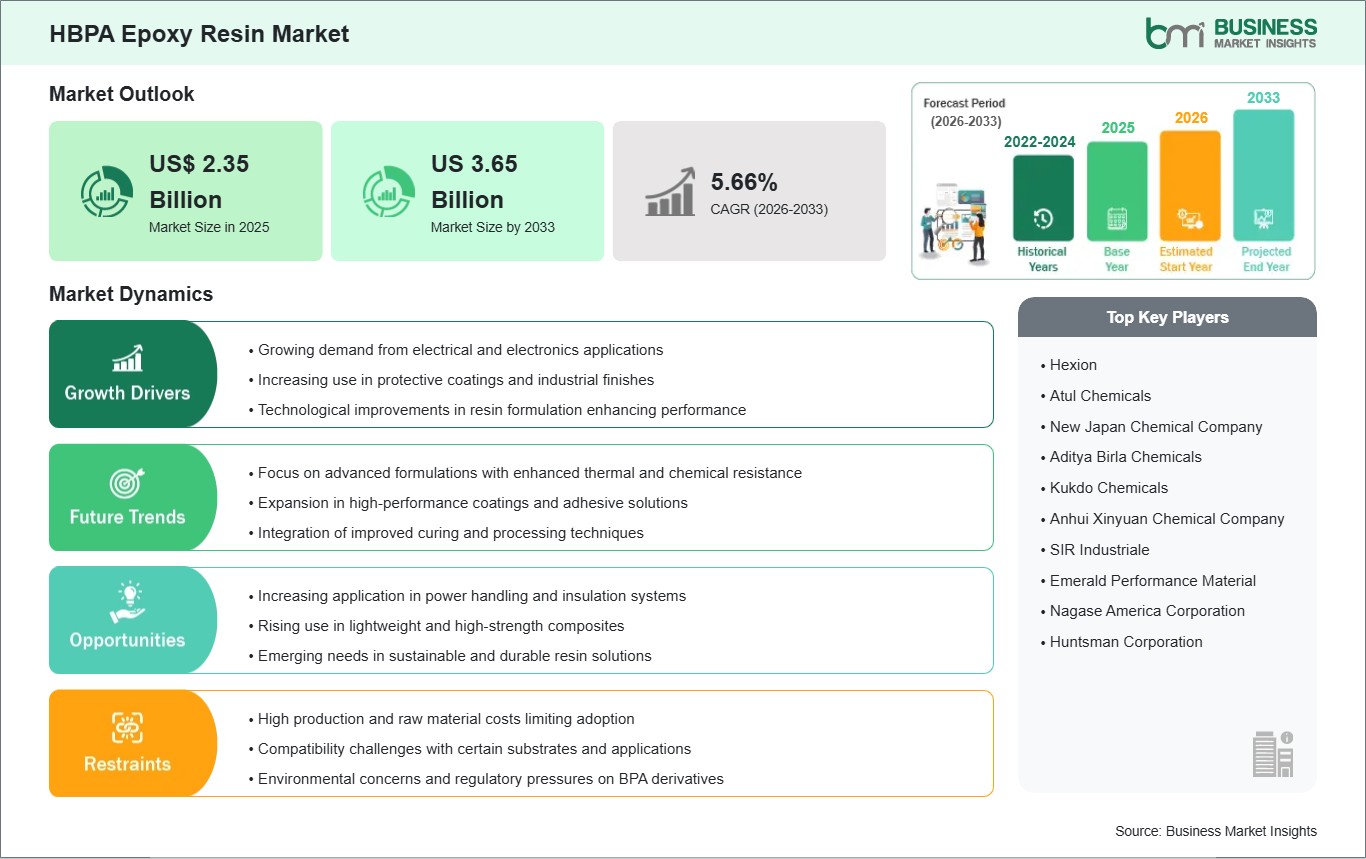
The HBPA Epoxy Resin Market size is expected to reach US$ 3.65 Billion by 2033 from US$ 2.35 Billion in 2025. The market is estimated to record a CAGR of 5.66% from 2026 to 2033.
The global HBPA (Hydrogenated Bisphenol A) epoxy resin market has emerged as a key segment in the broader epoxy resin industry due to its distinctive performance advantages and versatility across multiple applications. HBPA epoxy resins are formulated by hydrogenating bisphenol A before reacting it with epichlorohydrin, resulting in materials that offer improved color stability, enhanced weather resistance, low viscosity, and strong adhesion properties. These qualities make HBPA epoxy resins ideal for industrial coatings, adhesives, electrical insulation, protective coatings, and high-performance composites.
Demand for HBPA epoxy resins is driven primarily by industries seeking high-performance materials capable of enduring harsh environments while maintaining reliability and aesthetic quality. In the electronics sector, HBPA resins are valued for their excellent insulation and durability, while in construction and industrial coatings, they provide superior protection against wear, chemical exposure, and environmental degradation. Automotive and transportation sectors also increasingly use HBPA epoxy resins for lightweight components and durable adhesives that improve vehicle longevity.
The process of making HBPA epoxy resins is quite complex in comparison to other conventional epoxy resins. This complexity in manufacturing might act as an impediment to their usage by certain sections of the population. Even though HBPA epoxy resins offer better properties, other epoxy resins might be easier to manufacture and might satisfy minimum requirements in less demanding applications. Environmental factors also play an important role in epoxy resin manufacturing. With changing environmental regulations, epoxy resin manufacturers are focusing on developing environmentally friendly products. However, due to ongoing developments in material sciences and increased awareness of high-performance epoxy resins, there is still interest in HBPA epoxy resins globally.

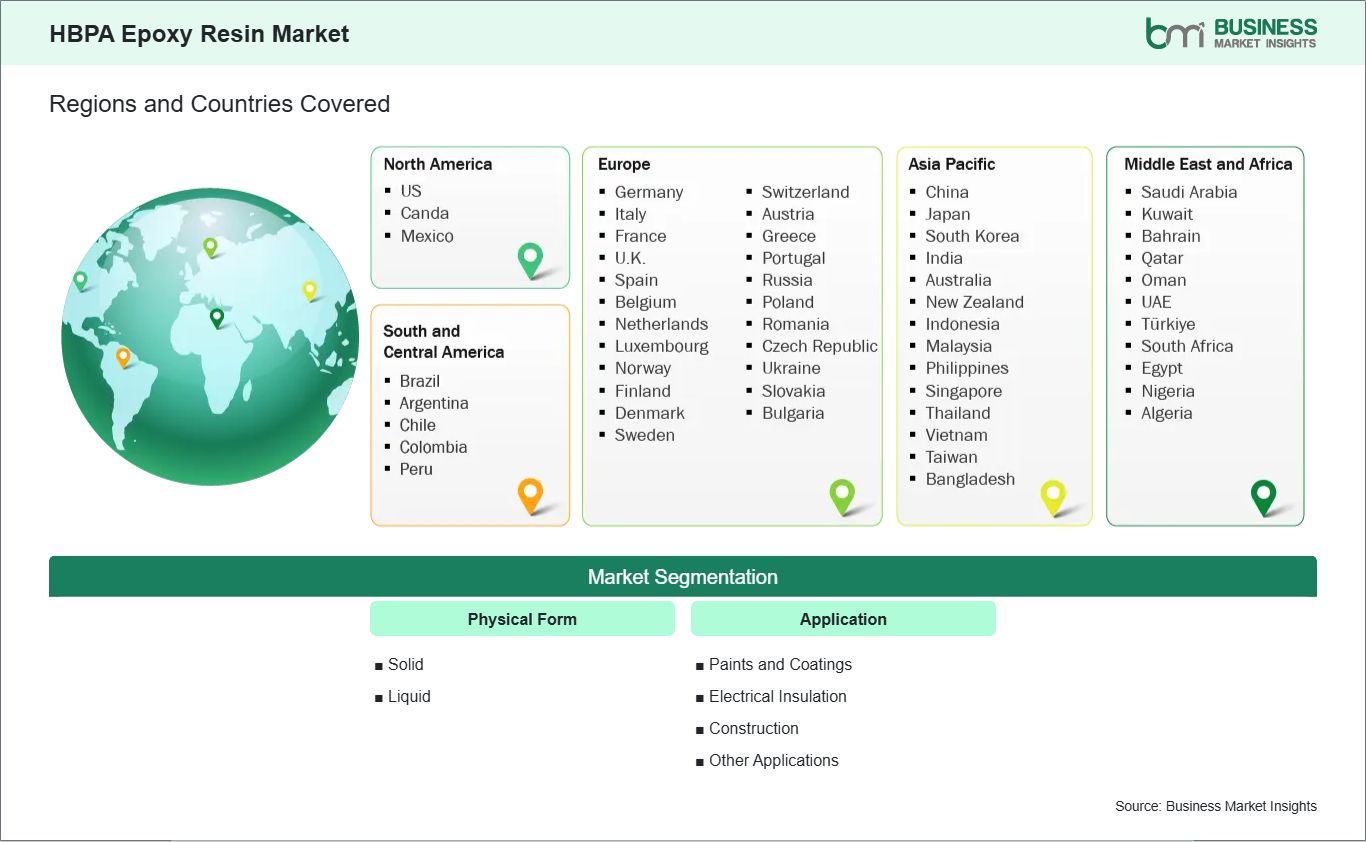
Key segments that contributed to the derivation of the HBPA epoxy resin market analysis are physical form and application.
The HBPA epoxy resin market is witnessing strong growth due to increasing demand from the electrical and electronics sector. These resins offer excellent thermal stability, superior mechanical strength, and high chemical resistance, making them ideal for high-performance electrical components. In major manufacturing hubs, HBPA epoxy resins are widely used in the production of printed circuit boards (PCBs), encapsulation of semiconductors, and insulation of motors and transformers. Their ability to maintain dielectric properties at elevated temperatures has made them a preferred choice in electronics that require long-term reliability under demanding conditions.
In addition, the rapid adoption of consumer electronics and smart devices is fueling the demand for HBPA epoxy resins in high-precision applications. Components such as connectors, sensors, and microelectronic assemblies increasingly rely on these resins for protection against heat, moisture, and mechanical stress. The chemical stability and low shrinkage of HBPA formulations ensure that delicate electronic parts remain securely encapsulated, enhancing product lifespan and performance. Manufacturers are actively investing in formulations that optimize resin curing times, adhesion, and thermal conductivity to meet the evolving requirements of modern electronics.
Furthermore, the emphasis on miniaturization and lightweight electronic devices is creating opportunities for HBPA epoxy resins with higher performance characteristics. As electronics become smaller, more complex, and subject to higher thermal loads, resins capable of superior insulation and mechanical reinforcement are in demand. The combination of thermal stability, chemical resistance, and electrical insulation has positioned HBPA epoxy resins as a critical material in both established and emerging electronics applications, driving sustained growth in the global market.
The use of HBPA epoxy resins in power handling and insulation applications is increasing, as the material possesses superior dielectric and thermal properties. HBPA epoxy resins are widely used in transformer windings, high voltage insulators, and stator and rotor insulation of electric motors. The material can endure thermal cycling and mechanical stresses, ensuring the efficient performance of the insulation materials used in power handling applications. The chemical resistance and dimensional stability of the material make it a viable option for resin-impregnated materials, as the durability of the materials is critical for the efficient performance of power handling applications.
The power generation, power distribution, and industrial equipment sectors are increasingly using HBPA epoxy resins to improve the insulation and efficiency of power handling applications. For example, the high glass transition temperatures and adhesion properties of HBPA epoxy resins make resin-encapsulated coils and insulation tapes efficient for power handling applications, as the materials can endure high voltage and extreme operating conditions without compromising the performance of the insulation materials used in the applications. The use of HBPA epoxy resins in power handling applications is a testament to the increasing requirements for efficient insulation materials used in power handling applications.
In addition, the trend toward renewable energy and electrification is creating further opportunities for HBPA epoxy resins in insulation applications. Components used in wind turbines, solar inverters, and electric vehicle traction motors require materials capable of withstanding high temperatures, mechanical stress, and exposure to harsh environmental conditions. HBPA epoxy resins provide a combination of mechanical reinforcement, thermal stability, and dielectric performance that is crucial for these systems. The increasing focus on energy efficiency, reliability, and long-term durability is thus driving the global market for HBPA epoxy resins in power handling and insulation systems.

The HBPA epoxy resin market is experiencing steady growth, with market size and share analysis reflecting evolving treatment preferences and competitive dynamics among key players. The report evaluates important subsegments categorized within physical form and application, highlighting their respective contributions to overall market performance.
By physical form, the liquid subsegment is expected to dominate the HBPA epoxy resin market in 2025. Liquid HBPA epoxy resins offer superior suitability for casting operations and processing advantages, which drives their widespread adoption.
Based on application, the paints and coatings subsegment dominated the HBPA epoxy resin market in 2025. Paints and coatings applications benefit from protective, durable, and industrial-grade performance, supporting strong demand for HBPA epoxy resin technologies.
| Report Attribute | Details |
|---|---|
| Market size in 2025 | US$ 2.35 Billion |
| Market Size by 2033 | US 3.65 Billion |
| Global CAGR (2026 - 2033) | 5.66% |
| Historical Data | 2022-2024 |
| Forecast period | 2026-2033 |
| Segments Covered | By Physical Form
|
|
Regions and Countries Covered
| |
| North America | US, Canada, Mexico |
| Europe | Belgium, Austria, Finland, Denmark, Greece, Poland, Romania, Russia, Ukraine, Czech Republic, Slovakia, Bulgaria, Italy, Luxembourg, Germany, Switzerland, France, Netherlands, Norway, Portugal, Spain, Sweden, United Kingdom |
| Asia-Pacific | Australia, China, India, Japan, South Korea, Indonesia, Malaysia, Philippines, Singapore, Thailand, Vietnam, Bangladesh, New Zealand, Taiwan |
| South and Central America | Brazil, Argentina, Peru, Chile, Colombia |
| Middle East and Africa | Bahrain, Kuwait, Oman, Qatar, Saudi Arabia, United Arab Emirates, Turkiye, South Africa, Egypt, Algeria, Nigeria |
| Market leaders and key company profiles |
|
The "HBPA Epoxy Resin Market Size and Forecast (2022 - 2033)" report provides a detailed analysis of the market covering below areas:
The geographical scope of the HBPA Epoxy Resin market report is divided into five regions: North America, Asia Pacific, Europe, Middle East & Africa, and South & Central America. The HBPA Epoxy Resin market in North America is expected to grow during the forecast period.
North America is the leading region in the HBPA epoxy resin market, supported by a mature industrial base, stringent performance standards, and diverse end-use applications that demand reliable, high-quality materials. The region’s industrial landscape, which includes sectors such as electronics, aerospace, automotive, and infrastructure, places a premium on resins that provide durability, thermal stability, and environmental resistance. These requirements have made HBPA epoxy resins a preferred choice in North American manufacturing and construction practices.
In the field of electronics, HBPA resins are used extensively for insulating and protecting sensitive parts, allowing the device or system to work efficiently under adverse operating conditions. In the field of industrial coatings, HBPA resins are useful due to their abrasion, chemical, and temperature resistance. This makes them useful for coating surfaces where protection against adverse operating conditions is necessary. In the field of automobiles and transportation, HBPA epoxy resins are used for high-performance adhesives and light composite parts, which is part of the overall trend. The high level of research, innovation, and compliance in the North American region adds to the dominance of the region as a major market for the product. The manufacturers work closely with the users to formulate HBPA resins according to the specific requirements of the users, which are very stringent for the environment as well as for the performance of the product.
The complexity of the production process, as well as the challenge from conventional epoxy resins, might act as a challenge, but the region’s technological capabilities and the high level of quality will keep the region at the top of the global HBPA epoxy resin market.

The HBPA epoxy resin market is evaluated by gathering qualitative and quantitative data post primary and secondary research, which includes important corporate publications, association data, and databases. A few of the key developments in the HBPA epoxy resin market are:
The HBPA Epoxy Resin Market is valued at US$ 2.35 Billion in 2025, it is projected to reach US 3.65 Billion by 2033.
As per our report HBPA Epoxy Resin Market, the market size is valued at US$ 2.35 Billion in 2025, projecting it to reach US 3.65 Billion by 2033. This translates to a CAGR of approximately 5.66% during the forecast period.
The HBPA Epoxy Resin Market report typically cover these key segments-
The historic period, base year, and forecast period can vary slightly depending on the specific market research report. However, for the HBPA Epoxy Resin Market report:
The HBPA Epoxy Resin Market is populated by several key players, each contributing to its growth and innovation. Some of the major players include:
The HBPA Epoxy Resin Market report is valuable for diverse stakeholders, including:
Essentially, anyone involved in or considering involvement in the HBPA Epoxy Resin Market value chain can benefit from the information contained in a comprehensive market report.
Please tell us your area of interest
(Market Segments/ Regions and Countries/ Companies)