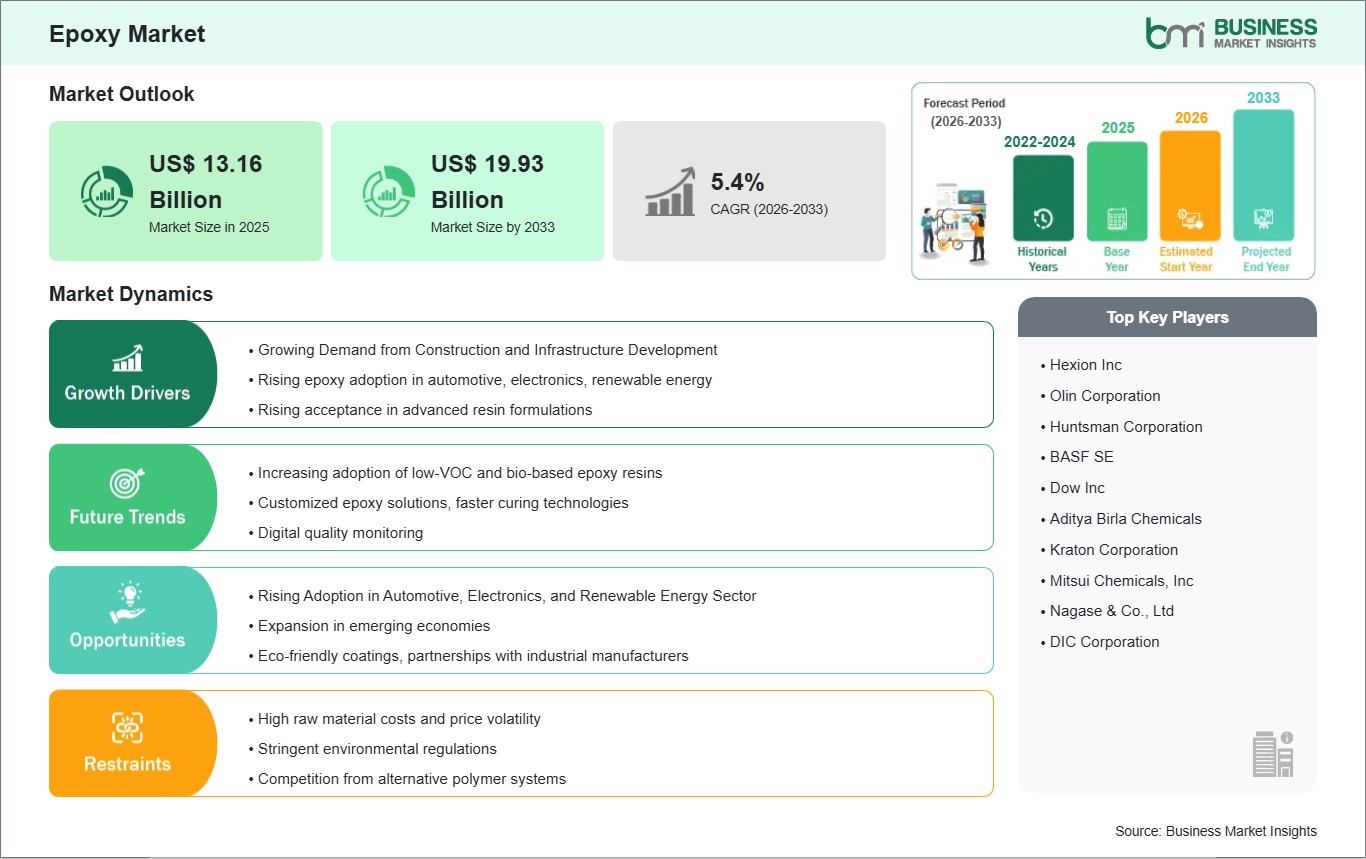
The Epoxy Market size is expected to reach US$ 19.93 Billion by 2033 from US$ 13.16 Billion in 2025 .The market is estimated to record a CAGR of 5.4% from 2026 to 2033.
The global epoxy market is defined by increasing demand for high-performance thermosetting polymers across industries such as construction, automotive, electronics, and energy. Epoxy resins are widely recognized for their superior mechanical strength, chemical resistance, and adhesion properties, making them essential in coatings, composites, and structural applications. This shift reflects broader industrial priorities: enhancing material performance, improving durability, and enabling lightweight and high-strength designs.
Competitive dynamics increasingly center on product innovation and sustainability, with emphasis on low-VOC formulations and bio-based epoxy resins. Manufacturers are investing in advanced resin technologies that offer improved thermal stability, corrosion resistance, and curing efficiency. Commercial strategies now include customized formulations tailored to specific end-use industries and performance requirements.
Meanwhile, industries are integrating epoxy materials to replace traditional materials and improve operational efficiency. Regulatory frameworks and environmental concerns are also influencing product development, particularly in coatings and construction applications. This evolving landscape positions epoxy resins as critical materials in modern industrial and infrastructure development.

Key segments that contributed to the derivation of the epoxy market analysis are type and application.
The global construction and infrastructure sector is undergoing rapid expansion, driven by urbanization, population growth, and government investments in housing, transportation, and industrial facilities. This surge in activity has created strong demand for durable, high‑performance materials, with epoxy resins emerging as a critical solution. Epoxy resins are widely used in coatings, flooring, adhesives, and composites due to their exceptional durability, chemical resistance, and ability to withstand harsh environmental conditions. In infrastructure projects such as bridges, highways, and commercial buildings, epoxy coatings provide long‑term protection against corrosion, moisture, and chemical exposure, thereby extending the lifespan of structures and reducing maintenance costs.
Urbanization in emerging economies is particularly fueling demand for epoxy‑based construction materials. Countries across Asia, the Middle East, and Africa are investing heavily in smart cities, industrial parks, and transportation networks, all of which require advanced protective coatings and flooring systems. Epoxy flooring, for instance, is increasingly used in industrial facilities and warehouses for its ability to resist heavy loads, abrasion, and chemical spills.
Technological advancements in epoxy formulations are further enhancing their appeal. New epoxy systems offer faster curing times, improved adhesion, and greater sustainability, aligning with the industry`s push toward eco‑friendly construction practices. As infrastructure development continues to accelerate globally, epoxy resins will remain indispensable in ensuring structural integrity, safety, and efficiency, making construction and infrastructure one of the strongest growth drivers for the epoxy market.
Beyond construction, epoxy resins are experiencing rising adoption in high‑growth industries such as automotive, electronics, and renewable energy. In the automotive and aerospace sectors, epoxy composites are used to manufacture lightweight yet strong components, contributing to improved fuel efficiency and reduced emissions. Their ability to deliver high mechanical strength while minimizing weight makes them ideal for structural parts, adhesives, and coatings in vehicles and aircraft.
In electronics, epoxy resins play a vital role in encapsulation and insulation, protecting sensitive components from moisture, dust, and mechanical stress. Printed circuit boards, semiconductors, and consumer electronics rely on epoxy materials to ensure reliability and long service life. With the global electronics industry expanding rapidly, demand for epoxy resins in this sector is expected to grow significantly.
Renewable energy is another major driver. Epoxy resins are extensively used in wind turbine blades, where their strength, durability, and resistance to fatigue are critical for performance. As countries invest in renewable energy infrastructure to meet sustainability goals, the demand for epoxy composites in wind energy applications is rising sharply.
Advancements in composite technologies are further expanding application areas. Innovations in resin chemistry are enabling better performance, faster curing, and improved recyclability, aligning with global sustainability trends. As automotive, electronics, and renewable energy industries continue to grow worldwide, epoxy resins will play an increasingly central role, driving market expansion and reinforcing their importance across diverse high‑tech applications.

The Epoxy Market demonstrates steady growth, with size and share analysis highlighting evolving trends and competitive dynamics among key players. The report examines subsegments categorized within type and application, offering insights into their contribution to overall market performance.
By type, the liquid subsegment dominated the market in 2025, driven by its versatility and ease of application.
In terms of application, the coatings subsegment dominated the market in 2025, driven by extensive use in protective and decorative applications.
| Report Attribute | Details |
|---|---|
| Market size in 2025 | US$ 13.16 Billion |
| Market Size by 2033 | US$ 19.93 Billion |
| Global CAGR (2026 - 2033) | 5.4% |
| Historical Data | 2022-2024 |
| Forecast period | 2026-2033 |
| Segments Covered | By Type
|
|
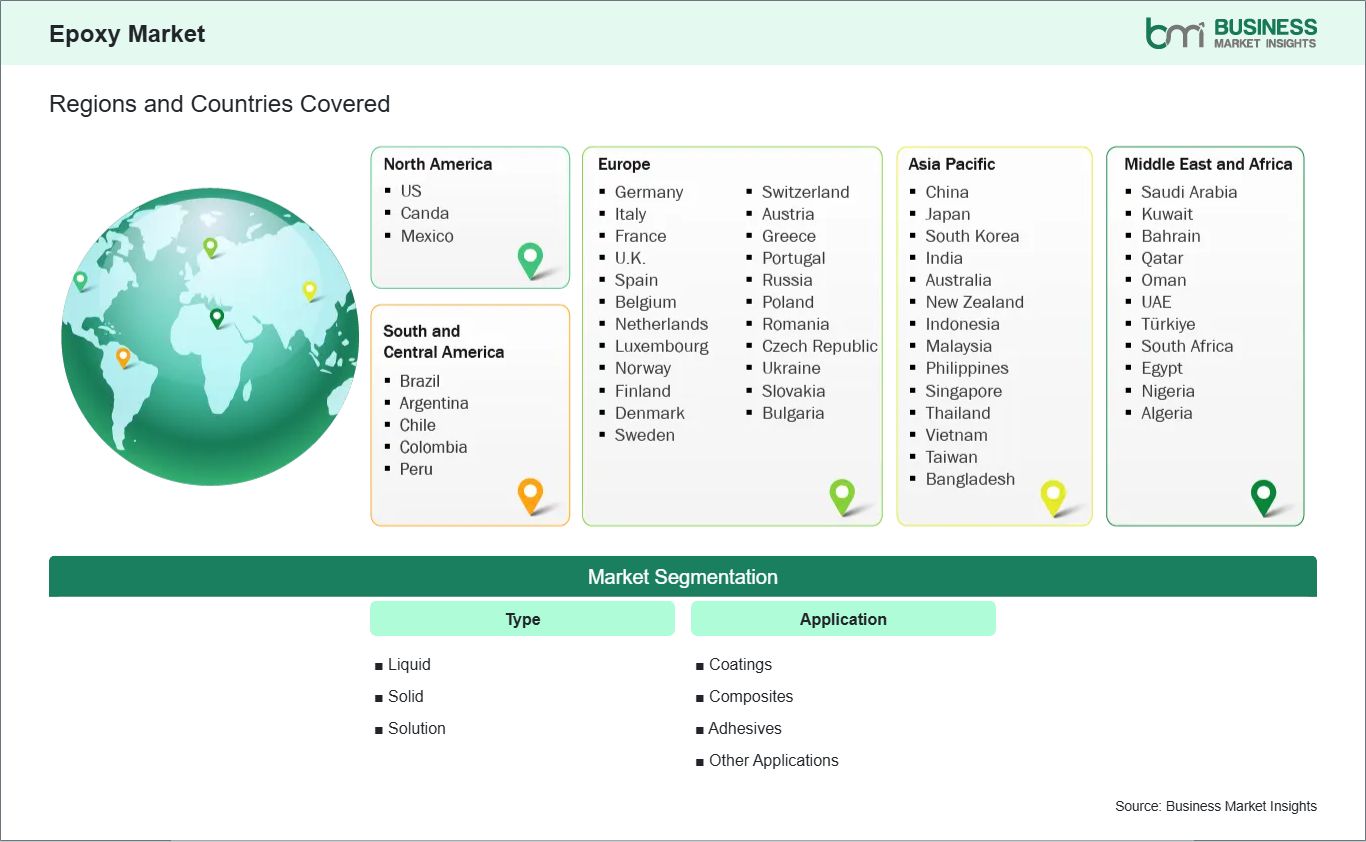
Regions and Countries Covered
| |
| North America | US, Canada, Mexico |
| Europe | Belgium, Austria, Finland, Denmark, Greece, Poland, Romania, Russia, Ukraine, Czech Republic, Slovakia, Bulgaria, Italy, Luxembourg, Germany, Switzerland, France, Netherlands, Norway, Portugal, Spain, Sweden, United Kingdom |
| Asia-Pacific | Australia, China, India, Japan, South Korea, Indonesia, Malaysia, Philippines, Singapore, Thailand, Vietnam, Bangladesh, New Zealand, Taiwan |
| South and Central America | Brazil, Argentina, Peru, Chile, Colombia |
| Middle East and Africa | Bahrain, Kuwait, Oman, Qatar, Saudi Arabia, United Arab Emirates, Turkiye, South Africa, Egypt, Algeria, Nigeria |
| Market leaders and key company profiles |
|
The "Epoxy Market Size and Forecast (2022 - 2033)" report provides a detailed analysis of the market covering below areas:
The geographical scope of the Epoxy Market report is divided into North America, Asia Pacific, Europe, Middle East & Africa, and South & Central America. North America held the largest share in 2025.
The adoption and maturity of epoxy materials vary across regions, driven by industrialization, infrastructure development, and manufacturing activity. In North America, strong demand from construction, automotive, and aerospace industries drives market growth, supported by advanced technologies and innovation.
In Europe, stringent environmental regulations and sustainability initiatives encourage the adoption of low-emission and eco-friendly epoxy formulations. Countries such as Germany, the UK, and France lead in advanced material adoption.
Asia Pacific market is growing due to rapid industrialization, urbanization, and infrastructure expansion in countries such as China, India, and Southeast Asia. The region benefits from strong manufacturing capabilities and increasing investments in construction and renewable energy sectors.
The Middle East & Africa and South & Central America regions show steady growth, driven by infrastructure development and industrial expansion. Across all regions, economic growth, regulatory frameworks, and industrial investments shape market dynamics.

The Epoxy Market is evaluated by gathering qualitative and quantitative data post primary and secondary research, which includes important corporate publications, association data, and databases. A few of the key developments in the epoxy market are:
The Epoxy Market is valued at US$ 13.16 Billion in 2025, it is projected to reach US$ 19.93 Billion by 2033.
As per our report Epoxy Market, the market size is valued at US$ 13.16 Billion in 2025, projecting it to reach US$ 19.93 Billion by 2033. This translates to a CAGR of approximately 5.4% during the forecast period.
The Epoxy Market report typically cover these key segments-
The historic period, base year, and forecast period can vary slightly depending on the specific market research report. However, for the Epoxy Market report:
The Epoxy Market is populated by several key players, each contributing to its growth and innovation. Some of the major players include:
The Epoxy Market report is valuable for diverse stakeholders, including:
Essentially, anyone involved in or considering involvement in the Epoxy Market value chain can benefit from the information contained in a comprehensive market report.
Please tell us your area of interest
(Market Segments/ Regions and Countries/ Companies)