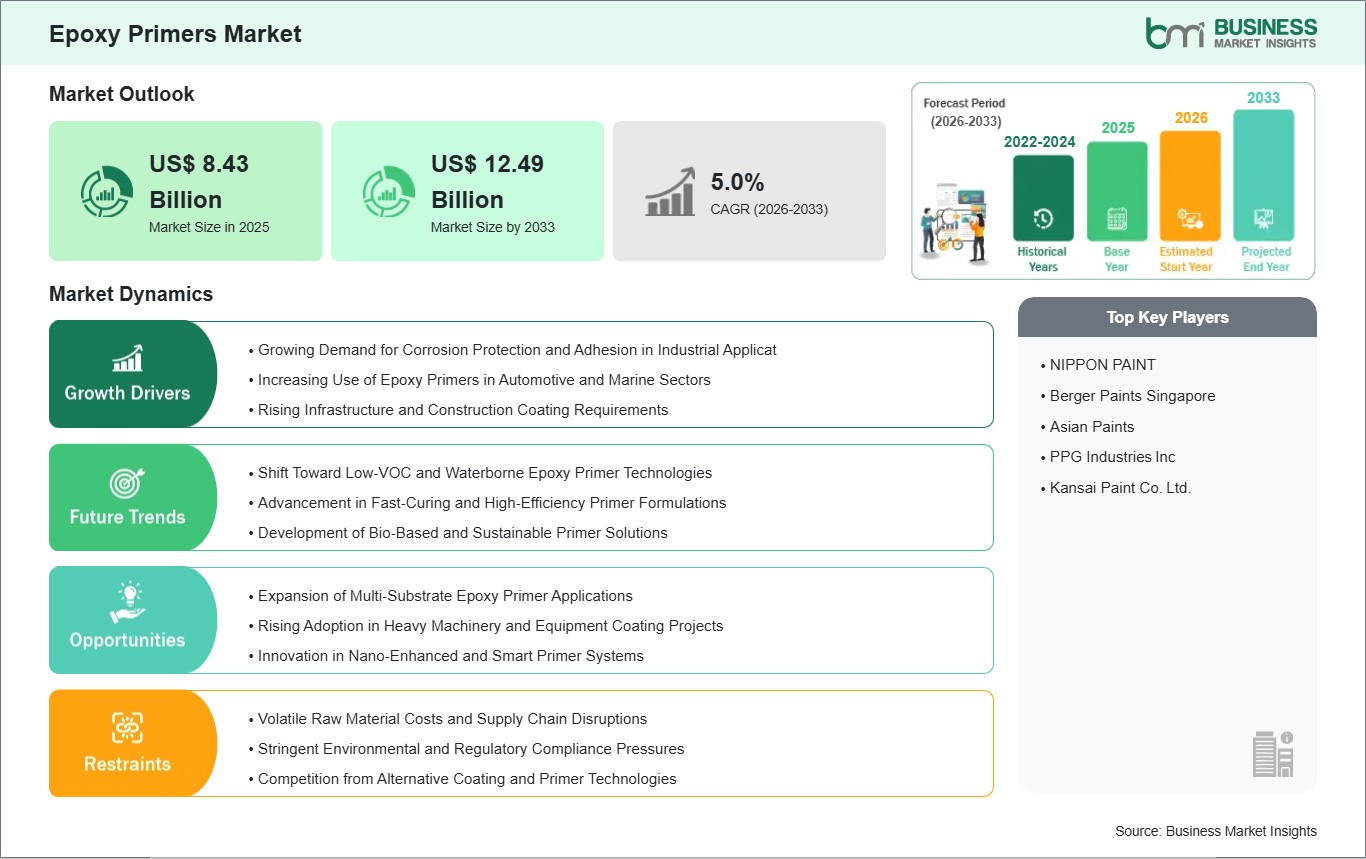
The Epoxy Primers Market size is expected to reach US$ 12.49 Billion by 2033 from US$ 8.43 Billion in 2025 .The market is estimated to record a CAGR of 5.0% from 2026 to 2033.
The global epoxy primers market is gaining momentum as industries place a higher priority on surface protection, durability, and long-lasting performance. Epoxy primers serve as the foundation for coatings, ensuring strong adhesion to a variety of surfaces while providing excellent corrosion resistance and chemical protection. They are widely used across industries like automotive, construction, marine, and industrial maintenance, where durability and long-term protection are critical. In automotive and aerospace sectors, primers prevent rust and enhance topcoat performance, while in construction and infrastructure, they protect steel, concrete, and pipelines from wear and environmental damage. The marine and offshore industries also rely heavily on epoxy primers for protection against saltwater and harsh weather conditions. At the same time, there is a trend toward sustainability that is pushing the development of low-VOC, solvent-free, and environmentally friendly primer products that meet even more stringent environmental regulations without sacrificing quality. There is the issue of the overall cost of premium resin and pigment raw materials that may limit market penetration in more price-sensitive markets, as well as the issue of supply chain interruptions. Yet the epoxy primer market is still expected to grow steadily as innovation is focused on delivering quality products that are environmentally friendly and will provide longer life to surfaces in many industries.

Key segments that contributed to the derivation of the epoxy primers market analysis are substrate type, technology, and application.
The growing demand for corrosion protection and adhesion in industrial applications is a major driver for the epoxy primers market. Across industries, surfaces are exposed to harsh environments, including moisture, chemicals, and heavy wear, making durable primers essential. Epoxy primers form a strong protective layer that prevents rust, enhances adhesion for subsequent coatings, and extends the life of equipment and structures. This makes them a critical component in industries ranging from construction and manufacturing to transportation and energy.
The other factor driving demand is based on considerations of efficiency and reliability. In industrial settings, operators are increasingly seeking coatings that minimize both maintenance downtime and cost. Epoxy primers not only provide better adhesion but also enhance the resistance of coatings to cracking, peeling, and degradation. By improving the quality of the topcoat, epoxy primers provide reliability and long-lasting durability. This reliability is one of the key reasons why epoxy primers are used in protective and functional coatings.
Environmental and regulatory factors are also driving demand. Complying with contemporary standards for low emissions and environmental impact is becoming more important. Advanced epoxy primers are able to provide both reliability and sustainability. They provide excellent resistance to corrosion and excellent adhesion without compromising on safety. This reliability and functionality are driving growth in industrial coatings.
The expansion of multi-substrate epoxy primer applications presents a significant opportunity for market growth. Modern manufacturing often involves diverse materials, including metals, plastics, and composites. Epoxy primers that can bond effectively to multiple substrates provide flexibility in design and simplify coating processes, making them highly valuable to manufacturers and industrial operators. This versatility allows for broader adoption in complex applications, from machinery and vehicles to specialized equipment and structural components.
In terms of product formulation, there are further opportunities arising through innovations, including fast-cure primers, heat- and chemical-resistant products, as well as primers with enhanced performance with newer, more demanding coating systems. The next generation of epoxy primers will allow for more efficient manufacturing processes, with the final product offering superior performance, both visually and physically. By overcoming issues related to adhesion, as well as resistance to extreme operating conditions, new opportunities are now presented.
Sustainability trends, as well as technological advancements, add further opportunities to the market potential of epoxy primers. In terms of sustainability, eco-friendly products, reduced VOCs, as well as products with enhanced performance with waterborne or hybrid coating systems will appeal to industry sectors looking to improve their sustainability credentials. At the same time, products with superior protective and adhesion properties will provide cost savings over the life of the product. In summary, the opportunities for multi-substrate epoxy primers are a major enabler for efficient, cost-effective, and sustainable coating systems across a range of different industry sectors.

The epoxy primers market is experiencing steady growth, with market size and share analysis reflecting evolving treatment preferences and competitive dynamics among key players. The report evaluates important subsegments categorized within substrate type, technology, and application, highlighting their respective contributions to overall market performance.
By substrate type, the Metal subsegment dominated the Epoxy Primers market in 2025. Metal substrates require strong adhesion, corrosion resistance, and durability, making metal the preferred choice for a wide range of industrial and structural applications, which drives its widespread adoption.
Based on technology, the Water-borne subsegment dominated the Epoxy Primers market in 2025. Water-borne technology offers low VOC emissions, environmental compliance, and ease of application, supporting strong demand in modern coating solutions.
In terms of application, the Building and Construction subsegment dominated the Epoxy Primers market in 2025. Building and construction projects demand long-lasting protection, surface adhesion, and enhanced durability, reinforcing the dominance of this segment in the market.
| Report Attribute | Details |
|---|---|
| Market size in 2025 | US$ 8.43 Billion |
| Market Size by 2033 | US$ 12.49 Billion |
| Global CAGR (2026 - 2033) | 5.0% |
| Historical Data | 2022-2024 |
| Forecast period | 2026-2033 |
| Segments Covered | By Substrate Type
|
|
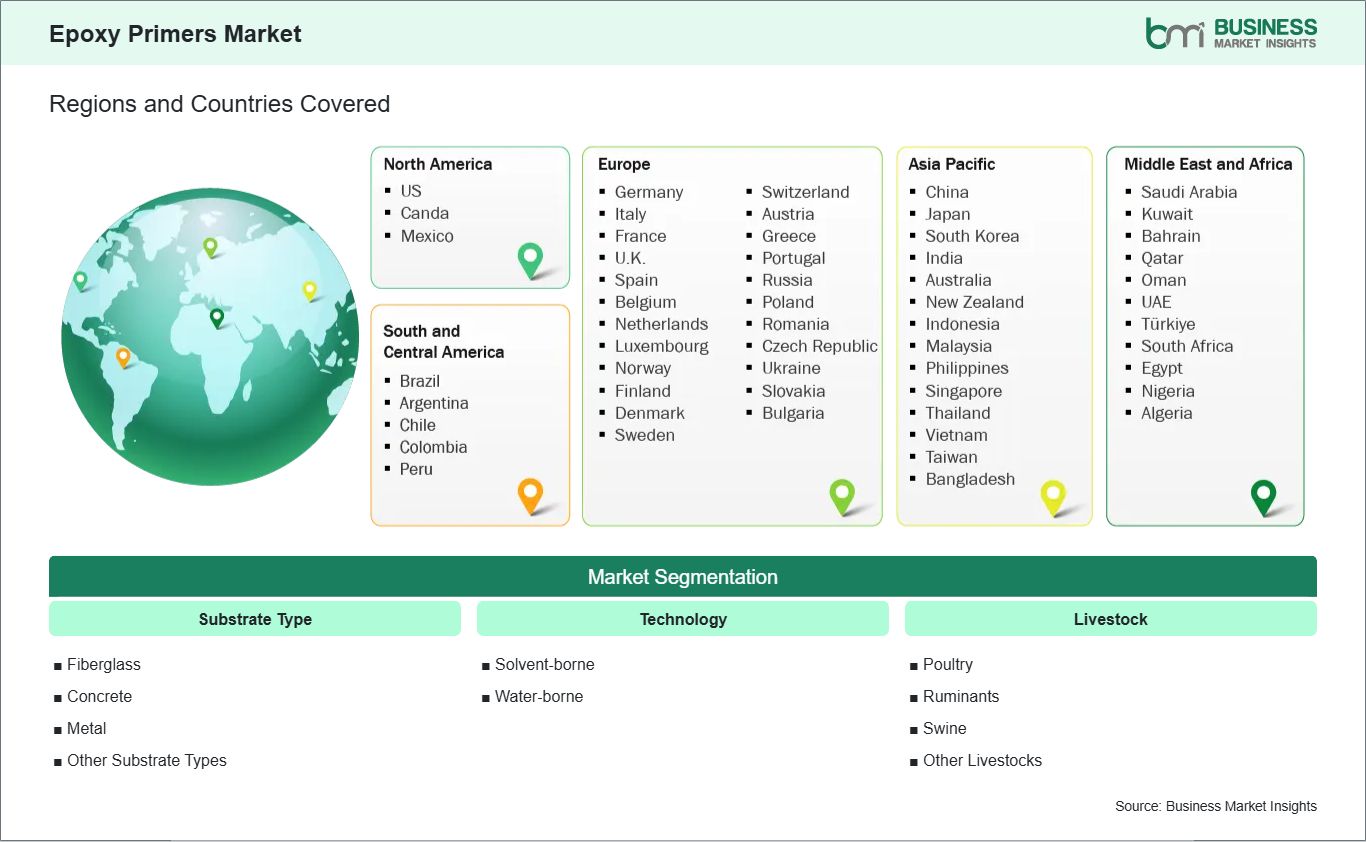
Regions and Countries Covered
| |
| North America | US, Canada, Mexico |
| Europe | Belgium, Austria, Finland, Denmark, Greece, Poland, Romania, Russia, Ukraine, Czech Republic, Slovakia, Bulgaria, Italy, Luxembourg, Germany, Switzerland, France, Netherlands, Norway, Portugal, Spain, Sweden, United Kingdom |
| Asia-Pacific | Australia, China, India, Japan, South Korea, Indonesia, Malaysia, Philippines, Singapore, Thailand, Vietnam, Bangladesh, New Zealand, Taiwan |
| South and Central America | Brazil, Argentina, Peru, Chile, Colombia |
| Middle East and Africa | Bahrain, Kuwait, Oman, Qatar, Saudi Arabia, United Arab Emirates, Turkiye, South Africa, Egypt, Algeria, Nigeria |
| Market leaders and key company profiles |
|
The "Epoxy Primers Market Size and Forecast (2022 - 2033)" report provides a detailed analysis of the market covering below areas:
The geographical scope of the Epoxy Primers market report is divided into five regions: North America, Asia Pacific, Europe, Middle East & Africa, and South & Central America. The Epoxy Primers market in North America is expected to grow during the forecast period.
North America is the largest market for epoxy primers in the world due to its strong industrial base and high demand for coatings that provide durability, adhesion, and resistance to corrosion. In North America, particularly in the U.S., the automotive and aerospace industries are major users of epoxy primers to prevent corrosion, ensure adhesion, and provide long service life to metal parts. In the construction industry, epoxy primers are used to coat steel structures, bridges, pipelines, and industrial equipment to prevent exposure to environmental conditions. In the marine and offshore industry in North America, particularly in the U.S. and Canada, epoxy primers are used to protect vessels and offshore structures from exposure to saltwater and severe weather conditions. Another important factor in the region is sustainability and regulatory compliance. This has led to manufacturers investing in low-VOC content, waterborne, and hybrid epoxy primers. Although cost fluctuations in raw materials and regulatory compliance may act as a barrier in the region, the presence of key players in the chemical industry and their cooperation with industrial users ensure the continued innovation and customization in the region.

The epoxy primers market is evaluated by gathering qualitative and quantitative data post primary and secondary research, which includes important corporate publications, association data, and databases. A few of the key developments in the epoxy primers market are:
The Epoxy Primers Market is valued at US$ 8.43 Billion in 2025, it is projected to reach US$ 12.49 Billion by 2033.
As per our report Epoxy Primers Market, the market size is valued at US$ 8.43 Billion in 2025, projecting it to reach US$ 12.49 Billion by 2033. This translates to a CAGR of approximately 5.0% during the forecast period.
The Epoxy Primers Market report typically cover these key segments-
The historic period, base year, and forecast period can vary slightly depending on the specific market research report. However, for the Epoxy Primers Market report:
The Epoxy Primers Market is populated by several key players, each contributing to its growth and innovation. Some of the major players include:
The Epoxy Primers Market report is valuable for diverse stakeholders, including:
Essentially, anyone involved in or considering involvement in the Epoxy Primers Market value chain can benefit from the information contained in a comprehensive market report.
Please tell us your area of interest
(Market Segments/ Regions and Countries/ Companies)