
Hard Services FM Market Outlook: Size, Share, Trends, Growth Analysis, Competitive Landscape & Forecast, 2026-2033

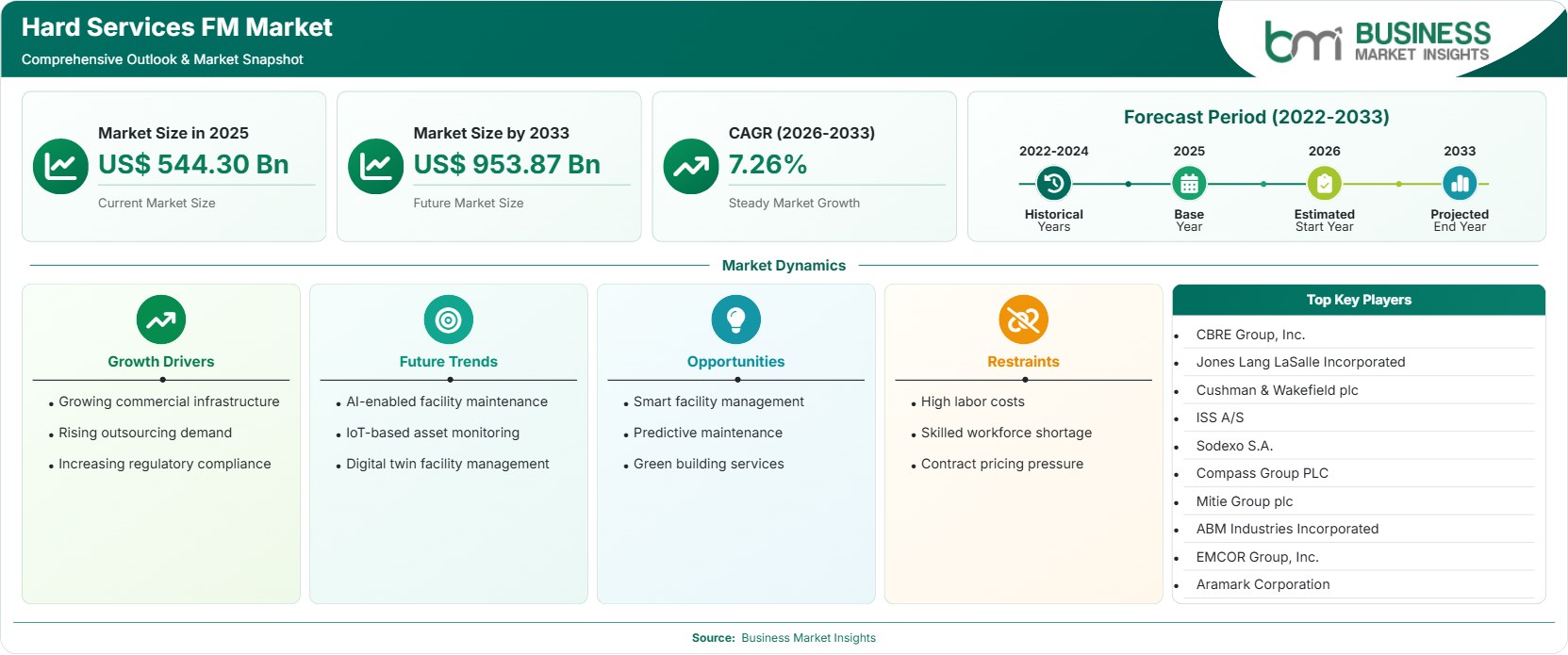
The Hard Services FM Market size was valued at US$ 544.30 billion in 2025 and is projected to reach US$ 953.87 billion by 2033, growing at a CAGR of 7.26% during 2026–2033. Growing commercial infrastructure development, rising outsourcing demand, and increasingly stringent building safety regulations continue to accelerate market expansion.

Report Coverage
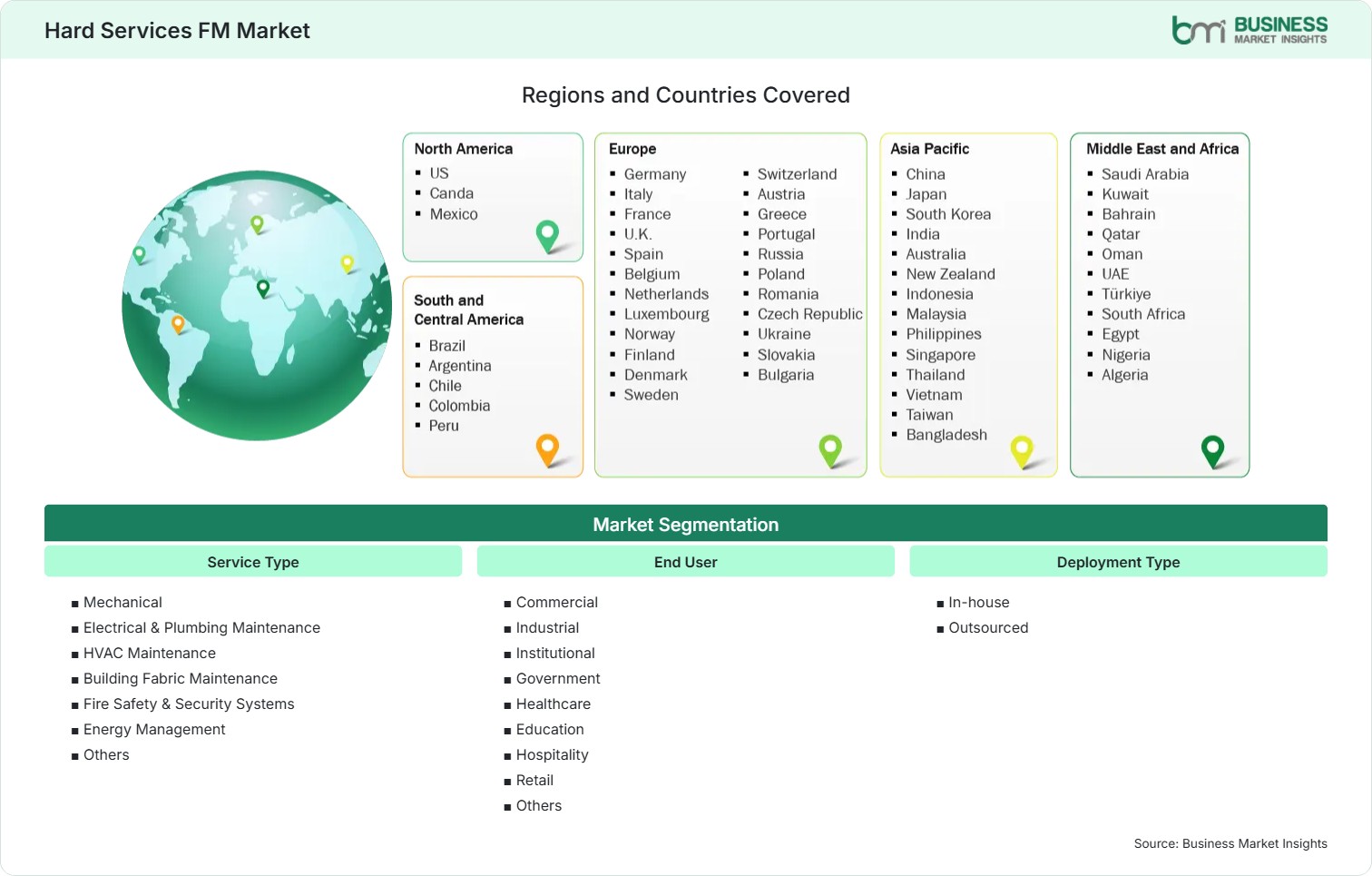
  • Service Type: Mechanical, Electrical & Plumbing Maintenance, HVAC Maintenance, Building Fabric Maintenance, Fire Safety & Security Systems, Energy Management, Others
  • End User: Commercial, Industrial, Institutional, Government, Healthcare, Education, Hospitality, Retail, Others
  • Deployment Type: In-house, Outsourced
US$ 544.30 Bn Market size in 2025
US$ 953.87 Bn Market Size by 2033
7.26% CAGR, 2026 - 2033
2026-2033 Forecast Period

AI Overview

Hard Services FM Market Summary

  • North America Region: North America holds an estimated 34%–37% market share in 2025 and is projected to expand at a CAGR of 6.8%–7.2% during 2026–2033. Demand is supported by aging commercial infrastructure, increasing outsourcing of integrated facility services, stringent safety regulations, and digital building management adoption. The United States dominates regional demand through widespread commercial real estate investments and is expected to grow at a CAGR of 6.9%–7.3%.
  • Fastest Growing Region: Asia Pacific accounts for approximately 28%–31% market share in 2025 and is anticipated to register the fastest CAGR of 8.5%–9.0% through 2033. Rapid urbanization, industrial expansion, smart city initiatives, and increasing commercial construction continue driving demand for integrated hard facility management services.
  • Leading Segment: Mechanical, Electrical & Plumbing (MEP) Maintenance represents around 31%–34% of the market in 2025 while growing at a CAGR of 7.1%–7.5%. Increasing complexity of commercial buildings, preventive maintenance requirements, and regulatory compliance continue supporting sustained demand.
  • High Growth Segment: Outsourced Deployment accounts for nearly 58%–61% market share in 2025 and is forecast to expand at a CAGR of 7.8%–8.3%. Organizations increasingly outsource technical maintenance to reduce operating costs, improve service quality, and access specialized workforce capabilities.
  • Key Market Opportunity: Smart building technologies, AI-enabled predictive maintenance, IoT-connected assets, and sustainability-focused facility modernization are creating new revenue opportunities for service providers delivering integrated lifecycle management solutions.
  • Major Market Players: CBRE Group, Inc., Jones Lang LaSalle Incorporated, Cushman & Wakefield plc, ISS A/S, Sodexo S.A., Compass Group PLC, Mitie Group plc, ABM Industries Incorporated, EMCOR Group, Inc., and Aramark Corporation.
Strategic Insights

Hard Services FM Market: Strategic Insights

Hard Services FM Market Strategic Framework
FREE PDF
Request your free sample
Request free sample
Stakeholder View

Key Takeaways

  • Integrated service delivery is reshaping the facility management value chain. Building owners increasingly prefer single-service providers capable of delivering mechanical, electrical, plumbing, HVAC, fire safety, and energy management services through unified contracts, improving operational efficiency and reducing vendor management complexity.
  • Commercial and industrial facilities offer the strongest long-term growth opportunities. Expansion of office complexes, logistics hubs, manufacturing facilities, airports, healthcare campuses, and mixed-use developments continues generating sustained demand for preventive and predictive maintenance services.
  • Digitalization is transforming technical maintenance operations. Internet of Things (IoT) sensors, artificial intelligence, digital twins, building management systems (BMS), and predictive analytics enable real-time asset monitoring, reduce equipment downtime, optimize maintenance scheduling, and improve lifecycle performance.
  • Asia Pacific presents the most attractive regional investment opportunity. Large-scale urbanization, industrial expansion, smart city developments, and government investments in commercial infrastructure across China, India, Southeast Asia, and Australia continue supporting strong demand for outsourced hard facility management services.
  • Outsourcing continues to gain momentum across enterprises. Organizations increasingly outsource technical facility management to improve compliance, reduce labor costs, access specialized engineering expertise, and focus internal resources on core business operations.
  • Sustainability and regulatory compliance are becoming competitive differentiators. Service providers with expertise in energy-efficient building operations, green building certifications, HVAC optimization, and environmental compliance are well positioned to secure long-term service contracts.
Geographic Outlook

Hard Services FM Market Regional Highlights

North America Hard Services FM Market

North America accounts for approximately 34%–37% of the global market in 2025 and is projected to grow at a CAGR of 6.8%–7.2% during 2026–2033. The region benefits from mature commercial real estate markets, increasing modernization of aging buildings, and widespread adoption of outsourced technical maintenance. Hard Services FM Market share remains the largest globally due to stringent building codes, advanced building automation systems, and high demand for integrated facility management across commercial and industrial sectors.

  • Commercial office buildings, healthcare facilities, educational institutions, airports, and logistics centers continue investing in predictive maintenance and energy-efficient infrastructure to improve operational performance and reduce lifecycle costs.
  • Increasing integration of IoT-enabled sensors, computerized maintenance management systems (CMMS), and building automation platforms supports proactive maintenance strategies while minimizing equipment failures and operational disruptions.
  • Regulatory requirements related to fire safety, HVAC performance, electrical systems, and occupational safety continue driving recurring demand for professional technical maintenance services.
  • Growth in hyperscale data centers and advanced manufacturing facilities is creating new opportunities for specialized MEP, HVAC, electrical infrastructure, and mission-critical facility management services.
  • Sustainability initiatives encourage retrofitting of existing buildings with energy-efficient systems, supporting long-term service contracts and recurring maintenance revenues.

US Hard Services FM Market

The United States represents approximately 27%–30% of the global Hard Services FM Market in 2025 and is expected to register a CAGR of 6.9%–7.3% through 2033. Strong commercial construction activity, increasing outsourcing across enterprise facilities, and continuous modernization of healthcare, industrial, and institutional infrastructure continue supporting steady market expansion.

  • Demand for integrated facility management continues rising among Fortune 500 companies seeking operational efficiency, regulatory compliance, and improved asset reliability.
  • Federal and state investments in transportation infrastructure, healthcare modernization, and public facilities continue generating opportunities for technical maintenance providers.
  • Expansion of data centers, semiconductor manufacturing plants, and logistics warehouses requires highly specialized electrical, HVAC, fire protection, and critical infrastructure maintenance services.
  • AI-enabled maintenance planning and remote asset monitoring continue improving service quality, reducing operational downtime, and enhancing long-term building performance.

Europe Hard Services FM Market

Europe represents approximately 26%–29% of the global Hard Services FM Market in 2025 and is forecast to expand at a CAGR of 7.0%–7.5% through 2033. The United Kingdom leads the regional market, while Germany records the fastest growth among major European economies with a CAGR of 7.4%–7.9%.

  • Decarbonization initiatives and energy efficiency regulations continue increasing investments in HVAC optimization, intelligent lighting, and building automation technologies.
  • Commercial offices, hospitals, universities, and industrial facilities increasingly outsource technical maintenance to improve compliance and reduce operational costs.
  • Building renovation programs across Western Europe create sustained demand for electrical upgrades, fire safety modernization, and energy management services.
  • Smart building technologies and digital maintenance platforms continue improving operational transparency and reducing maintenance response times.
  • ESG reporting requirements encourage facility owners to prioritize sustainable maintenance strategies and energy performance improvements.

Asia Pacific Hard Services FM Market

Asia Pacific accounts for approximately 28%–31% of the global Hard Services FM Market in 2025 and is expected to register the fastest CAGR of 8.5%–9.0% during 2026–2033. China leads regional revenue generation, while India records the fastest growth with a CAGR of 9.2%–9.7%.

  • Government investments in airports, metro rail networks, industrial corridors, hospitals, and smart cities continue driving long-term demand for hard facility management services.
  • Increasing outsourcing by multinational corporations supports growth in integrated maintenance contracts across commercial office buildings and manufacturing facilities.
  • Rising adoption of intelligent building management systems and predictive maintenance technologies enhances operational efficiency and reduces equipment downtime.
  • Expansion of industrial parks, logistics infrastructure, and data centers creates significant opportunities for specialized MEP, HVAC, and electrical maintenance providers.
  • Growing awareness of energy conservation encourages facility owners to adopt advanced energy management and sustainability-focused maintenance solutions.

Rest of World Hard Services FM Market

The Rest of World region represents approximately 9%–11% of global market revenue in 2025 and is projected to expand at a CAGR of 7.4%–7.8% through 2033.

The Gulf Cooperation Council countries continue investing heavily in commercial developments, tourism infrastructure, and smart city projects, while Brazil leads Latin American demand through commercial real estate expansion and industrial modernization.

  • Saudi Arabia continues expanding demand through Vision 2030 infrastructure projects, commercial complexes, airports, and hospitality developments requiring integrated technical facility management.
  • The United Arab Emirates increasingly adopts smart building technologies, energy-efficient infrastructure, and predictive maintenance across commercial and mixed-use developments.
  • Brazil records the fastest growth in Latin America with a CAGR of 7.8%–8.2%, supported by industrial investments, logistics expansion, and modernization of commercial facilities.
  • Healthcare, education, retail, and hospitality sectors continue increasing outsourced maintenance contracts to improve service quality and regulatory compliance.
  • Renewable energy installations and green building projects continue creating new opportunities for energy management and specialized engineering maintenance services.
Global Market Geography
FREE PDF
Request your free sample
Request free sample
Segment Analysis

Hard Services FM Market Segmentation

Service Type

The Service Type segment forms the core of the market, encompassing critical technical services required to ensure safe, efficient, and compliant building operations. Mechanical, Electrical & Plumbing (MEP) Maintenance remains the dominant service category, accounting for approximately 31%–34% of the market in 2025 and is projected to grow at a CAGR of 7.1%–7.5% during 2026–2033. The Hard Services FM Market scope continues to expand as facility owners prioritize preventive maintenance, digital monitoring, regulatory compliance, and lifecycle asset management across commercial, industrial, and institutional properties.

  • Mechanical, Electrical & Plumbing (MEP) Maintenance: Remains the largest service category owing to continuous inspection, repair, and optimization of essential building systems that ensure operational reliability, occupant safety, and regulatory compliance.
  • HVAC Maintenance: Experiences robust demand as organizations invest in indoor air quality, energy-efficient climate control systems, predictive maintenance technologies, and smart HVAC monitoring to reduce operational costs and equipment downtime.
  • Building Fabric Maintenance: Supports the structural integrity of commercial and industrial facilities through roofing, façade maintenance, masonry repairs, waterproofing, flooring, and preventive inspections that extend building lifecycle and reduce repair expenses.
  • Fire Safety & Security Systems: Continues expanding due to stringent fire protection regulations, increasing installation of intelligent surveillance systems, access control solutions, emergency response systems, and regular compliance inspections.
  • Energy Management: Gains momentum as organizations pursues sustainability targets through energy audits, smart metering, building automation, renewable energy integration, and optimization of electrical consumption to lower operating expenses and carbon emissions.

End User

The End User segment reflects the diverse adoption of technical facility management services across multiple industries requiring reliable building infrastructure and regulatory compliance. Commercial facilities account for approximately 34%–37% of the Hard Services FM Market in 2025 and are expected to expand at a CAGR of 7.3%–7.7% through 2033.

  • Commercial: Continues leading demand due to expanding office complexes, business parks, mixed-use developments, airports, and corporate campuses requiring continuous technical maintenance and asset optimization.
  • Industrial: Increasing automation, manufacturing modernization, logistics expansion, and stringent equipment reliability requirements continue supporting demand for specialized engineering and maintenance services.
  • Institutional: Universities, research centers, public facilities, and cultural institutions increasingly adopt preventive maintenance strategies to improve operational continuity, regulatory compliance, and infrastructure longevity.
  • Government: Public buildings, administrative offices, transportation infrastructure, and municipal facilities continue generating recurring maintenance contracts supported by infrastructure modernization initiatives.
  • Healthcare: Hospitals, diagnostic laboratories, pharmaceutical facilities, and healthcare campuses require highly specialized HVAC, electrical, medical gas, and critical infrastructure maintenance to ensure uninterrupted operations.
  • Education: Schools, colleges, and universities increasingly outsource technical maintenance to improve facility safety, energy efficiency, and operational reliability while optimizing maintenance budgets.
  • Hospitality: Hotels, convention centers, resorts, and entertainment venues invest in integrated building maintenance to improve guest experiences, reduce downtime, and maintain premium infrastructure standards.
  • Retail: Shopping malls, supermarkets, retail chains, and commercial outlets increasingly deploy smart maintenance solutions to improve customer comfort, energy efficiency, and asset utilization.

Deployment Type

The Deployment Type segment highlights the evolving service delivery models adopted by organizations seeking operational efficiency and cost optimization. Outsourced deployment represents approximately 58%–61% of the global market in 2025 and is projected to register a CAGR of 7.8%–8.3% during the forecast period.

  • In-house: Remains relevant among large industrial facilities, government organizations, and mission-critical infrastructure requiring dedicated engineering teams, immediate response capabilities, and direct operational control over technical assets.
  • Outsourced: Continues witnessing the fastest adoption as organizations leverage specialized expertise, standardized maintenance practices, advanced digital technologies, and scalable service models to improve operational efficiency while reducing fixed workforce costs.
Market Forces

Hard Services FM Market Dynamics

Key Market Drivers

Growing Commercial Infrastructure Development

Rapid expansion of commercial office complexes, mixed-use developments, industrial parks, airports, hospitals, data centers, and logistics facilities continues generating sustained demand for hard facility management services. Governments and private developers are investing heavily in modern infrastructure, particularly across Asia Pacific and the Middle East. These assets require continuous maintenance of mechanical, electrical, plumbing, HVAC, and fire protection systems throughout their operational lifecycle. Hard Services FM Market growth is therefore supported by increasing construction activity and the growing emphasis on maintaining high-value built assets efficiently.

Increasing Outsourcing of Technical Facility Services

Many organizations from a range of industries, including commerce, healthcare, manufacturing, educational, and retail, are now opting for outsourced technical maintenance services to enhance efficiency and simplify their administration process. Third-party suppliers possess engineering knowledge, standard maintenance techniques, electronic monitoring technologies, and regulation compliance management. The change allows companies to concentrate on their primary operations while ensuring reliability of assets, preventing breakdowns, and achieving effective life-cycle costing.

Stringent Building Safety and Regulatory Compliance

Governments continue strengthening regulations related to fire safety, electrical systems, indoor air quality, occupational safety, and environmental performance. Compliance with these standards requires periodic inspections, preventive maintenance, equipment certification, and documentation. The owners of facilities seek for professional help from service companies that can ensure continuous compliance and minimize risks of operation.

Key Market Opportunities

Smart Facility Management Solutions

Integration of IoT-enabled sensors, cloud-based building management platforms, digital twins, and artificial intelligence is transforming facility operations. Intelligent monitoring systems offer real-time asset visibility, facilitate automatic scheduling of maintenance, increase efficiency in fault detection, and minimize downtime. Such solutions bring new service possibilities to providers offering data-driven and performance-based maintenance services.

Predictive Maintenance Technologies

Predictive maintenance is quickly overtaking the conventional reactive maintenance models using condition monitoring, machine learning, and analytical techniques. Continuous monitoring of machines makes it possible to detect part failure at an earlier stage, thereby preventing unexpected downtime. Hard Services FM Market Forecasts indicate growing adoption of predictive maintenance across commercial buildings, manufacturing facilities, hospitals, and critical infrastructure over the forecast period.

Expansion of Green Building Services

Increasing adoption of green building certifications, carbon reduction targets, and energy efficiency regulations is encouraging facility owners to invest in sustainable maintenance solutions. Emerging Hard Services FM Market trends, such as Energy optimization, HVAC retrofits, renewable energy integration, intelligent lighting systems, and water conservation initiatives, continue creating long-term growth opportunities for technical facility management providers specializing in environmentally sustainable building operations.

Market Restraints and Challenges

High Labor Costs Affect Service Profitability

Factor: Rising wages for qualified engineers, electricians, HVAC technicians, and maintenance personnel significantly increase operating expenses for facility management providers.

Impact: Higher expenses associated with labor reduce profit margins, boost pricing in contracts, and heighten competition between service providers. Increasingly firms have been using automation, productivity software for laborers, remote monitoring technology, and maintenance software.

Shortage of Skilled Technical Workforce

Factor: Limited availability of certified technicians, electricians, mechanical engineers, and HVAC specialists restricts the industry's capacity to meet growing service demand.

Impact: Project implementation is delayed because of worker shortage, increased recruitment expenses, maintenance time is prolonged and services cannot be extended due to worker shortage. Companies are solving this problem through technician education, workforce development, digital maintenance and remote diagnosis.

Company Analysis

Competitive Landscape

The competitive landscape is characterized by global integrated facility management providers strengthening digital capabilities, sustainability expertise, and engineering-led maintenance services to address increasingly complex building infrastructure. The Hard Services FM Market analysis indicates that leading companies are expanding through strategic acquisitions, technology partnerships, smart building solutions, and geographically diversified service portfolios.

Company Name

Overview

Products and Services Relevant to this Market

CBRE Group, Inc.

Global commercial real estate and integrated facility management leader serving enterprise clients across multiple industries.

MEP maintenance, technical facility management, energy management, engineering services, smart building operations, workplace management.

Jones Lang LaSalle Incorporated

Global real estate services company providing integrated facilities, engineering, and workplace management solutions.

Building engineering, HVAC maintenance, energy optimization, technical operations, predictive maintenance, integrated facilities management.

Cushman & Wakefield plc

International real estate services provider with comprehensive technical facility management capabilities.

Mechanical maintenance, electrical services, building fabric maintenance, smart building solutions, asset lifecycle management.

ISS A/S

Global workplace experience and facility services provider with extensive technical maintenance expertise.

Technical services, HVAC maintenance, building operations, energy services, fire safety, engineering support.

Sodexo S.A.

Global facilities and workplace services company serving healthcare, education, government, and commercial sectors.

Hard FM services, engineering maintenance, energy management, compliance services, integrated building operations.

Compass Group PLC

Multinational support services provider delivering integrated workplace and facility solutions worldwide.

Technical maintenance coordination, engineering support, building services integration, workplace operations, asset management.

Mitie Group plc

UK-based facilities management specialist focused on technology-enabled engineering and compliance services.

MEP maintenance, fire and security systems, energy management, smart buildings, technical compliance services.

ABM Industries Incorporated

Leading provider of integrated facility, engineering, and infrastructure maintenance solutions across North America.

HVAC maintenance, electrical services, engineering operations, energy efficiency, facility optimization, technical support.

EMCOR Group, Inc.

Engineering and construction services company specializing in mission-critical building infrastructure maintenance.

Mechanical services, electrical systems, plumbing, fire protection, building automation, industrial maintenance.

Aramark Corporation

Global provider of workplace support services with integrated facility management capabilities.

Technical facility support, engineering coordination, maintenance management, building operations, sustainability services.

Industry Activity

Recent Developments

June 2026

NG Bailey reported a strong financial performance following the successful rollout of its journey to 2030 strategic plan. For the year ended 27 February 2026, the engineering and infrastructure services business reported turnover of £707 million, up from £662 million in 2025, with underlying operating profit increasing to £21.2 million. The company also grew its order book to £1.7 billion, supported by strong demand across engineering and facilities management services.

May 2026

Mitie won a £26 million contract with AstraZeneca at its Macclesfield campus, a major UK biopharmaceutical manufacturing, research and technology site. Under the contract, Mitie will deliver a range of engineering and energy services, including mechanical and electrical maintenance, for the facility.

May 2026

Tendra Technical Services acquired Dynamic FM Ltd, a technical services and maintenance provider headquartered in the North-West of England. Dynamic FM delivers mechanical and engineering works and facilities management contracts across public, private, and regulated sectors, expanding Tendra's hard service capability.

August 2025

Mitie acquired Marlowe Plc, creating a leader in Testing, Inspection and Certification services. The acquisition extends capabilities across Fire Compliance, Security Systems, Environmental and Water services, marking a strategic milestone in Mitie's transformation journey to lead the future of high-performing buildings.

Trust & Transparency

Research Methodology

The market analysis combines proprietary research with secondary data from government agencies, company disclosures, regulatory filings, industry databases and expert interviews. Market estimates are validated through data triangulation, cross-market benchmarking and analyst review.

View Full Research Methodology

Questions Answered

Frequently Asked Questions

Which region is expected to witness the fastest growth through 2033?

Asia Pacific is anticipated to record the highest growth during the forecast period due to rapid urbanization, commercial construction, industrial expansion, smart city initiatives, and increasing adoption of outsourced technical facility management services.

How does this Hard Services FM Market Report support business decision-making?

The report provides detailed insights into market size, regional trends, competitive positioning, segmentation, growth opportunities, technology adoption, and strategic developments to support investment planning, expansion strategies, and competitive benchmarking.

Why is outsourced deployment growing faster than in-house facility management?

Organizations increasingly outsource technical maintenance to access specialized engineering expertise, improve regulatory compliance, reduce operational costs, deploy advanced digital technologies, and focus internal resources on strategic business activities.

Which service segment holds the largest market share?

Mechanical, Electrical & Plumbing (MEP) Maintenance represents the leading service segment owing to its critical role in maintaining building functionality, regulatory compliance, operational safety, and long-term asset reliability across diverse facility types.

What factors are driving demand in the Hard Services FM Market?

Demand is primarily driven by commercial infrastructure expansion, increasing outsourcing of technical maintenance, stricter building safety regulations, growing adoption of smart buildings, and rising investments in energy-efficient facility operations across commercial, industrial, healthcare, and public infrastructure sectors.

Access the Full Hard Services FM Market Report

Get segment-level forecasts, regional estimates, competitive benchmarking, company profiles and downloadable Excel datasets.

Access the full Hard Services FM Market Report
350 pages PDF & Excel | 2026-08-04