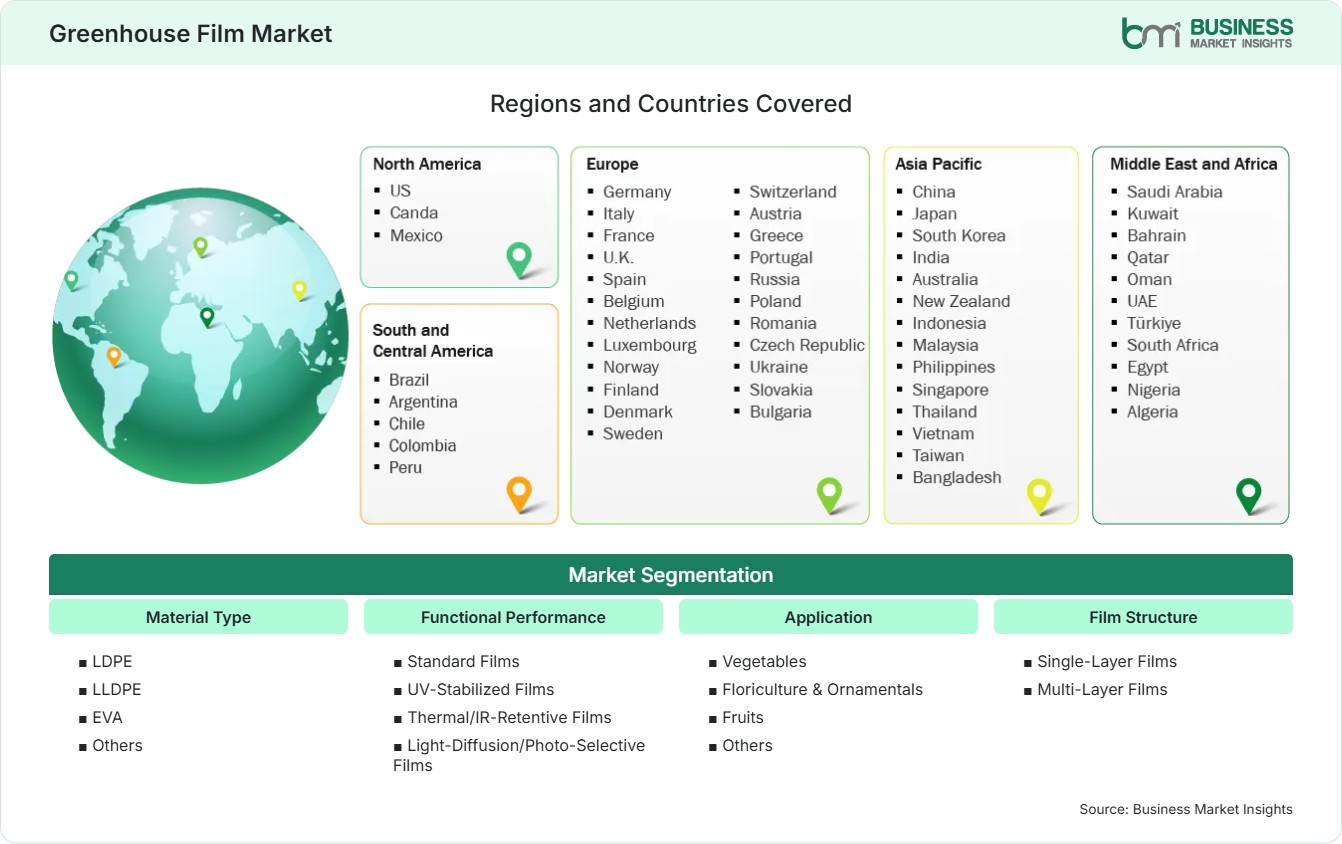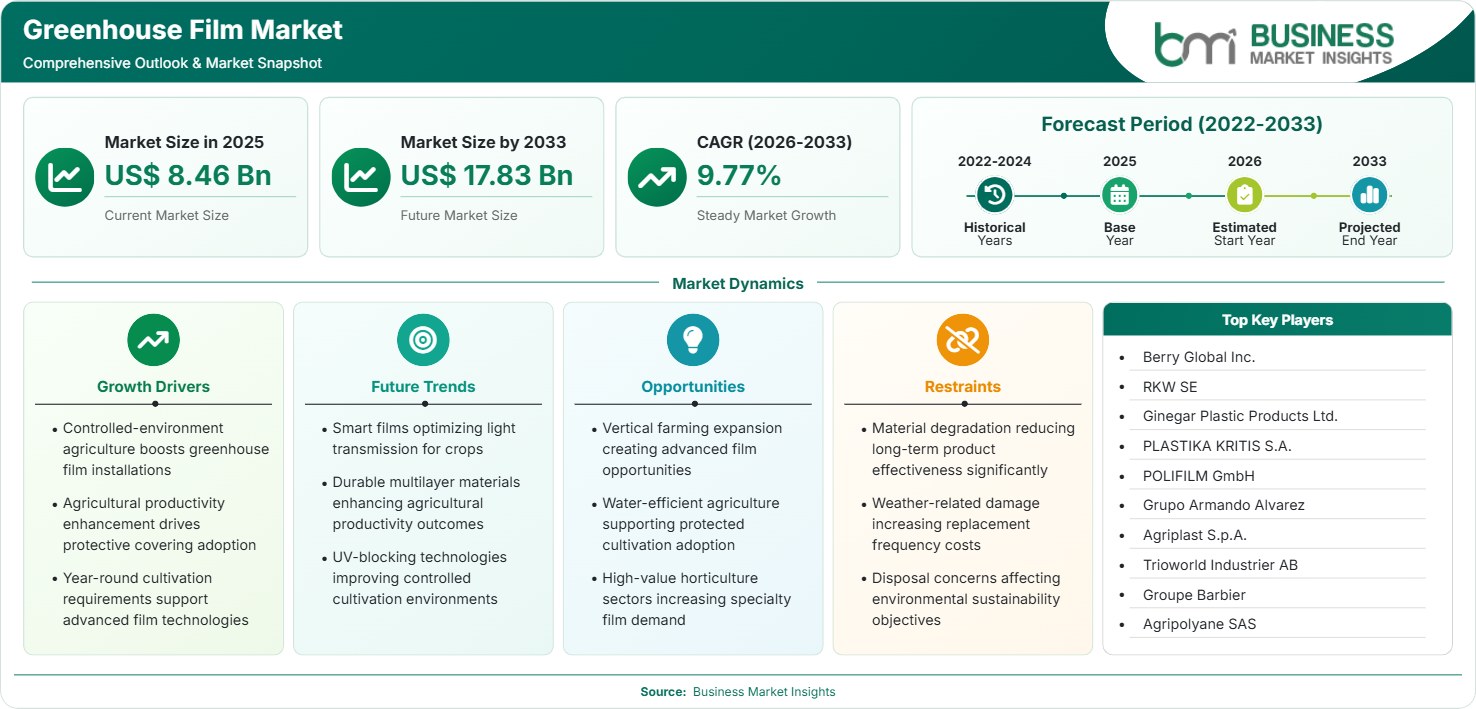
Greenhouse Film Market Regional Highlights
North America Greenhouse Film Market
North America represents a 17%–21% share in 2025 and is projected to expand at a 7.2%–8.0% CAGR through 2033. The region benefits from commercial greenhouse investment, controlled-environment agriculture, berry cultivation, specialty vegetables, and demand for year-round production. The US dominates regional consumption, while Canada contributes through greenhouse vegetables and floriculture. Greenhouse Film Market share is supported by growers seeking durable covers with better light management and thermal performance. Market growth increasingly reflects investment in high-value crops, automation, and controlled environments rather than expansion of conventional open-field farming alone.
- Commercial greenhouse operators increasingly prioritize films that extend service life and maintain optical performance because replacement downtime can disrupt carefully scheduled production cycles.
- Berry, tomato, cucumber, leafy-green, and specialty-crop cultivation supports demand for films capable of balancing sunlight transmission, heat management, moisture control, and crop protection.
- Controlled-environment agriculture investors increasingly evaluate greenhouse covers as part of the energy-management system because optical and thermal properties influence heating and cooling requirements.
- Premium films with anti-drip, UV stabilization, and light-diffusion properties are gaining attention among growers seeking consistent crop quality across changing seasonal conditions.
US Greenhouse Film Market
The US represents a 14%–17% global share and is projected to grow at a 7.3%–8.1% CAGR during 2026–2033. Demand is supported by commercial greenhouse vegetables, berries, floriculture, cannabis cultivation, and controlled-environment agriculture. Producers increasingly require films engineered for crop-specific radiation and temperature conditions. Berry Global's agricultural portfolio includes greenhouse films designed around light transmission, haze, clarity, tear strength, UV stabilization, and specialized crop requirements. The US also provides an important market for high-performance coverings where energy costs and crop value justify higher specification materials.
- Greenhouse operators are increasingly evaluating film performance through crop yield, energy consumption, replacement intervals, and labor requirements rather than material price alone.
- Specialty horticulture creates demand for light-management films that help growers regulate crop development, pigmentation, temperature, and production timing.
- Domestic film manufacturing and distribution capabilities shorten supply chains, allowing growers to access customized dimensions and performance specifications for commercial greenhouse structures.
Europe Greenhouse Film Market
Europe represents a 23%–27% share in 2025 and is projected to grow at a 7.6%–8.4% CAGR through 2033. Spain, Italy, France, the Netherlands, Germany, and Poland remain important greenhouse markets, with Spain and the Netherlands serving as major intensive horticulture centers. Higher-growth opportunities are developing in Eastern Europe, particularly Poland and Romania, as protected cultivation modernizes. Greenhouse Film Market share is influenced by energy efficiency, recyclability, crop quality, and compliance requirements. POLIFILM emphasizes UV stability, recyclable film solutions, and customizable optical and thermal characteristics for greenhouse applications.
- Spain remains a major protected-horticulture center where greenhouse coverings must manage intense solar radiation, temperature variation, humidity, and crop-specific microclimates.
- The Netherlands emphasizes high-technology greenhouse production, creating demand for specialized films that complement climate-control systems, lighting strategies, and precision horticultural management.
- Germany and France provide replacement-driven demand as growers prioritize durable coverings, lower material consumption, recyclability, and predictable performance across commercial greenhouse operations.
- Poland and Romania offer expansion opportunities as protected cultivation and modern horticultural infrastructure develop, supporting demand for efficient films adapted to temperate climates.
Asia Pacific Greenhouse Film Market
Asia Pacific region is expected to hold a 37%-41% market share in 2025 and grow at a CAGR of 10.3%-11.2% through 2033. The demand for greenhouse film products is mainly driven by China, India, Japan, South Korea, Australia, and other Southeast Asian countries. China has both large-scale horticultural production and extensive greenhouse facilities. On the other hand, India is rapidly expanding its protected cultivation activities for various crops, including vegetables, flowers, fruits, and valuable crops. Greenhouse Film Market share is being strengthened by food security requirements and the agricultural sector's development.
- China remains a major consumption center because greenhouse agriculture supports vegetable supply, high-value horticulture, climate adaptation, and productivity improvements across diverse agricultural regions.
- India provides strong growth potential through polyhouse expansion, horticultural modernization, private investment, and government-supported protected cultivation programs.
- Japan and South Korea maintain sophisticated greenhouse systems, supporting demand for films with precise optical, thermal, durability, and crop-management characteristics.
- Southeast Asia offers emerging opportunities as tropical climates encourage the use of films that regulate solar radiation, heat accumulation, humidity, and rainfall exposure.
Rest of World Greenhouse Film Market
South and Central America account for around 8% - 10% of global demand, and the Middle East and Africa combined contribute around 6% - 8%. The Combined Rest of World demand is expected to grow at an 8.0%-9.0% CAGR through 2033. Brazil, Mexico, Chile, Colombia, Türkiye, Saudi Arabia, the UAE, and South Africa are among the key markets in the region. Horticultural exports, climatic challenges, water resource constraints, and the adoption of protected agriculture will determine market share. Manufacturers that provide thermal protection and light-management covers will cater to harsh climatic conditions.
Middle Eastern countries require films that can block excess sunlight while allowing sufficient radiation for photosynthesis. Grupo Armando Alvarez designs greenhouse films based on the climatic region and the crops grown. In Latin America as well, the farmers use protective films to improve crop quality, growing period, and weather resistance. Greenhouse Film Market growth will thus depend on adaptation of formulations to regional climates rather than standard formulations.
- Brazil and Mexico offer opportunities in protected vegetables, berries, ornamentals, and specialty crops where improved microclimate control can increase commercial production reliability.
- Gulf markets prioritize heat management and water efficiency, creating demand for films designed to control near-infrared radiation and excessive solar loading.
- South Africa provides a regional hub for protected horticulture and specialist agriculture, while surrounding markets offer opportunities for imported films supported by technical distribution networks.
- Chile and Colombia benefit from export-oriented horticulture, where film durability, optical properties, and weather protection can influence crop quality and production scheduling.