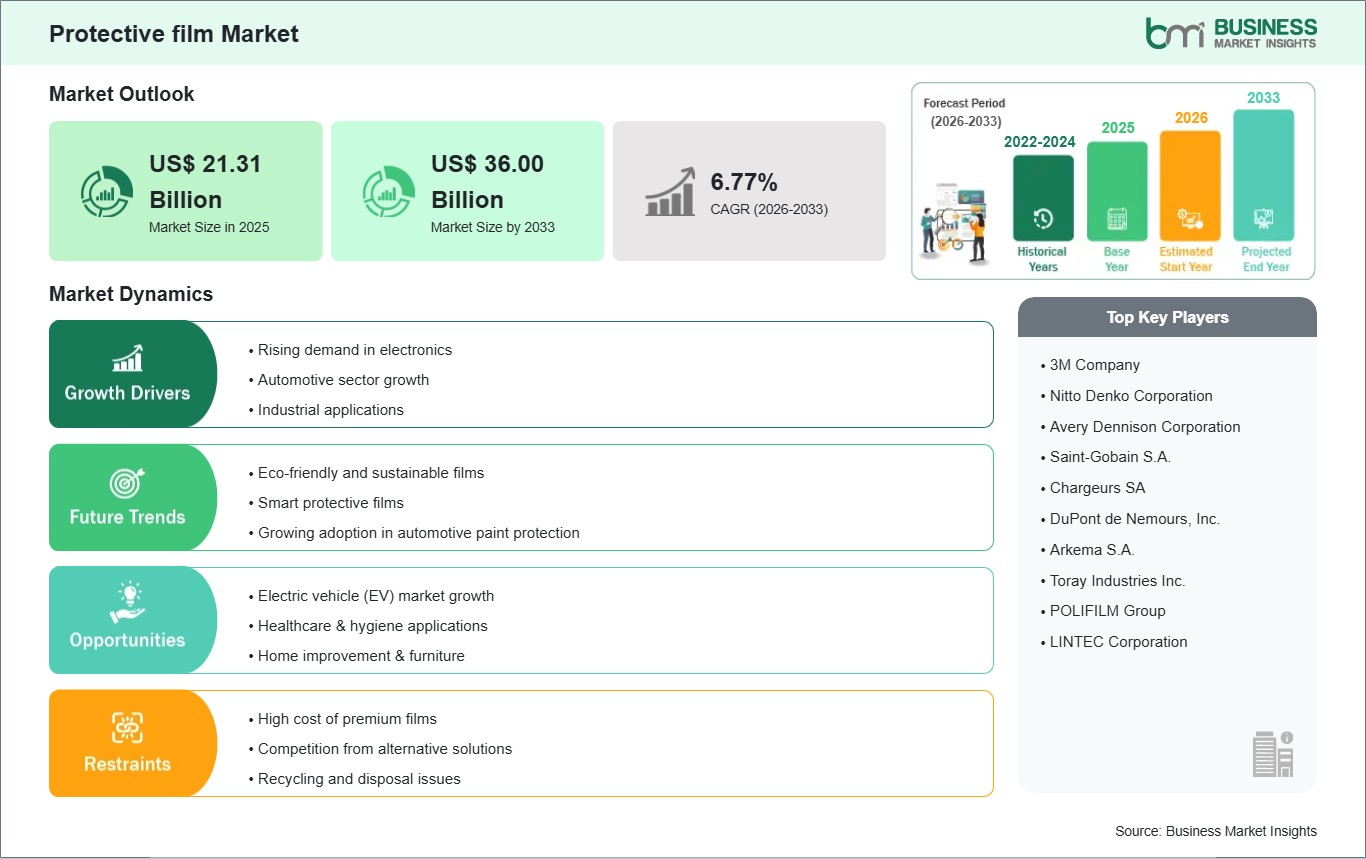
The Protective film Market size is expected to reach US$ 36. billion by 2033 from US$ 21.31 billion in 2025. The market is estimated to record a CAGR of 6.77% from 2026 to 2033.
The global protective film market is evolving rapidly as industries increasingly demand solutions that safeguard surfaces from scratches, dust, UV exposure, and chemical damage during manufacturing, transportation, and end-use applications. Protective films are widely applied across electronics, automotive, construction, packaging, and industrial machinery sectors, reflecting their versatility and critical role in quality preservation. The growth of the electronics industry, particularly smartphones, laptops, and display panels, has significantly increased the adoption of protective films to maintain aesthetic integrity and functional performance.
Similarly, in automotive and aerospace, protective films help preserve painted surfaces and components during assembly, transport, and storage. Rising consumer expectations for high-quality, durable products and the expansion of advanced manufacturing processes are driving market growth. Technological innovations, such as self-healing films, anti-fingerprint coatings, and environmentally friendly biodegradable options, are further enhancing market appeal.
However, the market faces challenges including high production costs for specialized films, difficulties in recycling multilayer protective films, and dependency on raw material availability. Additionally, inconsistent performance in extreme environments may limit certain applications. Despite these constraints, increasing industrial automation, the proliferation of electronics, and the emphasis on product longevity are expected to propel the global protective film market, making it a critical enabler for surface protection and quality assurance worldwide.

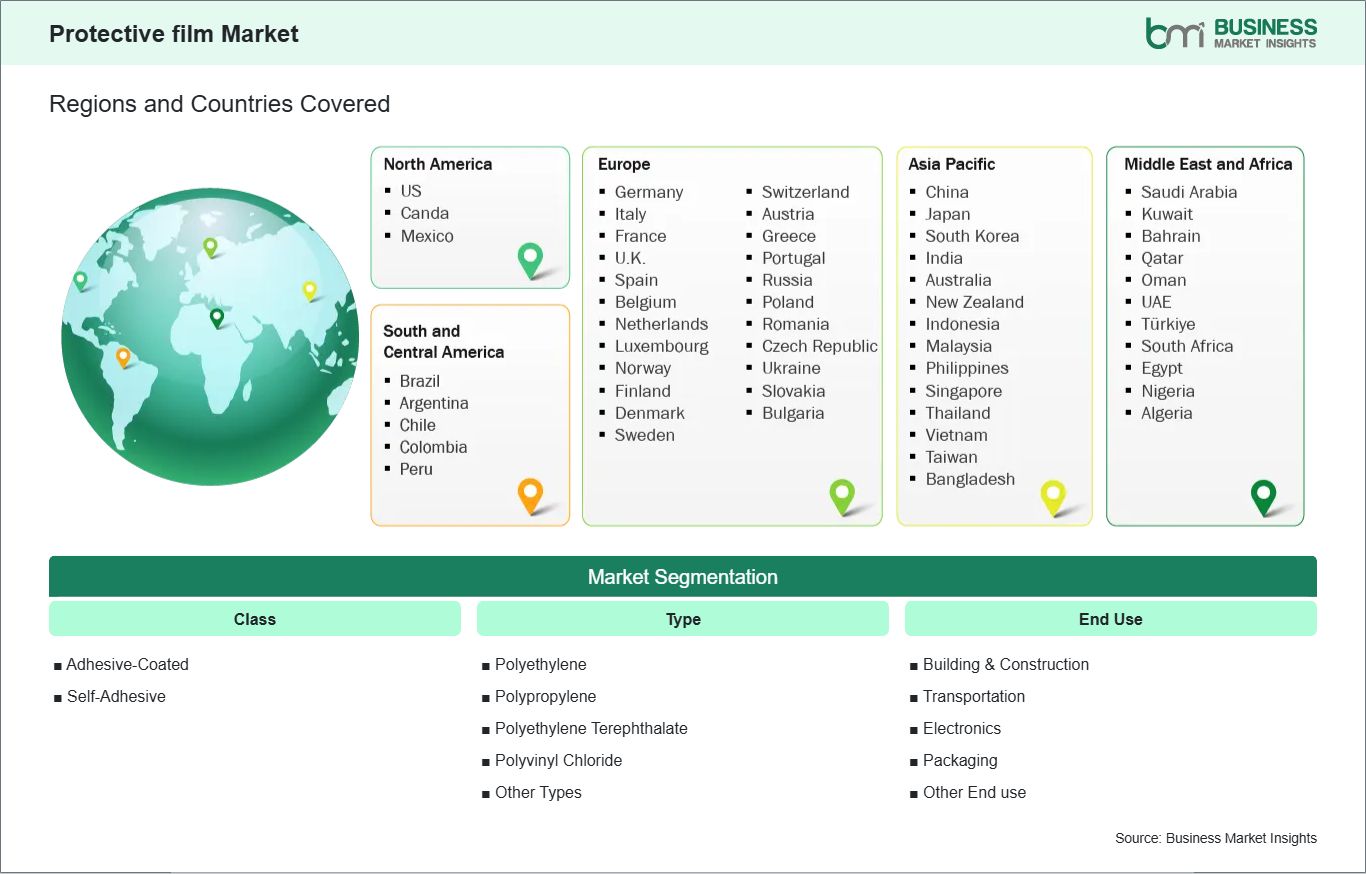
Key segments that contributed to the derivation of the Protective film market analysis are class, type, and end use.
The market for protective films in Western Europe is witnessing substantial growth owing to the rising demand in the consumer electronics and industrial electronics industries. Countries like Germany, France, and the Netherlands are major hubs for the manufacturing of electronic devices such as smartphones, tablets, and industrial displays. These industries are now using high-quality protective films to protect sensitive surfaces of the products during the assembly process. For instance, the assembler clusters in the Bavaria and Baden-Württemberg regions of Germany have incorporated scratch-resistant and anti-smudge films in the assembly process of electronic devices. As a result, they have observed a 12-15% reduction in screen damage cases in the electronic devices using multi-layer protective films.
Outside of consumer electronics, the industrial electronics market is also driving the market forward. In the Eindhoven region of the Netherlands and the industrial areas of Sweden, there is a significant requirement for industrial electronics in the field of automation and robotics. Here, there is a requirement for special films that can withstand abrasion resistance, chemical resistance, and static discharge protection for touchscreens and sensors. The adoption of Industry 4.0 in industrial areas of Western Europe is driving the requirement for protective films with special properties such as anti-glare coatings, EMI shielding, and hydrophobic coatings.
The emergence of flexible electronics and wearable technologies in Western Europe is also creating a market for protective films. Startups and research hubs in Paris and Copenhagen are working on flexible displays for healthcare wearables and smart clothing, where traditional rigid glass solutions are not possible. Manufacturers are increasingly relying on flexible protective films that can withstand repeated flexing without compromising optical quality. As consumers increasingly demand products that offer durability and high-end design, protective films manufacturers that offer high-end materials are creating new opportunities in Western Europe's electronics market.
The strong growth rate of the electric vehicle market in Western Europe is a major contributor to the growth of protective films in various applications in the automotive sector. Norway, Germany, and the Netherlands are some of the countries that have some of the highest rates of electric vehicle adoption in the world. These countries are witnessing a strong growth rate of protective films in their automotive sector. In these countries, many automotive companies are using protective films in their products to protect their products from damage. In addition, many Tier 1 suppliers near Stuttgart and Munich are specifying ceramic and nano-coated protective films for exterior EV panel parts to protect their products from UV degradation, stone chip damage, and road debris abrasion.
In the EV supply chain, the scope of integrated interior surfaces with protective films is also increasing. As EVs are already equipped with larger screens and interfaces, manufacturers in the UK and France are increasingly applying anti-fingerprint and anti-scratch films to the center consoles, instrument panels, and even the sunroofs of the vehicles to enhance the overall user experience. Protective films applied to metallic parts and battery pack casings by EV battery pack manufacturers in Spain and Italy also prevent corrosion during the assembly and transportation of the battery packs before the vehicles are even ready for the dealerships.
Furthermore, the development of infrastructure related to electric vehicles, such as charging stations and roadside information displays, is also contributing to the growth of demand for protective films beyond the electric vehicles manufacturing industry. Protective film manufacturers who provide anti-graffiti, anti-UV, and impact-resistant films for the protection of public electric vehicle charging stations are seeing increasing demand as Western European countries invest in the expansion of the fast-charging infrastructure for electric vehicles. In areas such as Catalonia and Île-de-France, local authorities are specifying robust protective films used in outdoor displays that are capable of withstanding the elements and vandalism. This further enhances the position of protective films in the wider electric vehicles ecosystem, not just in the electric vehicles manufacturing industry itself.

The global Protective film market is experiencing steady growth, with market size and share analysis reflecting evolving treatment preferences and competitive dynamics among key players. The report evaluates important subsegments categorized within class, type, and end use highlighting their respective contributions to overall market performance.
By class, the self-adhesive subsegment dominated the market in 2025 they are easy to apply and remove without leaving residue, making them highly suitable for diverse industries like electronics, automotive, and packaging.
By type, the polyethylene segment subsegment dominated the market in 2025 because it is lightweight, flexible, cost-effective, and provides adequate protection against scratches, dust, and moisture. PE films are widely used across packaging, electronics, and construction sectors.
By end use, the electronics subsegment dominated the market in 2025 due to growing demand for smartphones, tablets, wearable devices, and other consumer electronics. Protective films are critical for preventing scratches and damage during manufacturing, shipping, and end-user handling, driving higher demand in this sector compared to others like construction or transportation.
| Report Attribute | Details |
|---|---|
| Market size in 2025 | US$ 21.31 Billion |
| Market Size by 2033 | US$ 36.00 Billion |
| Global CAGR (2026 - 2033) | 6.77% |
| Historical Data | 2022-2024 |
| Forecast period | 2026-2033 |
| Segments Covered | By Class
|
|
Regions and Countries Covered
| |
| North America | US, Canada, Mexico |
| Europe | Belgium, Austria, Finland, Denmark, Greece, Poland, Romania, Russia, Ukraine, Czech Republic, Slovakia, Bulgaria, Italy, Luxembourg, Germany, Switzerland, France, Netherlands, Norway, Portugal, Spain, Sweden, United Kingdom |
| Asia-Pacific | Australia, China, India, Japan, South Korea, Indonesia, Malaysia, Philippines, Singapore, Thailand, Vietnam, Bangladesh, New Zealand, Taiwan |
| South and Central America | Brazil, Argentina, Peru, Chile, Colombia |
| Middle East and Africa | Bahrain, Kuwait, Oman, Qatar, Saudi Arabia, United Arab Emirates, Turkiye, South Africa, Egypt, Algeria, Nigeria |
| Market leaders and key company profiles |
|
The "Protective Film Market Size and Forecast (2022 - 2033)" report provides a detailed analysis of the market covering below areas:
The geographical scope of the Protective film market report is divided into: North America, Asia Pacific, Europe, Middle East & Africa, and South & Central America. North America held the largest share in 2025.
North America dominates the global protective film market due to its mature industrial ecosystem, high manufacturing standards, and early adoption of innovative materials. The United States is the primary driver, with significant demand originating from the electronics, automotive, and construction sectors. Electronics manufacturers in North America increasingly rely on protective films for screens, touch panels, and delicate components to reduce damage during assembly and shipment. In the automotive industry, protective films are widely applied to painted surfaces, metal components, and interior parts to prevent scratches, corrosion, and UV degradation during production and transport.
North America’s market strength is also supported by technological innovation, with manufacturers developing high-performance films such as self-healing coatings, anti-static layers, and films capable of withstanding extreme temperatures. Strong R&D infrastructure, regulatory compliance, and quality standards encourage early adoption, while collaborations between material suppliers and industrial users drive continuous product improvement. Challenges in the region include the high cost of advanced films, recycling concerns, and periodic raw material shortages. Despite these issues, North America maintains leadership through innovation, industry expertise, and strategic partnerships, setting benchmarks for protective film quality, performance, and adoption that influence other global markets.

The protective film market is evaluated by gathering qualitative and quantitative data post primary and secondary research, which includes important corporate publications, association data, and databases. A few of the key developments in the Protective film market are:
The Protective film Market is valued at US$ 21.31 Billion in 2025, it is projected to reach US$ 36.00 Billion by 2033.
As per our report Protective film Market, the market size is valued at US$ 21.31 Billion in 2025, projecting it to reach US$ 36.00 Billion by 2033. This translates to a CAGR of approximately 6.77% during the forecast period.
The Protective film Market report typically cover these key segments-
The historic period, base year, and forecast period can vary slightly depending on the specific market research report. However, for the Protective film Market report:
The Protective film Market is populated by several key players, each contributing to its growth and innovation. Some of the major players include:
The Protective film Market report is valuable for diverse stakeholders, including:
Essentially, anyone involved in or considering involvement in the Protective film Market value chain can benefit from the information contained in a comprehensive market report.
Please tell us your area of interest
(Market Segments/ Regions and Countries/ Companies)