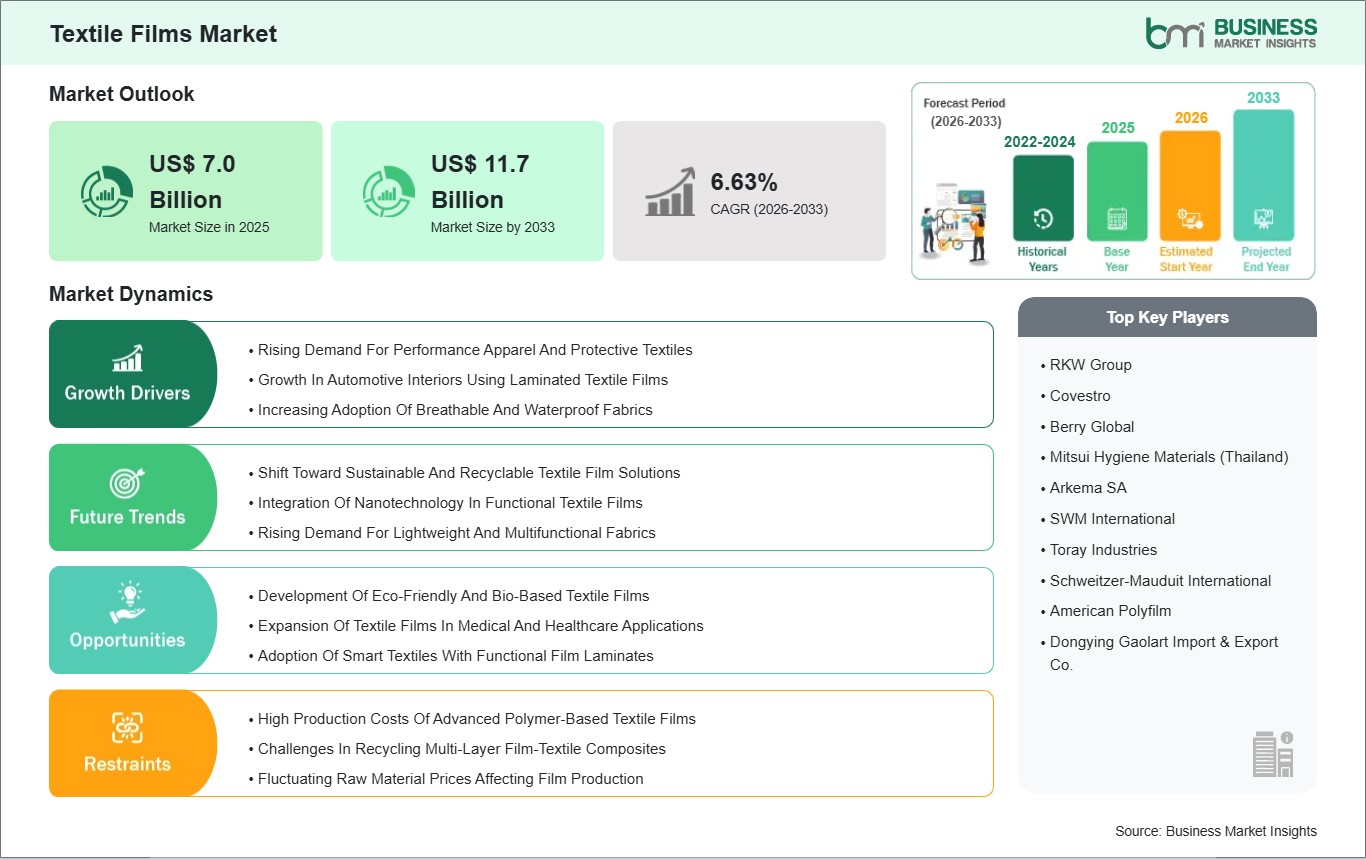
The Textile Films Market size is expected to reach US$ 11.7 billion by 2033 from US$ 7. billion in 2025. The market is estimated to record a CAGR of 6.63% from 2026 to 2033.
The global textile films market includes a wide selection of engineered polymer films that manufacturers create through the processes of lamination, coating and bonding to textile materials for improved performance in durability, breathability, water resistance and visual design. Textile films are used extensively across end‑use industries, including apparel, protective wear, automotive interiors, upholstery, healthcare products and industrial fabrics, which require functional materials that meet operational needs. The material possesses distinctive properties that enable it to provide users with the flexible and comfortable aspects of textiles together with the protective functions of films, thus making it a vital component for use in both consumer products and technical uses.
North America leads the market because of its advanced manufacturing capabilities, its early adoption of high-performance materials and its substantial apparel and technical textiles manufacturing base. The region has shown an increasing need for performance-enhanced fabrics, which activewear, outdoor gear and protective clothing use because textile films improve moisture management and thermal insulation and protection against environmental elements. The regional demand for laminated textile films in automotive interiors and acoustic applications has created a strong market base.
The global market is driven by several key factors, which include rising consumer demand for functional textiles and high-performing textiles together with scientific advances in polymer materials that create films with improved ability to transmit air and stretch, and the increasing demand for environmentally sustainable textiles, which can be recycled throughout their production process. The market faces multiple obstacles, which include changing raw material prices and difficulties involved in recycling multilayer film - textile composites and government regulations that monitor specific polymer materials because of their environmental effects.
The market can grow throughout the world because of two main factors, which include the development of bio-based recyclable film technologies and the growing use of these technologies for protective textiles and smart wearable systems. The textile industry needs advanced textile film solutions that will develop according to new material technologies and market requirements, because sustainability and performance drive its production processes.

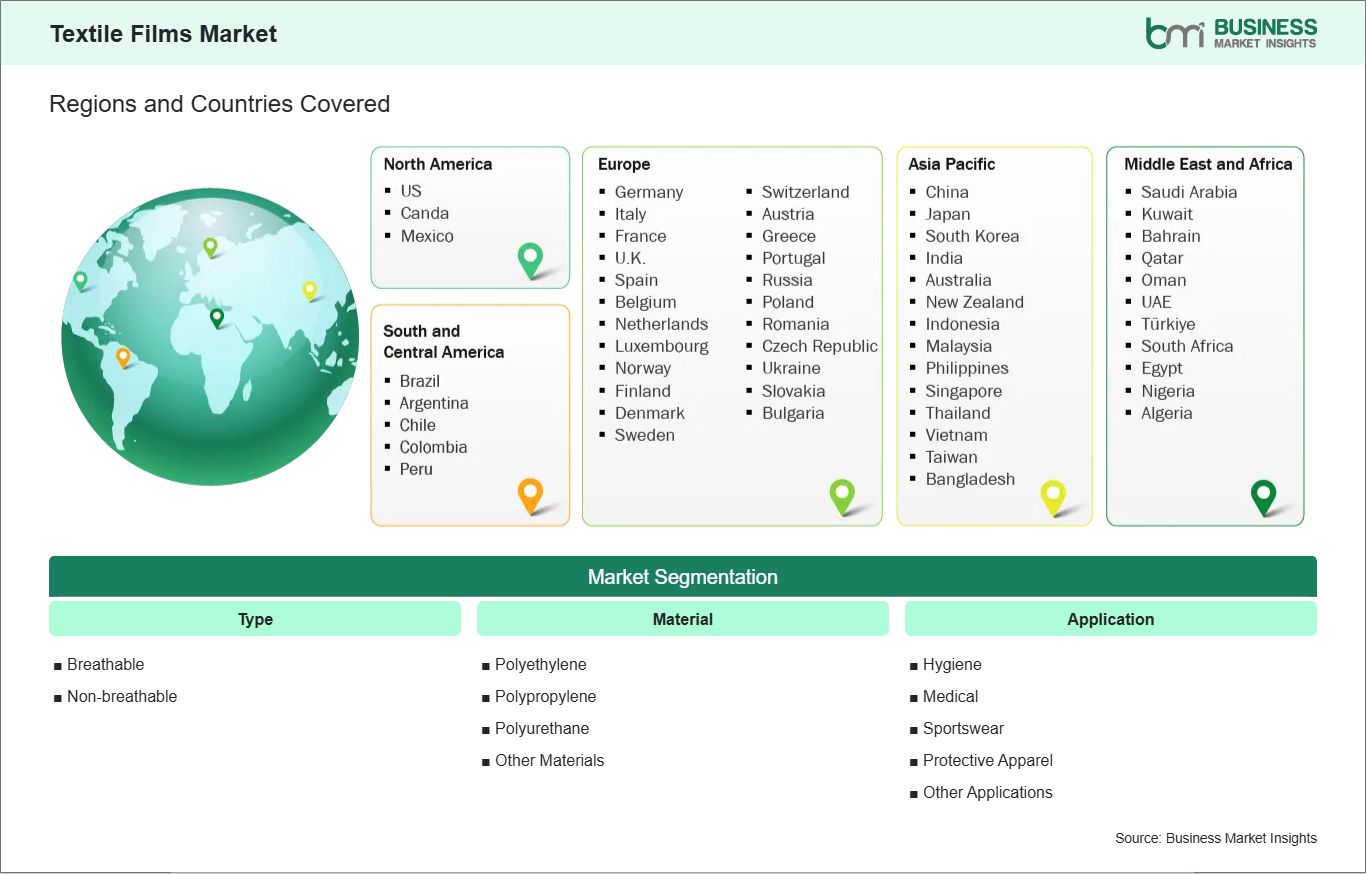
Key segments that contributed to the derivation of the textile films market analysis are type, material and application.
The global rise in active lifestyles and outdoor recreation has accelerated demand for performance apparel that combines comfort, durability, and advanced functionality. Textile films play a crucial role in enhancing garments by providing breathable, waterproof, and stretchable properties while maintaining lightweight flexibility. Markets across North America and Europe are particularly receptive, with consumers seeking technical apparel for sports, hiking, and professional uniforms that require moisture management and thermal regulation.
Protective textiles represent another major application driving market growth. Industries such as healthcare, manufacturing, and firefighting increasingly rely on textiles laminated with films to create barriers against chemicals, flames, and biological hazards. Textile films add critical protective layers without compromising mobility, making them indispensable in high-risk work environments. Emerging regions in Asia Pacific, where industrial and healthcare sectors are expanding rapidly, are also witnessing higher adoption rates for performance and protective garments.
In addition to functional benefits, end users increasingly prioritize aesthetics and versatility, prompting textile film manufacturers to innovate designs that merge performance with style. The integration of antimicrobial coatings, UV protection, and abrasion-resistant finishes into film-textile composites further enhances value propositions. As global awareness of occupational safety, athletic performance, and outdoor lifestyle continues to rise, the demand for textile films in both performance apparel and protective textiles is projected to remain strong across diverse geographies.
The global textile films market is being affected by sustainability concerns because manufacturers and consumers are searching for environmentally friendly substitutes to conventional polymer-based films. The industry is now adopting bio-based films, which use renewable materials together with recyclable multilayer composites, because these two options create less environmental damage. The strict environmental regulations in Europe and North America, together with rising consumer demand for sustainable apparel and industrial fabrics, have made these regions the main adopters of such solutions.
Textile manufacturers can now create performance and protective textiles through the new developments in biodegradable and compostable films without losing their essential functional features. Polylactic acid (PLA) and modified cellulose films are now being used in sportswear, medical garments and automotive interiors because they provide water resistance, breathability and durability while minimizing their environmental impact. Asia Pacific is starting to use bio-based films because its textile manufacturing industry needs to comply with international export standards and regulatory standards.
Companies are also funding research projects that aim to improve product recyclability while decreasing energy requirements throughout the manufacturing process. The industry establishes partnerships while the government provides financial incentives to help businesses implement sustainable practices, which include closed-loop recycling systems for textile-film composite materials. Eco-friendly and bio-based textile films have become essential differentiators for the global textile industry to implement circular economy practices, which drive innovation and product adoption across all segments of apparel, industrial and protective textile markets.
The textile films market demonstrates steady growth, with size and share analysis highlighting evolving trends and competitive dynamics among key players. The report examines subsegments categorized within type, material and application, offering insights into their contribution to overall market performance.
By type, the breathable subsegment dominated the market in 2025, driven by its combination of comfort, liquid barrier, and air permeability, making it ideal for medical and hygiene applications.
Based on material, the polyethylene (PE) subsegment dominated the market in 2025, driven by its wide availability, cost-effectiveness, and versatility across multiple end-use applications.
In terms of application, the hygiene subsegment dominated the market in 2025, driven by the growing global demand for baby diapers, sanitary products, and other high-quality hygiene solutions.
| Report Attribute | Details |
|---|---|
| Market size in 2025 | US$ 7.0 Billion |
| Market Size by 2033 | US$ 11.7 Billion |
| Global CAGR (2026 - 2033) | 6.63% |
| Historical Data | 2022-2024 |
| Forecast period | 2026-2033 |
| Segments Covered | By Type
|
|
Regions and Countries Covered
| |
| North America | US, Canada, Mexico |
| Europe | Belgium, Austria, Finland, Denmark, Greece, Poland, Romania, Russia, Ukraine, Czech Republic, Slovakia, Bulgaria, Italy, Luxembourg, Germany, Switzerland, France, Netherlands, Norway, Portugal, Spain, Sweden, United Kingdom |
| Asia-Pacific | Australia, China, India, Japan, South Korea, Indonesia, Malaysia, Philippines, Singapore, Thailand, Vietnam, Bangladesh, New Zealand, Taiwan |
| South and Central America | Brazil, Argentina, Peru, Chile, Colombia |
| Middle East and Africa | Bahrain, Kuwait, Oman, Qatar, Saudi Arabia, United Arab Emirates, Turkiye, South Africa, Egypt, Algeria, Nigeria |
| Market leaders and key company profiles |
|
The "Textile Films Market Size and Forecast (2022 - 2033)" report provides a detailed analysis of the market covering below areas:
The geographical scope of the Textile Films Market report is divided into North America, Asia Pacific, Europe, Middle East & Africa, and South & Central America. North America held the largest share in 2025.
North America leads the global textile films market because it has advanced manufacturing facilities, technical textiles, apparel industries, and it has started using high-performance materials.
The United States and Canada show high demand for breathable, waterproof and abrasion-resistant films which serve performance apparel, outdoor gear, protective clothing and automotive interiors. The region achieves product development through its advances in polymer science and laminating technologies, which produce comfortable yet durable and functional items.
Europe represents an established market that prioritizes sustainable practices and environmentally friendly materials. The UK, Germany, France and other European countries focus on developing recyclable and bio-based film solutions for their industrial fabrics and apparel needs, while strict environmental regulations and consumer green product preferences help them implement these solutions.
Asia Pacific develops into a high-growth area because its cities grow rapidly and people gain more money, while China, India, Japan and South Korea build more textile and garment production facilities. The sportswear, medical fabric and protective clothing markets show increasing demand for performance textiles which utilize advanced lightweight, breathable and multifunctional film technologies.
The Middle East & Africa market experiences growth because the construction, automotive, and hospitality sectors drive development, yet advanced textile films face adoption challenges because their manufacturing and distribution systems are divided into multiple parts. Brazil, Mexico and Argentina lead the gradual expansion of South & Central America, which shows increasing use of textile films in sportswear, upholstery and industrial fabrics. All regions of the market exhibit three main trends, which include
sustainability, performance enhancement and regulatory compliance. The North American region establishes the standard for innovation and professional adoption, but other areas now invest in sustainable textile films, which provide high performance to meet the needs of local consumers and industrial operations and global supply chains.

The Textile Films Market is evaluated by gathering qualitative and quantitative data post primary and secondary research, which includes important corporate publications, association data, and databases. A few of the key developments in the textile films market are:
The Textile Films Market is valued at US$ 7.0 Billion in 2025, it is projected to reach US$ 11.7 Billion by 2033.
As per our report Textile Films Market, the market size is valued at US$ 7.0 Billion in 2025, projecting it to reach US$ 11.7 Billion by 2033. This translates to a CAGR of approximately 6.63% during the forecast period.
The Textile Films Market report typically cover these key segments-
The historic period, base year, and forecast period can vary slightly depending on the specific market research report. However, for the Textile Films Market report:
The Textile Films Market is populated by several key players, each contributing to its growth and innovation. Some of the major players include:
The Textile Films Market report is valuable for diverse stakeholders, including:
Essentially, anyone involved in or considering involvement in the Textile Films Market value chain can benefit from the information contained in a comprehensive market report.
Please tell us your area of interest
(Market Segments/ Regions and Countries/ Companies)