
GPS Market Outlook: Size, Share, Trends, Growth Analysis, Competitive Landscape & Forecast, 2026-2033

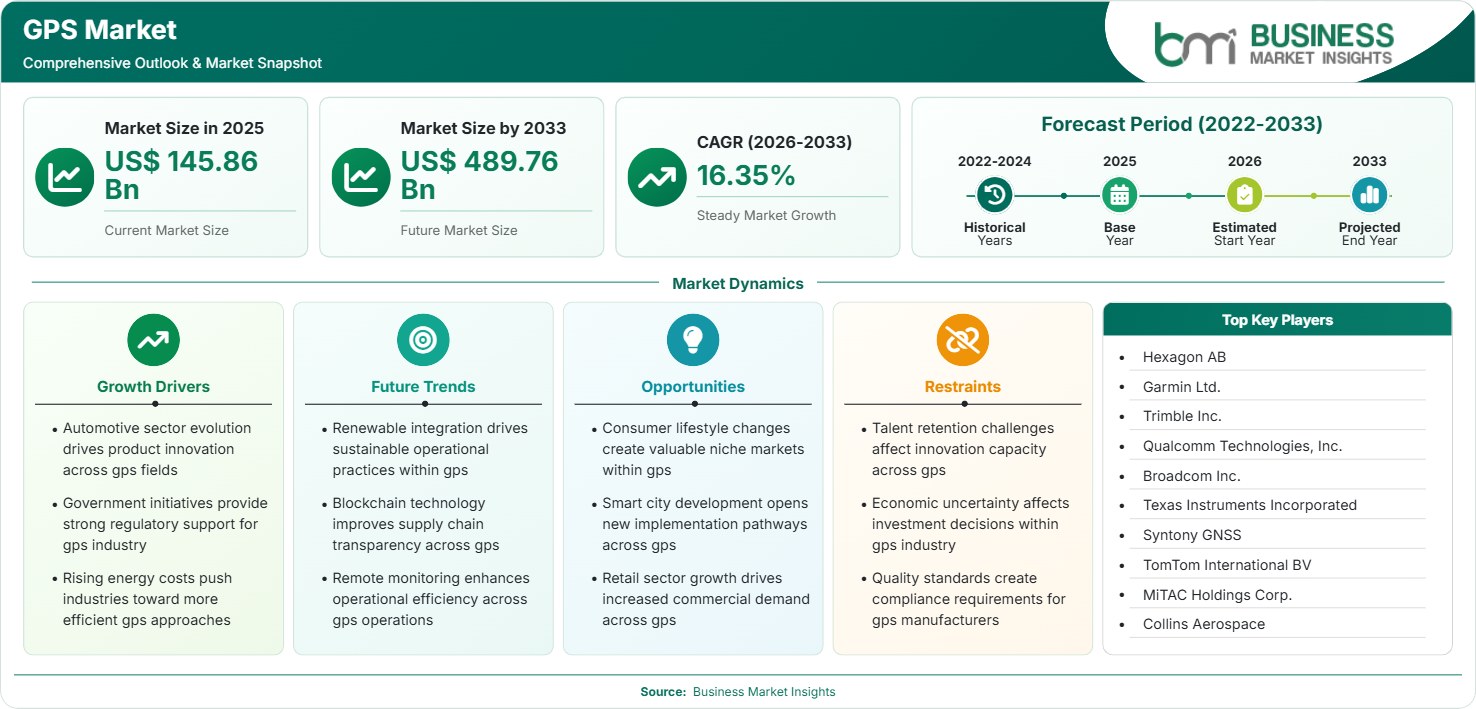
The GPS Market size was valued at US$ 145.86 Billion in 2025 and is projected to reach US$ 489.76 Billion by 2033, growing at a CAGR of 16.35% during 2026–2033. Growth is supported by connected mobility, precision positioning, location services, autonomous systems, wearable adoption, and resilient navigation demand.

Report Coverage
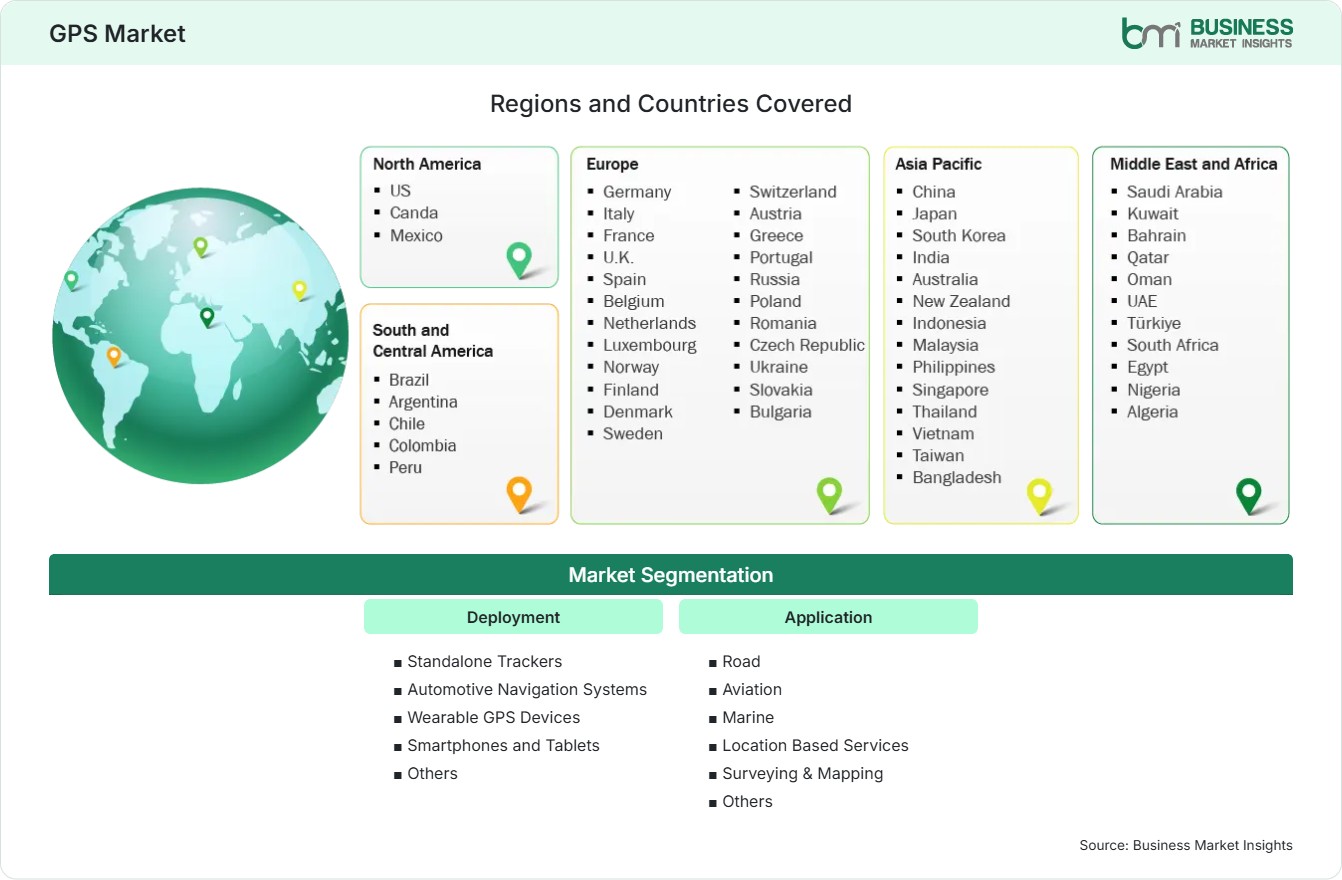
  • Deployment: Standalone Trackers, Automotive Navigation Systems, Wearable GPS Devices, Smartphones and Tablets, Others
  • Application: Road, Aviation, Marine, Location Based Services, Surveying & Mapping, Others
US$ 145.86 Bn Market size in 2025
US$ 489.76 Bn Market Size by 2033
16.35% CAGR, 2026 - 2033
2026-2033 Forecast Period

AI Overview

GPS Market Summary

  • North America Region: North America holds a GPS market share of 28%–31% in 2025, growing at a CAGR of 14.5%–15.5% during 2026–2033, supported by connected vehicles, precision agriculture, fleet telematics, autonomous mobility, location services, defense modernization, and high smartphone penetration. The US market is projected to expand at a 14.8%–15.8% CAGR, supported by automotive connectivity, geospatial modernization, wearable adoption, and high-value positioning applications.
  • Fastest Growing Region: Asia Pacific accounts for a 31%–34% share in 2025 and is advancing at a 18.0%–19.0% CAGR during 2026–2033, driven by smartphone penetration, vehicle tracking, industrial automation, regional navigation systems, smart-city investment, logistics digitization, and expanding location-based services across emerging economies.
  • Leading Segment: Smartphones and Tablets represent a 38%–42% share in 2025, expanding at a 16.0%–17.0% CAGR during 2026–2033, supported by integrated GNSS chipsets, navigation applications, location-based services, emergency positioning, digital payments, ride-hailing, delivery platforms, and increasingly accurate multi-constellation positioning capabilities.
  • High Growth Segment: Wearable GPS Devices hold an estimated 11%–14% share in 2025 and are growing at a 20.0%–21.5% CAGR during 2026–2033, supported by outdoor recreation, fitness monitoring, child safety, elderly tracking, connected health ecosystems, satellite messaging, and increasingly compact low-power positioning hardware.
  • Key Market Opportunity: Opportunity is expanding through multi-constellation positioning, AI-assisted navigation, sensor fusion, resilient positioning, autonomous mobility, precision logistics, smart infrastructure, and location intelligence, particularly where conventional satellite signals face obstruction.
  • Major Market Players: Hexagon AB, Garmin Ltd., Trimble Inc., Qualcomm Technologies, Inc., Broadcom Inc., Texas Instruments Incorporated, Syntony GNSS, TomTom International BV, MiTAC Holdings Corp., and Collins Aerospace.
Strategic Insights

GPS Market: Strategic Insights

GPS Market Strategic Framework
FREE PDF
Request your free sample
Request free sample
Stakeholder View

Key Takeaways

  • The focus on value creation is shifting from receiver hardware to positioning platforms that consist of chipsets, antennas, corrections, mapping, software, cloud analytics, and data for specific applications.
  • Smartphones and tablets represent the most extensive deployment base, whereas wearable devices, connected cars, autonomous systems, precision logistics, and professional surveying represent opportunities for value-added growth.
  • Differentiation based on multiband GNSS, multi-constellation support, artificial intelligence positioning, inertial sensor integration, visual positioning, corrections services, and anti-jamming are becoming increasingly relevant.
  • The Asia-Pacific GPS market presents an attractive investment case as the use of smartphones, vehicle tracking, logistics, automation, and navigation infrastructures develop concurrently.
  • The technology around positioning is undergoing strategic consolidation. In 2025, Hexagon completed its purchase of Septentrio to enhance resilient positioning and mission-critical navigation solutions.
  • GNSS interference is increasing the commercial value of resilient positioning. IATA reported that GPS spoofing incidents rose 193% in 2025 compared with 2023, increasing demand for redundancy and interference mitigation.
Geographic Outlook

GPS Market Regional Highlights

North America GPS Market

North America held a 28%–31% share in 2025 and is projected to expand at a 14.5%–15.5% CAGR during 2026–2033. The United States remains the dominant contributor, while Canada supports demand through geospatial modernization and infrastructure applications. GPS Market share remains supported by established technology suppliers, correction-service networks, and strong enterprise spending on high-accuracy positioning.

  • Lane level navigation becomes one of the trends in automotive positioning due to the implementation of GNSS along with other technologies by connected and electric vehicles.
  • The need for high precision positioning at the centimeter level is driven by applications like precision agriculture, construction, surveying, and infrastructure monitoring and is provided through professional receivers, correction systems, cloud, and automation.
  • Resilient navigation becomes a priority for aerospace applications due to the threat of GNSS interference and has been stated in recommendations of IATA and EASA.
  • The regional ecosystem is strengthened by semiconductor, mapping, receiver, automotive, and correction-service vendors involved in value chains.

US GPS Market

The US represented approximately 72%–76% of North America's GPS Market share in 2025, with a projected 14.8%–15.8% CAGR during 2026–2033. Demand is supported by automotive electronics, defense, aviation, geospatial services, smartphones, wearables, logistics, and precision agriculture. Federal investment in geodetic modernization also supports professional positioning demand. Trimble is aligning its software and positioning workflows with modernization of the US National Spatial Reference System, with official adoption anticipated toward the end of 2026.

  • Automotive implementation is progressing on the basis of precise positioning, dead reckoning, connected cars, and software-based architectures, which need constant positioning capabilities in difficult urban situations.
  • The importance of professional positioning systems cannot be underestimated in such areas as construction, surveying, agriculture, infrastructure and transport, when correction services and high precision receivers enable automation and efficiency in operations.
  • Demand for navigation systems in wearable equipment and outdoor applications keeps growing due to the integration of mapping, positioning, emergency communication, fitness, and battery-saving positioning technologies.

Europe GPS Market

Europe accounted for a 24%–27% GPS market share in 2025 and is expected to expand at a 15.0%–16.0% CAGR during 2026–2033. Germany, the UK, France, Italy, and the Nordic countries remain important demand centers, while Germany is estimated to lead regional adoption and France represents a strong high-growth market at approximately 16.0%–17.0% CAGR. Galileo interoperability, automotive technology, aviation resilience, logistics, and geospatial modernization support regional demand.

  • European automotive firms have a greater need for accurate positioning for electric cars, navigation systems, driver assistance programs, charging-route planning, and vehicle software architecture.
  • The strengths of Germany lie in automotive manufacturing, industrial automation, mapmaking, logistics, and engineering. As a result, there is a widespread need for positioning technologies.
  • Advantages of France include aerospace, automotive engineering, geomatics, and specific GNSS technology. European regulation on navigation resilience will enhance the development of positioning architecture.

Asia Pacific GPS Market

Asia Pacific represented a 31%–34% share in 2025 and is projected to record the fastest regional expansion at a 18.0%–19.0% CAGR during 2026–2033. China, Japan, South Korea, India, and Southeast Asian economies support demand through smartphones, automotive production, logistics, industrial automation, and location services. GPS Market forecast estimates that the India is estimated to achieve approximately 19.0%–20.0% CAGR, supported by NavIC adoption, transportation tracking, surveying, and smart infrastructure.

  • High smartphone and tablet saturation levels provide extensive embedded positioning, while local application ecosystems turn location information into navigation, delivery, mobility, commerce, and security services.
  • India is working to increase the use of domestically made satellite navigation through NavIC, which covers the whole of India and up to 1,500 kilometers from the borders of India.
  • China, Japan, and South Korea are utilizing advanced electronics production along with car makers, robot makers, map makers, logistics providers, and consumer device companies to develop high-volume positioning technology.
  • Southeast Asia offers another set of possibilities, including fleet management, ride-sharing, maritime logistics, tourism, smartphones, and location-based services.

Rest of World GPS Market

Rest of World accounted for a 13%–16% share in 2025 and is expected to grow at a 16.0%–17.0% CAGR during 2026–2033. South and Central America are supported by logistics, agriculture, mining, fleet tracking, and consumer navigation. Middle East and Africa demand is influenced by aviation, maritime transport, defense, construction, and smart-city initiatives, with selected Gulf economies showing stronger positioning investments.

  • Brazil and Mexico continue to be key players in the Latin American GPS market due to fleet management, agricultural machines, logistics optimization, surveying, and location services using mobile devices across large geographic areas.
  • Investments by Gulf nations in intelligent transportation, logistics, digital maps, smart infrastructure, and autonomous vehicles present opportunities for positioning platforms integrated into smart transport networks.
  • The maritime and aviation industry applications offer a structural demand for positioning technology in coastal countries that require navigation, fleet tracking, and logistics optimization.
  • South Africa and other advanced economies of Africa are good entry points for precision agriculture, mining, surveying, communications, and fleet tracking markets; however, the growth is limited by cost factors.
Global Market Geography
FREE PDF
Request your free sample
Request free sample
Segment Analysis

GPS Market Segmentation

Deployment

Deployment represented the broadest structural category in 2025, with Smartphones and Tablets holding a 38%–42% share and expanding at a 16.0%–17.0% CAGR during 2026–2033. Adoption is driven by embedded GNSS, digital mobility, navigation applications, location services, emergency positioning, and connected-device ecosystems. GPS Market trends increasingly favor software-integrated positioning, multi-constellation reception, and sensor fusion across consumer and commercial deployments.

  • Standalone Trackers: Standalone trackers support fleet management, asset monitoring, personal safety, logistics, and recovery applications, with cellular connectivity increasingly combined with GNSS for continuous remote visibility.
  • Automotive Navigation Systems: Automotive navigation integrates satellite positioning with digital maps, traffic data, inertial sensors, connectivity, and driver-assistance functions, creating demand for higher accuracy and resilient positioning.
  • Wearable GPS Devices: Wearables are expanding through fitness, outdoor recreation, child safety, elderly monitoring, sports analytics, and satellite communication, with low-power chipsets improving operating endurance and compact device design.
  • Smartphones and Tablets: Smartphones and tablets provide the largest embedded positioning ecosystem, enabling navigation, ride-hailing, delivery, location-based commerce, emergency services, augmented experiences, and personalized mobility applications.

Application

Road applications represent the leading application base, supported by navigation, telematics, fleet management, connected vehicles, logistics, and driver-assistance functions. The segment benefits from growing software-defined vehicle adoption and greater reliance on precise location data. GPS Market scope is expanding as road positioning evolves from turn-by-turn guidance toward lane-level navigation, predictive mobility, automated routing, vehicle safety, and infrastructure interaction across connected transportation ecosystems.

  • Road: Road applications use positioning for navigation, fleet management, electronic tolling, route optimization, emergency response, vehicle tracking, connected mobility, and increasingly precise advanced driver-assistance functions.
  • Aviation: Aviation uses satellite positioning for navigation, surveillance, flight operations, and route efficiency, while increasing interference risks are driving investment in redundancy, monitoring, alternative positioning, and mitigation technologies.
  • Marine: Marine applications support vessel navigation, fleet monitoring, port operations, offshore activities, fishing, route optimization, and safety, with GNSS integrated into broader electronic navigation and communication systems.
  • Location Based Services: Location-based services use positioning to support mobility, advertising, delivery, mapping, social applications, emergency assistance, tourism, and context-aware digital experiences across connected consumer devices.
  • Surveying & Mapping: Surveying and mapping require highly accurate positioning for land administration, infrastructure development, construction, geodesy, agriculture, mining, and geographic information systems, supporting premium correction-enabled equipment.
Market Forces

GPS Market Dynamics

Key Market Drivers

Connected Vehicles Are Increasing Demand for Precise Positioning

Connected vehicles need accurate location data for navigation, telematics, emergency, traffic management, driver assistance, and, increasingly, for automated driving. Qualcomm Technologies, Inc. is working on solutions that provide positioning solutions for automotive architecture based on multi-frequency/multi-constellation GNSS with dead reckoning and precise positioning. Trimble illustrated the business direction in January 2026 when their RTX and ProPoint Go technologies were incorporated into the Lucid Gravity to provide centimeter-level positioning in challenging environments through integration of satellite and inertial sensors. Such innovations will aid market growth by adding value to positioning applications, moving from simple navigation to safety critical in-vehicle systems. The GPS Market trends are moving towards sensor fusion, correction services, lane level accuracy, and continuous positioning in tunnels, parking structures, urban canyons, and other challenging environments where satellite reception could be compromised.

Smartphone Integration Expands the Embedded Positioning Base

Smartphones and tablets still offer a huge customer base for satellite navigation since GNSS is included in devices used for navigation, delivery, mobility, emergency services, location-based commerce, and mapping. In addition, the technology now integrates GPS with Galileo, BeiDou, GLONASS, QZSS, cell phone technology, Wi-Fi, and even inertial sensors and cloud correction services. India’s Department of Space said that there were more than 60 smartphone brands that supported NavIC by the end of December 2025, showing how regional satellite navigation can work together with global positioning technology. This kind of development can contribute to the GPS Market growth through expanding availability of multi-constellation GNSS services without having special equipment. Thus, the market trends become increasingly associated with semiconductors, energy savings, software defined location platforms, and application ecosystem monetization.

Expansion of Precision Positioning Across Industrial Applications

Industrial users increasingly require centimeter-level positioning for construction, agriculture, surveying, mining, infrastructure inspection, robotics, autonomous equipment, and logistics. Unlike consumer navigation, these applications can justify correction subscriptions, specialized receivers, reference networks, and sensor-fusion platforms because positioning accuracy directly influences productivity and operational risk. Hexagon’s acquisition of Septentrio strengthened its portfolio in high-accuracy and resilient positioning for autonomy and mission-critical applications, while its later positioning strategy expanded into tactical-grade GNSS and inertial navigation. These developments demonstrate how GPS Market trends are moving toward higher-value industrial workflows. The market growth is consequently supported by the convergence of satellite signals, inertial measurement, correction services, cloud processing, and machine-control software.

Key Market Opportunities

Resilient Positioning Creates New Premium Technology Demand

Interference issues with GNSS technology are now presenting opportunities in terms of developing resilient positioning systems through a combination of multiple constellations, frequencies, inertial measurement units, optical references, ground-based signals, corrections, and interference detection. There are more reasons now than ever for aviation, marine, defense, automated mobility, infrastructure, and logistics businesses to invest in redundant systems of positioning. There is an opportunity for those who provide positioning, rather than just receiver technology.

Software-Defined Vehicles Expand Automotive Positioning Revenues

Vehicle manufacturers are progressively moving from hardware-based navigation solutions towards software-based navigation, which is more flexible, adaptable, and can connect with cloud services. TomTom released the next generation Automotive Navigation Application in September 2025 that integrates Orbis Maps, Navigation SDK features, and an application layer designed to assist car makers with better navigation deployments. It means there are chances for positioning companies to make money not only through receiver hardware but by using their services related to software, maps, traffic, charging, driver assistance, and location intelligence. There are high chances of investments in such areas where precision positioning is combined with real-time maps, EV navigation, autonomous driving, connectivity, and over-the-air capability.

Regional Navigation Systems Support Specialized Ecosystems

Regional navigation systems create opportunities for chipset suppliers, device manufacturers, automotive OEMs, infrastructure providers, and application developers to support multi-constellation receivers. India’s NavIC provides civilian positioning services across India and approximately 1,500 km beyond the country, while its newer generation incorporates L1-band capability to broaden interoperability and user adoption. More than 10,000 trains, 30,000 fishing vessels, and over 1.5 million vehicles had been equipped with NavIC-enabled or certified tracking technologies by December 2025. The opportunity extends beyond satellite infrastructure into receivers, automotive systems, maritime equipment, fleet platforms, timing services, surveying tools, and location-based applications tailored to regional requirements.

Market Restraints and Challenges

GNSS Interference Creates Reliability and Safety Risks

Factor: deliberate or accidental jamming and spoofing can degrade satellite positioning, particularly around aviation corridors, conflict zones, ports, borders, and dense radio environments.

Impact: degraded positioning can disrupt navigation, increase operational complexity, require redundancy, and raise system costs for safety-critical users. IATA reported a 67% increase in reported jamming events in 2025 compared with 2023, alongside a 193% rise in reported spoofing incidents. The challenge increases demand for resilient architectures but can also slow deployment where operators require extensive validation before integrating positioning into critical systems. Suppliers must therefore demonstrate continuity, interference detection, fallback positioning, cybersecurity, and dependable performance under degraded signal conditions.

Hardware Complexity and Power Constraints Limit Device Integration

Factor: multi-frequency, multi-constellation receivers, additional sensors, antennas, correction services, and advanced processing can increase bill-of-materials complexity, energy consumption, thermal requirements, and software integration effort.

Impact: cost-sensitive consumer products may prioritize basic positioning even when premium accuracy is technically available. Wearables, compact trackers, and low-cost smartphones are particularly sensitive to battery and component constraints. Qualcomm’s latest quad-frequency GNSS work highlights the industry response, including a reported 25% reduction in power consumption compared with its previous generation for the relevant positioning platform. Continued semiconductor integration and algorithmic optimization will be required to balance accuracy, resilience, power efficiency, size, and affordability across deployment categories.

Company Analysis

Competitive Landscape

GPS Market analysis shows competition spanning satellite-positioning hardware, automotive electronics, mapping, precision correction services, semiconductor components, professional receivers, wearable devices, and integrated navigation software.

Company Name

Overview

Products and Services relevant to this market

Hexagon AB

Swedish measurement and positioning technology group serving geospatial, autonomy, industrial, and mission-critical applications.

GNSS receivers, correction services, positioning platforms, inertial navigation, geospatial technologies, and autonomous positioning solutions.

Garmin Ltd.

US-based technology company with a strong position in consumer navigation, wearables, outdoor devices, aviation, and marine electronics.

Handheld GPS navigators, wearable devices, automotive navigation, marine electronics, aviation navigation, mapping, and location services.

Trimble Inc.

Positioning and technology provider focused on construction, transportation, agriculture, geospatial workflows, and precision applications.

GNSS receivers, correction services, precise positioning, surveying systems, mapping technologies, automotive positioning, and geospatial software.

Qualcomm Technologies, Inc.

Semiconductor and connectivity technology provider integrating GNSS into mobile, automotive, and connected-device platforms.

Multi-constellation GNSS, automotive positioning, dead reckoning, precise positioning, modem-RF platforms, and connected mobility technologies.

Broadcom Inc.

Semiconductor supplier providing location, connectivity, timing, and wireless technologies for consumer and industrial electronics.

GNSS receiver components, positioning chipsets, connectivity solutions, timing technologies, and integrated semiconductor platforms.

Texas Instruments Incorporated

Semiconductor manufacturer supplying analog and embedded-processing components used in location-enabled electronic systems.

Signal-chain components, processors, power-management devices, interfaces, and embedded technologies supporting GNSS system architectures.

Syntony GNSS

French specialist focused on GNSS simulation, testing, signal generation, and positioning technology for professional applications.

GNSS simulators, signal-generation systems, test solutions, interference testing, and positioning technology development tools.

TomTom International BV

Netherlands-based location technology company supplying maps, navigation, traffic information, and automotive software.

Digital maps, navigation SDKs, traffic services, automotive navigation applications, EV routing, and location data services.

MiTAC Holdings Corp.

Taiwan-based technology group with activities spanning navigation, consumer electronics, computing, and connected device solutions.

Navigation devices, GPS products, telematics, wearable technologies, automotive navigation, and connected positioning solutions.

Collins Aerospace

Aerospace technology business of RTX serving commercial aviation, defense, and advanced navigation markets.

Aircraft navigation systems, avionics, positioning technologies, flight management, communication systems, and resilient navigation solutions.

Trust & Transparency

Research Methodology

The market analysis combines proprietary research with secondary data from government agencies, company disclosures, regulatory filings, industry databases and expert interviews. Market estimates are validated through data triangulation, cross-market benchmarking and analyst review.

View Full Research Methodology

Access the Full GPS Market Report

Get segment-level forecasts, regional estimates, competitive benchmarking, company profiles and downloadable Excel datasets.

Access the full GPS Market Report
350 pages PDF & Excel | 2026-09-15
Similar Research

Related Market Reports