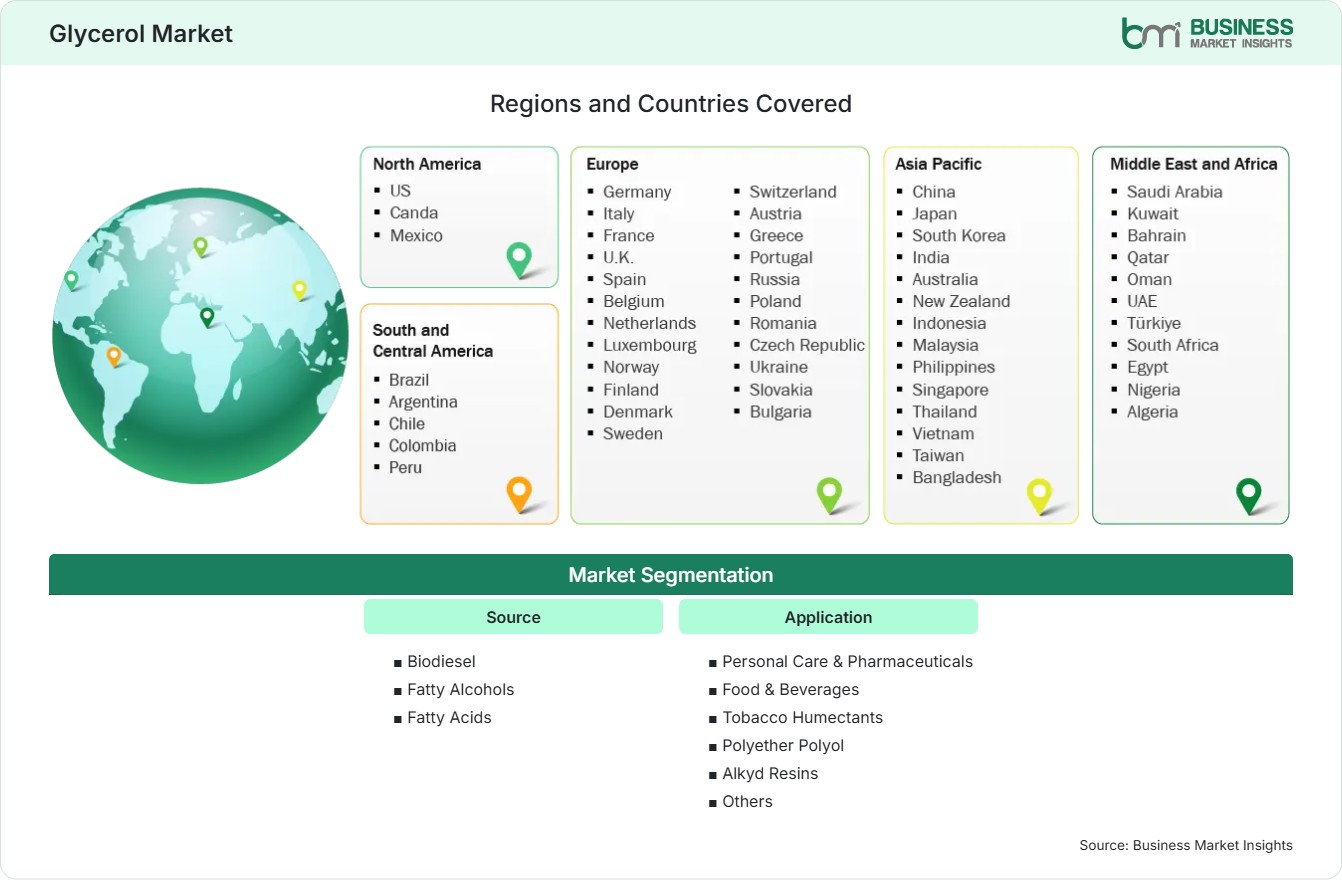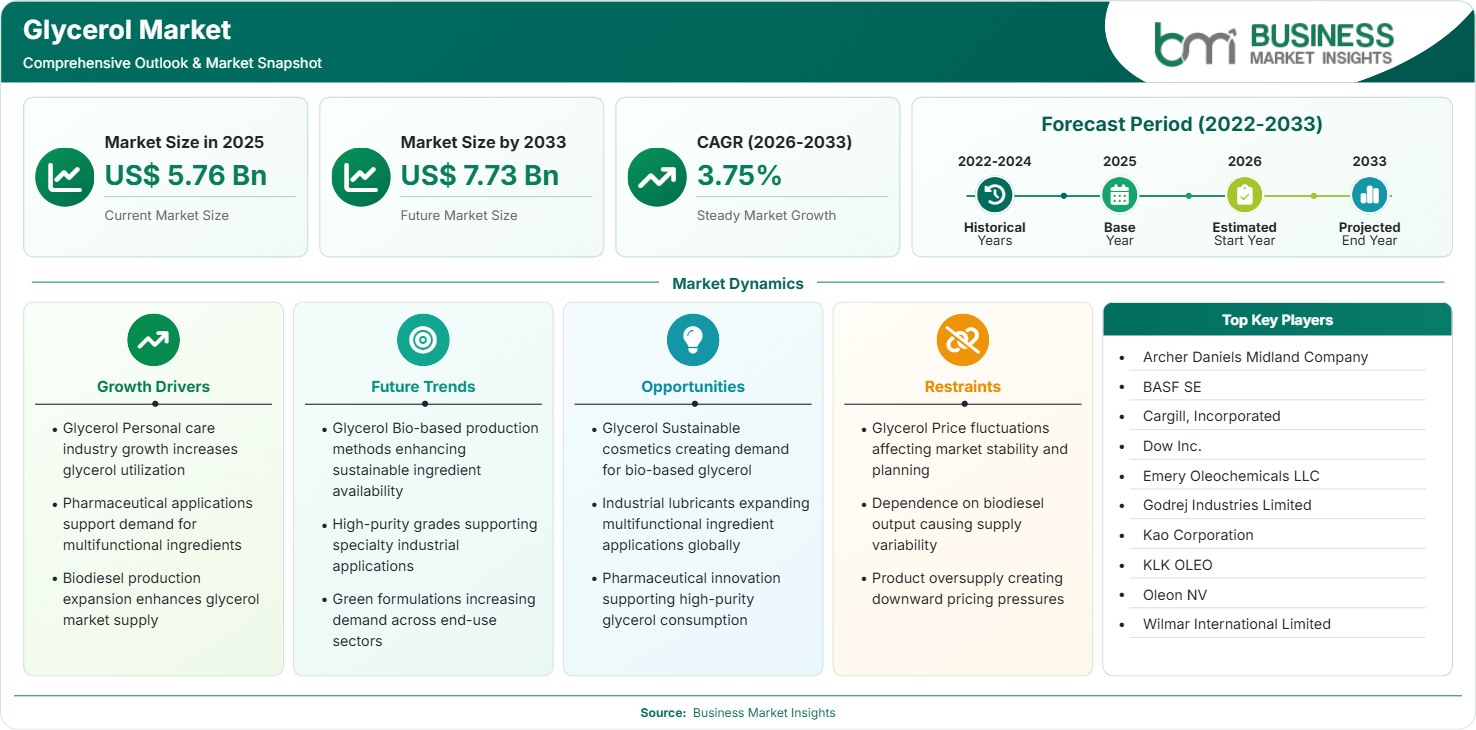
Glycerol Market Regional Highlights
North America Glycerol Market
North America represents a 31%–35% Glycerol Market share in 2025 and is projected to expand at a 3.30%–3.70% CAGR through 2033. The region benefits from biodiesel production, pharmaceutical manufacturing, personal-care formulation, food processing, and domestic refining. US demand remains the principal contributor, while Canada adds renewable-fuel and oleochemical requirements.
- Crude glycerin that is linked to biodiesel still has strategic value since the production of renewable fuels provides a continuous supply of feedstock to regional refiners and to downstream chemical processors.
- Those who formulate products for the pharmaceutical and personal-care industries prefer to use glycerin that is high in purity and has consistent specifications, adequate documentation, and a reliable supply, which in turn increases the demand for refined grades.
- Glycerin is used by food manufacturers for its humectancy, sweetening properties, its ability to retain moisture, and for formulation control, which in turn creates a demand that is not directly linked to the economics of biodiesel.
- The ability to carry out specialty conversion into polyols and bio-based intermediates provides extra markets, which helps producers lessen their dependence on commodity-grade price fluctuations.
US Glycerol Market
The US represents approximately 78%–83% of North American Glycerol Market demand in 2025 and is growing at a 3.35%–3.70% CAGR through 2033. Large biodiesel operations generate crude glycerin, while established pharmaceutical, personal-care, food, and industrial formulation industries support refined consumption. Domestic producers offer USP, technical, and crude grades, enabling differentiated applications.
- Policies concerning renewable fuels promote biodiesel production and as a result offer a continuous domestic supply of crude glycerin for purification and conversion.
- The production of pharmaceuticals and healthcare products requires controlled specifications, documented quality, and a steady supply suitable for use as excipients and in formulations.
- The ability to refine domestically enables buyers to cut down on their exposure to disruptions in overseas shipping, even though the economics of feedstock and energy still affect the delivered costs.
- Instead of merely selling glycerin that has been conventionally refined, bio-based chemical conversion offers a method of turning glycerin into more valuable intermediates.
Europe Glycerol Market
Europe accounts for a 23%–27% Glycerol Market share in 2025 and is projected to grow at a 3.20%–3.60% CAGR through 2033. Germany, France, the Netherlands, Italy, and the United Kingdom form important downstream markets, while Germany and the Netherlands provide strong chemical-processing infrastructure. Germany is estimated at a 3.30%–3.70% CAGR, while France is positioned around 3.20%–3.60%.
- Germany has a deep level of expertise in the chemical manufacturing sector and is also involved in the production of pharmaceuticals and personal-care products, meeting the demand for certified refined grades and downstream glycerol derivatives.
- France makes use of glycerin in the fields of cosmetics, food, pharmaceuticals, and specialty chemicals since it has a moisture-retaining effect, acts as a solvent, and contributes to the stability of the formulations.
- The Netherlands acts as a major center for logistics and the processing of chemicals, which allows for the distribution within the region and for integration with the European oleochemical supply chains.
- As a result, information on sustainability is having a greater impact on procurement, since manufacturers now take into account not only the technical specifications but also the availability of renewable feedstocks, traceability, certifications, and the various lifecycle characteristics.
Asia Pacific Glycerol Market
Asia Pacific holds a 35%–39% Glycerol Market share in 2025 and is forecast to expand at a 4.20%–4.70% CAGR, making it the fastest-growing regional market. Indonesia and Malaysia anchor oleochemical supply, while China and India provide extensive downstream consumption. China is estimated at 4.10%–4.60% CAGR, and India at 4.50%–5.00%.
- Both Indonesia and Malaysia have a well-developed infrastructure based on palm oil, the result of which is the production of glycerin during the processing of fatty acids, fatty alcohols, and biodiesel.
- Although there are substantial domestic formulation industries, China also has a large capacity for chemical processing, and changes in the supply situation can lead to pressure on imported and local prices.
- Because of growing demand in India for pharmaceuticals, personal-care products, food, and industrial goods, local storage, refining, and distribution are becoming more important for ensuring a secure supply.
- Instead, Japan and South Korea place greater emphasis on higher-value applications that demand consistent purity, comprehensive technical documentation, and specialized formulation support.
Rest of World Glycerol Market
Rest of World represents approximately 8%–12% of global Glycerol Market demand in 2025 and is projected to grow at a 3.80%–4.30% CAGR through 2033. South and Central America benefit from biodiesel, vegetable-oil processing, and food manufacturing. Brazil is estimated at 3.90%–4.40% CAGR, while Argentina remains relevant to biodiesel-linked supply. Mexico provides additional downstream demand through food, pharmaceutical, and personal-care manufacturing.
- Brazil has a biodiesel industry as well as a big range of manufacturing activities in the areas of food, pharmaceuticals, and personal care, which in turn leads to both a supply of crude material and downstream demand.
- The biodiesel industry in Argentina helps to ensure a supply of glycerin, and since agricultural processing is geared towards exports, this provides opportunities for integrated purification and the production of derivatives.
- Although a great deal of the refined material needed by formulators is still obtained from external sources, Saudi Arabia has a chemical ecosystem that enables specialty chemical conversion.
- South Africa acts as a distribution centre for customers in the southern African markets in the fields of food, pharmaceuticals, personal care and industry.