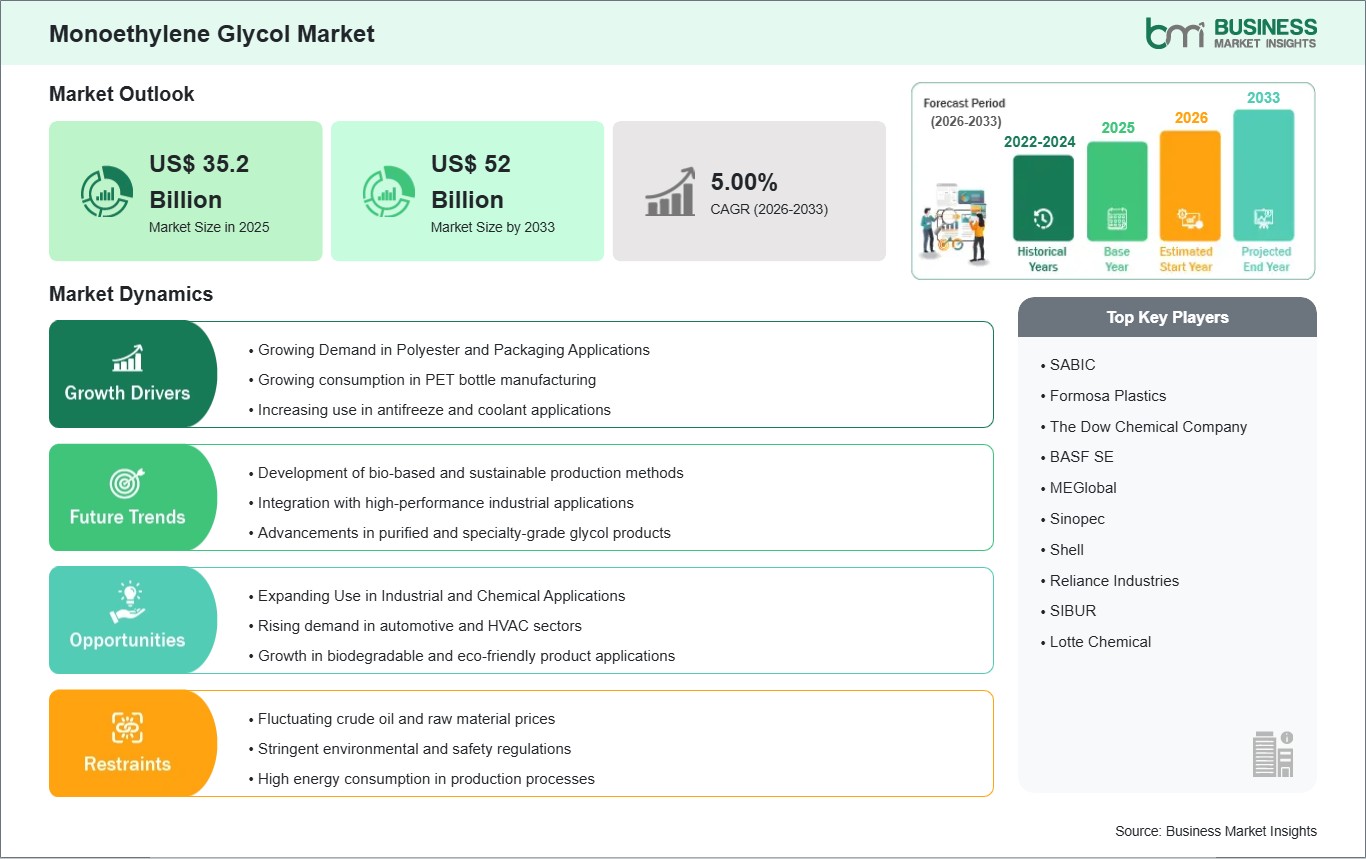
The Monoethylene Glycol Market size is expected to reach US$ 52 Billion by 2033 from US$ 35.2 Billion in 2025. The market is estimated to record a CAGR of 5.00% from 2026 to 2033.
There is robust expansion occurring in the monoethylene glycol (MEG) market due to the substantial need for MEG as a feedstock in polyester fiber production, polyethylene terephthalate (PET) resins, and antifreeze products. Polyester production is a major part of the global textile and packaging industries and is being affected by increased demand for clothing, industrial textiles, and PET bottles. The expansion of e-commerce, packaged foods, and beverage businesses has also contributed to increased consumption of PET resins, which affects the demand for MEG. The production of MEG has also benefited from technological improvements to produce MEG economically through processes such as more efficient hydration of ethylene oxide and greater integration of refining. Additional efficiencies have been realised through increased yields and increased product purity. There has been a continued focus on achieving cost efficiencies through increased energy efficiency during large-scale production.
Sustainability and environmental regulations continue to drive the adoption of bio-based MEG and closed-loop recycling initiatives, with Europe and North America leading the charge. Market challenges will continue to revolve around raw material price volatility, energy-intensive production processes, as well as challenges associated with the corrosive properties of MEG, requiring more stringent procedures in handling and storing MEG. Market participants are looking to expand their overall capacity, vertically integrating to their downstream and entering into agreements with polyester and PET manufacturers to enter long-term supply contracts and optimise margin opportunities. In sum, the MEM market outlook is good due to the global climate of industrialisation; stronger manufacturing of textiles and packaging, and governments pursuing sustainable development policies.

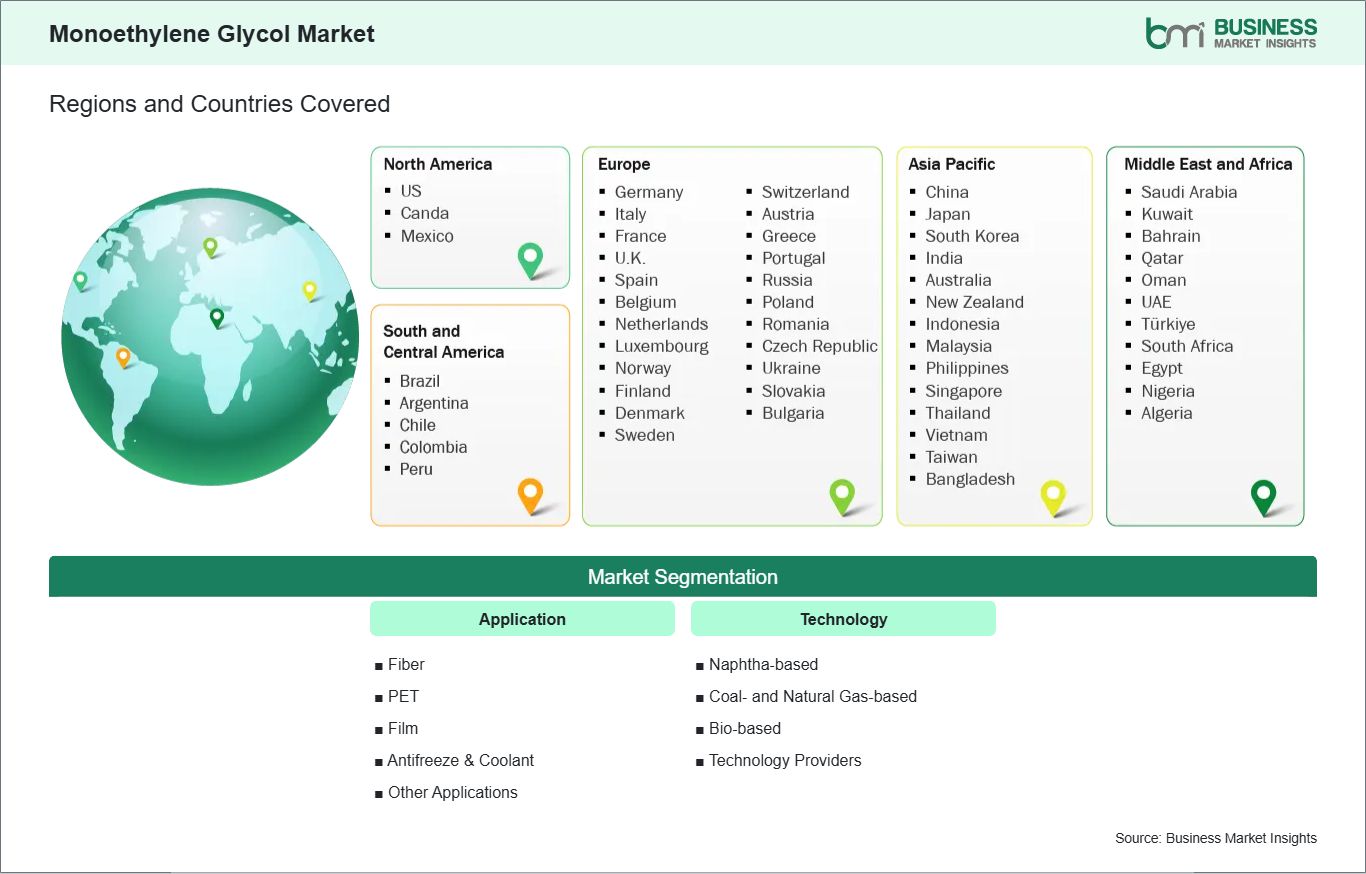
Key segments that contributed to the derivation of the monoethylene glycol (MEG) market analysis are application and technology.
The monoethylene glycol market is growing significantly due to the increasing use of the product in polyester production, especially polyethylene terephthalate fibers and resins. Monoethylene glycol is mainly used as one of the raw materials in the production of polyester, and polyester is used extensively in various industries. The increasing demand for durable, lightweight, and recyclable packaging materials is driving the monoethylene glycol market, especially in the consumer goods, food and beverage, and industrial packaging industries.
The chemical properties of monoethylene glycol enable manufacturers to produce quality polyester with good strength, clarity, and heat stability. The use of monoethylene glycol in the production of polyethylene terephthalate resin ensures the quality and performance of polyester, enabling the production of polyester fibers, bottles, and films, and providing support to various applications that require quality polyester with good strength, flexibility, and transparency. The increasing trend towards recyclable packaging is driving the monoethylene glycol market, as polyethylene terephthalate is one of the most recycled plastics worldwide.
Beyond packaging and textiles, MEG is also used in antifreeze, heat transfer fluids, and other industrial applications. Its versatility, chemical stability, and cost-effectiveness make it a preferred choice for multiple industrial processes. With the ongoing growth in consumer demand for lightweight and recyclable products, MEG continues to play a critical role in supporting polyester manufacturing, packaging innovations, and related industrial applications worldwide.
Monoethylene glycol is increasingly utilized in industrial and chemical sectors due to its versatility as a raw material and solvent. It is used in the production of antifreeze, coolants, and heat transfer fluids, which are essential for automotive, HVAC, and power generation systems. Its ability to maintain low freezing points, resist corrosion, and provide stable thermal performance makes it a preferred choice in these applications.
MEG is also applied in the production of resins, plasticizers, and coatings, contributing to the manufacturing of paints, adhesives, and other chemical products. Its chemical stability and compatibility with various reagents make it an essential intermediate in industrial synthesis. The material`s reliability allows manufacturers to develop customized formulations for specific applications, enhancing product performance and operational efficiency.
Growing industrialization, urbanization, and expansion of chemical and automotive sectors are driving demand for MEG across diverse applications. Its multifunctional properties, including high boiling point, low toxicity, and ease of handling, make it indispensable for modern chemical and industrial processes. As industries increasingly focus on efficiency, sustainability, and high-performance materials, MEG continues to emerge as a key chemical intermediate that supports innovation and operational resilience across multiple global sectors.

The monoethylene glycol market demonstrates steady growth, with size and share analysis highlighting evolving trends and competitive dynamics among key players. The report examines subsegments categorized within application and technology, offering insights into their contribution to overall market performance.
By Application, the PET subsegment dominated the market in 2025, driven by its extensive use in polyester fibers and packaging films.
Based on Technology, the naphtha‑based subsegment dominated the market in 2025, supported by its cost-effectiveness and established production infrastructure.
| Report Attribute | Details |
|---|---|
| Market size in 2025 | US$ 35.2 Billion |
| Market Size by 2033 | US$ 52 Billion |
| Global CAGR (2026 - 2033) | 5.00% |
| Historical Data | 2022-2024 |
| Forecast period | 2026-2033 |
| Segments Covered | By Application
|
|
Regions and Countries Covered
| |
| North America | US, Canada, Mexico |
| Europe | Belgium, Austria, Finland, Denmark, Greece, Poland, Romania, Russia, Ukraine, Czech Republic, Slovakia, Bulgaria, Italy, Luxembourg, Germany, Switzerland, France, Netherlands, Norway, Portugal, Spain, Sweden, United Kingdom |
| Asia-Pacific | Australia, China, India, Japan, South Korea, Indonesia, Malaysia, Philippines, Singapore, Thailand, Vietnam, Bangladesh, New Zealand, Taiwan |
| South and Central America | Brazil, Argentina, Peru, Chile, Colombia |
| Middle East and Africa | Bahrain, Kuwait, Oman, Qatar, Saudi Arabia, United Arab Emirates, Turkiye, South Africa, Egypt, Algeria, Nigeria |
| Market leaders and key company profiles |
|
The "Monoethylene Glycol Market Size and Forecast (2022 - 2033)" report provides a detailed analysis of the market covering below areas:
The geographical scope of the Monoethylene Glycol Market report is divided into North America, Asia Pacific, Europe, Middle East & Africa, and South & Central America. North America held the largest share in 2025.
Regional-level dynamics in the monoethylene glycol market reveal diverse growth patterns influenced by industrial capacity, regulatory frameworks, and downstream demand. North America is the dominant region, supported by a mature chemical manufacturing industry, extensive polyester and PET production, and robust regulatory compliance in handling and environmental safety. The United States leads in integrating advanced MEG production technologies to ensure consistent quality and efficiency.
Europe shows steady growth, driven by sustainability mandates, stringent environmental regulations, and adoption of recycled PET and bio-MEG in Germany, France, and the UK.
Asia Pacific is the fastest-growing region, led by China, India, and Japan, fueled by massive polyester fiber manufacturing, booming packaging industries, and infrastructure development. Investments in expanding ethylene oxide and MEG production capacities further strengthen regional growth.
Middle East & Africa demonstrates moderate growth, supported by petrochemical expansion and growing industrialization, though limited local MEG production makes the region reliant on imports.
South & Central America is an emerging market, with Brazil and Argentina leading adoption due to growing textile and packaging sectors, although high cost sensitivity and infrastructure limitations slow market penetration.
Across all regions, growth is shaped by downstream polyester and PET demand, industrial expansion, and increasing focus on sustainable and energy-efficient production solutions.

The Monoethylene Glycol Market is evaluated by gathering qualitative and quantitative data post primary and secondary research, which includes important corporate publications, association data, and databases. A few of the key developments in the monoethylene glycol market are:
The Monoethylene Glycol Market is valued at US$ 35.2 Billion in 2025, it is projected to reach US$ 52 Billion by 2033.
As per our report Monoethylene Glycol Market, the market size is valued at US$ 35.2 Billion in 2025, projecting it to reach US$ 52 Billion by 2033. This translates to a CAGR of approximately 5.00% during the forecast period.
The Monoethylene Glycol Market report typically cover these key segments-
The historic period, base year, and forecast period can vary slightly depending on the specific market research report. However, for the Monoethylene Glycol Market report:
The Monoethylene Glycol Market is populated by several key players, each contributing to its growth and innovation. Some of the major players include:
The Monoethylene Glycol Market report is valuable for diverse stakeholders, including:
Essentially, anyone involved in or considering involvement in the Monoethylene Glycol Market value chain can benefit from the information contained in a comprehensive market report.
Please tell us your area of interest
(Market Segments/ Regions and Countries/ Companies)