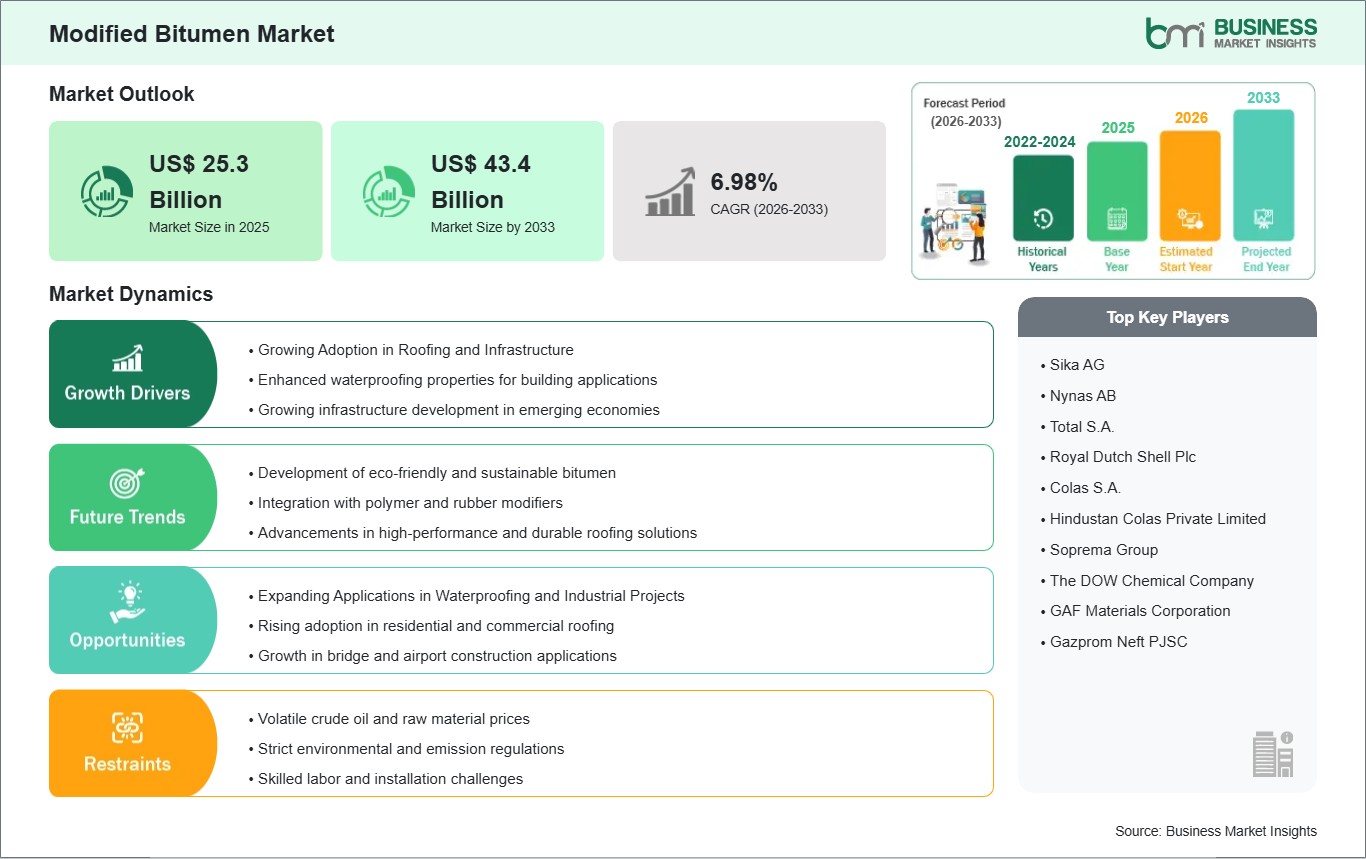
The Modified Bitumen Market size is expected to reach US$ 43.4 Billion by 2033 from US$ 25.3 Billion in 2025. The market is estimated to record a CAGR of 6.98% from 2026 to 2033.
The demand for modacrylic fibers is continuing to grow due to their versatility and use in a variety of markets, including textiles, protective clothing, and home furnishings. Modacrylic fibers are fire-retardant, resist chemicals and other environmental factors, and can be blended with other fibers for a softer and better-performing finished product. They are typically used in industrially protective clothing, clothing for the military, as well as wigs and upholstery. Improvements in spinning, blending, and finishing processes due to technology have increased the functional, aesthetic, and quality characteristics of modacrylic textiles, thereby expanding their market applications.
The market's growth is also supported by the increase in safety-related laws and regulations for many specific industries, such as oil and gas, firefighting, and electrical utilities, which require the use of flame-resistant fabrics. Increased consumer concern about safety and comfort when selecting residential textiles, wigs, and costume fabrics have also resulted in increased usage of modacrylic fibers. Challenges to the modacrylic fiber market include increased raw material costs, competition with alternative synthetic materials (such as aramid and polyester), and environmentally responsible concerns due to non-biodegradable products. Market participants are utilizing R&D initiatives to create green modacrylic fibers; enhance the ability for blending of fibers to improve product quality and mechanical performance, and to improve the aesthetics of the finished product. By working with apparel manufacturers, industrial textile producers, and distributors, companies which produce modacrylic fiber will be able to develop a greater market presence throughout the world.

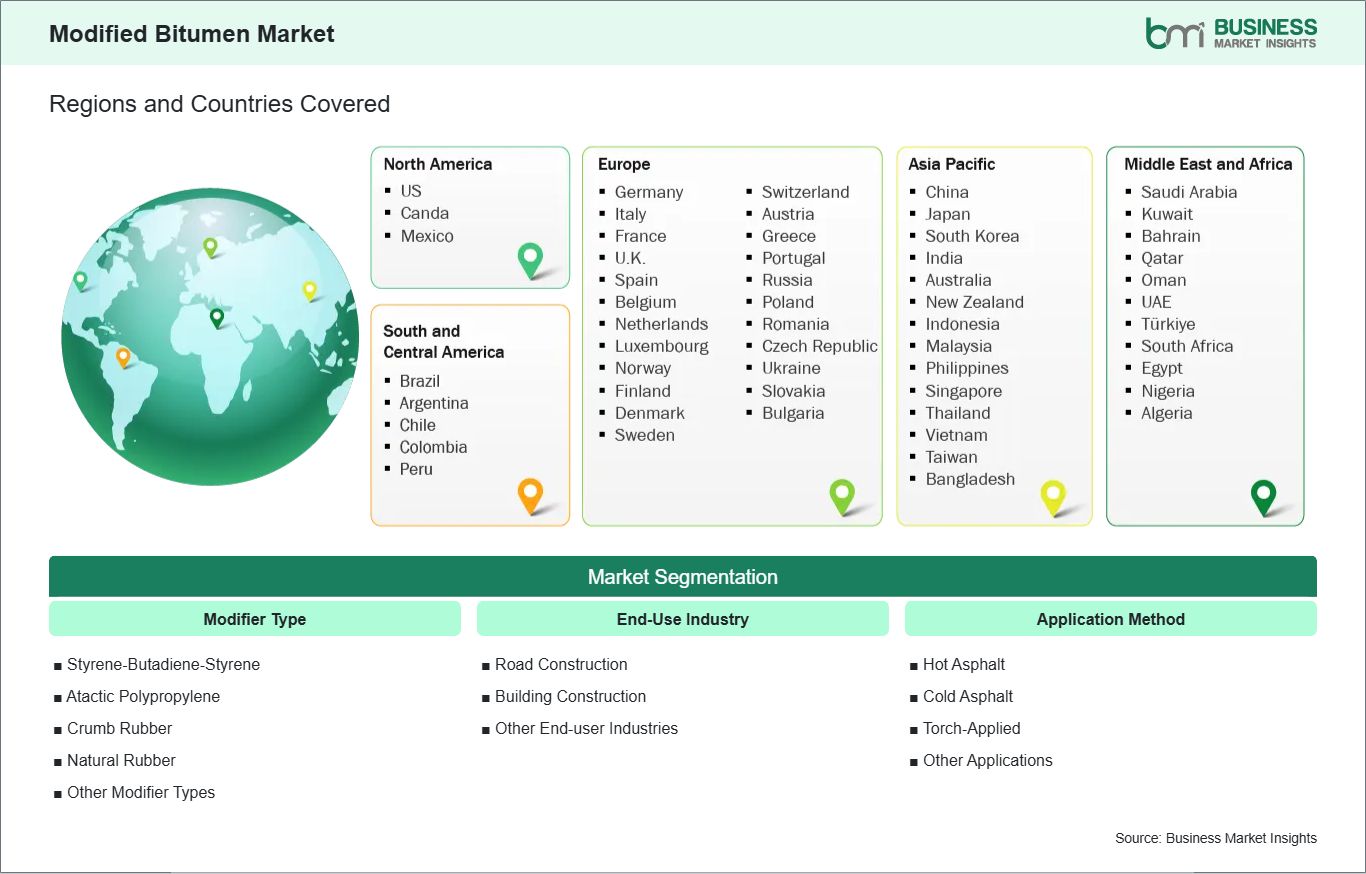
Key segments that contributed to the derivation of the modified bitumen market analysis are modifier type, end-use industry, and application method.
The modified bitumen market is increasing with the increasing need for a product that is not only durable and resistant to the elements but also cost-effective for roofing applications. This product is a combination of bitumen and polymers such as APP (atactic polypropylene) and SBS (styrene-butadiene-styrene). This product is best for flat and low-sloped roofs due to its flexibility and resistance to cracking from temperature changes. This product is best for flat and low-sloped roofs due to the fact that traditional asphalt may not withstand the elements for a long time.
This product is versatile and can be applied in different ways: torch-on, self-adhesive, and cold-applied. This product is also durable and can extend the life of a roof, making it a good product for buildings that need a roof that can withstand heavy traffic and extreme environmental conditions.
Beyond roofing, modified bitumen contributes to energy efficiency by providing insulation and reflective surfaces that help reduce heat absorption. Its combination of performance, longevity, and ease of application makes it increasingly preferred by builders, contractors, and infrastructure developers. With growing investments in urban infrastructure, commercial construction, and sustainable building practices, modified bitumen is becoming a key material in modern roofing and infrastructure projects, offering reliability, cost-effectiveness, and long-term protection.
Modified bitumen is increasingly utilized in waterproofing and industrial applications due to its superior adhesion, flexibility, and chemical resistance. It is widely applied in bridges, tunnels, podium decks, and parking structures to protect concrete and other materials from water infiltration and environmental damage. Its enhanced polymer composition allows it to withstand dynamic loads, thermal stress, and prolonged exposure to moisture, ensuring structural integrity and longevity.
The material is also used in industrial facilities, warehouses, and energy plants to protect surfaces exposed to chemicals, heavy machinery, and fluctuating temperatures. Modified bitumen`s ability to form a continuous, impermeable membrane reduces maintenance needs and extends the service life of critical infrastructure components. Its adaptability allows for application on both new constructions and retrofitting projects, offering flexibility for a wide range of civil and industrial engineering requirements.
Growing emphasis on sustainable and resilient construction practices is further driving demand. Modified bitumen provides a cost-effective solution that combines waterproofing, durability, and environmental protection. Its ability to deliver consistent performance under challenging conditions positions it as an essential material for modern infrastructure development, commercial construction, and industrial applications. As construction projects become more complex and safety standards stricter, modified bitumen continues to gain importance as a reliable and versatile solution for long-lasting performance.
The modified bitumen market demonstrates steady growth, with size and share analysis highlighting evolving trends and competitive dynamics among key players. The report examines subsegments categorized within modifier type, end-use industry, and application method, offering insights into their contribution to overall market performance.
By Modifier Type, the SBS subsegment dominated the market in 2025, driven by its superior flexibility, adhesion, and durability in roofing and paving applications.
Based on End-Use Industry, the road construction subsegment dominated the market in 2025, fueled by increasing infrastructure and highway development globally.
Based on Application Method, the hot asphalt subsegment dominated the market in 2025, supported by widespread adoption due to ease of handling and effective bonding properties.
| Report Attribute | Details |
|---|---|
| Market size in 2025 | US$ 25.3 Billion |
| Market Size by 2033 | US$ 43.4 Billion |
| Global CAGR (2026 - 2033) | 6.98% |
| Historical Data | 2022-2024 |
| Forecast period | 2026-2033 |
| Segments Covered | By Modifier Type
|
|
Regions and Countries Covered
| |
| North America | US, Canada, Mexico |
| Europe | Belgium, Austria, Finland, Denmark, Greece, Poland, Romania, Russia, Ukraine, Czech Republic, Slovakia, Bulgaria, Italy, Luxembourg, Germany, Switzerland, France, Netherlands, Norway, Portugal, Spain, Sweden, United Kingdom |
| Asia-Pacific | Australia, China, India, Japan, South Korea, Indonesia, Malaysia, Philippines, Singapore, Thailand, Vietnam, Bangladesh, New Zealand, Taiwan |
| South and Central America | Brazil, Argentina, Peru, Chile, Colombia |
| Middle East and Africa | Bahrain, Kuwait, Oman, Qatar, Saudi Arabia, United Arab Emirates, Turkiye, South Africa, Egypt, Algeria, Nigeria |
| Market leaders and key company profiles |
|
The "Modified Bitumen Market Size and Forecast (2022 - 2033)" report provides a detailed analysis of the market covering below areas:
The geographical scope of the Modified Bitumen Market report is divided into North America, Asia Pacific, Europe, Middle East & Africa, and South & Central America. North America held the largest share in 2025.
Regional-level dynamics in the modacrylic fiber market reveal varied growth trajectories influenced by textile industry maturity, regulatory frameworks, and end-use demand. North America is the dominant region, driven by stringent safety standards, well-established industrial and protective clothing sectors, and high adoption in military, firefighting, and industrial applications. The United States leads in innovation and application of high-performance flame-retardant fibers.
Europe exhibits steady growth, supported by strict fire safety regulations, eco-friendly textile initiatives, and adoption in industrial protective clothing, upholstery, and fashion segments, with Germany, France, and Italy at the forefront.
Asia Pacific is the fastest-growing region due to rapid industrialization, expanding apparel and home textile industries, and increasing safety awareness in countries such as China, India, and Japan. Local manufacturers are enhancing production capacities to meet rising domestic and export demand.
Middle East & Africa demonstrates moderate growth, driven by industrial safety requirements and protective wear adoption in oil, gas, and construction sectors.
South & Central America is an emerging market, with growing demand in industrial, residential, and apparel applications, particularly in Brazil and Argentina, though adoption remains constrained by price sensitivity and limited technical awareness.
Across all regions, market growth is shaped by regulatory compliance, increasing safety consciousness, and the demand for durable, flame-resistant, and high-performance textile solutions.

The Modified Bitumen Market is evaluated by gathering qualitative and quantitative data post primary and secondary research, which includes important corporate publications, association data, and databases. A few of the key developments in the modified bitumen market are:
The Modified Bitumen Market is valued at US$ 25.3 Billion in 2025, it is projected to reach US$ 43.4 Billion by 2033.
As per our report Modified Bitumen Market, the market size is valued at US$ 25.3 Billion in 2025, projecting it to reach US$ 43.4 Billion by 2033. This translates to a CAGR of approximately 6.98% during the forecast period.
The Modified Bitumen Market report typically cover these key segments-
The historic period, base year, and forecast period can vary slightly depending on the specific market research report. However, for the Modified Bitumen Market report:
The Modified Bitumen Market is populated by several key players, each contributing to its growth and innovation. Some of the major players include:
The Modified Bitumen Market report is valuable for diverse stakeholders, including:
Essentially, anyone involved in or considering involvement in the Modified Bitumen Market value chain can benefit from the information contained in a comprehensive market report.
Please tell us your area of interest
(Market Segments/ Regions and Countries/ Companies)