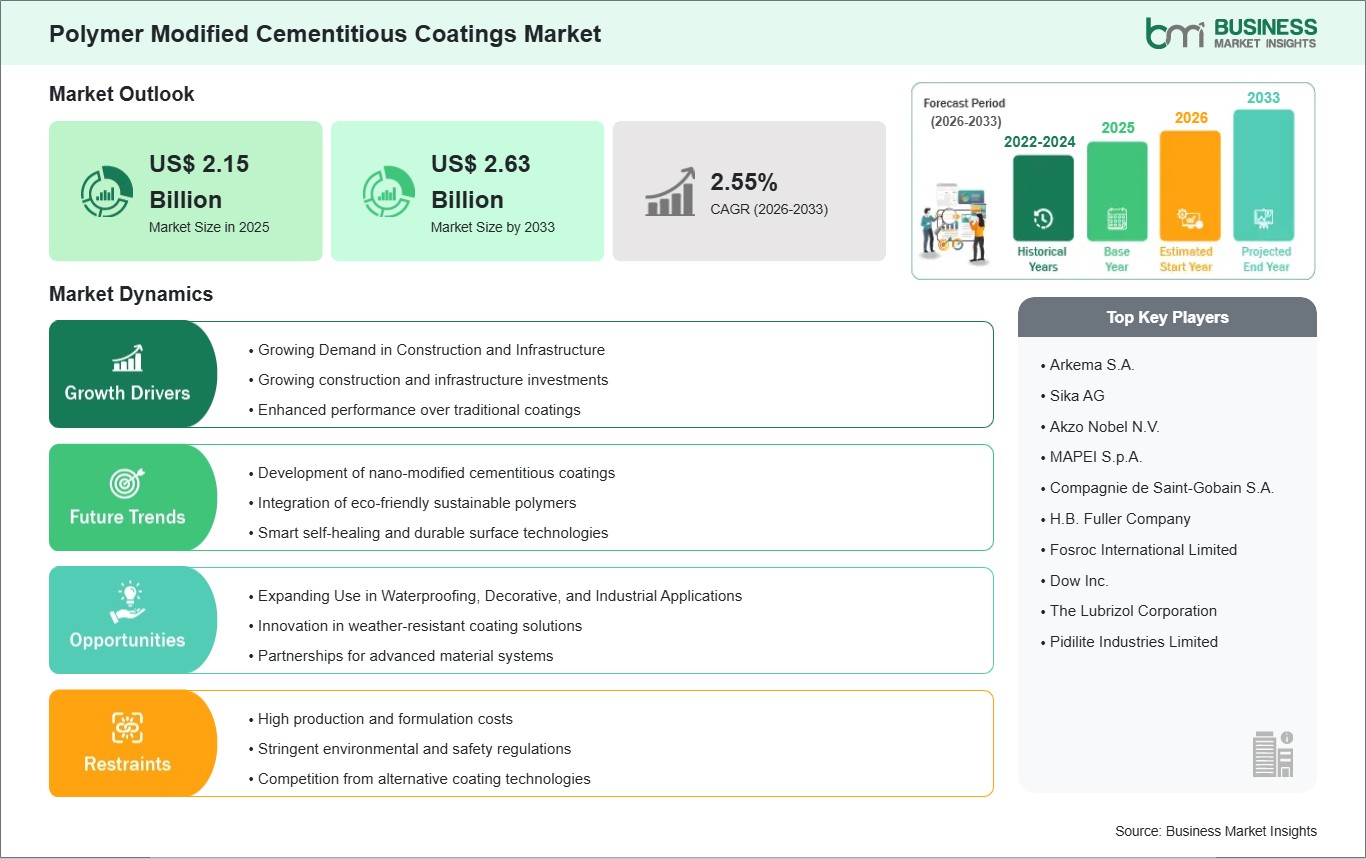
The Polymer Modified Cementitious Coatings Market size is expected to reach US$ 2.63 billion by 2033 from US$ 2.15 billion in 2025. The market is estimated to record a CAGR of 2.55% from 2026 to 2033.
The polymer modified cementitious coatings market is growing at a fast pace, owing to the increasing demand for high-performance products that provide durability, waterproofing, and surface protection to concrete structures. These coatings are made by combining polymers such as acrylics, styrene-butadiene, and ethylene-vinyl acetate with cementitious binders to provide flexibility and adhesion to the coatings. Factors such as the increasing rate of urbanization, infrastructure development by the government, and growth in the renovation and retrofit segment are contributing to the growth of the market.
Improvements in technology, such as two-component products and specialty acrylics, provide the ability to bridge cracks, cure quickly, and provide weather resistance in a variety of conditions. The market is highly competitive with manufacturers focusing on R&D, product innovations, and sustainable and low VOC products in compliance with stringent environmental regulations. Although the market faces some challenges in terms of raw materials’ cost fluctuation and products’ shelf life, the focus on long-term cost efficiency, reduced maintenance, and superior performance is driving the market with increased demand in various end-use segments such as industrial buildings, commercial buildings, and residential buildings.
Overall, the market is a reflection of technological innovations and sustainability trends with polymer modified cementitious coatings being the preferred choice for modern building and infrastructure development.

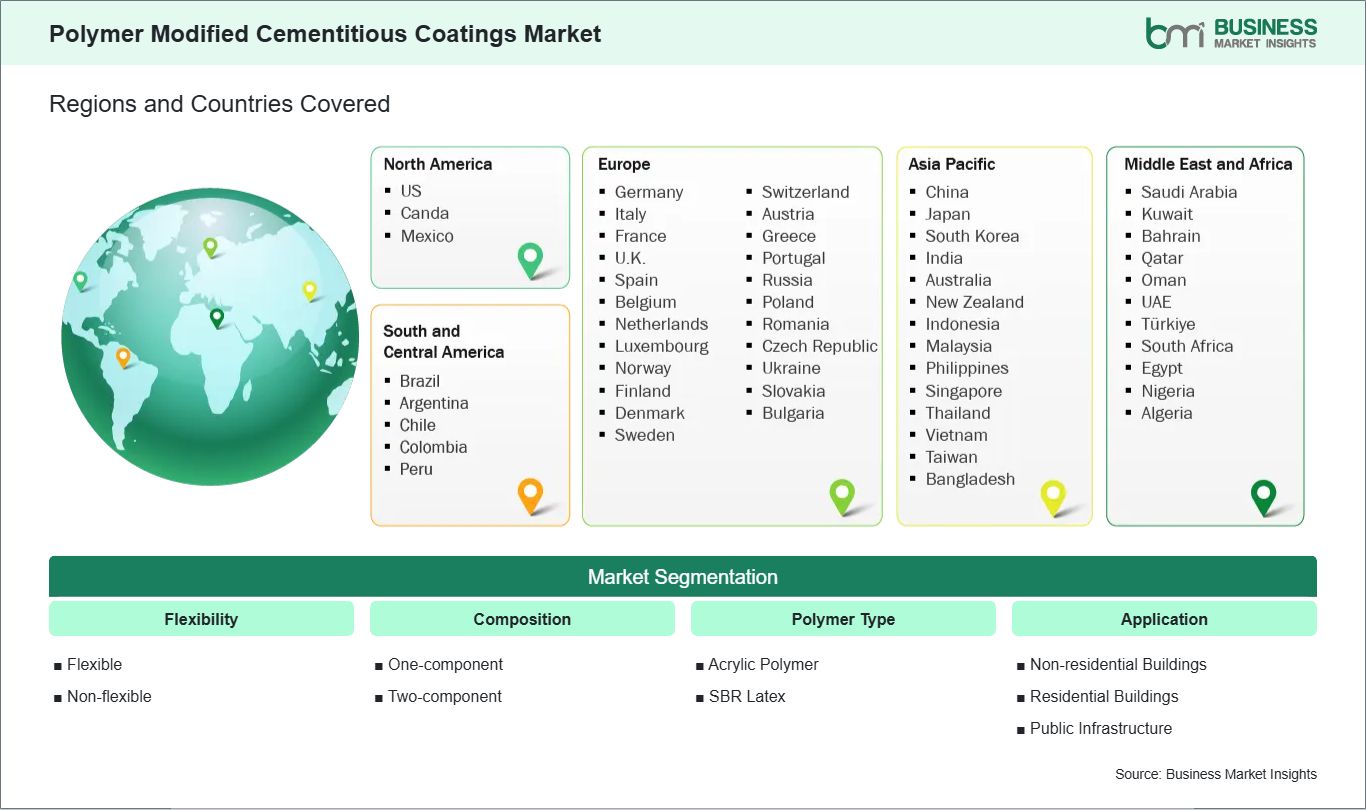
Key segments that contributed to the derivation of the polymer modified cementitious coatings market analysis are flexibility, composition, polymer type, and application.
The market for polymer modified cementitious coatings is expanding significantly because of the increased usage of the product in various construction and infrastructure development works. This is because the coatings provide improved durability and resistance to water and chemicals for concrete and masonry surfaces. They are being used in various structures such as bridges, tunnels, industrial floors, and buildings. They provide protection against environmental degradation, corrosion, and moisture penetration in structures. Therefore, the increasing urbanization and modernization of infrastructure and buildings require the usage of polymer modified cementitious coatings in various construction works undertaken globally.
In addition to protection against environmental factors and chemicals, polymer modified cementitious coatings provide improved mechanical properties for surfaces. They provide improved durability for concrete surfaces exposed to structural stress. This is because the coatings can provide improved adhesion and flexibility for concrete surfaces. Therefore, they can be used in various structures and buildings under development and renovation works. In addition, the coatings provide improved benefits for structures with rapid construction works that require the coatings’ easy application and rapid setting properties.
Sustainability is also fueling market growth. These coatings reduce maintenance costs and extend the lifespan of structures, minimizing material waste and the need for frequent repairs. Many formulations are compatible with green building standards, promoting energy efficiency and environmental responsibility. As the construction industry continues to prioritize durability, cost-efficiency, and eco-friendly solutions, polymer modified cementitious coatings are emerging as a key material for modern infrastructure worldwide.
Polymer modified cementitious coatings are increasingly used in waterproofing structures such as roofs, basements, water tanks, and terraces. These coatings, owing to their high adhesive value, ensure that there is no infiltration of water, thus protecting structures from damage. The increased demand for leak-proof structures in both commercial and residential areas is a major driver for polymer modified cementitious coatings. These coatings are particularly beneficial in areas that are prone to harsh weather conditions.
The decorative segment is another driver for polymer modified cementitious coatings. These coatings can be formulated in a manner that provides a textured, colored, or patterned look, thus enhancing the aesthetic value of a building. These coatings are widely used by designers and architects to ensure that buildings are both functional and visually appealing, thus fulfilling the growing demand for modern, visually appealing structures. They can be used on a variety of surfaces, including concrete, masonry, and plaster.
Industrial applications are another key driver for PMCC usage. Coatings protect floors, walls, and storage areas in chemical plants, manufacturing facilities, and warehouses from abrasion, chemical attack, and heavy-duty wear. Technological advancements in polymer additives and cementitious formulations have improved application efficiency, durability, and environmental compliance. As industries increasingly seek high-performance, sustainable, and multi-functional coatings, polymer modified cementitious coatings are positioned as an essential material for construction, protective, and decorative applications globally.

The polymer modified cementitious coatings market demonstrates steady growth, with size and share analysis highlighting evolving trends and competitive dynamics among key players. The report examines subsegments categorized within flexibility, composition, polymer type, and application, offering insights into their contribution to overall market performance.
By Flexibility, the flexible subsegment dominated the market in 2025, driven by superior crack bridging and waterproofing performance.
Based on Composition, the two‑component subsegment dominated the market in 2025, supported by higher durability and mechanical strength.
On the Basis of Polymer Type, the acrylic polymer subsegment dominated the market in 2025, owing to strong adhesion and versatility.
In Terms of Application, the residential buildings subsegment dominated the market in 2025, fueled by urbanization and rising housing demand.
| Report Attribute | Details |
|---|---|
| Market size in 2025 | US$ 2.15 Billion |
| Market Size by 2033 | US$ 2.63 Billion |
| Global CAGR (2026 - 2033) | 2.55% |
| Historical Data | 2022-2024 |
| Forecast period | 2026-2033 |
| Segments Covered | By Flexibility
|
|
Regions and Countries Covered
| |
| North America | US, Canada, Mexico |
| Europe | Belgium, Austria, Finland, Denmark, Greece, Poland, Romania, Russia, Ukraine, Czech Republic, Slovakia, Bulgaria, Italy, Luxembourg, Germany, Switzerland, France, Netherlands, Norway, Portugal, Spain, Sweden, United Kingdom |
| Asia-Pacific | Australia, China, India, Japan, South Korea, Indonesia, Malaysia, Philippines, Singapore, Thailand, Vietnam, Bangladesh, New Zealand, Taiwan |
| South and Central America | Brazil, Argentina, Peru, Chile, Colombia |
| Middle East and Africa | Bahrain, Kuwait, Oman, Qatar, Saudi Arabia, United Arab Emirates, Turkiye, South Africa, Egypt, Algeria, Nigeria |
| Market leaders and key company profiles |
|
The "Polymer Modified Cementitious Coatings Market Size and Forecast (2022 - 2033)" report provides a detailed analysis of the market covering below areas:
The geographical scope of the Polymer Modified Cementitious Coatings Market report is divided into North America, Asia Pacific, Europe, Middle East & Africa, and South & Central America. North America held the largest share in 2025.
The polymer modified cementitious coatings market demonstrates significant regional variation, with North America dominating the market due to advanced construction and renovation activities, strong regulatory compliance, and high adoption of durable, performance-driven coating solutions in the United States and Canada. In Asia Pacific, rapid urbanization, large-scale infrastructure projects, and increasing real estate developments in China, India, and Southeast Asia are driving substantial demand for high-performance coatings, with cost-efficiency and scalable production supporting market expansion.
Europe represents a mature market, where sustainability initiatives, stringent environmental standards, and advanced industrial manufacturing in Germany, France, and the UK encourage the use of eco-friendly, long-lasting coatings in both commercial and residential applications. The Middle East & Africa region is gradually increasing adoption, fueled by infrastructure diversification, construction modernization, and industrial development, while reliance on imports and partnerships ensures access to high-quality polymer-modified formulations.
South & Central America shows steady growth led by Brazil, Mexico, and surrounding countries, driven by industrial, commercial, and residential projects, though cost sensitivity and limited local production capacity influence adoption. Collectively, regional dynamics highlight how industrial maturity, regulatory frameworks, and application-specific requirements shape the global polymer modified cementitious coatings market.

The Polymer Modified Cementitious Coatings Market is evaluated by gathering qualitative and quantitative data post primary and secondary research, which includes important corporate publications, association data, and databases. A few of the key developments in the polymer modified cementitious coatings market are:
The Polymer Modified Cementitious Coatings Market is valued at US$ 2.15 Billion in 2025, it is projected to reach US$ 2.63 Billion by 2033.
As per our report Polymer Modified Cementitious Coatings Market, the market size is valued at US$ 2.15 Billion in 2025, projecting it to reach US$ 2.63 Billion by 2033. This translates to a CAGR of approximately 2.55% during the forecast period.
The Polymer Modified Cementitious Coatings Market report typically cover these key segments-
The historic period, base year, and forecast period can vary slightly depending on the specific market research report. However, for the Polymer Modified Cementitious Coatings Market report:
The Polymer Modified Cementitious Coatings Market is populated by several key players, each contributing to its growth and innovation. Some of the major players include:
The Polymer Modified Cementitious Coatings Market report is valuable for diverse stakeholders, including:
Essentially, anyone involved in or considering involvement in the Polymer Modified Cementitious Coatings Market value chain can benefit from the information contained in a comprehensive market report.
Please tell us your area of interest
(Market Segments/ Regions and Countries/ Companies)