Market Summary
Executive Summary and Global Market Analysis
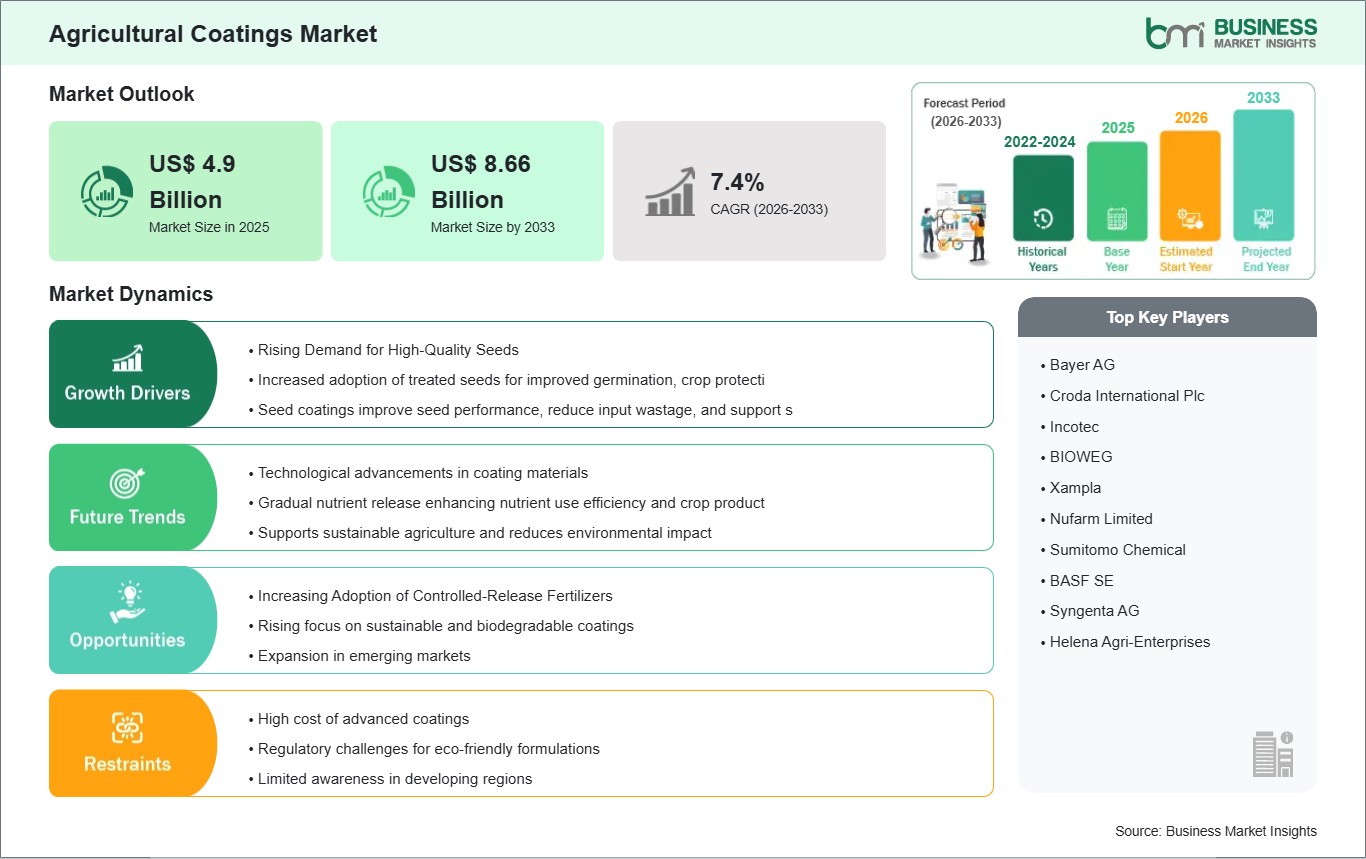
The global agricultural coatings market is defined by the increasing need for enhanced seed performance, improved nutrient efficiency, and sustainable farming practices. Agricultural coatings are widely used to improve the effectiveness of seeds, fertilizers, and pesticides by providing controlled release, protection, and better handling properties. These coatings play a critical role in modern agriculture by improving crop yield, reducing input wastage, and enhancing overall productivity.
The market is witnessing a shift toward advanced coating technologies that offer precision delivery of active ingredients. Seed coatings, in particular, are gaining significant traction due to their ability to protect seeds from pests and diseases while improving germination rates. Fertilizer coatings are also being increasingly adopted to enable controlled nutrient release, reducing environmental impact and improving nutrient use efficiency.
Competitive dynamics are centered on innovation in coating materials and formulations. Manufacturers are focusing on developing biodegradable and eco-friendly coatings that comply with environmental regulations. Technological advancements, including polymer-based coatings and microencapsulation techniques, are enhancing product performance. Strategic collaborations with agricultural input companies and expansion into emerging markets are key strategies adopted by market players.
Segment Analysis
Agricultural Coatings Market Segmentation
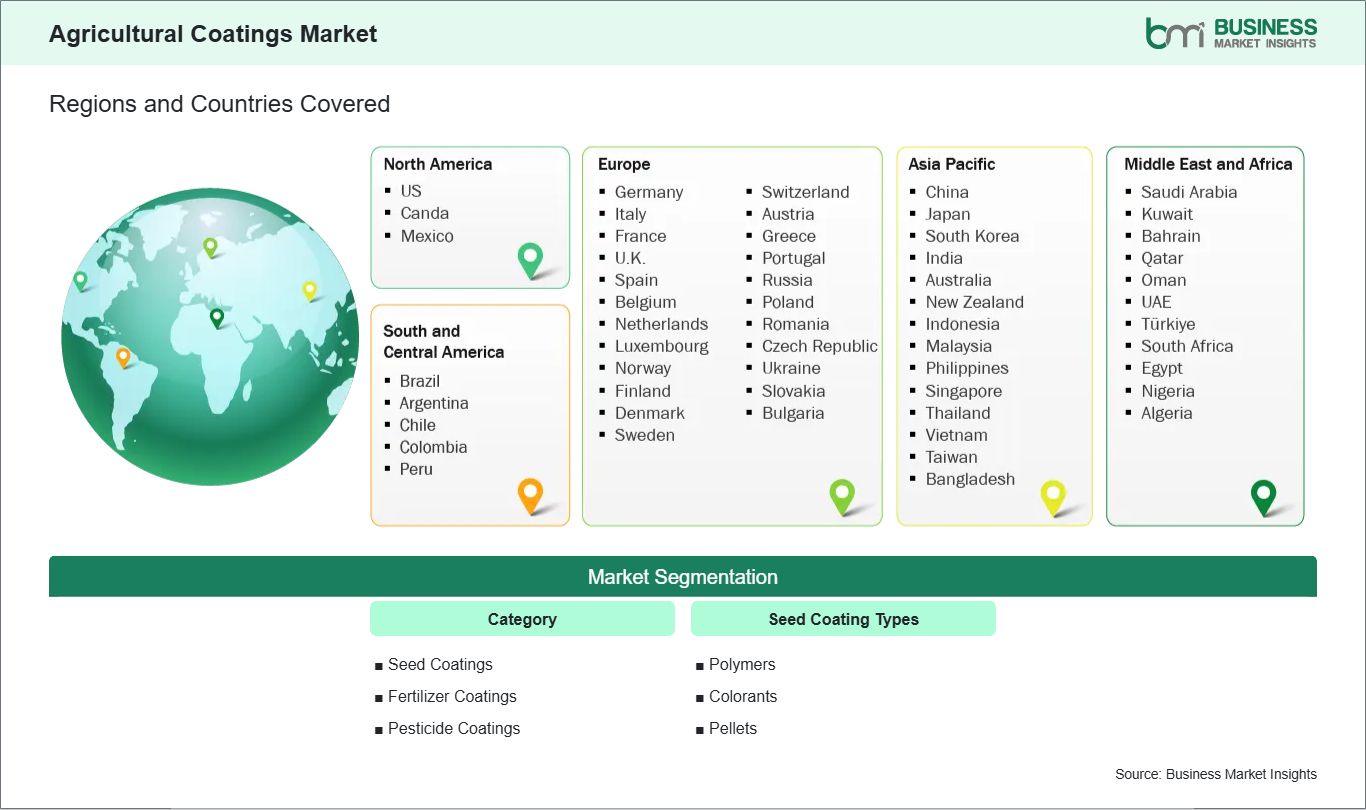
Key segments that contributed to the derivation of the agricultural coatings market analysis are category and seed coating types.
- By category, the agricultural coatings market is segmented into seed coatings, fertilizer coatings, and pesticide coatings. The seed coatings segment dominated the market in 2025.
- Based on seed coating types, the market is segmented into polymers, colorants, and pellets. The polymers segment dominated the market in 2025.
Market Forces
Agricultural Coatings Market Drivers and Opportunities
Rising Demand for High-Quality Seeds
The rise in demand for quality seeds is a major factor behind growth of the agricultural coatings market. As farmers place an emphasis on increasing crop yields and crop quality, they are starting to adopt more sophisticated seed coating technologies. Seed coatings help seeds germinate, protect seed from pests and diseases, and enable better handling and planting of seeds.
Modern seed coatings include a variety of different active ingredients such as nutrients, pesticides, and growth stimulants that allow the best possible performance of seedlings. Seed coatings also provide uniformity of size and shape of seeds, allowing for mechanized planting and ensuring proper establishment of crops. Seed coatings lower overall use of inputs, resulting in cost savings and environmental sustainability.
Advances in technology in the area of coating materials and processes continue to improve the effectiveness of seed coatings. Innovations and developments in areas such as biodegradable polymers and precision coating have increased the performance while reducing the ecological impact of seed coatings. This growing demand for quality seeds is propelling the agricultural coatings market.
Increasing Adoption of Controlled-Release Fertilizers
The growing adoption of controlled-release fertilizers is creating significant opportunities for the agricultural coatings market. Fertilizer coatings enable the gradual release of nutrients, ensuring that plants receive essential nutrients over an extended period. This improves nutrient use efficiency and reduces losses due to leaching and volatilization.
Controlled-release fertilizers are particularly beneficial in regions with poor soil conditions and limited water availability. They help optimize nutrient delivery and support sustainable farming practices by minimizing environmental impact. The demand for such fertilizers is increasing as farmers seek to improve productivity while reducing input costs.
The integration of precision agriculture technologies is further supporting the adoption of coated fertilizers. These technologies enable accurate application of nutrients based on soil and crop requirements, enhancing efficiency and reducing waste. As sustainable agriculture practices continue to gain importance, the demand for agricultural coatings is expected to grow steadily.
Size and Share Analysis
Agricultural Coatings Market Size and Share Analysis
The Agricultural Coatings Market demonstrates steady growth, with size and share analysis highlighting evolving trends and competitive dynamics among key players. The report examines subsegments categorized within category and seed coating types, offering insights into their contribution to overall market performance.
By category, the seed coatings subsegment dominated the market in 2025, driven by increasing adoption of treated seeds to enhance germination, protect against pests, and improve crop yield.
Based on seed coating types, the polymers subsegment dominated the market in 2025, driven by their ability to provide uniform coating, controlled release of active ingredients, and improved seed durability.
Report Coverage
Agricultural Coatings Market Report Coverage and Deliverables
The "Agricultural Coatings Market Size and Forecast (2022 - 2033)" report provides a detailed analysis of the market covering below areas:
- Agricultural Coatings Market size and forecast at global, regional, and country levels for all the key market segments covered under the scope
- Agricultural Coatings Market trends, as well as drivers, restraints, and opportunities
- Agricultural Coatings Market analysis covering key trends, global and regional framework, major players, regulations, and recent developments
- Industry landscape and competition analysis covering market concentration, heat map analysis, prominent players, and recent developments for the Agricultural Coatings Market
- Detailed company profiles, including SWOT analysis
Geographic Insights
Agricultural Coatings Market Geographic Insights
The geographical scope of the Agricultural Coatings Market report is divided into North America, Asia Pacific, Europe, Middle East & Africa, and South & Central America. North America held the largest share in 2025.
The demand for agricultural coatings varies across regions, influenced by agricultural practices, crop types, and adoption of advanced farming technologies. Asia Pacific leads the market due to large agricultural land areas, increasing food demand, and growing adoption of modern farming techniques in countries such as China and India.
North America and Europe are mature markets, characterized by high adoption of advanced seed technologies and precision agriculture practices.
Latin America is experiencing significant growth due to expanding agricultural activities and increasing demand for high-yield crops. The Middle East & Africa region is also witnessing growth, supported by the adoption of advanced irrigation and fertilization techniques in arid regions. Across all regions, the need for improved crop productivity and efficient input utilization is driving market expansion.
Industry Activity
Recent Developments
The Agricultural Coatings Market is evaluated by gathering qualitative and quantitative data post primary and secondary research, which includes important corporate publications, association data, and databases. A few of the key developments in the agricultural coatings market are:
- In November 2023, Bayer AG announced a partnership with BIOWEG to develop biodegradable seed coatings and sustainable formulation materials, enhancing germination and resilience while reducing environmental impact.
- In February 2022, Croda International Plc (via Incotec) partnered with Xampla to create biodegradable, microplastic‑free seed coatings for agriculture, focusing on sustainability and improved nutrient delivery.
Trust & Transparency
Research Methodology
The market analysis combines proprietary research with secondary data from government agencies, company disclosures, regulatory filings, industry databases and expert interviews. Market estimates are validated through data triangulation, cross-market benchmarking and analyst
review.
View Full Research Methodology
Key Sources Referred:
Food and Agriculture Organization (FAO)World Bank GroupOrganisation for Economic Cooperation and Development (OECD)International Fertilizer Association (IFA)United States Department of Agriculture (USDA)International Trade Administration