
Bitumen Additives Market Outlook: Size, Share, Trends, Growth Analysis, Competitive Landscape & Forecast, 2026-2033

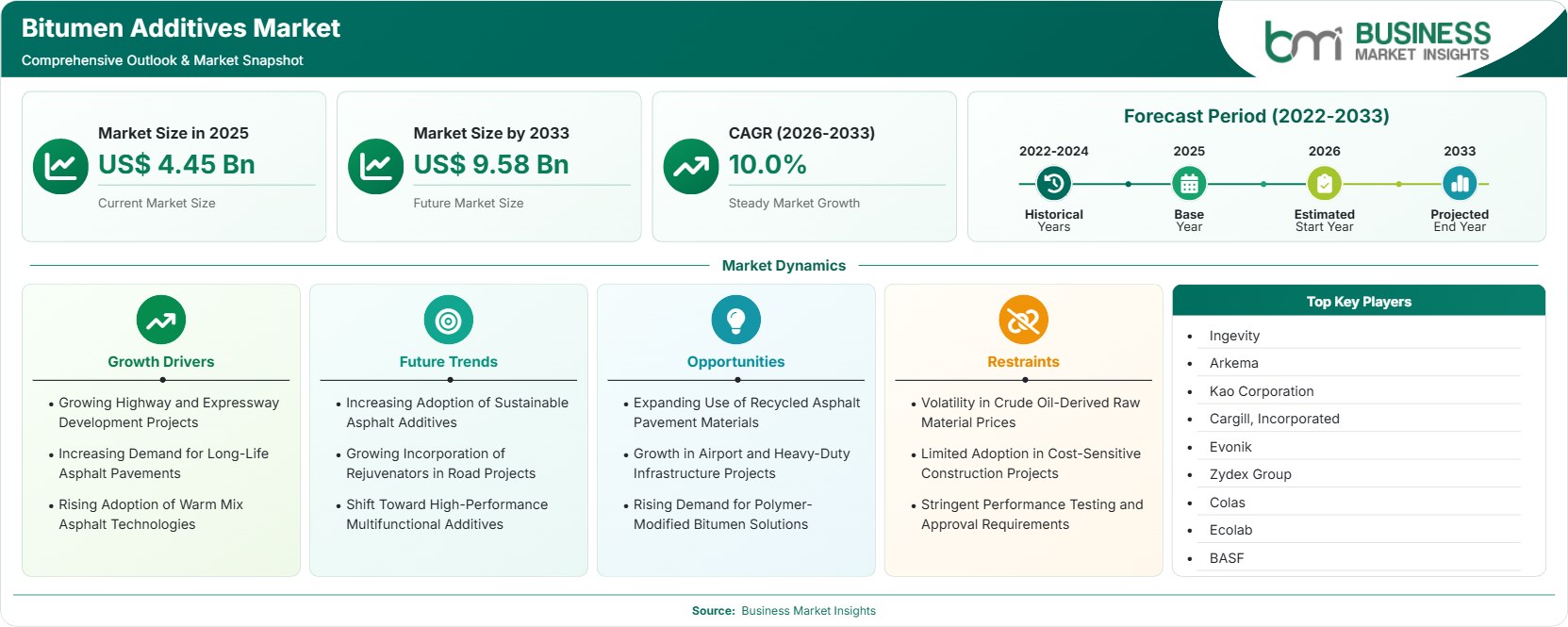
The Bitumen Additives Market size was valued at US$ 4.45 billion in 2025 and is projected to reach US$ 9.58 billion by 2033, growing at a CAGR of 10.0% during 2026–2033. Rising investments in road infrastructure, increasing adoption of warm mix asphalt technologies, and growing demand for durable pavements are accelerating market expansion. Opportunities are emerging from sustainable construction practices, bio-based additive development, and expanding transportation infrastructure projects across developing economies.

Report Coverage
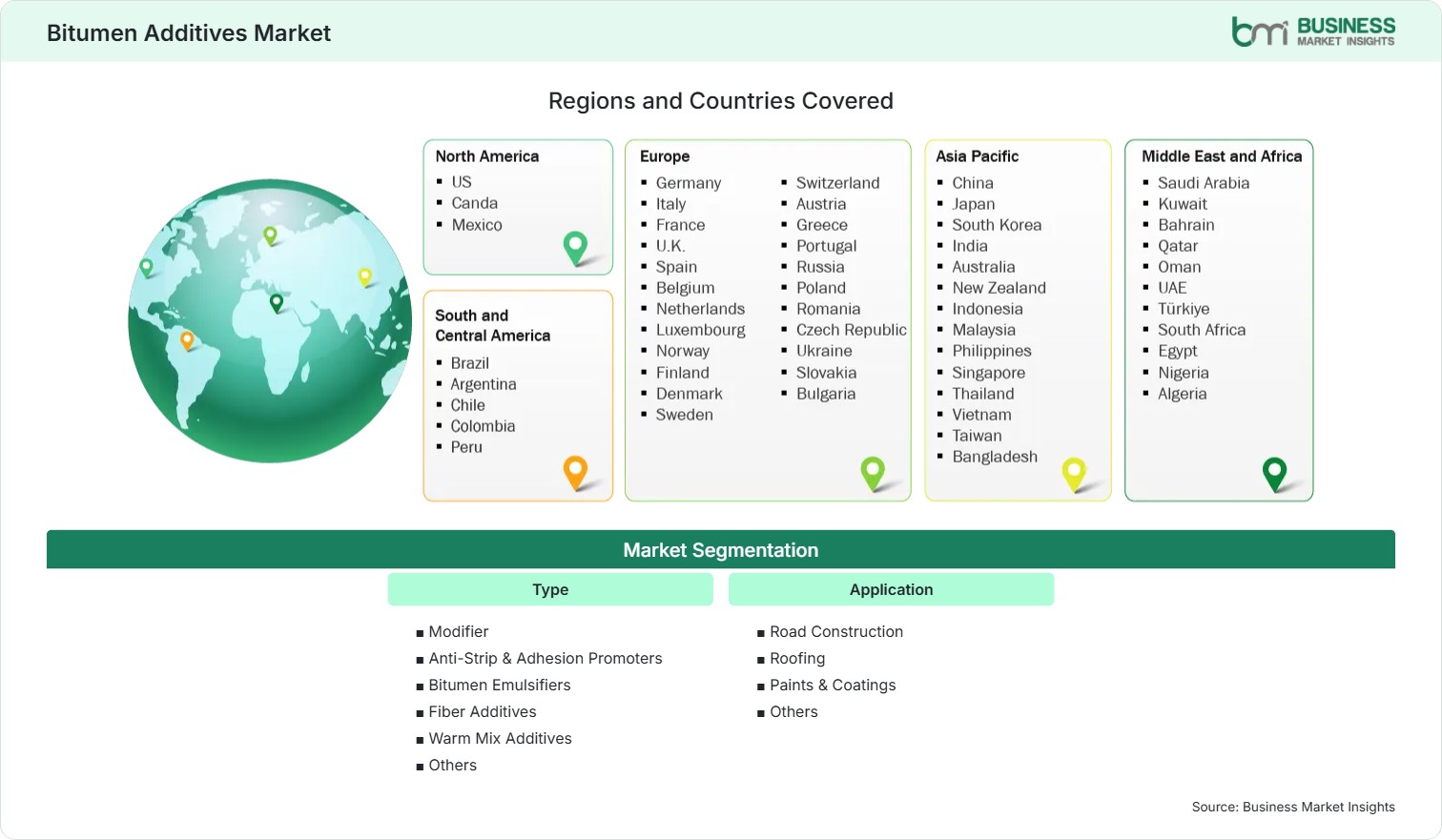
  • Type: Modifier, Anti-Strip & Adhesion Promoters, Bitumen Emulsifiers, Fiber Additives, Warm Mix Additives, Others
  • Application: Road Construction, Roofing, Paints & Coatings, Others
US$ 4.45 Bn Market size in 2025
US$ 9.58 Bn Market Size by 2033
10.0% CAGR, 2026 - 2033
2026-2033 Forecast Period

AI Overview

Bitumen Additives Market Summary

  • North America Region: North America holds 34%–36% market share in 2025 and is estimated at 34%-36%. CAGR growth of 9.2% and 9.6% is expected from 2026 to 2033. Highway rehabilitation initiatives, sustainable pavement technologies, and increased construction expenditure will continue to fuel demand. In the US market, growth rates will be between 9.3% and 9.7% CAGR till 2033
  • Fastest Growing Region: The Asia Pacific region holds 27%-29% market share in 2025 and is projected to grow at a 11.3%-11.8% CAGR from 2026 to 2033. The factors contributing to the growth include rapid urbanization, highway development, infrastructure projects by the government, and increased use of polymer
  • Leading Segment: Road Construction represents 67%–70% market share in 2025 and is expected to grow at a 10.1%–10.5% CAGR through 2033. Rising investments in highways, airport runways, bridge rehabilitation, and longer-lasting pavements continue driving demand for advanced asphalt performance additives globally.
  • High Growth Segment: Warm Mix Additives represent 15%-18% of the market share in 2025 and are projected to grow at a CAGR of 12.4%-12.9% between 2026 and 2033. The benefits offered by warm mix asphalt include low temperature for production, emission reduction, better workability, and regulations
  • Key Market Opportunity: With the increasing use of bio-based asphalt additives and efforts towards the circular economy, manufacturers may be able to formulate environmentally sustainable products and enhance pavement performance.
  • Major Market Players: Ingevity Corporation, Arkema S.A., Kao Corporation, Cargill, Incorporated, Evonik Industries AG, Zydex Group, Colas SA, Ecolab Inc., BASF SE, Nouryon Holding B.V
Strategic Insights

Bitumen Additives Market: Strategic Insights

Bitumen Additives Market Strategic Framework
FREE PDF
Request your free sample
Request free sample
Stakeholder View

Key Takeaways

  • The industry is increasingly relying on integrated supply chains involving crude oil-based bitumen suppliers, specialty chemical manufacturers, additive companies, asphalt mix plants, construction firms, and government transport agencies to improve paving performance and economy.
  • Road construction continues to be the main source of revenue, but warm mix additives are likely to exhibit the greatest growth potential in the future due to the adoption of sustainable infrastructure development initiatives.
  • Innovation in products is focusing on additives that provide multiple benefits, such as improved adhesion, moisture resistance, rutting resistance, recyclability, and reduced production temperatures in asphalt, without affecting pavement lifespan.
  • Asia Pacific presents the best investment prospects due to rapid expansion in highways, urban infrastructure, industrialization, and government spending on transport projects in China, India, Indonesia, and Southeast Asia.
  • Strategic acquisitions, regional production growth, and partnerships between specialty chemical producers and road construction companies are enhancing their product lines, regional supply capabilities, and customer responsiveness.
  • Digital road surface condition monitoring, performance-driven road specification systems, and life-cycle asset management techniques are becoming more prevalent in decision-making processes, thereby pushing specialty chemical producers to develop high-performance additives.
Geographic Outlook

Bitumen Additives Market Regional Highlights

North America Bitumen Additives Market

North America accounted for 34%–36% of the Bitumen Additives Market share in 2025 and is projected to expand at a 9.2%–9.6% CAGR during 2026–2033. The region is characterized by significant investments in highway rehabilitation, airport runway modernization, and public infrastructure through long-term transportation funding programs. Use of polymer-modified and warm mix technologies is increasing in this area, owing to a preference for durable roads, reduced cost of construction, and lower levels of carbon emissions. The United States accounts for the largest share, while demand in Canada is increasing owing to provincial investments in transport infrastructure.

  • Federal highway funding programs continue supporting pavement rehabilitation projects, encouraging wider adoption of high-performance bitumen modifiers that improve resistance against rutting, cracking, and moisture damage while extending roadway service life.
  • Warm mix asphalt technologies are gaining commercial acceptance due to stricter environmental regulations, lower production temperatures, improved fuel efficiency, and increasing sustainability targets established by transportation authorities across the region.
  • Manufacturers continue investing in advanced polymer and adhesion-promoting technologies designed to improve recycled asphalt pavement compatibility and enhance long-term pavement performance under varying climatic conditions.
  • Airport runway upgrades and logistics infrastructure expansion continue generating demand for premium asphalt additives capable of withstanding heavy traffic loads, extreme temperatures, and higher operational reliability requirements.
  • Growing public-private infrastructure partnerships encourage long-term procurement of specialty additives that optimize pavement durability while reducing maintenance frequency and total ownership costs.

US Bitumen Additives Market

The United States represented 26%–28% of the global market in 2025 and is expected to register a 9.3%–9.7% CAGR through 2033. High investment in federal transportation bills, along with continual maintenance of interstate highways, bridges, and airport pavements, ensures consistent demand. The rising use of recycled asphalt pavement and the implementation of pavement performance specifications speed up the adoption of new technologies in additives to bitumen.

  • The Federal Highway Administration continues promoting durable pavement technologies, increasing adoption of additives that improve moisture resistance, fatigue performance, and pavement longevity across interstate highways.
  • Rising use of recycled asphalt pavement creates demand for rejuvenators, adhesion promoters, and specialty modifiers that restore binder performance while supporting circular infrastructure development objectives.
  • Growing airport modernization projects require advanced asphalt formulations capable of delivering superior resistance to deformation, thermal cracking, and heavy aircraft loading conditions.
  • Specialty chemical manufacturers continue expanding domestic production capabilities to improve supply resilience and support growing infrastructure investments across multiple transportation sectors.

Europe Bitumen Additives Market

Europe held 25%–27% of the Bitumen Additives market share in 2025 and is forecast to grow at a 9.4%–9.9% CAGR during 2026–2033. Demand in this region is facilitated by sustainable construction laws, the development of a circular economy, and the widespread use of warm-mix asphalt techniques. The largest national market continues to be represented by Germany due to road maintenance expenditures. Poland experiences rapid growth due to infrastructure developments driven by transportation upgrades and European financial programs.

  • European climate policies continue encouraging adoption of low-temperature asphalt production technologies that reduce greenhouse gas emissions while maintaining pavement quality and construction efficiency.
  • Germany leads regional consumption through continuous investments in motorway maintenance, urban transportation infrastructure, and premium asphalt performance enhancement technologies.
  • Poland represents one of the fastest-growing national markets due to expanding expressway construction and increasing infrastructure investments supported by regional development initiatives.
  • Growing emphasis on recycled construction materials encourages wider utilization of additives that improve compatibility between virgin binders and reclaimed asphalt pavement materials.
  • Innovation activities focus on bio-based additives, lower-carbon formulations, and enhanced pavement durability aligned with European sustainability objectives.

Asia Pacific Bitumen Additives Market

Asia Pacific accounted for 27%–29% of global demand in 2025 and is anticipated to expand at a 11.3%–11.8% CAGR during 2026–2033, representing the fastest regional Bitumen Additives Market growth. Rapid urbanization, industrialization, expressways, and airport construction help sustain demand. In terms of regional income generation, China dominates through its massive transportation investment program, whereas India is witnessing the highest rate of growth owing to highway, smart city, and rural area development projects.

  • China remains the largest regional consumer through sustained investments in highways, logistics corridors, airports, and municipal infrastructure supporting long-term transportation development.
  • India records the strongest growth owing to Bharatmala, urban infrastructure expansion, and increasing adoption of durable pavement technologies across national and state highway projects.
  • Southeast Asian countries continue increasing investments in transportation connectivity, supporting demand for specialty asphalt additives with improved durability and workability characteristics.
  • Expanding domestic specialty chemical manufacturing strengthens regional supply chains while improving product availability for infrastructure developers.
  • Governments increasingly encourage sustainable construction practices, accelerating commercial adoption of warm mix asphalt and environmentally friendly additive technologies.

Rest of World Bitumen Additives Market

Rest of World accounted for 11%–13% market share in 2025 and is projected to register a 10.2%–10.7% CAGR during 2026–2033. South and Central America continue benefiting from highway modernization and urban transportation investments, with Brazil remaining the largest Bitumen Additives market and Chile recording comparatively stronger growth through expanding road development initiatives.

The Middle East and Africa experience increasing adoption of premium asphalt additives owing to smart city developments, airport expansion, and highway construction. Saudi Arabia leads regional demand through large infrastructure programs, while the United Arab Emirates demonstrates faster growth driven by sustainable urban development projects.

  • Brazil continues investing in logistics corridors, highways, and public transportation infrastructure, supporting demand for high-performance pavement modification technologies.
  • Saudi Arabia's large infrastructure developments under national economic diversification initiatives continue increasing consumption of specialty asphalt additives for premium road construction projects.
  • The United Arab Emirates records faster market expansion due to smart city developments, airport upgrades, and increasing adoption of sustainable paving technologies.
  • African economies are gradually increasing road infrastructure spending, creating long-term opportunities for cost-effective additive technologies improving pavement durability.
  • International infrastructure financing and public-private partnerships continue supporting transportation development projects across emerging economies, strengthening long-term regional demand.
Global Market Geography
FREE PDF
Request your free sample
Request free sample
Segment Analysis

Bitumen Additives Market Segmentation

Type

The type segment accounted for the complete market classification in 2025, with Warm Mix Additives emerging as the fastest-growing product category. Modifier products continued to hold the largest revenue contribution due to their extensive use in high-performance pavements. The overall segment is expected to expand at a 10.0%–10.4% CAGR through 2033, supported by increasing infrastructure investments, sustainable paving technologies, and the expanding Bitumen Additives Market scope across transportation and industrial applications.

  • Modifier: Widely adopted to improve elasticity, rutting resistance, and fatigue performance in asphalt pavements. Increasing demand for longer-lasting highways and heavy-duty roads continues supporting product adoption across developed and emerging economies.
  • Anti-Strip & Adhesion Promoters: Improve bonding between bitumen and aggregates while minimizing moisture-induced pavement failures. Growing emphasis on durable road construction and reduced maintenance costs supports wider commercial utilization.
  • Bitumen Emulsifiers: Essential for producing stable asphalt emulsions used in road maintenance, surface dressing, and cold mix applications. Rising preference for energy-efficient paving methods continues driving market demand.
    • Cationic: Preferred for superior adhesion with mineral aggregates and rapid setting characteristics, making them suitable for highway construction, maintenance activities, and pavement preservation projects.
    • Anionic: Utilized in specific aggregate conditions and specialized road construction applications where compatibility with alkaline materials enhances pavement performance and operational efficiency.
    • Non-ionic: Selected for niche formulations requiring improved stability across varying aggregate types and environmental conditions while supporting specialized industrial and infrastructure applications.
  • Fiber Additives: Enhance crack resistance, tensile strength, and structural stability of asphalt mixtures. Increasing use in heavy-traffic roads, airport pavements, and bridge decks supports long-term adoption.
  • Warm Mix Additives: Enable asphalt production at lower temperatures, reducing fuel consumption and emissions while improving workability. Sustainability regulations and energy-efficiency objectives continue accelerating global demand.

Application

Application-wise, Road Construction held 67%–70% market share in 2025 and is anticipated to register a 10.1%–10.5% CAGR during 2026–2033. With more money being spent on highway construction, expressways, bridges, and airports, the trend towards consumption is bound to continue. On the other hand, the usage of roofs and industrial coatings will keep on rising as manufacturers include specialized materials.

  • Road Construction: Dominant in terms of applications because of its large usage in highways, city roads, airports, bridges, and other such infrastructure because of the requirement of increased durability, water-resistance, and reduced maintenance needs.
  • Roofing: Increasing adoption of modified bitumen membranes for commercial and residential buildings supports demand for additives that enhance flexibility, weather resistance, ultraviolet stability, and long-term structural protection.
  • Paints & Coatings: Specialty bitumen formulations improve corrosion resistance, waterproofing performance, and protective coating durability across industrial facilities, marine infrastructure, pipelines, and civil engineering applications.
Market Forces

Bitumen Additives Market Dynamics

Key Market Drivers

Growing Highway and Expressway Development Projects

Highway, expressway, bridge, and transportation corridor construction remains a priority for governments in both developed and developing nations, as they attempt to make their transportation networks more efficient and interconnected. Such constructions require tough, hard-wearing asphalt that can withstand increased loads, which is why sophisticated bitumen additives are needed. The Federal Highway Administration (FHWA) estimates that 90% of roadways in the United States are paved with asphalt. Growing freight movement, urban expansion, and smart transportation initiatives further support long-term demand for specialty modifiers, adhesion promoters, emulsifiers, and fiber additives used in modern road construction, reflecting evolving Bitumen Additives Market trends.

Increasing Demand for Long-Life Asphalt Pavements

There has been an increasing trend among transportation organizations towards implementing pavement specifications that emphasize longevity, low maintenance, and cost-effectiveness. High-performance bitumen additives provide enhanced resistance to rutting, fatigue, moisture, and thermal stresses, allowing pavements to withstand heavy commercial traffic and various climatic conditions. Owners of infrastructure facilities have begun procuring construction materials that have longevity and minimize maintenance requirements. Growing investments in airport runways, industrial roads, ports, and logistics corridors further strengthen demand for modified asphalt solutions that maintain structural integrity in demanding operating environments, supporting the Bitumen Additives Market forecast.

Rising Adoption of Warm Mix Asphalt Technologies

The increasing adoption of warm mix asphalt is creating sustained demand for specialty additives that improve binder workability at lower production temperatures. The FHWA suggests that warm mix asphalt technology helps produce asphalt at a temperature 30°F to 120°F cooler than hot mix asphalt, resulting in fuel savings of about 20%. Cooler asphalt production reduces emissions, improves worker safety, extends the paving season, and enables longer transportation distances without compromising asphalt pavement quality, strengthening the Bitumen Additives Market forecast. These operational and environmental benefits are encouraging transportation agencies and contractors worldwide to integrate warm mix additives into large-scale infrastructure projects.

Key Market Opportunities

Expanding Use of Recycled Asphalt Pavement Materials

The growing utilization of reclaimed asphalt pavement (RAP) presents a significant opportunity for additive manufacturers to develop products that restore binder performance and improve compatibility between recycled and virgin materials. Transportation agencies increasingly encourage pavement recycling to reduce raw material consumption, construction costs, and environmental impacts. Advanced rejuvenators, adhesion promoters, and polymer modifiers enable higher RAP incorporation while maintaining pavement durability and workability. Bitumen Additives Market Forecasts indicate that continued investment in circular construction practices and sustainable infrastructure development will accelerate demand for innovative additive formulations designed specifically for recycled asphalt applications.

Growth in Airport and Heavy-Duty Infrastructure Projects

Expansion of airports, logistics parks, industrial corridors, container terminals, and mining infrastructure creates strong demand for premium asphalt additives capable of withstanding heavy static and dynamic loading conditions. These applications require pavements with superior fatigue resistance, deformation control, and moisture protection compared with conventional road surfaces. Governments continue prioritizing infrastructure modernization to support economic development and freight mobility, creating attractive opportunities for manufacturers offering high-performance bitumen modification technologies. Customized additive formulations for high-load pavements are expected to become an increasingly important area of product development and commercial differentiation.

Rising Demand for Polymer-Modified Bitumen Solutions

Polymer-modified bitumen is gaining wider acceptance as infrastructure owners seek materials that improve pavement flexibility, crack resistance, rutting performance, and overall lifecycle durability. Increasing climate variability and heavier traffic volumes require asphalt mixtures capable of maintaining structural performance under more demanding service conditions. This Bitumen Additives Market trend encourages manufacturers to expand portfolios of polymer-based additives compatible with diverse aggregate types and regional climatic conditions. Continuous research into advanced elastomers, plastomers, and hybrid polymer technologies further creates opportunities for differentiated products delivering superior long-term pavement performance.

Market Restraints and Challenges

Volatility in Crude Oil-Derived Raw Material Prices

Factor: Most conventional bitumen additives rely on petrochemical feedstocks whose pricing is directly influenced by fluctuations in global crude oil markets, refining capacity, and supply chain disruptions. Impact: Unstable raw material costs increase manufacturing expenses and reduce pricing predictability for suppliers and contractors. Infrastructure projects operating under fixed budgets often delay procurement or substitute lower-cost alternatives when input costs rise sharply. These pricing uncertainties compress manufacturer margins, complicate long-term supply agreements, and reduce investment confidence for specialty additive producers, particularly during periods of significant volatility in global energy markets.

Limited Adoption in Cost-Sensitive Construction Projects

Factor: Many local road construction projects prioritize initial construction costs over long-term pavement performance, particularly in developing regions with constrained infrastructure budgets. Impact: Contractors frequently choose conventional asphalt formulations instead of premium additive-enhanced mixtures despite their lower lifecycle maintenance costs. Limited technical awareness, budget restrictions, and procurement policies focused primarily on upfront expenditure slow adoption of specialty additives. This creates uneven market penetration across regions and restricts demand growth in smaller municipal projects where cost remains the primary purchasing criterion.

Company Analysis

Competitive Landscape

The competitive environment of the Bitumen Additives Market analysis is characterized by the presence of established specialty chemical manufacturers and asphalt technology providers focusing on product innovation, sustainable formulations, and regional manufacturing expansion. Companies are investing in polymer modification technologies, warm mix asphalt additives, adhesion promoters, and bio-based solutions to strengthen their product portfolios. Strategic collaborations with road construction companies, infrastructure agencies, and asphalt producers are helping market participants expand their global footprint while addressing evolving performance and environmental requirements.

Company Name

Overview

Products and Services relevant to this market

Ingevity Corporation

US-based specialty chemicals company serving pavement technologies through advanced asphalt performance solutions with a strong presence across global infrastructure markets.

Asphalt rejuvenators, warm mix asphalt additives, anti-strip additives, emulsifiers, pavement preservation technologies, and specialty performance chemicals for road construction.

Arkema S.A.

Global specialty materials manufacturer focused on sustainable chemical innovations supporting infrastructure, construction, and advanced material applications.

Asphalt modifiers, adhesion promoters, polymer additives, emulsifiers, specialty resins, and performance materials for durable asphalt formulations.

Kao Corporation

Japanese chemical manufacturer offering surfactant technologies and industrial chemicals supporting construction, pavement, and infrastructure applications worldwide.

Bitumen emulsifiers, surfactants, asphalt additives, specialty chemicals, and performance-enhancing solutions for road construction and maintenance.

Cargill, Incorporated

Global food and industrial products company with a growing portfolio of bio-based technologies supporting sustainable road construction solutions.

Bio-based bitumen additives, rejuvenators, asphalt performance modifiers, sustainable construction materials, and renewable specialty ingredients.

Evonik Industries AG

German specialty chemicals company providing advanced additive technologies across transportation, construction, and industrial sectors.

Polymer additives, specialty chemicals, asphalt modifiers, performance additives, adhesion technologies, and infrastructure material solutions.

Zydex Group

India-based specialty chemicals manufacturer focused on sustainable road construction technologies and pavement performance improvement.

Nano-engineered road additives, soil stabilization solutions, bitumen modifiers, waterproofing chemicals, and sustainable pavement technologies.

Colas SA

Global road construction and infrastructure company developing innovative pavement materials alongside engineering and maintenance services.

Bitumen emulsions, modified binders, pavement technologies, recycled asphalt solutions, road construction materials, and maintenance services.

Ecolab Inc.

Global provider of specialty chemicals and industrial process solutions serving infrastructure and manufacturing industries.

Specialty process chemicals, surfactants, industrial additives, formulation support, and chemical technologies applicable to asphalt production processes.

BASF SE

Leading global chemical manufacturer with extensive expertise in construction chemicals and performance material technologies.

Polymer modifiers, performance additives, dispersants, specialty chemicals, emulsifiers, and sustainable solutions for asphalt and infrastructure applications.

Ingevity Corporation

US-based specialty chemicals company serving pavement technologies through advanced asphalt performance solutions with a strong presence across global infrastructure markets.

Asphalt rejuvenators, warm mix asphalt additives, anti-strip additives, emulsifiers, pavement preservation technologies, and specialty performance chemicals for road construction.

Industry Activity

Recent Developments

June 2026

Kao Corporation announced that it launched DANOX RAP-400, an asphalt recycling agent designed to improve the quality and workability of reclaimed asphalt pavement (RAP), supporting higher recycled material utilization and more sustainable road construction.

April 2026

Ingevity Corporation completed the sale of its Ozark Materials road markings business to strengthen its strategic focus on core specialty chemicals and performance materials businesses, including solutions serving infrastructure and pavement applications.

June 2025

Arkema S.A. announced enhanced environmental validation for its CECABASE® RT BIO 10 warm mix asphalt additive, demonstrating up to 30% lower CO₂ emissions and compatibility with asphalt mixtures containing up to 50% reclaimed asphalt pavement (RAP).

June 2024

BASF announced the launch of Butonal® MB 5126, a biomass balance asphalt additive with a net-zero product carbon footprint, designed to improve asphalt flexibility, durability, and cost efficiency while reducing emissions during production and paving.

Trust & Transparency

Research Methodology

The market analysis combines proprietary research with secondary data from government agencies, company disclosures, regulatory filings, industry databases and expert interviews. Market estimates are validated through data triangulation, cross-market benchmarking and analyst review.

View Full Research Methodology

Questions Answered

Frequently Asked Questions

Who are the major players in the Bitumen Additives Market Report?

Leading companies include Ingevity Corporation, Arkema S.A., Kao Corporation, Cargill, Incorporated, Evonik Industries AG, Zydex Group, Colas SA, Ecolab Inc., BASF SE, and Nouryon Holding B.V.

Which product type is expected to witness the fastest growth?

Warm Mix Additives are projected to record the fastest growth owing to their ability to lower asphalt production temperatures, reduce fuel consumption and emissions, improve workability, and support sustainable pavement construction practices.

Which region holds the largest share in the market?

North America holds the largest regional share at 34%–36% in 2025, supported by extensive road rehabilitation programs, federal infrastructure investments, and widespread adoption of high-performance asphalt modification technologies.

Which application segment dominates the market?

Road construction is the leading application segment, accounting for 67%–70% of the market in 2025. Demand is supported by highway expansion, airport runway construction, bridge rehabilitation, and urban infrastructure modernization projects worldwide.

What is driving the growth of the Bitumen Additives Market?

The market is primarily driven by increasing investments in highway and expressway construction, rising adoption of warm mix asphalt technologies, growing use of polymer-modified bitumen, and the need for longer-lasting pavements with lower maintenance requirements.

Access the Full Bitumen Additives Market Report

Get segment-level forecasts, regional estimates, competitive benchmarking, company profiles and downloadable Excel datasets.

Access the full Bitumen Additives Market Report
350 pages PDF & Excel | 2026-09-02
Similar Research

Related Market Reports