
Fuel Additives Market Outlook: Size, Share, Trends, Growth Analysis, Competitive Landscape & Forecast, 2026-2033

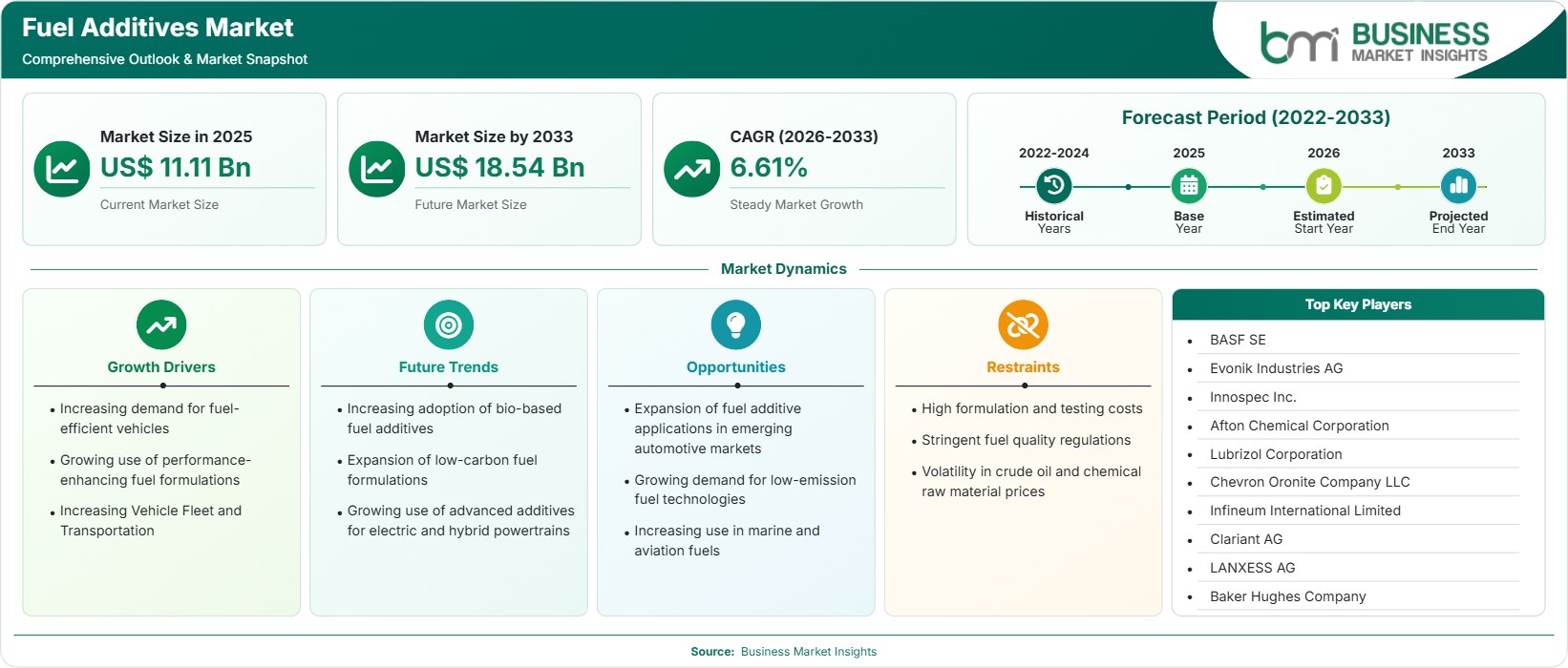
The Fuel Additives Market size was valued at US$ 11.11 Billion in 2025 and is projected to reach US$ 18.54 Billion by 2033, growing at a CAGR of 6.61% during 2026–2033. Market growth is driven by increasing demand for fuel-efficient vehicles, growing use of performance-enhancing fuel formulations, and expansion of the global vehicle fleet. Rising emphasis on engine performance, fuel economy, and emissions reduction continues supporting adoption across automotive, aviation, and industrial sectors.

Report Coverage
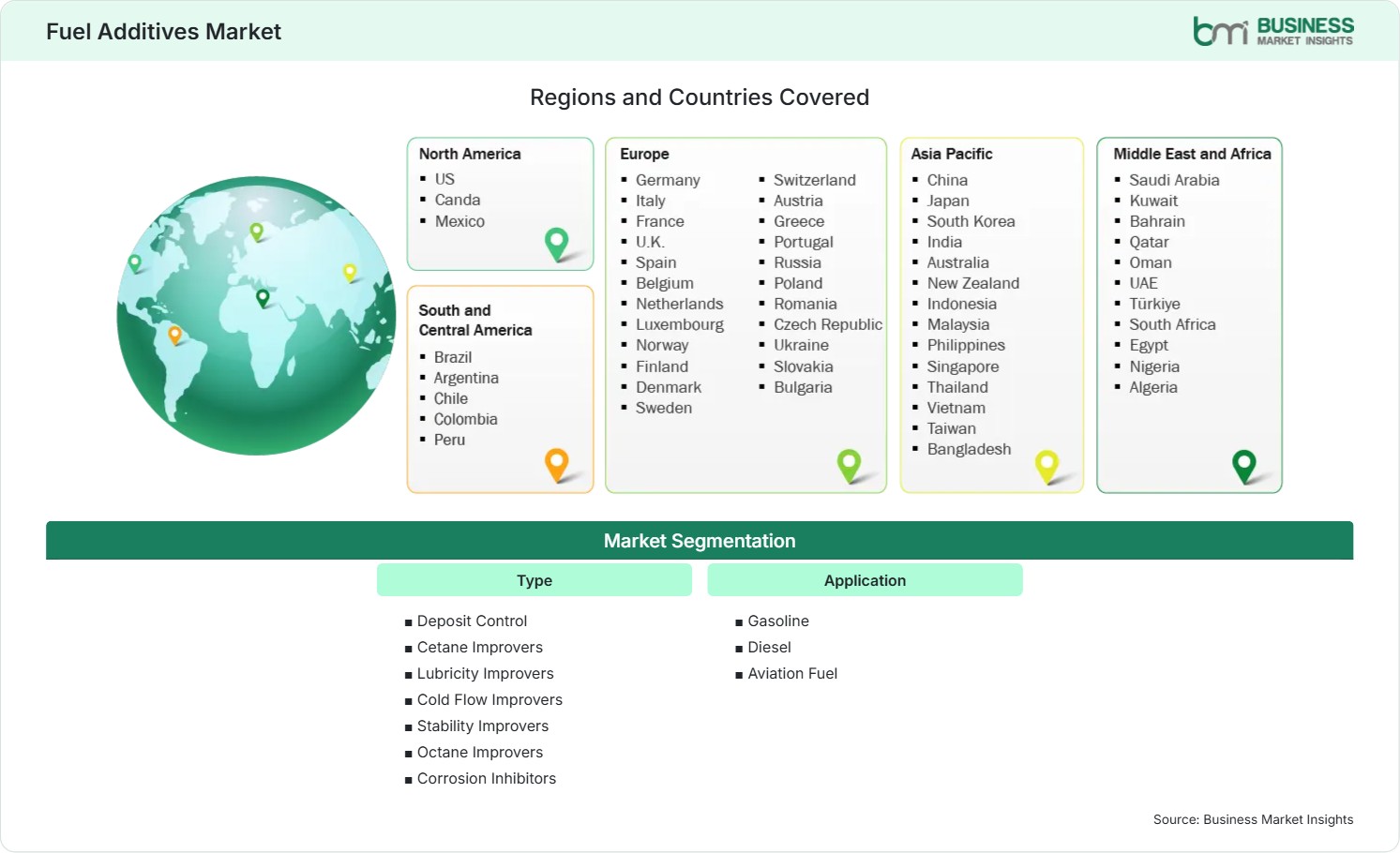
  • Type: Deposit Control, Cetane Improvers, Lubricity Improvers, Cold Flow Improvers, Stability Improvers, Octane Improvers, Corrosion Inhibitors
  • Application: Gasoline, Diesel, Aviation Fuel
US$ 11.11 Bn Market size in 2025
US$ 18.54 Bn Market Size by 2033
6.61% CAGR, 2026 - 2033
2026-2033 Forecast Period

01 AI Overview

Fuel Additives Market Summary

  • North America Region: North America holds a 34%–37% share in 2025 and is projected to expand at a 6.1%–6.7% CAGR during 2026–2033. Demand is supported by mature transportation infrastructure, stringent fuel quality standards, growing use of premium fuels, increasing vehicle ownership, and rising focus on emission reduction technologies. The U.S. remains the largest regional market, growing at a 6.2%–6.8% CAGR.
  • Fastest Growing Region: Asia Pacific accounts for 28%–31% share in 2025 and is anticipated to register a 7.3%–7.9% CAGR through 2033. Rapid urbanization, industrialization, expanding transportation networks, and increasing fuel consumption support strong market growth.
  • Leading Segment: Deposit Control Additives represent 24%–28% share in 2025 and are expected to grow at a 6.8%–7.3% CAGR during 2026–2033. Their ability to improve engine cleanliness, fuel efficiency, and operational performance continues supporting widespread adoption.
  • High Growth Segment: Diesel accounts for 44%–48% share in 2025 and is projected to expand at a 6.9%–7.5% CAGR through 2033. Growth is supported by commercial transportation demand, industrial activity, and fuel-quality enhancement requirements.
  • Key Market Opportunity: Increasing adoption of low-emission fuels, advanced engine technologies, and specialized performance additives is creating substantial opportunities for market participants.
  • Major Market Players: BASF SE, Evonik Industries AG, Innospec Inc., Afton Chemical Corporation, Lubrizol Corporation, Chevron Oronite Company LLC, Infineum International Limited, Clariant AG, LANXESS AG, and Baker Hughes Company.
02 Strategic Insights

Fuel Additives Market: Strategic Insights

Fuel Additives Market Strategic Framework
FREE PDF
Request your free sample
Request free sample
03 Stakeholder View

Key Takeaways

  • The market is increasingly driven by advancements in fuel chemistry, engine efficiency requirements, and emissions reduction initiatives across transportation and industrial sectors.
  • Diesel applications continue to represent a substantial revenue opportunity due to widespread use in commercial transportation, logistics, construction equipment, and industrial machinery.
  • Innovation is focused on multifunctional additive packages that improve fuel economy, reduce deposits, enhance lubricity, and support compliance with evolving emissions standards.
  • Asia Pacific offers strong growth potential owing to increasing vehicle ownership, industrial development, expanding transportation infrastructure, and rising fuel consumption.
  • Manufacturers are investing in research and development to create advanced formulations compatible with modern engines, alternative fuels, and low-emission technologies.
  • Regulatory pressure to improve fuel quality and operational efficiency continues supporting demand for high-performance additive solutions across global markets.
04 Geographic Outlook

Fuel Additives Market Regional Highlights

North America Fuel Additives Market

North America accounted for approximately 34%–37% share in 2025 and is projected to grow at a 6.1%–6.7% CAGR through 2033. Demand is supported by stringent fuel quality regulations, widespread adoption of premium fuel formulations, and increasing focus on engine efficiency. Fuel suppliers and automotive operators continue investing in additive technologies to improve performance, reduce emissions, and enhance fuel stability. Advanced transportation infrastructure and strong vehicle ownership levels further support fuel additives market share expansion.

  • Increasing consumption of premium fuels is encouraging greater use of deposit control and performance-enhancing additives across vehicle fleets.
  • Regulatory emphasis on emissions reduction continues supporting adoption of advanced fuel treatment technologies.
  • Commercial transportation operators are increasingly utilizing additives to improve fuel economy and engine reliability.
  • Ongoing innovation in additive chemistry is enhancing compatibility with modern engine technologies and fuel standards.

US Fuel Additives Market

The United States accounts for approximately 79%–83% share within North America and is expected to expand at a 6.2%–6.8% CAGR during 2026–2033. Strong transportation demand, extensive commercial vehicle operations, and growing awareness regarding fuel efficiency continue supporting fuel additives market forecasts. Refiners and fuel marketers are increasingly incorporating advanced additive packages to differentiate fuel offerings and improve operational performance.

  • Growing vehicle ownership continues supporting sustained demand for fuel quality enhancement products.
  • Commercial fleet operators increasingly rely on additives to improve engine protection and fuel efficiency.
  • Advanced fuel formulations are gaining traction across retail and industrial fuel markets.
  • Continuous investment in transportation infrastructure supports long-term fuel consumption growth.

Europe Fuel Additives Market

Europe represented approximately 26%–29% share in 2025 and is forecast to register a 6.3%–6.9% CAGR through 2033. Strong environmental regulations, advanced automotive technologies, and increasing emphasis on fuel efficiency are supporting market expansion. Countries such as Germany, France, and the United Kingdom remain major consumers due to established transportation and industrial sectors in fuel additives market.

  • Emissions reduction initiatives are encouraging widespread adoption of advanced fuel additive formulations.
  • Automotive manufacturers continue promoting fuel technologies that support efficiency and lower environmental impact.
  • Premium fuel consumption remains an important driver across mature transportation markets.
  • Industrial users increasingly utilize additives to improve equipment performance and fuel stability.

Asia Pacific Fuel Additives Market

Asia Pacific accounted for approximately 28%–31% share in 2025 and is projected to witness the fastest growth at a 7.3%–7.9% CAGR through 2033. Rapid urbanization, industrialization, and transportation expansion continue supporting strong fuel demand in fuel additives market trends. Rising vehicle production and increasing consumption of gasoline, diesel, and aviation fuels are strengthening the need for advanced additive solutions across the region.

  • China remains a leading market supported by large-scale transportation activity and industrial development.
  • India is experiencing rapid growth due to expanding vehicle ownership and infrastructure projects.
  • Fuel quality improvement initiatives are encouraging adoption of advanced additive technologies.
  • Expanding aviation and logistics industries continue contributing to market growth.

Rest of World Fuel Additives Market

The Rest of World region accounted for approximately 6%–8% share in 2025 and is expected to grow at a 6.4%–7.0% CAGR through 2033. Growth is supported by increasing transportation activity, infrastructure development, and industrial fuel consumption across Latin America, the Middle East, and Africa. Rising awareness regarding engine performance and fuel optimization continues creating opportunities for additive manufacturers in fuel additives market.

  • Brazil remains an important market due to expanding transportation and industrial sectors.
  • Middle Eastern economies continue investing in fuel quality enhancement and energy infrastructure.
  • Growing commercial transportation activity supports additive consumption across emerging markets.
  • Rising demand for operational efficiency is encouraging adoption of advanced fuel treatment solutions.
Global Market Geography
FREE PDF
Request your free sample
Request free sample
05 Segment Analysis

Fuel Additives Market Segmentation

Type

The type segment is led by deposit control additives, accounting for approximately 24%–28% share in 2025 and expected to expand at a 6.8%–7.3% CAGR through 2033. Growing demand for engine cleanliness, improved combustion efficiency, reduced emissions, and enhanced fuel economy continues supporting fuel additives market growth. Increasing adoption of premium fuels and advanced engine technologies is further driving demand for high-performance additive formulations across transportation and industrial applications.

  • Deposit Control: The leading additive category owing to its ability to prevent deposit formation, improve engine efficiency, and extend engine life across gasoline and diesel applications.
  • Cetane Improvers: Widely utilized in diesel fuels to enhance ignition quality, improve combustion performance, and support fuel efficiency under varying operating conditions.
  • Lubricity Improvers: Increasingly adopted to reduce wear in fuel systems, protect engine components, and compensate for lower sulfur fuel formulations.
  • Cold Flow Improvers: Critical for maintaining diesel fuel operability in low-temperature environments by preventing wax crystal formation and fuel flow restrictions.
  • Stability Improvers: Utilized to maintain fuel quality during storage and transportation while reducing oxidation-related degradation.
  • Octane Improvers: Important in gasoline formulations for enhancing combustion efficiency, engine performance, and knock resistance.
  • Corrosion Inhibitors: Support protection of fuel systems, storage facilities, and engine components against rust and corrosion-related damage.

Application

The application segment is dominated by diesel fuels, accounting for approximately 44%–48% share in 2025 and projected to grow at a 6.9%–7.5% CAGR through 2033. Strong demand from commercial transportation, industrial equipment, agricultural machinery, and logistics operations continues supporting segment leadership in fuel additives market. Growing emphasis on fuel quality improvement and emissions management is further strengthening additive adoption across end-use industries.

  • Gasoline: Significant demand is supported by passenger vehicle usage, fuel economy improvement initiatives, and increasing adoption of premium fuel formulations.
  • Diesel: The largest application segment owing to extensive utilization across commercial transportation, heavy-duty vehicles, construction equipment, and industrial operations.
  • Aviation Fuel: Growing utilization of fuel additives is driven by the need for improved fuel stability, corrosion protection, and operational efficiency in aviation applications.
06 Market Forces

Fuel Additives Market Dynamics

Key Market Drivers

Increasing Demand for Fuel-Efficient Vehicles

Fuel efficiency is increasingly valued by automotive producers and consumers. The use of fuel additives has several benefits, such as improved fuel combustion, reduced engine deposits, increased fuel economy, and improved vehicle performance. As governments increasingly encourage energy conservation and emissions reduction through various policies, automobile manufacturers are using fuel additives to comply with regulations. There is an increasing need for additives that ensure engine cleanliness and maximum fuel efficiency.

Growing Use of Performance-Enhancing Fuel Formulations

Fuel producers are increasingly focusing on developing specialized fuel formulations to improve engine performance, efficiency, and exhaust emissions control. Performance-improving additives help increase combustion efficiency, reduce deposit buildup, and improve engine stability and protection. Consumers and fleet managers are coming to understand the benefits of special fuel formulas in extending engine life and increasing vehicle efficiency. Advances in additive chemistry are helping fuel producers develop multifunctional additives to meet various performance needs.

Increasing Vehicle Fleet and Transportation

Expanding vehicle ownership and growth in transportation activity are contributing significantly to global fuel consumption levels. Commercial logistics, public transportation, industrial operations, and passenger mobility continue generating strong demand for fuels with enhanced performance characteristics. Fuel additives help maintain engine efficiency, reduce maintenance requirements, and improve combustion quality across diverse operating conditions. As transportation networks expand globally and fuel quality expectations increase, additive manufacturers are benefiting from rising consumption. Growth in both developed and emerging economies continues creating a favorable environment for sustained market expansion.

Key Market Opportunities

Expansion of Fuel Additive Applications in Emerging Automotive Markets

There are several factors that indicate growing potential of fuel additives market in emerging automotive markets. There has been significant increase in number of vehicles, growth of transportation infrastructure, and use of fuel in emerging markets. Governments and other stakeholders are becoming more concerned about better fuel and less pollution, which creates favorable environment for fuel additives usage. At the same time, automakers that operate in developing countries are also supporting technologies that need better fuel and engines. All these factors will lead to rising demand for deposit control additives, lubricity enhancers, and performance enhancing additives.

Growing Demand for Low-Emission Fuel Technologies

Environmental challenges, along with the emergence of stringent regulatory standards, are boosting the demand for low-emission fuels. The fuel additives are important to improve the efficiency of the combustion process and reduce emissions. Producers and suppliers of fuels are incorporating advanced additive packages into their fuels to improve performance and reduce their environmental footprint. The constant innovations in the technology for emissions reduction have created an increased need for new-generation additive products to address the emerging regulatory standards.

Increasing Use in Marine and Aviation Fuels

Marine and aviation industries are increasingly adopting advanced fuel additives to enhance operational efficiency, maintain fuel stability, and improve equipment reliability. Additives provide protection against corrosion, oxidation, microbial contamination, and performance degradation during storage and transportation. Growing global trade volumes and increasing air travel activity are strengthening fuel demand within these sectors. Additionally, tightening environmental standards are encouraging utilization of specialized additives that support cleaner fuel combustion and improved operational performance. These factors continue creating new growth avenues for additive manufacturers serving transportation and industrial fuel markets.

Market Restraints and Challenges

High Formulation and Testing Costs

Factor: Development of advanced fuel additives requires extensive formulation research, laboratory validation, engine testing, regulatory certification, and continuous product optimization. Manufacturers must invest heavily in technical expertise, testing infrastructure, and performance evaluation to ensure additive effectiveness across diverse fuel systems and operating conditions. Impact: High development and validation costs can increase product prices and create barriers for smaller market participants. Extended testing timelines may also slow commercialization of new formulations. These cost pressures can affect profitability and limit adoption in price-sensitive markets despite the operational benefits associated with advanced additive technologies.

Stringent Fuel Quality Regulations

Factor: Governments and regulatory agencies continue implementing strict fuel quality, emissions, and environmental standards that require ongoing compliance and product adaptation. Additive manufacturers must continually reformulate products and demonstrate compatibility with changing fuel specifications and regulatory requirements. Impact: Regulatory compliance increases operational complexity, development expenditures, and time-to-market requirements. Differences in regional standards may further complicate global product deployment strategies. While regulations create demand for advanced additives, they also represent a significant challenge for companies seeking efficient product development and market expansion.

07 Company Analysis

Competitive Landscape

The competitive landscape is characterized by continuous investment in additive chemistry innovation, fuel performance enhancement technologies, emissions reduction solutions, and advanced engine protection formulations. The Fuel Additives Market analysis indicates that leading companies are focusing on expanding product portfolios, strengthening research capabilities, and developing multifunctional additive packages that improve fuel economy, engine cleanliness, and environmental compliance across automotive, marine, aviation, and industrial applications.

Company Name

Overview

Products and Services relevant to this market

BASF SE

Global chemical company with strong capabilities in fuel treatment technologies and specialty performance additives.

Deposit control additives, cetane improvers, fuel performance chemicals, combustion enhancement technologies, and refinery solutions.

Evonik Industries AG

Specialty chemicals manufacturer focused on advanced additive technologies for transportation and industrial applications.

Fuel additives, lubricity improvers, specialty performance chemicals, refinery additives, and emissions reduction solutions.

Innospec Inc.

Global specialty chemicals company specializing in fuel treatment and performance-enhancing technologies.

Diesel additives, gasoline additives, cetane improvers, corrosion inhibitors, and fuel quality enhancement solutions.

Afton Chemical Corporation

Leading developer of additive technologies serving automotive, industrial, and transportation sectors worldwide.

Deposit control additives, fuel performance packages, engine protection technologies, and fuel treatment solutions.

Lubrizol Corporation

Specialty chemical company providing advanced technologies for fuel and lubricant applications.

Fuel additives, stability improvers, corrosion inhibitors, performance enhancement formulations, and specialty chemical solutions.

Chevron Oronite Company LLC

Additive technology provider supporting transportation fuels and industrial applications globally.

Deposit control additives, cetane improvers, fuel performance packages, and fuel system protection products.

Infineum International Limited

Global developer of fuel and lubricant additives emphasizing efficiency and emissions reduction.

Fuel additive packages, performance enhancers, engine cleanliness technologies, and stability improvement solutions.

Clariant AG

Specialty chemicals company delivering innovative solutions for fuel treatment and industrial performance applications.

Fuel additives, refinery chemicals, cold flow improvers, performance formulations, and specialty additive technologies.

LANXESS AG

Specialty chemicals manufacturer with expertise in fuel quality enhancement products and industrial formulations.

Fuel treatment additives, specialty chemicals, corrosion inhibitors, and performance improvement solutions.

Baker Hughes Company

Industrial technology company providing chemical solutions for energy and fuel applications.

Fuel treatment technologies, chemical additives, refinery performance solutions, and operational efficiency products.


10 Trust & Transparency

Research Methodology

The market analysis combines proprietary research with secondary data from government agencies, company disclosures, regulatory filings, industry databases and expert interviews. Market estimates are validated through data triangulation, cross-market benchmarking and analyst review.

View Full Research Methodology

11 Questions Answered

Frequently Asked Questions

What are the major challenges in the fuel additives market?

Key challenges include high formulation and testing costs, complex regulatory compliance requirements, and volatility in crude oil and specialty chemical raw material prices that can affect production costs and profitability.

Which region is expected to witness the fastest growth?

Asia Pacific is anticipated to register the highest growth rate due to rapid industrialization, rising vehicle ownership, expanding transportation infrastructure, and increasing fuel consumption across major economies.

Why is diesel the dominant application segment in fuel additives market report?

Diesel remains the largest application segment because of extensive usage in commercial transportation, industrial machinery, agricultural equipment, logistics fleets, and heavy-duty vehicle operations.

Which additive type holds the largest market share?

Deposit control additives represent the leading segment due to their effectiveness in preventing engine deposits, improving combustion efficiency, enhancing fuel economy, and supporting long-term engine performance.

What are fuel additives?

Fuel additives are chemical compounds added to gasoline, diesel, aviation fuels, and other fuel types to improve fuel performance, enhance engine efficiency, reduce deposits, increase stability, and protect fuel system components.

Access the Full Fuel Additives Market Report

Get segment-level forecasts, regional estimates, competitive benchmarking, company profiles and downloadable Excel datasets.

Access the full Fuel Additives Market Report
350 pages PDF & Excel | 2026-08-20