
Slip Additives Market Outlook: Size, Share, Trends, Growth Analysis, Competitive Landscape & Forecast, 2026-2033

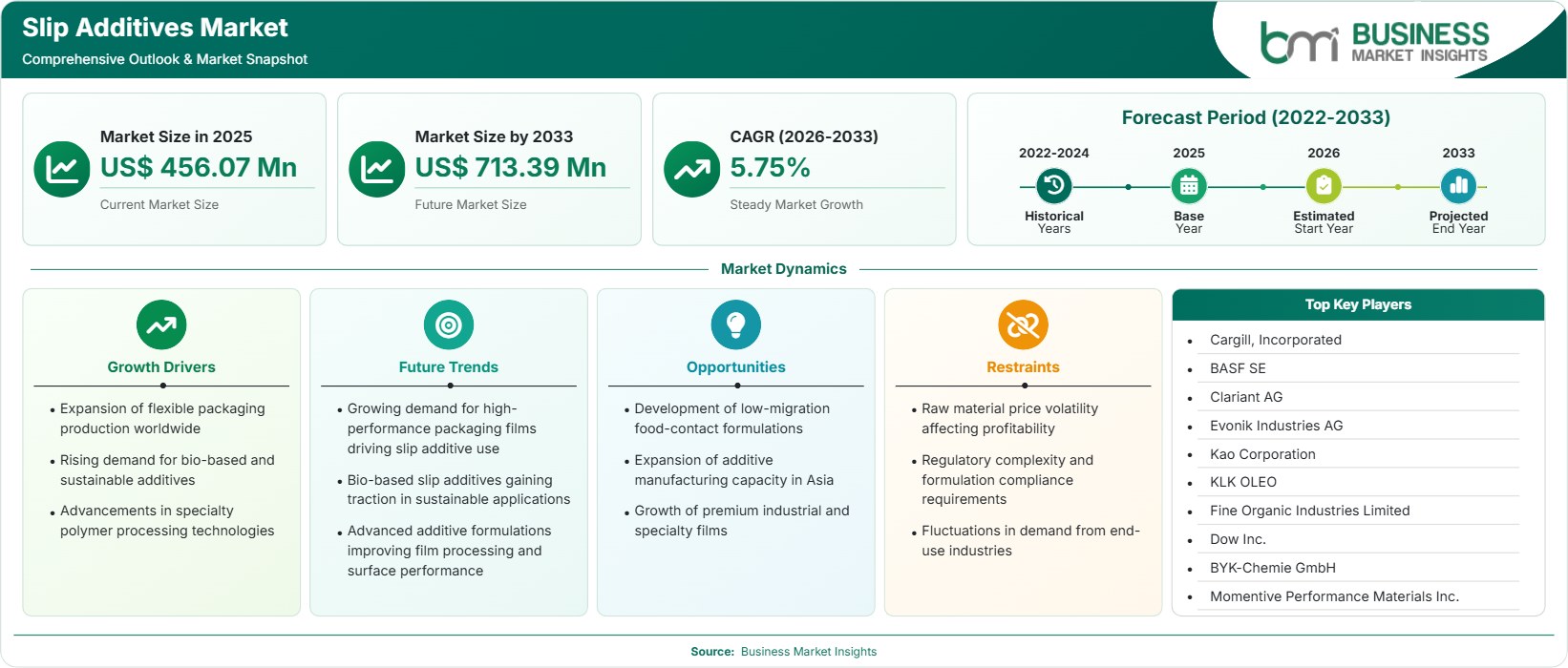
The Slip Additives Market size was valued at US$ 456.07 million in 2025 and is projected to reach US$ 713.39 million by 2033, growing at a CAGR of 5.75% during 2026–2033. Rising flexible packaging demand, growth in polyolefin processing, increasing use of specialty films, and expanding bio-based additive development are creating substantial opportunities across packaging, industrial, and consumer applications.

Report Coverage
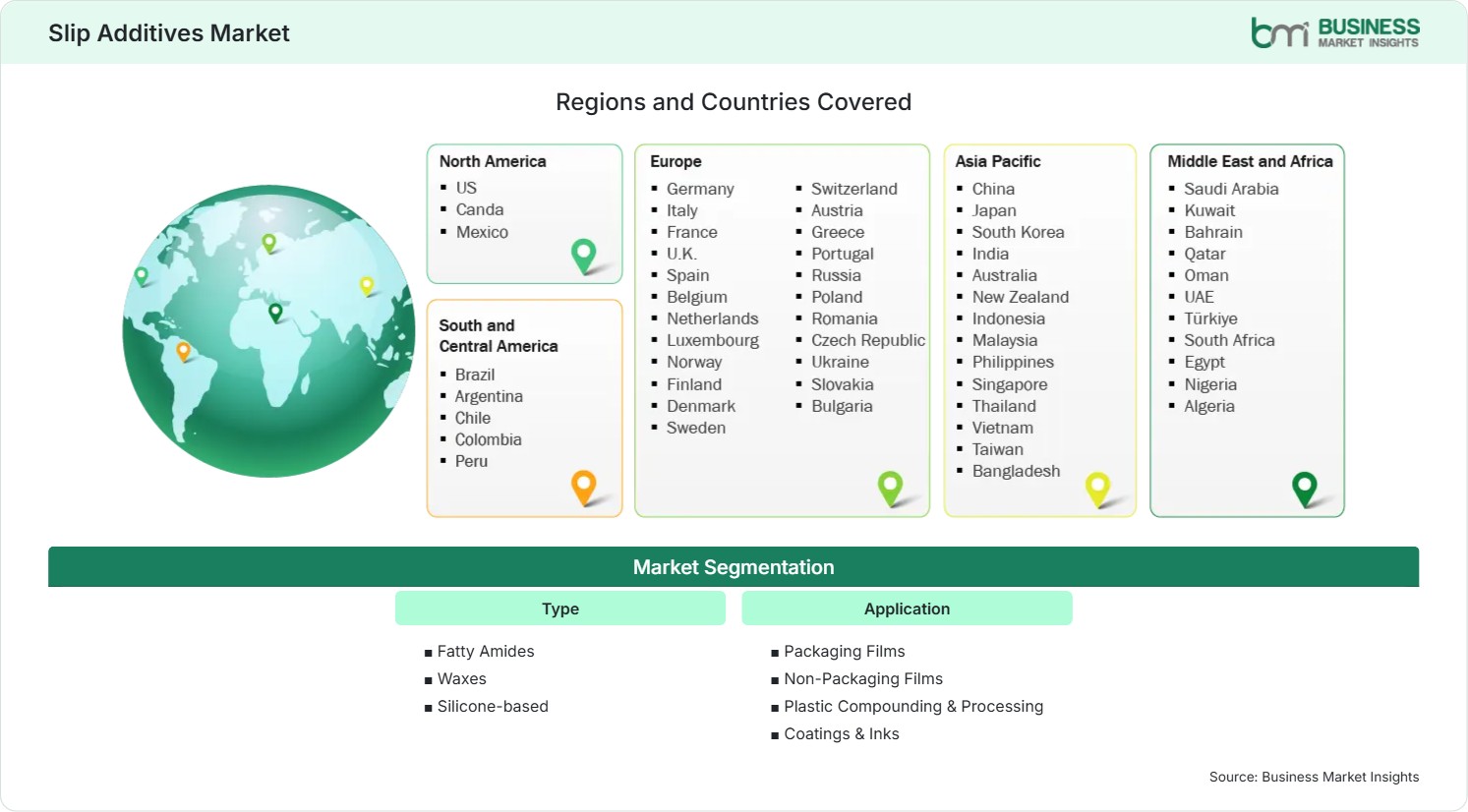
  • Type: Fatty Amides, Waxes, Silicone-based
  • Application: Packaging Films, Non-Packaging Films, Plastic Compounding & Processing, Coatings & Inks
US$ 456.07 Mn Market size in 2025
US$ 713.39 Mn Market Size by 2033
5.75% CAGR, 2026 - 2033
2026-2033 Forecast Period

AI Overview

Slip Additives Market Summary

  • North America Region: North America holds a market share of 24%–27% in 2025, growing with a CAGR of 5.2%–5.6% during 2026–2033. Demand is supported by advanced packaging conversion, food-contact compliant additives, specialty polymer processing, sustainable film manufacturing investments, and growing adoption of premium surface-modification technologies across industrial applications. The U.S. market benefits from strong packaging innovation and specialty polymer demand, expanding at approximately 5.3%–5.7% CAGR.
  • Fastest Growing Region: Asia Pacific holds a market share of 42%–45% in 2025, growing with a CAGR of 6.4%–6.8% during 2026–2033. Expanding flexible packaging production, industrialization, polymer processing investments, consumer goods manufacturing growth, and increasing local additive manufacturing capacity continue creating strong regional opportunities.
  • Leading Segment: Packaging Films account for 44%–47% share in 2025 and are expected to grow at 5.8%–6.2% CAGR in slip additives market. Strong utilization in food packaging, BOPP films, multilayer structures, e-commerce packaging formats, and efficiency-focused film converting operations sustains segment leadership.
  • High Growth Segment: Silicone-based additives account for 17%–20% share in 2025 and are projected to grow at 6.8%–7.3% CAGR. Rising demand for permanent slip performance, low migration characteristics, scratch resistance, and premium surface properties supports accelerated adoption.
  • Key Market Opportunity: Growing investment in bio-based oleochemical additives and low-migration formulations enables manufacturers to address sustainability requirements, food-contact regulations, circular packaging objectives, and premium-performance applications across multiple polymer systems.
  • Major Market Players: Cargill, Incorporated, BASF SE, Clariant AG, Evonik Industries AG, Kao Corporation, KLK OLEO, Fine Organic Industries Limited, Dow Inc., BYK-Chemie GmbH, and Momentive Performance Materials Inc.
Strategic Insights

Slip Additives Market: Strategic Insights

Slip Additives Market Strategic Framework
FREE PDF
Request your free sample
Request free sample
Stakeholder View

Key Takeaways

  • The value chain of the industry is becoming highly integrated with oleochemicals providers, specialty chemicals producers, masterbatches, film processing facilities, and packaging converters working together to enhance surface performance characteristics and processing efficiency.
  • Packaging films continue being the key source of revenues, while silicone chemistry represents the highest growth potential due to demands for premium slip characteristics and low migration capability.
  • Innovation efforts of the industry are now focusing on development of bio-based erucamide, specialty amide, PFAS-free processing aids, and permanent slip solutions which are helping to enhance sustainability profiles without sacrificing processing performance.
  • Asia Pacific region represents the best investment opportunity due to growth in packaging production, increase in polymer usage and local production of specialty chemicals.
  • Acquisition activities and portfolio expansion of specialty chemical firms are enhancing their access to high-value-added polymer additives and surface modification technology.
  • Regulatory pressures in food packaging market segment and sustainability goals are driving greater adoption of custom additive systems suitable for specific polymers.
Geographic Outlook

Slip Additives Market Regional Highlights

North America Slip Additives Market

North America accounted for approximately 24%–27% Slip Additives Market share in 2025 and is projected to expand at a CAGR of 5.2%–5.6% through 2033. Demand is supported by sophisticated packaging supply chains, food-grade polymer processing, and strong adoption of specialty additives. The region benefits from advanced film-converting capabilities and continuous innovation in sustainable packaging materials. Growth remains supported by investments in high-performance plastics and increasing requirements for processing efficiency across industrial applications.

  • The manufacturers of food packaging are making efforts to incorporate low migration additives as per regulations and at the same time keeping up the converting efficiencies.
  • Growth in the use of specialty polyethylene and polypropylene films drives the demand for superior friction management systems.
  • The focus on sustainability promotes the use of bio-based additives, especially in consumer goods and food packaging industries.
  • Automation and investments in high-speed film lines need better coefficient of friction control, which drives the demand for superior additive formulations.

US Slip Additives Market

The U.S. represented approximately 78%–82% of regional revenue in 2025 and is expected to grow at 5.3%–5.7% CAGR. Strong packaging innovation, advanced extrusion infrastructure, and increasing demand for specialty films support market expansion. Food packaging, healthcare packaging, and industrial film applications continue driving additive consumption. Domestic investments in sustainable materials and localized chemical manufacturing strengthen long-term competitiveness while supporting technology development for high-performance polymer applications.

  • High-end packaging converters are embracing superior additive packages to increase efficiency, reduce downtime, and ensure consistent surface performance.
  • E-commerce packaging trends drive increasing use of polyethylene and polypropylene films that need optimal slips.
  • Extensive specialty chemicals environment facilitates quick commercialization of additives for sustainability and regulatory compliance.

Europe Slip Additives Market

Europe held approximately 22%–25% share in 2025 and is projected to register 5.0%–5.4% CAGR through 2033. Germany remains the leading regional market, while Poland and other Central European countries represent higher-growth opportunities. Sustainability legislation, recycling initiatives, and advanced polymer processing capabilities support regional demand. Manufacturers increasingly focus on low-migration and bio-based technologies aligned with circular economy goals, creating favorable conditions for premium additive adoption.

  • Germany maintains leadership through extensive plastics processing capabilities, specialty chemical expertise, and strong packaging manufacturing infrastructure.
  • Poland is emerging as a high-growth market due to expanding packaging production and increasing foreign direct investment in manufacturing.
  • Regulatory emphasis on recyclable packaging structures drives innovation in additive systems compatible with circular-material objectives.
  • Food-contact compliance requirements encourage adoption of advanced specialty formulations with improved migration characteristics and process stability.

Asia Pacific Slip Additives Market

Asia Pacific accounted for 42%–45% share in 2025 and remains the fastest-growing region with a CAGR of 6.4%–6.8%. China leads regional demand, while India exhibits the highest growth momentum. Expansion of flexible packaging production, rapid industrialization, and rising consumer goods manufacturing underpin growth. Increasing investments in local additive production and polymer processing capacity further strengthen regional competitiveness while supporting long-term consumption across packaging and industrial applications.

  • China remains the largest market due to extensive polymer processing capacity and substantial flexible packaging production volumes.
  • India demonstrates strong growth supported by packaging modernization, food processing expansion, and increasing domestic manufacturing activity.
  • Southeast Asian countries are attracting investment in packaging conversion facilities serving regional consumer and export markets.
  • Rising middle-class consumption drives demand for packaged goods, increasing utilization of specialty additives across film applications.
  • Local production investments improve supply-chain resilience and reduce dependence on imported specialty chemical products.

Rest of World Slip Additives Market

South and Central America account for an important share of regional demand, supported by packaging industry expansion in Brazil and Mexico. The Middle East and Africa benefit from growing polymer production capacity and industrial diversification initiatives.

The broader region collectively represents 9%–12% share in 2025 and is expected to grow at 5.5%–5.9% CAGR. Brazil remains the largest market, while Saudi Arabia demonstrates stronger growth potential due to downstream petrochemical investments and packaging manufacturing development.

  • Brazil benefits from a large consumer market and expanding food packaging sector requiring enhanced film-processing performance.
  • Mexico gains from nearshoring trends and integration with North American manufacturing supply chains.
  • Saudi Arabia supports downstream plastics development through strategic petrochemical investments and industrial diversification programs.
  • Demand for packaged consumer goods across emerging economies continues supporting adoption of advanced polymer additive technologies.
Global Market Geography
FREE PDF
Request your free sample
Request free sample
Segment Analysis

Slip Additives Market Segmentation

Type

The Type segment represented a significant portion of industry revenue in 2025. Fatty amides-maintained leadership with approximately 46%–49% share, while silicone-based technologies recorded the fastest growth at 6.8%–7.3% CAGR. The Slip Additives Market scope continues expanding through demand for improved film handling, lower friction coefficients, enhanced processing efficiency, and sustainable additive solutions across multiple polymer systems.

  • Fatty Amides: Widely used in polyethylene and polypropylene applications due to cost-effectiveness, excellent slip performance, broad compatibility, and strong acceptance across packaging, agricultural film, and industrial processing operations.
  • Waxes: Utilized to improve surface smoothness, lubrication, dispersion efficiency, and processing stability, particularly in applications requiring balanced performance and economical formulation strategies.
  • Silicone-based: Increasingly adopted where permanent slip properties, low migration characteristics, enhanced scratch resistance, and premium surface performance are required across specialty polymer applications.

Application

Application demand remains dominated by packaging-related uses. Packaging Films accounted for approximately 44%–47% market share in 2025 and are projected to grow at 5.8%–6.2% CAGR. Slip Additives Market trends indicate increasing consumption in multilayer structures, flexible packaging, and high-speed converting operations where friction management directly influences productivity, product quality, and processing economics.

  • Packaging Films: Strong demand from food packaging, consumer goods packaging, and e-commerce logistics applications requiring optimized machinability and efficient film handling performance.
  • Non-Packaging Films: Growth is supported by agricultural, industrial, construction, and specialty film applications requiring durable surface-performance characteristics and reliable processing efficiency.
  • Plastic Compounding & Processing: Increasing use in engineered plastics and masterbatch production enhances processing stability, mold release performance, and finished-product surface quality.
  • Coatings & Inks: Adoption is driven by requirements for rub resistance, print quality enhancement, surface smoothness, and improved performance on polymer substrates.
Market Forces

Slip Additives Market Dynamics

Key Market Drivers

Expansion of flexible packaging production worldwide

Global packaging demand continues rising alongside urbanization, food processing growth, and e-commerce expansion. Industry sources indicate flexible packaging remains among the fastest-growing packaging formats worldwide. Packaging films represent the largest application segment for slip technologies because friction control directly affects film winding, converting efficiency, and production speeds. Slip Additives Market growth is increasingly linked to rising consumption of polyethylene and polypropylene films used across food, healthcare, and consumer packaging. Manufacturers are investing in advanced additive systems that improve process stability while maintaining sealability and printability. As packaging producers seek higher operational efficiency, adoption of specialized friction-control additives continues accelerating across major manufacturing regions.

Rising demand for bio-based and sustainable additives

Sustainability commitments are reshaping raw-material sourcing across the specialty chemicals industry. Bio-based erucamide and oleamide technologies derived from vegetable feedstocks are gaining importance as manufacturers seek lower environmental footprints. Fine Organic Industries and other suppliers continue expanding vegetable-based additive portfolios for film applications. Regulatory focus on food-contact safety and migration performance further supports adoption of advanced formulations. Slip Additives Market trends increasingly favor renewable-feedstock solutions that provide comparable processing performance to conventional products. Companies able to deliver sustainable chemistry without sacrificing friction-control efficiency are strengthening competitive positions and capturing premium application opportunities across packaging and industrial markets.

Advancements in specialty polymer processing technologies

High speed extrusion, multilayer films and more complex converting processes need accurate coefficient of friction management. Current production systems work with much higher productivity rates, thereby making the consistency of additives an essential aspect of the whole operation. New additive systems developed by additive producers allow reducing downtime, increasing productivity and providing better surface quality. PFAS-free processing and permanent slip are now becoming interesting to the companies working on sustainability goals. The continuous investments into the development of specialty plastics, engineered polymers and advanced package constructions ensure steady demand for additives in the future.

Key Market Opportunities

Development of low-migration food-contact formulations

Food packaging regulations continue becoming more stringent across major economies. This creates opportunities for additive manufacturers to develop low-migration technologies that maintain performance while satisfying regulatory requirements. Advanced silicone and specialty amide formulations can help converters achieve food-contact compliance without compromising process efficiency. Slip Additives Market Forecasts indicate growing demand for premium solutions capable of balancing sustainability, safety, and functionality. Investment in application-specific R&D enables suppliers to differentiate offerings and secure long-term partnerships with global packaging companies. As packaged food consumption expands worldwide, demand for compliant and high-performance additive technologies is expected to strengthen considerably across key end-use industries.

Expansion of additive manufacturing capacity in Asia

Specialty Chemicals, Polymer Processing, and Packaging Conversion are receiving substantial investments in the Asia Pacific region. Manufacturing close to the customers lowers lead time, increases reliability, and satisfies regional needs. Some of the countries that are developing manufacturing capabilities in various types of additives include China, India, Malaysia, and Vietnam. Local suppliers benefit greatly by establishing local manufacturing plants, which offer better access to fast-growing markets for both packaging and industry. The governments of such regions are also offering incentives in terms of infrastructure and industrial development.

Growth of premium industrial and specialty films

The films utilized for agricultural purposes, construction, electronic goods, and special purposes demand higher levels of surface performance. The need for films with durability, ease of handling, enhanced scratch resistance and ease of processing opens up possibilities for value-added films. The silicone-based technologies, especially, find themselves very well suited for meeting these needs owing to their slip performance and low migration properties. Film producers can take advantage of customization of their additive formulations based on end-use requirements and hence earn premium prices as well as better customer relations.

Market Restraints and Challenges

Raw material price volatility affecting profitability

Factor: Feedstocks used in fatty amides and specialty additives remain exposed to fluctuations in vegetable oils, petrochemical derivatives, and energy costs. Impact: Maintaining stability of margins and pricing is difficult for manufacturers. Variation in the cost of agriculture raw materials impacts the economics of oleochemical manufacturing; however, variation in petrochemicals impacts the cost of synthetic additives. Price changes are resisted by customers, which puts profit at risk. This problem is especially challenging for small manufacturers that lack purchasing power and flexibility of inventory. Variability may result in the postponement of purchases by converters and compounders.

Regulatory complexity and formulation compliance requirements

Factor: Global regulations governing food-contact materials, migration limits, sustainability disclosures, and chemical registrations continue evolving. Impact: The product development cycle becomes lengthier while compliance costs rise. Companies have to undertake testing, documenting, certifying, and reformulating operations in order to be able to gain market access. Jurisdictional differences create a difficult situation for multinational firms with international portfolios of products. It is possible that small businesses encounter limitations when they try to meet different compliance needs. These needs might delay innovation and increase costs.

Company Analysis

Competitive Landscape

Slip Additives Market analysis indicates competition is driven by oleochemical expertise, specialty additive innovation, regulatory compliance capabilities, and global distribution networks.

Company Name

Overview

Products and Services relevant to this market

Cargill, Incorporated

Global agribusiness and ingredients company with strong oleochemical capabilities supporting specialty additive applications.

Bio-based fatty amides, oleochemical intermediates, renewable feedstocks, and specialty ingredients for polymer processing applications.

BASF SE

Major specialty chemicals producer with extensive additives portfolio and global manufacturing footprint.

Polymer additives, processing aids, surface modifiers, specialty chemicals, and packaging-focused additive technologies.

Clariant AG

Swiss specialty chemicals company with established additives business serving plastics industries worldwide.

Performance additives, polymer-processing solutions, specialty formulations, and application-focused additive technologies.

Evonik Industries AG

Leading specialty chemicals supplier with strong materials and additive innovation capabilities.

High-performance additives, specialty silicones, processing aids, and advanced surface-modification solutions.

Kao Corporation

Global chemical producer with expertise in oleochemical-derived specialty ingredients and additives.

Fatty amide derivatives, specialty chemicals, surface-active materials, and polymer additive ingredients.

KLK OLEO

Integrated oleochemical manufacturer serving industrial and specialty chemical markets globally.

Oleochemical feedstocks, fatty acid derivatives, amides, and specialty ingredients for polymer formulations.

Fine Organic Industries Limited

Leading producer of polymer additives with strong presence in slip-agent technologies.

Erucamide, oleamide, specialty lubricants, anti-block additives, and processing-performance solutions.

Dow Inc.

Diversified materials science company supporting packaging and plastics industries worldwide.

Specialty polymers, packaging materials, processing technologies, and performance-enhancing additives.

BYK-Chemie GmbH

Specialty additives company focused on advanced material-performance solutions.

PFAS-free processing aids, surface modifiers, plastics additives, and specialty performance technologies.

Momentive Performance Materials Inc.

Global silicone technology provider serving industrial and specialty applications.

Silicone-based slip additives, surface-performance solutions, specialty silicones, and formulation support.

Trust & Transparency

Research Methodology

The market analysis combines proprietary research with secondary data from government agencies, company disclosures, regulatory filings, industry databases and expert interviews. Market estimates are validated through data triangulation, cross-market benchmarking and analyst review.

View Full Research Methodology

Questions Answered

Frequently Asked Questions

What does a Slip Additives Market Report typically evaluate?

A comprehensive report examines market size, competitive positioning, technology trends, regulatory developments, regional demand patterns, segmentation performance, and long-term growth opportunities.

Which region offers the strongest long-term investment potential?

Asia Pacific provides the strongest opportunity due to rapid industrialization, expanding packaging production, rising polymer consumption, and increasing domestic specialty chemical manufacturing.

How are sustainability goals influencing product development?

Manufacturers are increasing investments in bio-based feedstocks, low-migration formulations, PFAS-free technologies, and solutions compatible with circular packaging objectives.

What makes fatty amides the dominant product category?

Fatty amides provide an attractive balance of performance, compatibility, availability, and cost-effectiveness across polyethylene and polypropylene processing applications.

What factors are shaping future demand for slip additives?

Growth in flexible packaging, specialty films, food-contact applications, and sustainable polymer processing are the most influential demand drivers through 2033.

Access the Full Slip Additives Market Report

Get segment-level forecasts, regional estimates, competitive benchmarking, company profiles and downloadable Excel datasets.

Access the full Slip Additives Market Report
350 pages PDF & Excel | 2026-08-24