
Cement Additives Market Outlook: Size, Share, Trends, Growth Analysis, Competitive Landscape & Forecast, 2026-2033

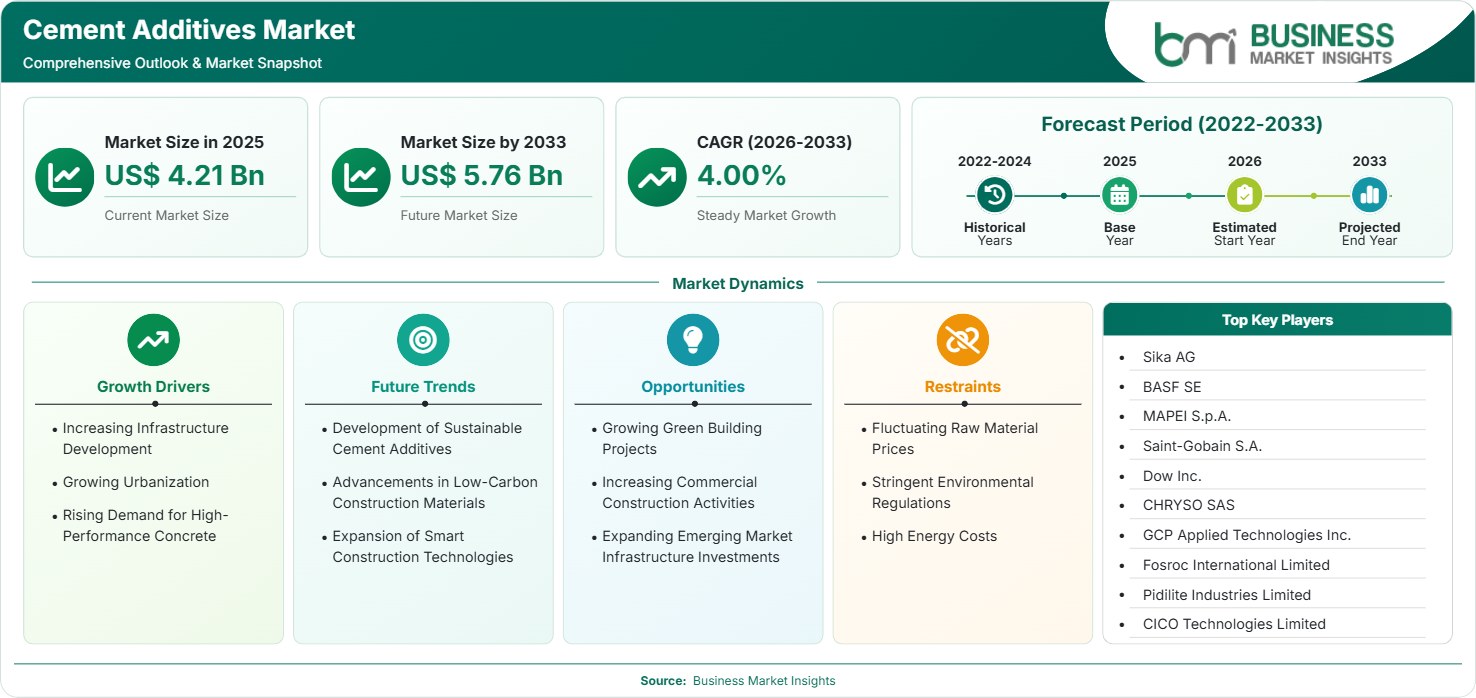
The Cement Additives Market size was valued at US$ 4.21 Billion in 2025 and is projected to reach US$ 5.76 Billion by 2033, growing at a CAGR of 4.00% during 2026–2033. Rising infrastructure development, accelerating urbanization, increasing demand for durable construction materials, sustainable cement manufacturing, and expanding green building investments continue creating attractive opportunities for advanced cement additive technologies.

Report Coverage
  • Type: Grinding Aids, Performance & Strength Enhancers, Others
  • Application: Portland Cement, Blended Cement, Others
US$ 4.21 Bn Market size in 2025
US$ 5.76 Bn Market Size by 2033
4.00% CAGR, 2026 - 2033
2026-2033 Forecast Period

AI Overview

Cement Additives Market Summary

  • North America Region: North America holds 30%–33% market share in 2025, expanding at a 3.4%–3.8% CAGR during 2026–2033. Demand is supported by infrastructure rehabilitation, sustainable construction initiatives, and adoption of premium concrete technologies across commercial and industrial developments. The U.S. remains the regional leader, supported by transportation investments and modernization projects, recording a CAGR of 3.5%–3.9%.
  • Fastest Growing Region: Asia Pacific accounts for 34%–37% market share in 2025 and is projected to expand at a 4.8%–5.3% CAGR through 2033. Large-scale infrastructure spending, urban housing programs, industrial expansion, and government-backed smart city developments continue stimulating demand across regional cement manufacturers.
  • Leading Segment: Grinding Aids represent 43%–46% market share in 2025 and are anticipated to grow at a 3.9%–4.3% CAGR. Their ability to improve mill efficiency, reduce energy consumption, enhance production throughput, and optimize cement quality encourages widespread adoption among manufacturers.
  • High Growth Segment: Blended Cement accounts for 35%–38% market share in 2025 while advancing at a 4.7%–5.1% CAGR. Sustainability objectives, lower clinker consumption, improved durability, and carbon emission reduction initiatives continue strengthening demand across commercial construction applications.
  • Key Market Opportunity: Growing investment in low-carbon cement technologies, supplementary cementitious materials, digital process optimization, and performance-enhancing additives enables manufacturers to improve production efficiency while supporting global sustainability commitments and long-term infrastructure expansion.
  • Major Market Players: Sika AG, BASF SE, MAPEI S.p.A., Saint-Gobain S.A., Dow Inc., CHRYSO SAS, GCP Applied Technologies Inc., Fosroc International Limited, Pidilite Industries Limited, and CICO Technologies Limited.
Strategic Insights

Cement Additives Market: Strategic Insights

Cement Additives Market Strategic Framework
FREE PDF
Request your free sample
Request free sample
Stakeholder View

Key Takeaways

  • Value chain in the industry is increasingly merging with chemical producers, cement companies, construction firms, and infrastructure development firms, thereby fostering innovation to improve production processes.
  • Blended cement applications present attractive long-term growth opportunities because governments increasingly encourage lower-carbon construction materials that reduce clinker utilization.
  • Innovation is increasingly moving towards multi-functional additives that can optimize the processes of grinding, hydration, compressive strength, durability, and environmental performance using improved chemical formulations.
  • Asia Pacific remains the most attractive regional investment destination as governments continue funding transportation infrastructure, urban development, industrial corridors, renewable energy facilities, and affordable housing projects requiring high-performance cement products.
  • Acquisitions and partnerships in technology continue to be competitive moves in order to achieve wider product range, improved distribution channels, manufacturing capabilities and sustainable practices.
Geographic Outlook

Cement Additives Market Regional Highlights

North America Cement Additives Market

North America accounts for 30%–33% of global demand in 2025 and is projected to expand at a 3.4%–3.8% CAGR through 2033. The region benefits from aging infrastructure rehabilitation, commercial redevelopment, and increasing investment in resilient transportation networks. The Cement Additives Market share remains supported by advanced manufacturing capabilities, widespread adoption of specialty construction chemicals, and ongoing modernization of cement production facilities.

  • Federal infrastructure funding continues accelerating highway, bridge, airport, and public transit projects, encouraging cement manufacturers to increase adoption of grinding aids and performance-enhancing additives for improved operational efficiency and product consistency.
  • Sustainability regulations encourage cement producers to reduce greenhouse gas emissions through energy-efficient manufacturing processes, supplementary cementitious materials, and advanced additive technologies supporting lower clinker utilization and enhanced durability.
  • Digital manufacturing technologies, automated quality monitoring, and process optimization software enable manufacturers to improve production efficiency while maintaining consistent cement performance across large-scale infrastructure and commercial construction projects.
  • Growing commercial renovation activities and industrial facility expansion continue supporting premium cement demand, particularly for high-strength concrete applications requiring specialized additives that improve workability, durability, and long-term structural performance.

US Cement Additives Market

The United States contributes 31%–34% of North American demand and is expected to register a 3.5%–3.9% CAGR through 2033. Federal infrastructure legislation, modernization of transportation systems, and industrial expansion continue supporting cement production. Manufacturers increasingly adopt advanced additives to improve milling efficiency, reduce production costs, and comply with environmental regulations while meeting demand for durable construction materials.

  • Transportation modernization projects generate significant cement demand across highways, railways, ports, and airport construction, encouraging wider utilization of performance-enhancing additive technologies.
  • Sustainable commercial construction increasingly specifies blended cement formulations supported by chemical additives that enhance mechanical strength while reducing lifecycle environmental impact.
  • Modern cement manufacturing plants continue investing in automation, predictive maintenance, and advanced process controls to maximize additive effectiveness and improve operational productivity.
  • Industrial expansion across manufacturing, logistics, and energy sectors continues driving consistent demand for specialty cement products designed for high-performance structural applications.

Europe Cement Additives Market

Europe represents 24%–27% Cement Additives Market share in 2025 while advancing at a 3.6%–4.0% CAGR during the forecast period. Germany remains the leading regional market due to advanced industrial infrastructure, while Eastern European countries record stronger growth supported by infrastructure modernization and increased construction investment.

  • European cement producers increasingly utilize additives compatible with supplementary cementitious materials, supporting decarbonization strategies while maintaining high-quality structural performance across infrastructure developments.
  • Germany leads regional innovation through advanced cement technologies, whereas Poland and Romania demonstrate faster growth supported by transportation and residential infrastructure investments.
  • Energy efficiency improvements remain a major priority as manufacturers deploy grinding aids that reduce electricity consumption while improving production throughput and operational profitability.
  • Public infrastructure renovation funded through regional development programs continues expanding demand for durable, environmentally responsible cement formulations across transportation and civic construction.

Asia Pacific Cement Additives Market

Asia Pacific holds 34%–37% Cement Additives Market share during 2025 and records the highest regional CAGR of 4.8%–5.3% through 2033. Rapid industrialization, urban population growth, and substantial infrastructure investment continue driving cement consumption. China remains the largest regional producer, while India records the fastest expansion due to affordable housing initiatives, industrial corridor development, and transportation infrastructure construction.

  • Government-supported smart city projects continue increasing cement consumption while encouraging manufacturers to improve production efficiency using advanced grinding and performance-enhancing additive technologies.
  • China maintains regional leadership through extensive cement manufacturing capacity, whereas India experiences stronger growth driven by highways, metro rail systems, renewable energy infrastructure, and housing developments.
  • Rising private investment in industrial parks, logistics facilities, and commercial real estate strengthens demand for premium cement products offering superior durability and structural performance.
  • Environmental regulations across regional markets encourage adoption of blended cement technologies supported by innovative additives capable of reducing emissions and improving manufacturing efficiency.

Rest of World Cement Additives Market

The Rest of World region is projected to expand at a 4.2%–4.6% CAGR throughout the forecast period as governments prioritize infrastructure modernization, industrial diversification, and urban development. South & Central America experiences increasing construction activity supported by transportation and housing investments, while Middle East & Africa benefits from megaproject developments, industrial expansion, and tourism infrastructure.

  • Brazil leads South & Central America through transportation modernization and residential development, while Colombia demonstrates faster expansion supported by commercial infrastructure investment.
  • Saudi Arabia leads Middle Eastern demand through large-scale economic diversification projects, whereas the United Arab Emirates continues investing in commercial and tourism infrastructure requiring premium cement materials.
  • African economies increasingly prioritize affordable housing, transport corridors, and industrial infrastructure, supporting wider adoption of efficient cement manufacturing technologies.
  • International development funding and public-private partnerships continue strengthening cement demand across emerging economies, encouraging investment in advanced additive manufacturing capabilities.
  • Sustainability initiatives and modernization of cement production facilities support long-term adoption of environmentally responsible additive technologies throughout developing construction markets.
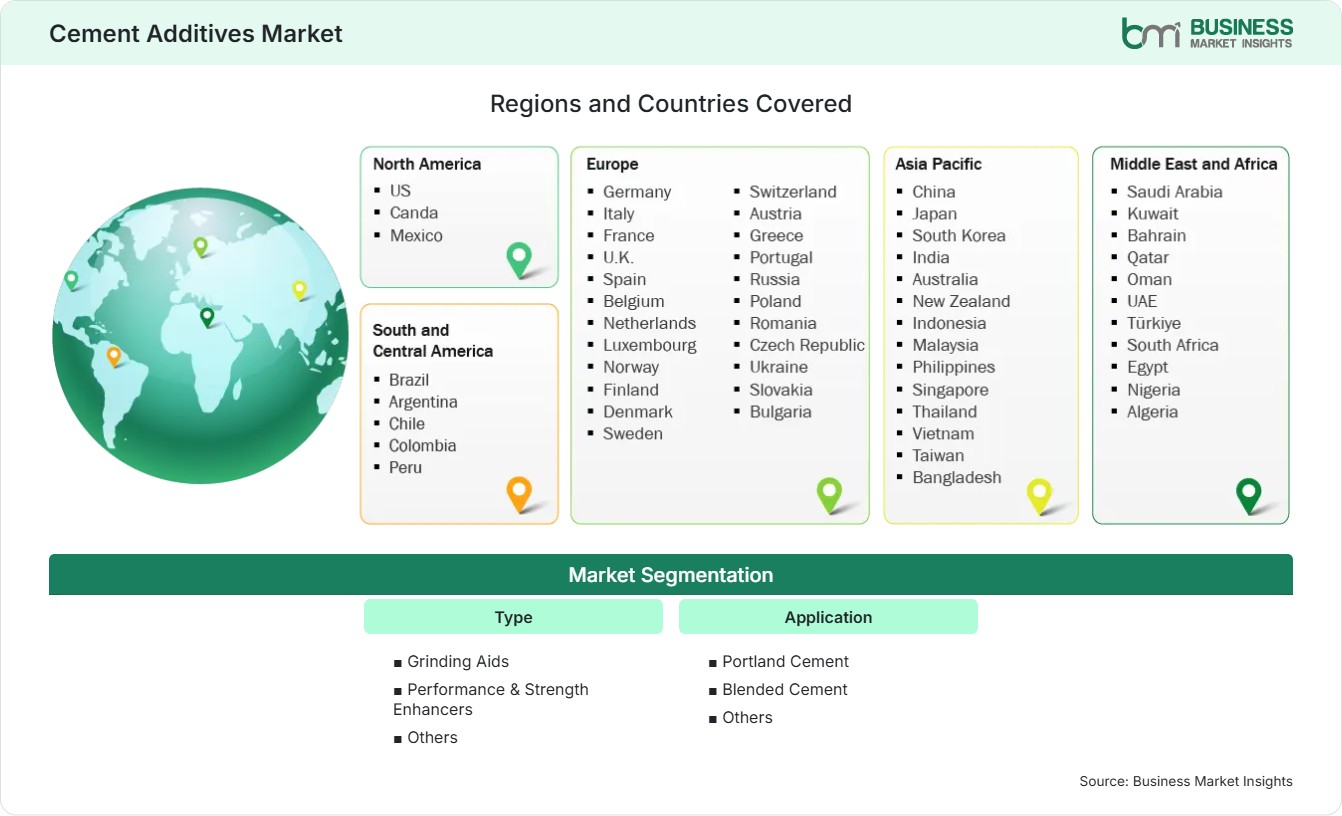
Global Market Geography
FREE PDF
Request your free sample
Request free sample
Segment Analysis

Cement Additives Market Segmentation

Type

The Type segment accounted for 58%–61% market share in 2025 and is projected to expand at a 3.9%–4.4% CAGR during 2026–2033. Product innovation focuses on improving grinding efficiency, reducing production costs, enhancing cement quality, and lowering energy consumption. The Cement Additives Market scope continues expanding as manufacturers develop multifunctional formulations that simultaneously improve mill productivity, clinker substitution compatibility, strength development, and environmental performance across modern cement manufacturing facilities.

  • Grinding Aids: Represent the largest product category due to their ability to reduce particle agglomeration, improve grinding efficiency, lower electricity consumption, and increase cement mill productivity while maintaining consistent product quality.
  • Performance & Strength Enhancers: Experience rising adoption as infrastructure projects increasingly demand cement offering superior compressive strength, durability, hydration efficiency, crack resistance, and long-term structural reliability under challenging environmental conditions.
  • Others: Includes specialty additives developed for setting control, water reduction, rheology improvement, and customized manufacturing requirements supporting niche construction applications and premium cement formulations across industrial projects.

Application

Application remains a critical demand indicator, representing 39%–42% market share in 2025 while growing at a 4.2%–4.7% CAGR through 2033. Expanding infrastructure investment, stricter environmental standards, and sustainable construction practices continue encouraging adoption of additive-enhanced cement products. The segment also reflects evolving Cement Additives Market trends, particularly the transition toward lower-carbon cement formulations supporting improved operational efficiency and environmental compliance.

  • Portland Cement: Continues generating significant demand because of its extensive use across residential, commercial, industrial, and transportation infrastructure requiring reliable performance, consistent quality, and compatibility with modern additive technologies.
  • Blended Cement: Records the fastest expansion as governments and contractors increasingly prioritize sustainable construction materials capable of reducing clinker consumption while maintaining mechanical performance, durability, and environmental efficiency.
  • Others: Covers specialized cement formulations designed for oil wells, marine structures, precast components, mining applications, and high-performance engineering projects requiring customized additive combinations for demanding operating environments.
Market Forces

Cement Additives Market Dynamics

Key Market Drivers

Increasing Infrastructure Development

Governments worldwide continue increasing investments in transportation corridors, airports, ports, industrial facilities, renewable energy projects, and public utilities, directly supporting cement consumption. As per international trends on investments in infrastructure made by multilateral development organizations, emerging nations are still investing heavily in infrastructure modernization budgets. This creates an increasing demand for additives which will increase the efficiency of production, require less grinding energy, and increase the longevity of the cement produced. The Cement Additives Market growth is driven even more as producers try to use efficient technologies that will increase mill efficiency while still maintaining product uniformity and adhering to changing environmental standards.

Growing Urbanization

Urban populations continue expanding rapidly, particularly across Asia Pacific, Africa, and Latin America, creating sustained demand for residential housing, commercial buildings, healthcare facilities, educational institutions, and transportation infrastructure. The cement industry is incorporating advanced additives that will enhance the efficiency of its operations, despite the increased output. Better grinding performance, better hydration properties, and improved cement quality make it possible for cement manufacturers to facilitate expansion of urban construction activities at reduced cost and impact on the environment.

Rising Demand for High-Performance Concrete

Modern construction increasingly requires concrete capable of delivering higher compressive strength, improved durability, longer service life, and resistance to aggressive environmental conditions. High-rise buildings, bridges, tunnels, marine structures, and industries call for quality cement production using high-level additives. Companies conduct research in order to appear with new technology of chemicals that will help to increase the workability of the product, minimize permeability, and optimize the engineering performance of the structure in the long term. These innovations strengthen competitive differentiation while supporting infrastructure resilience and sustainable building objectives.

Key Market Opportunities

Growing Green Building Projects

Global green construction initiatives continue encouraging adoption of sustainable cement technologies capable of lowering embodied carbon while maintaining structural performance. Green building certification programs reward construction materials that lessen their impact on the environment due to decreased use of clinker and efficient manufacturing processes. Cement Additives Market Forecast shows growth in demand for innovative additives used in the manufacture of blended cement, efficient grinding processes, and reduced greenhouse gas emissions. Companies that focus on green product offerings stand to gain competitive advantages and comply with the set government procurement standards for sustainability.

Increasing Commercial Construction Activities

Commercial real estate development continues expanding across logistics facilities, industrial parks, data centers, healthcare infrastructure, hospitality projects, and mixed-use developments. Such projects increasingly involve high-end concrete solutions that have greater durability, improved mechanical strength, and enhanced performance during their lifecycle. Additives to cement that can enhance the production process and concrete performance represent promising business ventures for firms that want unique products. Increasing investments in the construction industry by the private sector in emerging markets provide a solid foundation for the growth of additive technology aimed at commercial applications.

Expanding Emerging Market Infrastructure Investments

Rapid economic development across Asia, Africa, and Latin America continues to stimulate investment in transportation, energy generation, water management, industrial facilities, and affordable housing. International financing institutions and public-private partnerships increasingly support these infrastructure initiatives. Regional manufacturing capabilities by cement producers and regional formulations for additives enable them to benefit from increased building activity while overcoming differences in the nature of materials as well as regional regulations. Localized manufacturing also helps to build better supply chains, reduce costs of transport, and nurture customer relationships in emerging economies.

Market Restraints and Challenges

Fluctuating Raw Material Prices

Factor: Volatility in petrochemical feedstocks, specialty chemicals, and energy costs significantly influences additive manufacturing expenses and production planning. Impact: Manufacturers experience margin pressure, pricing uncertainty, and procurement challenges that may reduce profitability or limit investment in research, production expansion, and innovation. Producers must continuously balance production efficiency, customer pricing expectations, and raw material procurement strategies to maintain stable operations under changing global commodity market conditions.

Stringent Environmental Regulations

Factor: Increasing environmental regulations governing industrial emissions, chemical usage, manufacturing processes, and carbon reduction require continuous technological upgrades and regulatory compliance investments. Impact: Compliance costs increase operational expenditure while extending product development timelines and certification requirements. Manufacturers must invest in cleaner production technologies, environmentally compatible formulations, and sustainable manufacturing practices to remain competitive.

Company Analysis

Competitive Landscape

The Cement Additives Market analysis is characterized by continuous product innovation, sustainability-focused research, regional manufacturing expansion, and strategic collaborations between construction chemical suppliers and cement producers. Leading companies are strengthening their portfolios through advanced grinding aids, performance enhancers, and low-carbon additive technologies.

Company Name

Overview

Products and Services Relevant to this Market

Sika AG

Global specialty chemicals company serving construction and industrial markets through innovative concrete, mortar, and cement technologies.

Cement grinding aids, performance enhancers, concrete admixtures, waterproofing systems, repair solutions, and technical services for cement manufacturing.

BASF SE

International chemical manufacturer with a broad portfolio supporting construction materials, industrial chemicals, and sustainable manufacturing technologies.

Cement additives, grinding aids, performance chemicals, construction solutions, concrete admixtures, and sustainable material technologies.

MAPEI S.p.A.

Leading producer of construction chemicals with strong expertise in cement production optimization and specialty building materials.

Cement grinding aids, strength enhancers, concrete admixtures, flooring systems, repair products, and construction chemical solutions.

Saint-Gobain S.A.

Global building materials company delivering sustainable construction solutions through advanced materials and specialty chemicals.

Cement additives, construction chemicals, insulation materials, gypsum products, and sustainable building material technologies.

Dow Inc.

Multinational materials science company supplying specialty chemicals for construction, infrastructure, and industrial manufacturing sectors.

Performance additives, specialty polymers, construction chemicals, formulation technologies, and cement manufacturing solutions.

CHRYSO SAS

Construction chemicals specialist focused on innovative additives for cement production and high-performance concrete applications.

Grinding aids, strength enhancers, cement performance additives, concrete admixtures, and process optimization technologies.

GCP Applied Technologies Inc.

Provider of specialty construction products supporting cement manufacturing efficiency and infrastructure performance.

Cement additives, grinding aids, concrete admixtures, waterproofing products, and specialty construction technologies.

Fosroc International Limited

Global construction chemicals manufacturer serving infrastructure, industrial, and commercial building projects worldwide.

Cement additives, concrete admixtures, repair mortars, waterproofing systems, protective coatings, and construction solutions.

Pidilite Industries Limited

Indian specialty chemicals company offering construction chemicals and building material enhancement technologies.

Cement additives, waterproofing products, construction chemicals, repair compounds, and specialty performance materials.

CICO Technologies Limited

Construction chemicals manufacturer specializing in infrastructure protection, repair, and cement performance enhancement products.

Cement additives, concrete admixtures, repair materials, waterproofing technologies, protective coatings, and infrastructure maintenance solutions.

Trust & Transparency

Research Methodology

The market analysis combines proprietary research with secondary data from government agencies, company disclosures, regulatory filings, industry databases and expert interviews. Market estimates are validated through data triangulation, cross-market benchmarking and analyst review.

View Full Research Methodology

Questions Answered

Frequently Asked Questions

How does the Cement Additives Market Report support business decisions?

The report provides detailed insights into market dynamics, competitive positioning, regional opportunities, technology developments, segment performance, and future strategic growth areas, enabling informed investment and expansion planning.

Which regions are expected to generate the highest investment opportunities?

Asia Pacific remains the strongest investment destination owing to rapid infrastructure development, industrialization, urban expansion, affordable housing initiatives, and increasing government expenditure on transportation and commercial construction.

How do cement additives improve manufacturing efficiency?

They reduce grinding energy consumption, improve mill productivity, enhance cement strength, optimize particle distribution, lower production costs, and support consistent product quality across large-scale manufacturing operations.

Which application segment offers the strongest long-term opportunity?

Blended cement presents the strongest long-term opportunity because governments and construction companies increasingly prioritize lower-carbon building materials that reduce clinker consumption while maintaining structural performance and durability.

What factors are driving demand in the Cement Additives Market?

Infrastructure expansion, urbanization, sustainable construction practices, higher demand for durable concrete, improved manufacturing efficiency, and stricter environmental regulations continue driving adoption of advanced cement additive technologies globally.

Access the Full Cement Additives Market Report

Get segment-level forecasts, regional estimates, competitive benchmarking, company profiles and downloadable Excel datasets.

Access the full Cement Additives Market Report
350 pages PDF & Excel | 2026-08-25
Similar Research

Related Market Reports