
Blended Cement Market Outlook: Size, Share, Trends, Growth Analysis, Competitive Landscape & Forecast, 2026-2033

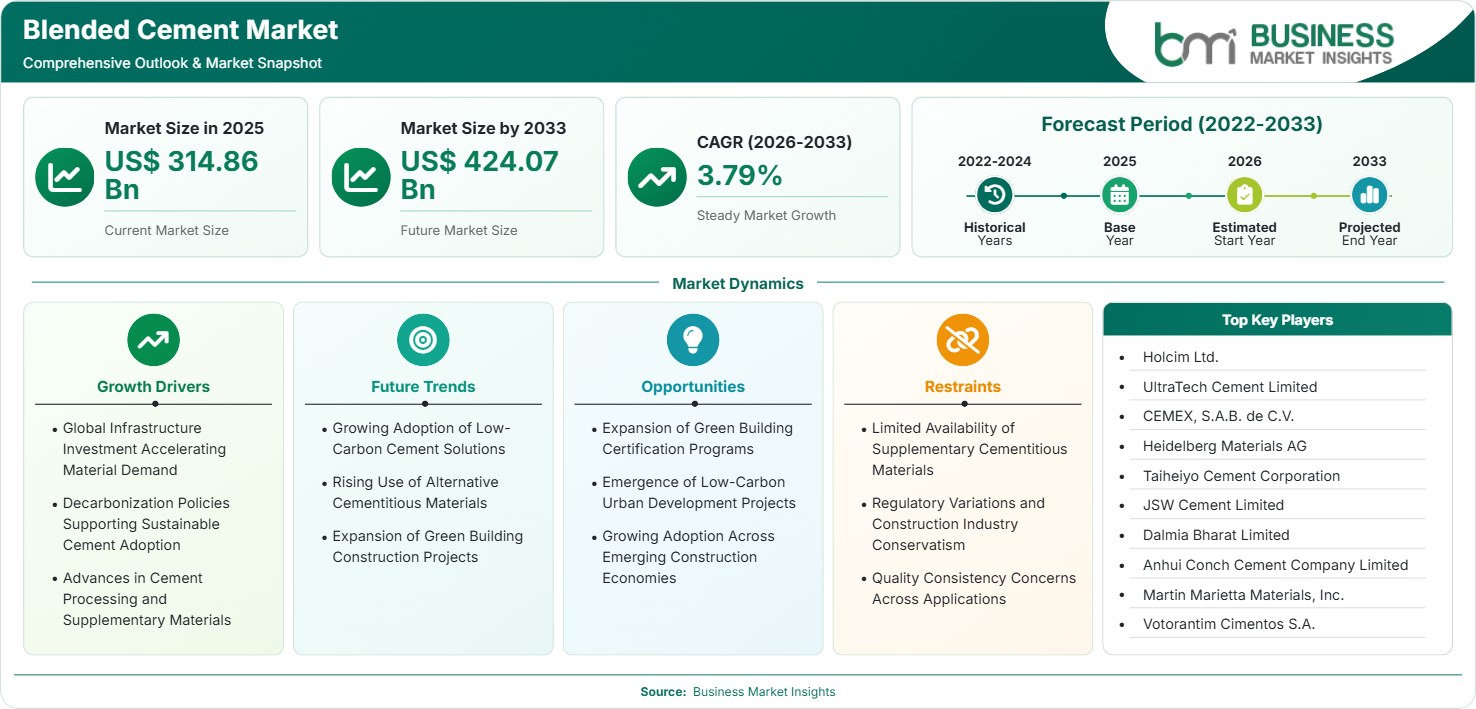
The Blended Cement Market size was valued at US$ 314.86 Billion in 2025 and is projected to reach US$ 424.07 Billion by 2033, growing at a CAGR of 3.79% during 2026–2033, driven by infrastructure modernization, lower-carbon construction materials adoption, urban development investments, sustainable building regulations, and increasing utilization of supplementary cementitious materials across construction projects.

Report Coverage
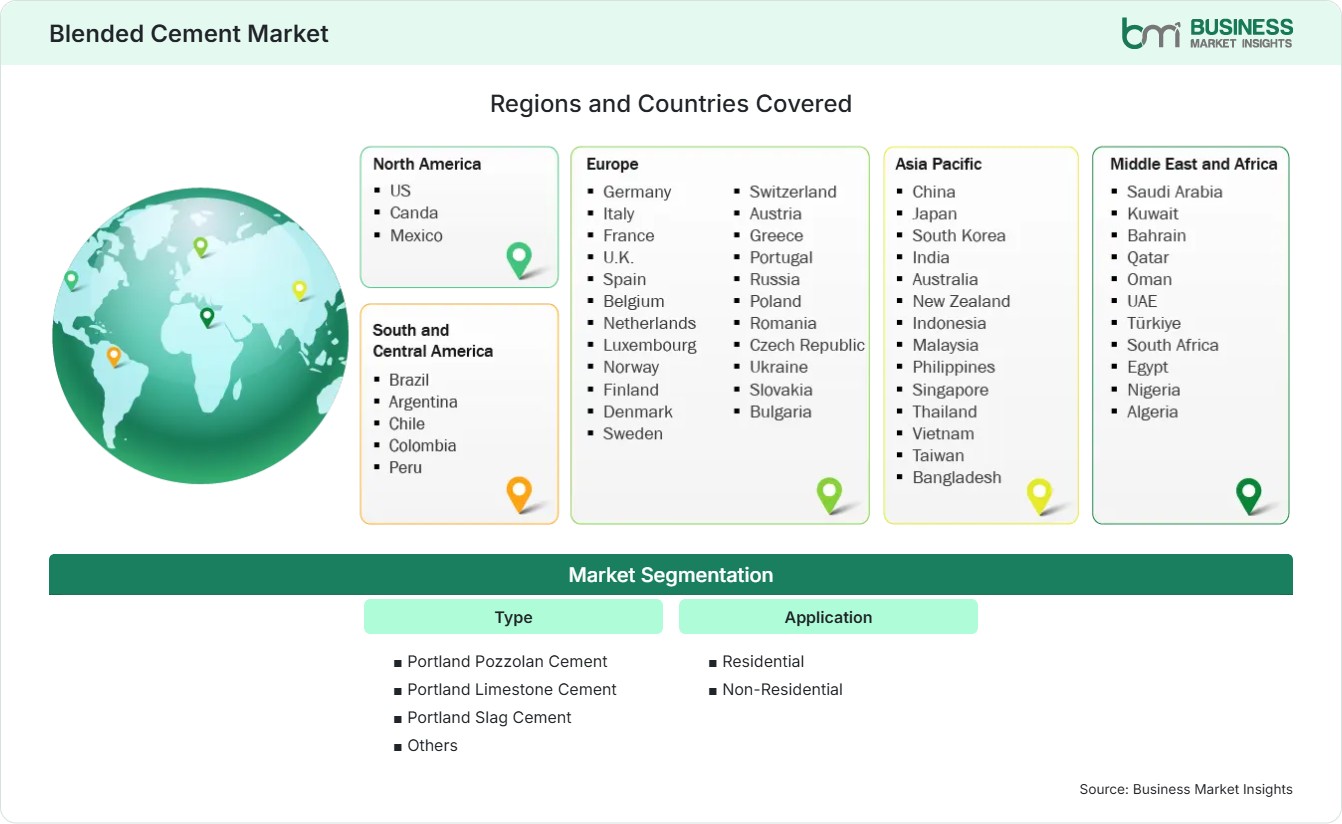
  • Type: Portland Pozzolan Cement, Portland Limestone Cement, Portland Slag Cement, Others
  • Application: Residential, Non-Residential
US$ 314.86 Bn Market size in 2025
US$ 424.07 Bn Market Size by 2033
3.79% CAGR, 2026 - 2033
2026-2033 Forecast Period

AI Overview

Blended Cement Market Summary

  • North America Region: North America accounts for 20%–23% market share in 2025 and is projected to grow at a CAGR of 3.2%–3.7% during 2026–2033. Infrastructural rehabilitation, transportation investments, low-carbon-footprint construction objectives, public works projects, development in the commercial sector, and the rising use of supplementary cementitious materials drive expansion opportunities in the region. The United States enjoys benefits from infrastructure investment and sustainable construction requirements, and the country is witnessing growth at a CAGR of 3.3%–3.8% through 2033.
  • Fastest-Growing Region: Asia Pacific has 46%–49% market share in 2025, growing at a CAGR of 4.3%–4.9% during 2026–2033. Urbanization, industrial corridors development, affordable housing schemes, manufacturing sector growth, investments in transport infrastructure, and government-driven sustainable construction programs drive the region’s growth.
  • Leading Segment: Portland Pozzolan Cement (PPC) accounts for a market shar and is projected to grow atn 2025 and will be growing at a CAGR of 3.8%–4.3% from 2026 to 2033. The extensive use in infrastructural projects, benefits of durability, reduced consumption of clinker, good strength properties over time, and acceptance in housing projects make it a leader.
  • Fast-Growing Segment: Portland Limestone Cement (PLC) is expected to account for a market share of 18%–21% in 2025 and will grow at a CAGR of 4.8%–5.4% from 2026 to 2033. Reduced carbon goals, government backing, smaller carbon footprints, suitability for construction practices, and increasing use in sustainable building projects drive its growth.
  • Important Market Opportunity: There are opportunities in green construction, which in turn create opportunities in low-carbon cement technologies, alternative binders, infrastructure decarbonization, and performance-based blended cements.
  • Major Market Players: Holcim Ltd., UltraTech Cement Limited, CEMEX, S.A.B. de C.V., Heidelberg Materials AG, Taiheiyo Cement Corporation, JSW Cement Limited, Dalmia Bharat Limited, Anhui Conch Cement Company Limited, Martin Marietta Materials, Inc., and Votorantim Cimentos S.A.
Strategic Insights

Blended Cement Market: Strategic Insights

Blended Cement Market Strategic Framework
FREE PDF
Request your free sample
Request free sample
Stakeholder View

Key Takeaways

  • Integration of the industry value chain continues as raw material suppliers, cement producers, transport companies, and builders cooperate to achieve greater efficiency and sustainability.
  • The greatest opportunities lie in infrastructure projects, transportation, and construction, where environmental considerations drive the trend toward using lower-carbon cement products rather than regular ones.
  • Product development involves clinker reduction, improvements in supplementary cementitious materials, carbon capture implementation, and high-performance mixes that meet stringent building requirements.
  • Asia-Pacific is the leading region in terms of investment opportunities for the reason of having a large amount of infrastructure development, urban populations, and supportive government spending programs.
  • Strategic acquisitions and capacity projects shape competitive dynamics to achieve a better geographic spread and sustainable product offerings.
  • Environmental performance indicators are becoming the primary criterion for purchase, driving producers to distinguish themselves through carbon reduction and sustainability in construction.
Geographic Outlook

Blended Cement Market Regional Highlights

North America Blended Cement Market

North America accounted for approximately 20%–23% of global revenue in 2025 and is expected to register a CAGR of 3.2%–3.7% through 2033. Effective public spending on infrastructure construction, modernized transportation systems, and sustainable building codes remains a key driver of regional demand. Increasing consumption of supplemental cementitious materials is consistent with the goals of decarbonization. Regulatory support, manufacturing capabilities, and growing preference for environmentally friendly building materials have been driving growth in the Blended Cement Market share in North America.

  • Federal and state infrastructure programs are generating sustained demand for durable construction materials capable of meeting long-term performance requirements while supporting environmental objectives.
  • Adoption of blended formulations is increasing as contractors seek compliance with green building standards and embodied carbon reduction targets across major development projects.
  • Transportation, energy, and water infrastructure investments continue creating stable demand for high-performance cement products across public-sector construction programs.
  • Technological advancements in material processing and quality control improve consistency, enabling broader acceptance of blended alternatives in critical infrastructure applications.
  • Sustainability commitments among developers and engineering firms are accelerating procurement of products that support lifecycle emissions reductions and resource efficiency goals.

US Blended Cement Market

The United States represented approximately 78%–82% of North American demand in 2025 and is forecast to expand at a CAGR of 3.3%–3.8% through 2033. Large-scale infrastructure upgrades, the construction of transportation corridors, and greater sustainability demands will further fuel market expansion. Increased focus on resilience materials and carbon-sensitive procurement methods will continue boosting demand. Investments by the federal government, along with ongoing residential and commercial construction, will make the nation an important driver of regional development.

  • Public infrastructure funding continues supporting bridge rehabilitation, highway expansion, and utility modernization projects that require durable and environmentally optimized cement products.
  • Green building certifications increasingly influence material selection decisions, encouraging broader adoption of lower-carbon cement formulations in commercial developments.
  • Construction firms are integrating sustainability metrics into procurement processes, supporting demand for products capable of reducing lifecycle emissions.
  • Industrial and logistics facility construction remains a significant demand contributor as manufacturing investments and supply-chain expansion projects progress nationwide.

Europe Blended Cement Market

Europe held approximately 21%–24% of global revenue in 2025 and is projected to grow at a CAGR of 3.1%–3.6% during 2026–2033. Decarbonization policies, emissions trading frameworks, and stringent sustainability requirements are accelerating adoption of low-clinker cement products. Germany remains the largest regional market with a CAGR of 3.0%–3.5% in Blended Cement Market, while Poland demonstrates stronger expansion ranging from 3.8%–4.4%. Investments in sustainable infrastructure and energy-efficient buildings continue supporting demand across the region’s construction ecosystem.

  • European climate policies encourage manufacturers to reduce clinker content and expand production of lower-emission construction materials aligned with environmental objectives.
  • Germany benefits from established infrastructure renewal programs and advanced construction standards supporting consistent demand for sustainable cement products.
  • Poland is emerging as a high-growth market due to infrastructure development, industrial investment, and increasing construction activity supported by modernization initiatives.
  • Green public procurement programs are encouraging wider utilization of environmentally optimized materials in government-funded construction projects.
  • Investment in sustainable urban development and energy-efficient buildings continues supporting adoption across residential and non-residential applications.

Asia Pacific Blended Cement Market

Asia Pacific accounted for approximately 46%–49% of global revenue in 2025 and is anticipated to record the fastest CAGR of 4.3%–4.9% through 2033. Rapid urbanization, infrastructure expansion, industrial development, and housing demand continue driving consumption. China remains the largest regional market with growth of 4.0%–4.5%, while India demonstrates stronger momentum at approximately 4.8%–5.4%. Government-backed construction programs and increasing awareness of sustainable building practices support long-term Blended Cement Market development across the region.

  • Urban infrastructure expansion remains a major demand catalyst, particularly across transportation networks, industrial zones, and public utility projects.
  • China maintains leadership through extensive construction activity, manufacturing capacity, and large-scale investments in infrastructure modernization.
  • India is experiencing accelerated adoption due to housing initiatives, industrial growth, and increasing focus on sustainable construction materials.
  • Growing environmental awareness is encouraging adoption of products with lower clinker content and reduced carbon footprints.
  • Regional governments continue supporting infrastructure development through policy measures and public investment programs that stimulate construction activity.

Rest of World Blended Cement Market

Rest of World represented approximately 8%–11% of global revenue in 2025 and is expected to grow at a CAGR of 3.5%–4.1% through 2033. South & Central America benefit from infrastructure investment, urban development, and industrial construction activity. Brazil remains the leading regional market with growth ranging from 3.7%–4.3% in Blended Cement Market.

Middle East & Africa markets continue expanding through transportation, energy, and commercial development projects. Saudi Arabia and the United Arab Emirates are witnessing increasing demand linked to diversification initiatives, while South Africa supports regional consumption through infrastructure rehabilitation and urban development programs.

  • Brazil continues strengthening demand through public infrastructure programs, industrial investment, and modernization projects supporting long-term construction activity.
  • Major development initiatives in Gulf countries are increasing utilization of durable and sustainable building materials across commercial and infrastructure sectors.
  • Growing urban populations across developing economies continue supporting residential construction and public infrastructure investment requirements.
  • Energy transition projects, logistics developments, and industrial facilities contribute to expanding demand for advanced cement formulations.
  • Regional sustainability objectives are gradually encouraging adoption of products designed to reduce environmental impact while maintaining construction performance.
Global Market Geography
FREE PDF
Request your free sample
Request free sample
Segment Analysis

Blended Cement Market Segmentation

Type

The Type segment remains the primary revenue contributor, reflecting the industry's transition toward lower-clinker and environmentally optimized cement formulations. This segment accounted for approximately 62%–66% of total market revenue in 2025 and is projected to expand at a CAGR of 3.7%–4.2% through 2033. Growing infrastructure demand, sustainability regulations, and cost-efficient material utilization continue influencing adoption patterns. The Blended Cement Market scope is expanding as manufacturers increase production of formulations that balance environmental performance, durability, and structural reliability across diverse construction applications.

  • Portland Pozzolan Cement (PPC): Widely utilized across infrastructure, residential, and commercial construction due to durability advantages, improved long-term strength development, and efficient use of supplementary cementitious materials.
  • Portland Limestone Cement (PLC): Adoption is accelerating as contractors and developers pursue lower-carbon alternatives that align with sustainability objectives while maintaining compatibility with existing construction methods and standards.
  • Portland Slag Cement (PSC): Strong demand exists in marine structures, industrial facilities, and infrastructure projects where enhanced durability, sulfate resistance, and long-term performance remain critical requirements.

Application

The Application segment reflects demand generated by ongoing urbanization, infrastructure modernization, and commercial development projects worldwide. This segment represented approximately 34%–38% of overall industry revenue in 2025 and is expected to grow at a CAGR of 3.9%–4.4% through 2033. Public infrastructure spending, housing development, and industrial construction activities continue supporting consumption. The Blended Cement Market trends indicate increasing preference for sustainable construction materials across both residential and non-residential environments as environmental compliance requirements become more stringent.

  • Residential: Housing developments increasingly incorporate blended formulations due to sustainability considerations, structural performance benefits, and compliance with evolving environmental standards adopted by developers and regulators.
  • Non-Residential: Commercial buildings, transportation networks, industrial facilities, and public infrastructure projects continue driving demand for durable cement solutions capable of supporting large-scale construction requirements.
Market Forces

Blended Cement Market Dynamics

Key Market Drivers

Global Infrastructure Investment Accelerating Material Demand

Governments worldwide continue allocating significant resources toward transportation, utility, and public infrastructure modernization programs. According to multilateral development institutions, infrastructure funding requirements remain substantial across both developed and emerging economies. Large-scale investments in highways, bridges, rail systems, airports, ports, and urban transit networks are generating sustained demand for durable construction materials. The Blended Cement Market growth is strongly linked to these projects because blended formulations provide enhanced durability and lower environmental impact compared with conventional alternatives. Expanding infrastructure pipelines in Asia Pacific, North America, and the Middle East are encouraging manufacturers to increase capacity, improve distribution networks, and develop application-specific products suited to complex engineering requirements.

Decarbonization Policies Supporting Sustainable Cement Adoption

There is growing concern about the need for the construction and building materials industries to reduce greenhouse gas emissions. Regulation measures in Europe, North America, and even some parts of Asia are favoring reduced use of clinker and promoting increased use of supplementary cementitious materials. Certification processes and public procurement practices are increasingly focused on environmentally friendly construction products. Manufacturers are taking up the challenge by utilizing technologies that help minimize carbon footprints through alternative fuels and blended products. The trend towards environmentally favorable building materials is increasingly shaping buying preferences of contractors, developers, and government bodies. There will be increased need for blended products as climate goals continue to rise.

Advances in Cement Processing and Supplementary Materials

Advances in grinding technology, material mixing, and quality control systems are resulting in consistent product performance. Companies are increasingly employing efficient process monitoring and digitalization of processes to increase efficiency and reduce production cost. The increased availability of fly ash, slag, calcined clay, and limestone-based additives is enabling formulation development. These improvements enable companies to produce materials for specific applications without compromising durability or structural strength. Innovations centered on the development of next-generation binders and performance-based additives are increasing commercial possibilities.

Key Market Opportunities

Expansion of Green Building Certification Programs

Green building standards are becoming increasingly influential across public and private construction projects worldwide. Certification systems encourage developers to select materials with lower environmental impacts and improved lifecycle performance. Demand for sustainable construction inputs is rising across commercial real estate, institutional facilities, residential developments, and infrastructure projects. Manufacturers capable of demonstrating measurable emissions reductions and resource efficiency benefits are positioned to capture greater market share. Blended Cement Market Forecasts indicate that sustainability-driven procurement requirements will continue expanding opportunities for environmentally optimized formulations. Growing awareness among architects, engineers, and developers further strengthens the commercial outlook for certified low-carbon cement products.

Emergence of Low-Carbon Urban Development Projects

Increasingly, cities are incorporating sustainability goals into their development strategies, creating space for the development of new construction materials. Smart city concepts, resilient infrastructure, and climate change adaptation projects often focus on low-emission construction. The demand for mixed cement is projected to increase as cities pursue environmentally efficient constructions. Specialized products designed specifically for urban infrastructural applications such as public transport, utility network, and public buildings are being created. This provides a good environment for high-end sustainable products that can help achieve environmental goals while maintaining their engineering integrity.

Growing Adoption Across Emerging Construction Economies

The ongoing process of urbanization and industrialization in Asia, Africa, and chosen regions of Latin America is generating many potential openings for companies producing blended cement. Deficiencies in infrastructure and a rapidly growing population necessitate substantial investment in building new homes, transportation networks, power plants, and services. The environmentally friendly nature of the products is becoming increasingly recognized by government institutions. Increased manufacturing capacities in these areas and successful cooperation with partners contribute to making these products more available in developing countries. Considering all these factors, there will be increased demand for improved blended products in the future.

Market Restraints and Challenges

Limited Availability of Supplementary Cementitious Materials

Factor: Availability of fly ash, granulated slag, and other supplementary materials varies significantly across regions due to industrial production patterns, energy transitions, and supply chain constraints.

Impact: Inconsistent raw material access can increase production costs and limit manufacturers' ability to expand blended cement output. As coal-fired power generation declines in some markets, fly ash availability may become increasingly constrained. Producers must therefore identify alternative materials and invest in new sourcing strategies. Supply uncertainty can complicate long-term planning, reduce operational flexibility, and create regional disparities in product availability, affecting market competitiveness and adoption rates.

Regulatory Variations and Construction Industry Conservatism

Factor: Building codes, technical standards, and approval processes differ across countries and regions, creating challenges for product standardization and market expansion.

Impact: Adoption may proceed more slowly where contractors, engineers, or regulatory authorities remain cautious regarding alternative formulations. Construction stakeholders often prioritize proven materials with established performance records, particularly in critical infrastructure projects. Additional testing, certification, and education efforts may be required before broader acceptance occurs. These barriers can increase commercialization timelines and development costs, limiting the pace at which innovative blended products penetrate traditional construction markets.

Company Analysis

Competitive Landscape

The competitive environment is shaped by capacity expansion, sustainability initiatives, low-carbon product development, and regional distribution network optimization. Blended Cement Market analysis indicates that leading manufacturers are focusing on clinker reduction strategies, alternative raw materials, digital manufacturing technologies, and infrastructure-focused product portfolios to strengthen their competitive positions.

Company Name

Overview

Products and Services relevant to this market

Holcim Ltd.

Global building materials leader with extensive cement, aggregates, and sustainable construction solutions operations across multiple continents.

Blended cement products, low-carbon cement solutions, construction materials, aggregates, ready-mix concrete, and sustainable building technologies.

UltraTech Cement Limited

India's largest cement producer with integrated manufacturing facilities and a broad portfolio supporting infrastructure and residential construction.

Portland pozzolan cement, blended cement products, ready-mix concrete, construction materials, and infrastructure-focused solutions.

CEMEX, S.A.B. de C.V.

Multinational building materials company with strong presence in cement manufacturing, sustainability innovation, and construction solutions.

Blended cement, low-carbon cement products, ready-mix concrete, aggregates, and infrastructure construction materials.

Heidelberg Materials AG

Global producer focused on sustainable construction materials and decarbonization technologies across cement and aggregates operations.

Portland limestone cement, blended cement solutions, aggregates, ready-mix concrete, and carbon-reduction construction materials.

Taiheiyo Cement Corporation

Leading Japanese cement manufacturer serving infrastructure, industrial, and environmental construction markets.

Blended cement, specialty cement products, construction materials, recycling solutions, and infrastructure support products.

JSW Cement Limited

Indian cement producer emphasizing green cement technologies and sustainable construction materials development.

Portland slag cement, blended cement products, low-carbon cement solutions, and construction materials.

Dalmia Bharat Limited

Major cement manufacturer recognized for sustainability-focused operations and diversified product offerings.

Blended cement, specialty cement products, infrastructure materials, and environmentally optimized construction solutions.

Anhui Conch Cement Company Limited

One of the world's largest cement producers with extensive manufacturing capacity and distribution capabilities.

Portland blended cement, infrastructure cement products, construction materials, and industrial building solutions.

Martin Marietta Materials, Inc.

Construction materials supplier serving infrastructure and commercial development markets throughout North America.

Cement products, aggregates, construction materials, infrastructure support solutions, and industrial building products.

Votorantim Cimentos S.A.

Global building materials company with significant presence across Latin America and international markets.

Blended cement, sustainable cement solutions, concrete products, aggregates, and infrastructure construction materials.

Trust & Transparency

Research Methodology

The market analysis combines proprietary research with secondary data from government agencies, company disclosures, regulatory filings, industry databases and expert interviews. Market estimates are validated through data triangulation, cross-market benchmarking and analyst review.

View Full Research Methodology

Questions Answered

Frequently Asked Questions

What does the Blended Cement Market Report suggest about future industry priorities?

The Report indicates that decarbonization technologies, alternative binder development, green building compliance, digital manufacturing optimization, and low-carbon infrastructure materials will remain central strategic priorities.

What role do supplementary cementitious materials play in production?

These materials improve resource efficiency, reduce clinker dependence, lower carbon intensity, enhance durability properties, and support manufacturers in meeting sustainability objectives without compromising performance standards.

Which application segment generates the highest demand in Blended Cement Market?

Non-residential construction accounts for substantial consumption due to infrastructure projects, industrial developments, transportation networks, public facilities, and large-scale commercial construction activities requiring durable building materials.

How do environmental regulations influence product adoption?

Governments and regulatory bodies increasingly promote lower-carbon construction materials through procurement policies, emissions targets, and green building frameworks, encouraging wider utilization of blended cement formulations.

What distinguishes blended cement from ordinary Portland cement?

Blended cement incorporates supplementary cementitious materials such as fly ash, slag, or limestone to reduce clinker content, improve sustainability performance, and enhance specific durability characteristics required in construction applications.

Access the Full Blended Cement Market Report

Get segment-level forecasts, regional estimates, competitive benchmarking, company profiles and downloadable Excel datasets.

Access the full Blended Cement Market Report
350 pages PDF & Excel | 2026-09-01