
Cementing Chemicals Market Outlook: Size, Share, Trends, Growth Analysis, Competitive Landscape & Forecast, 2026–2033

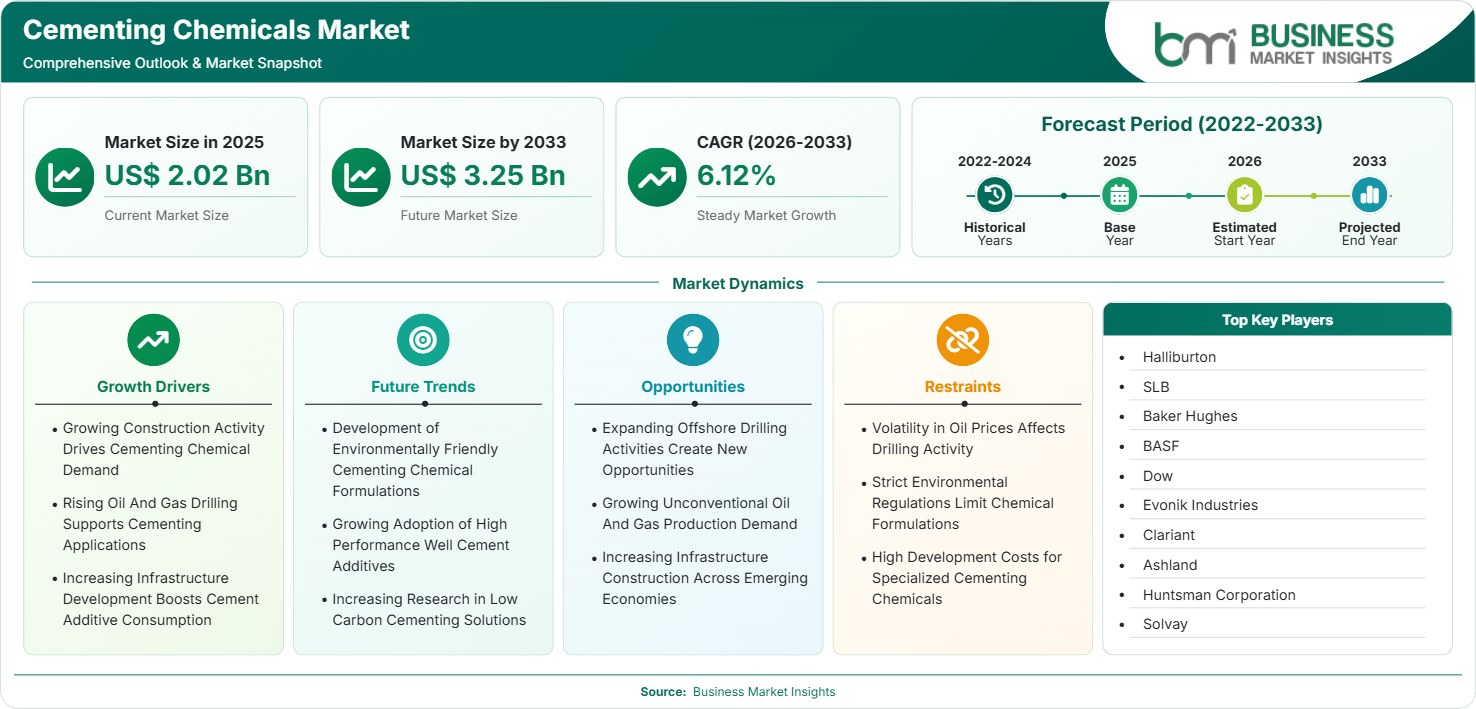
The Cementing Chemicals Market size was valued at US$ 2.02 billion in 2025 and is projected to reach US$ 3.25 billion by 2033, growing at a CAGR of 6.12% during 2026–2033. Growing drilling activity, complex well construction, offshore exploration, infrastructure expansion, and demand for reliable well integrity are creating opportunities.

Report Coverage
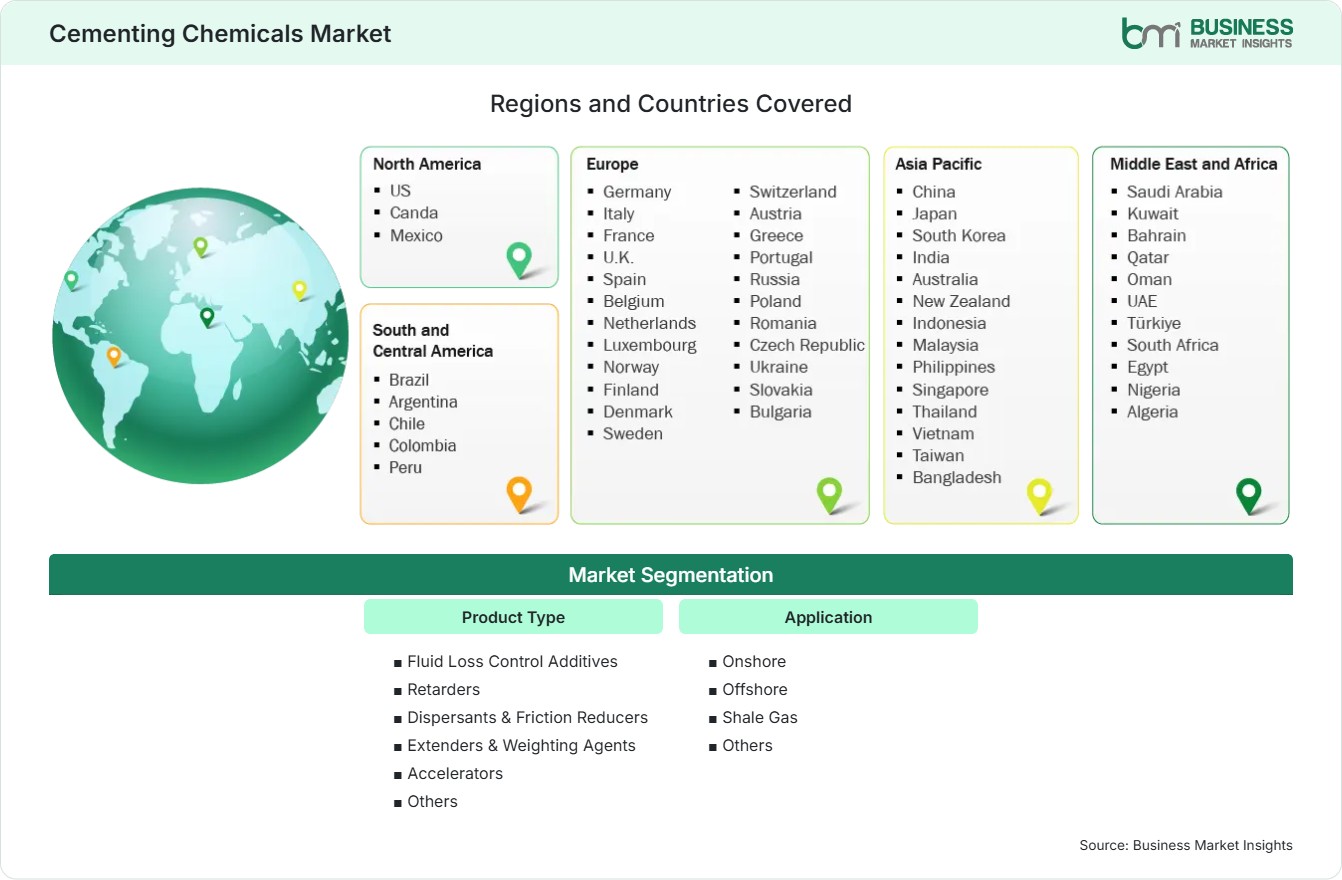
  • Product Type: Fluid Loss Control Additives, Retarders, Dispersants & Friction Reducers, Extenders & Weighting Agents, Accelerators, Others
  • Application: Onshore, Offshore, Shale Gas, Others
US$ 2.02 Bn Market size in 2025
US$ 3.25 Bn Market Size by 2033
6.12% CAGR, 2026 - 2033
2026-2033 Forecast Period

01 AI Overview

Cementing Chemicals Market Summary

  • North America Region: North America holds a 27%–31% share in 2025 and is projected to grow at a 5.8%–6.5% CAGR through 2033, supported by drilling activity, shale development, mature-well interventions, advanced cementing requirements, and well-integrity investments.
  • Fastest Growing Region: Asia Pacific holds a 31%–35% share in 2025 and is projected to grow at a 6.8%–7.5% CAGR through 2033, supported by expanding energy demand, upstream development, infrastructure investment, offshore exploration, and unconventional resource development.
  • Leading Segment: Fluid Loss Control Additives hold a 28%–32% share in 2025 and are projected to grow at a 6.5%–7.1% CAGR through 2033, supported by slurry stability, formation protection, zonal isolation, and demanding well conditions.
  • High Growth Segment: Offshore applications hold an 18%–22% share in 2025 and are projected to grow at a 7.0%–7.8% CAGR through 2033, supported by deepwater activity, technically demanding wells, integrity requirements, and specialized cement formulations.
  • Key Market Opportunity: High-performance formulations, offshore drilling, shale development, low-carbon cement systems, digital slurry design, and emerging energy markets create opportunities for suppliers offering application-specific chemical solutions.
  • Major Market Players: Halliburton Company; SLB; Baker Hughes Company; BASF SE; Dow Inc.; Evonik Industries AG; Clariant AG; Ashland Inc.; Huntsman Corporation; Solvay SA.
02 Strategic Insights

Cementing Chemicals Market: Strategic Insights

Cementing Chemicals Market Strategic Framework
FREE PDF
Request your free sample
Request free sample
03 Stakeholder View

Key Takeaways

  • The value chain spans specialty chemical producers, oilfield service providers, cementing contractors, drilling companies, equipment suppliers, distributors, and operators, making formulation support and application expertise important sources of differentiation.
  • Fluid-loss control, offshore cementing, shale gas applications, and advanced weighting systems offer attractive opportunities because technically demanding wells require precise control of slurry behavior and long-term barrier performance.
  • Innovation is moving toward high-temperature formulations, lower-carbon cement systems, improved gas-migration control, enhanced elasticity, and digitally supported slurry design that can address increasingly complex well conditions.
  • Asia Pacific provides an attractive expansion environment because energy demand, upstream development, offshore projects, and infrastructure investment are increasing the need for specialized cementing chemistry and technical support.
  • Investment strategies are increasingly centered on specialty formulations, application engineering, regional production capabilities, and partnerships that strengthen customer responsiveness across oilfield and industrial markets.
  • Suppliers that combine chemical performance with laboratory testing, field support, formulation customization, and reliable distribution can strengthen customer retention where cementing failures carry substantial operational and remediation costs.
04 Geographic Outlook

Cementing Chemicals Market Regional Highlights

North America Cementing Chemicals Market

North America represents 27%–31% of global demand in 2025 and is projected to grow at a 5.8%–6.5% CAGR through 2033. The region benefits from established oilfield infrastructure, shale development, mature-well activity, and demand for technically optimized cementing systems. The United States remains the principal contributor within the regional market, supported by diverse well construction and completion requirements.

  • Shale and unconventional wells require customized cement formulations capable of managing complex pressure, temperature, and formation conditions while maintaining dependable zonal isolation across horizontal well sections.
  • Mature oil and gas assets generate continuing demand for remedial cementing, workover activity, and specialized additives that address integrity problems and extend productive well lifecycles.
  • Offshore development in the Gulf of Mexico supports demand for high-performance retarders, fluid-loss control additives, weighting agents, and formulations designed for challenging placement conditions.
  • Regional suppliers increasingly compete through technical services, laboratory formulation, application support, and customized additive packages rather than commodity chemical availability alone.

US Cementing Chemicals Market

The United States accounts for approximately 72%–76% of North American demand in 2025 and is projected to grow at a 5.9%–6.6% CAGR through 2033. The market is supported by shale operations, mature-well interventions, offshore projects, and established oilfield service infrastructure. Demand increasingly favors application-specific chemistry capable of addressing complex cement placement and long-term integrity requirements.

  • Shale gas and tight-oil development supports recurring demand for cement additives that improve slurry placement, fluid-loss control, strength development, and resistance to demanding downhole conditions.
  • Remedial and plug-and-abandonment activities create opportunities for specialized cement systems designed to establish dependable barriers across mature or decommissioned wells.
  • Offshore operations require formulations with controlled thickening time, density management, and high-temperature performance, supporting higher-value specialty additive demand.

Europe Cementing Chemicals Market

Europe accounts for 22%–26% of global demand in 2025 and is projected to grow at a 5.5%–6.2% CAGR through 2033. Norway and the United Kingdom remain important offshore markets, while Germany and other countries contribute through industrial applications and energy-transition projects. Demand increasingly reflects well integrity, environmental performance, mature-field management, and specialized offshore cementing requirements.

  • Norway remains a leading regional opportunity, with offshore operations requiring reliable cement barriers and formulations capable of performing under demanding subsea and high-pressure conditions.
  • The United Kingdom presents opportunities in mature offshore assets, decommissioning, and well-integrity applications requiring specialized cementing chemistry and dependable barrier performance.
  • European environmental priorities are encouraging development of formulations that reduce material intensity, improve durability, and support lower-impact well construction practices.
  • Specialty suppliers can differentiate through low-carbon formulations, technical validation, and chemistry designed for offshore, geothermal, and subsurface applications.

Asia Pacific Cementing Chemicals Market

Asia Pacific holds 31%–35% of global demand in 2025 and is projected to grow at a 6.8%–7.5% CAGR through 2033. China, Australia, India, Indonesia, and Malaysia represent important markets because energy demand and upstream investment continue supporting well construction requirements. The regional opportunity combines conventional, offshore, and unconventional activities with expanding industrial infrastructure.

  • China supports demand through domestic upstream development, increasing technical requirements, and continued investment in exploration and production infrastructure.
  • Australia offers opportunities in offshore and unconventional gas projects where specialized additives are required to manage challenging formations and long well sections.
  • Southeast Asian markets are creating demand through offshore exploration, mature-field development, and expansion of regional oilfield service capabilities.
  • India presents longer-term potential as energy infrastructure expands and domestic exploration creates additional requirements for cementing materials and technical services.

Rest of World Cementing Chemicals Market

Rest of World accounts for 12%–16% of global demand in 2025 and is projected to grow at a 5.8%–6.5% CAGR through 2033. Latin America is supported by upstream development, while the Middle East and Africa benefit from oil and gas production and expanding field-service requirements. Brazil, Saudi Arabia, the United Arab Emirates, and selected African markets represent attractive application opportunities.

Latin America is supported by offshore and onshore development, particularly in Brazil and other hydrocarbon-producing economies. Middle Eastern markets emphasize reliable cement barriers across large-scale drilling programs, while African markets offer selective growth through exploration and production investment.

  • Brazil represents an important offshore opportunity because deepwater developments require specialized cementing chemistry, reliable zonal isolation, and high-performance formulations.
  • Saudi Arabia and the United Arab Emirates provide demand through large-scale upstream operations and continued investment in sophisticated well construction capabilities.
  • African exploration markets create selective opportunities for suppliers able to provide technical support, localized distribution, and formulations adapted to varied field conditions.
  • Latin American mature fields support remedial applications, while new developments increase demand for fluid-loss control, retarders, dispersants, and weighting systems.
Global Market Geography
FREE PDF
Request your free sample
Request free sample
05 Segment Analysis

Cementing Chemicals Market Segmentation

Product Type

Fluid Loss Control Additives hold a 28%–32% share in 2025 and are projected to grow at a 6.5%–7.1% CAGR through 2033. Their importance in slurry stability, formation protection, and zonal isolation supports segment leadership across complex well applications. The Cementing Chemicals Market scope is expanding through advanced additives designed for high-temperature, high-pressure, offshore, and unconventional wells.

  • Fluid Loss Control Additives: These additives limit water migration from cement slurry into permeable formations, supporting consistent placement, strength development, and reliable zonal isolation.
  • Retarders: Retarders extend cement thickening time, enabling controlled placement in deeper and hotter wells where premature setting could compromise cementing efficiency.
  • Dispersants & Friction Reducers: These chemicals improve slurry rheology and flow characteristics, helping achieve more consistent placement while supporting efficient pumping across challenging well geometries.
  • Extenders & Weighting Agents: Extenders adjust slurry density and volume, while weighting agents increase density where formation pressures require greater hydrostatic control during cement placement.
  • Accelerators: Accelerators shorten setting time where rapid strength development is required, supporting operational efficiency in selected low-temperature and time-sensitive cementing applications.
  • Others: Specialty additives address gas migration, expansion, corrosion resistance, foaming, adhesion, and other specific well conditions requiring tailored cement performance.

Application

Offshore applications hold an 18%–22% share in 2025 and are projected to grow at a 7.0%–7.8% CAGR through 2033. Deepwater projects, demanding placement conditions, and strict well-integrity requirements support higher-value chemical adoption. Offshore operations also encourage customized formulations that balance pumpability, setting behavior, density, and long-term barrier performance.

  • Onshore: Onshore applications remain broad across conventional and unconventional wells, with demand shaped by drilling intensity, formation conditions, cementing frequency, and requirements for reliable zonal isolation.
  • Offshore: Offshore cementing requires specialized chemistry capable of maintaining slurry performance under pressure, temperature, long placement times, complex casing programs, and demanding subsea operating conditions.
  • Shale Gas: Shale gas wells require additives supporting fluid-loss control, rheology, strength, and durability across long horizontal sections and variable formation conditions.
  • Others: Other applications include geothermal, carbon-management, remedial, and specialized well-integrity activities requiring tailored cement chemistry and long-term barrier performance.
06 Market Forces

Cementing Chemicals Market Dynamics

Key Market Drivers

Growing Construction Activity Drives Cementing Chemical Demand

Increases in construction activities and infrastructure development will drive demand for materials used in cement operations and allow for a greater capacity in chemical production, logistics, and expertise. In terms of oilfield uses, industrial infrastructure developments will also lead to more efficient service offerings in areas of oilfield drilling operations. The Cementing Chemicals Market growth relies on increased efforts from upstream companies in drilling programs, along with investment in infrastructure developments. Cementing chemicals provide the ability to control the properties of the slurry, enhance the process of positioning the cement, and meet the unique needs of the formation.

Rising Oil and Gas Drilling Supports Cementing Applications

Cementing activities resulting from oil and gas drilling operations generate demand for primary cementing, remedial cementing, liner cementing, and abandonment cementing. The additives that are required may vary in nature for each well due to the differences in depth, temperature, pressure, formation permeability, and desired performance of the barriers. The expansion of exploration and development projects will increase demand for retarders, fluid loss control agents, dispersants, weighting agents, and specialty chemicals. It is also good for the industry that existing mature fields will necessitate intervention during the life of these wells. This provides scope for chemical companies that can formulate chemicals according to field conditions.

Increasing Infrastructure Development Boosts Cement Additive Consumption

Infrastructure development provides the basis for demand in areas of energy generation, transport, industry, and building materials, indirectly supporting the activity upstream needed to support increasing energy systems. Exploration programs and the opening of new production and infrastructure corridors are positive for the use of cement additives. Additives become ever more critical in the event of high temperature or high-pressure conditions or complicated formation environments encountered in wells. A supplier can distinguish itself with product formulations that help with pumpability, fluid loss control, setting time control, and barrier integrity. Lifecycle events, including remediation and abandonment, can affect demand.

Key Market Opportunities

Expanding Offshore Drilling Activities Create New Opportunities

Offshore drilling offers a promising option because most wells may need some special chemistry, extensive lab tests, and cementing. Complex and deepwater offshore drilling operations generate a need for formulations that will ensure controlled rheology, density, thickening time, and strength formation in challenging situations. The Cementing Chemicals Market trend is heading towards high-performance chemistry as operators seek dependable barriers and low risks. Growth of suppliers can be achieved through product offering packages tailored for specific applications, offshore technical services, local stock of chemicals, and digital formulation services. Higher technical demands can contribute to the positioning of premium products due to the high contribution of the chemicals to well integrity and predictable completion operations.

Growing Unconventional Oil and Gas Production Demand

Unconventional wells provide an opening for products tailored to long horizontal wells, temperature differences, hard rock formations, and difficult cement placement needs. Control of fluid loss, rheology, and durability is especially crucial in cases where the integrity of the cement is to be maintained through difficult well geometries. Suppliers can gain an advantage by coming up with formulations that lessen the risks associated with placement and increase compatibility with contemporary completion procedures. Increased production in the region presents an opportunity for regional manufacturing facilities and technical labs, as well as field service arrangements. The best business model will integrate chemistry with application engineering to allow operators to choose formulations depending on the geologic conditions.

Increasing Infrastructure Construction Across Emerging Economies

Economies that are growing can present opportunities in view of the increasing demand for reliable upstream logistics associated with industrialization, energy development, and construction. An expansion in local exploration activities may lead to an increased demand for cementing additives, and advancements in logistics infrastructure will help overcome problems of delivery associated with specialized chemicals. The Cementing Chemicals Market forecast is in favor of companies that can provide an adequate balance between performance and cost, as well as regional availability of their products. Technical facilities that can test formulations quickly are helpful in satisfying the demands of the field.

Market Restraints and Challenges

Volatility in Oil Prices Affects Drilling Activity

Factor: Oil prices that are volatile may change budgets for exploration, drill plans, and resource allocation in the upstream companies. Impact: Fewer drilling activities may reduce the need for cementing chemicals and delay purchases of specialized chemical products. This will be further aggravated if the companies focus on optimizing existing oil wells rather than on drilling additional wells. Thus, chemical firms experience cyclical orders and inventory issues. Companies should consider diversifying their products to serve other applications, including the mature wells and geothermal/subsurface projects, to avoid risks. Upstream companies continue to play a role in demand drivers.

Strict Environmental Regulations Limit Chemical Formulations

Factor: Some chemical components may be restricted due to environmental considerations, resulting in additional testing and possibly needing to change the composition of previously used cementing agents. Implication: The need to comply with regulations may increase costs involved in developing new products, slow down the process of qualifying such products, and delay their commercialization. There is a need to develop more environmentally friendly chemistry, prepare the necessary documentation, perform laboratory and field tests, and ensure satisfactory performance of the cement. This issue becomes especially important in offshore operations, where chemicals used are more closely reviewed.

07 Company Analysis

Competitive Landscape

The competitive environment combines oilfield service expertise with specialty chemical development, formulation engineering, and field application support. The Cementing Chemicals Market analysis indicates that differentiation depends increasingly on product performance under complex well conditions, technical support, formulation customization, and reliable regional supply. Participants compete across both chemical portfolios and integrated cementing solutions.

Company Name

Overview

Products and Services relevant to this market

Halliburton Company

Global energy technology and oilfield services provider with extensive well construction capabilities.

Cementing chemicals, fluid-loss additives, retarders, dispersants, weighting systems, cementing services, and well-integrity solutions.

SLB

Global energy technology company serving drilling, well construction, completion, and production markets.

Cement systems, additive technologies, cementing services, slurry design, placement solutions, and well-integrity technologies.

Baker Hughes Company

Energy technology provider offering well construction, cementing, and completion solutions.

Cementing systems, specialty additives, slurry technologies, cementing equipment, and technical application services.

BASF SE

Diversified chemical producer supplying specialty chemistry for energy and industrial applications.

Fluid-loss additives, retarders, dispersants, gas-migration additives, and customized cementing chemical formulations.

Dow Inc.

Global materials science company serving industrial, energy, and specialty chemical applications.

Polymer-based additives, performance chemicals, formulation materials, and specialty chemistry applicable to cementing systems.

Evonik Industries AG

Specialty chemicals producer with advanced formulation and performance-material capabilities.

Specialty polymers, additives, formulation chemistry, and performance materials supporting demanding industrial applications.

Clariant AG

Specialty chemicals company developing application-focused additives and performance solutions.

Specialty additives, surfactants, formulation chemicals, and performance materials relevant to oilfield cementing applications.

Ashland Inc.

Specialty ingredients and materials company serving industrial and performance chemical markets.

Rheology modifiers, polymers, additives, formulation technologies, and specialty materials for demanding chemical applications.

Huntsman Corporation

Global specialty chemicals producer with advanced polymer and performance-material capabilities.

Specialty polymers, additives, formulation materials, and performance chemistry applicable to energy and industrial markets.

Solvay SA

Advanced materials and specialty chemicals company serving energy and industrial applications.

Specialty polymers, additives, performance materials, and chemical technologies supporting demanding well and industrial environments.

10 Trust & Transparency

Research Methodology

The market analysis combines proprietary research with secondary data from government agencies, company disclosures, regulatory filings, industry databases and expert interviews. Market estimates are validated through data triangulation, cross-market benchmarking and analyst review.

View Full Research Methodology

11 Questions Answered

Frequently Asked Questions

What does the Cementing Chemicals Market report indicate about future competition?

The report indicates that competition will increasingly focus on formulation performance, customization, technical services, environmental compliance, regional availability, and application engineering. Companies combining specialty chemistry with laboratory validation and field support can strengthen customer relationships and improve positioning across complex well construction environments.

Why are offshore operations creating new opportunities for cementing chemical suppliers?

Offshore operations involve technically demanding well designs, complex casing programs, extended placement requirements, and strict integrity expectations. These conditions create demand for specialized formulations that maintain predictable slurry behavior under challenging pressure and temperature conditions while supporting dependable long-term barriers.

How are advanced formulations influencing cementing chemical adoption?

Advanced formulations are enabling better control of fluid loss, rheology, setting time, density, strength development, gas migration, and cement durability. Suppliers are increasingly developing application-specific additive packages that address complex well conditions rather than relying exclusively on standardized chemical systems.

Which applications present the strongest opportunity in the market?

Offshore, shale gas, complex onshore wells, mature-field remediation, and specialized well-integrity applications present strong opportunities. These environments require customized additive packages capable of addressing temperature, pressure, formation permeability, placement time, density, and long-term cement barrier requirements.

What factors are improving Cementing Chemicals Market return on investment?

Increasing drilling complexity, offshore exploration, shale development, well-integrity requirements, and demand for customized cement systems are improving return on investment. Cementing chemicals support reliable slurry placement, controlled setting, fluid-loss management, and long-term zonal isolation, helping operators reduce remediation exposure and improve well construction performance.

Access the Full Cementing Chemicals Market Report

Get segment-level forecasts, regional estimates, competitive benchmarking, company profiles and downloadable Excel datasets.

Access the full Cementing Chemicals Market Report
350 pages PDF & Excel | 2026-08-19