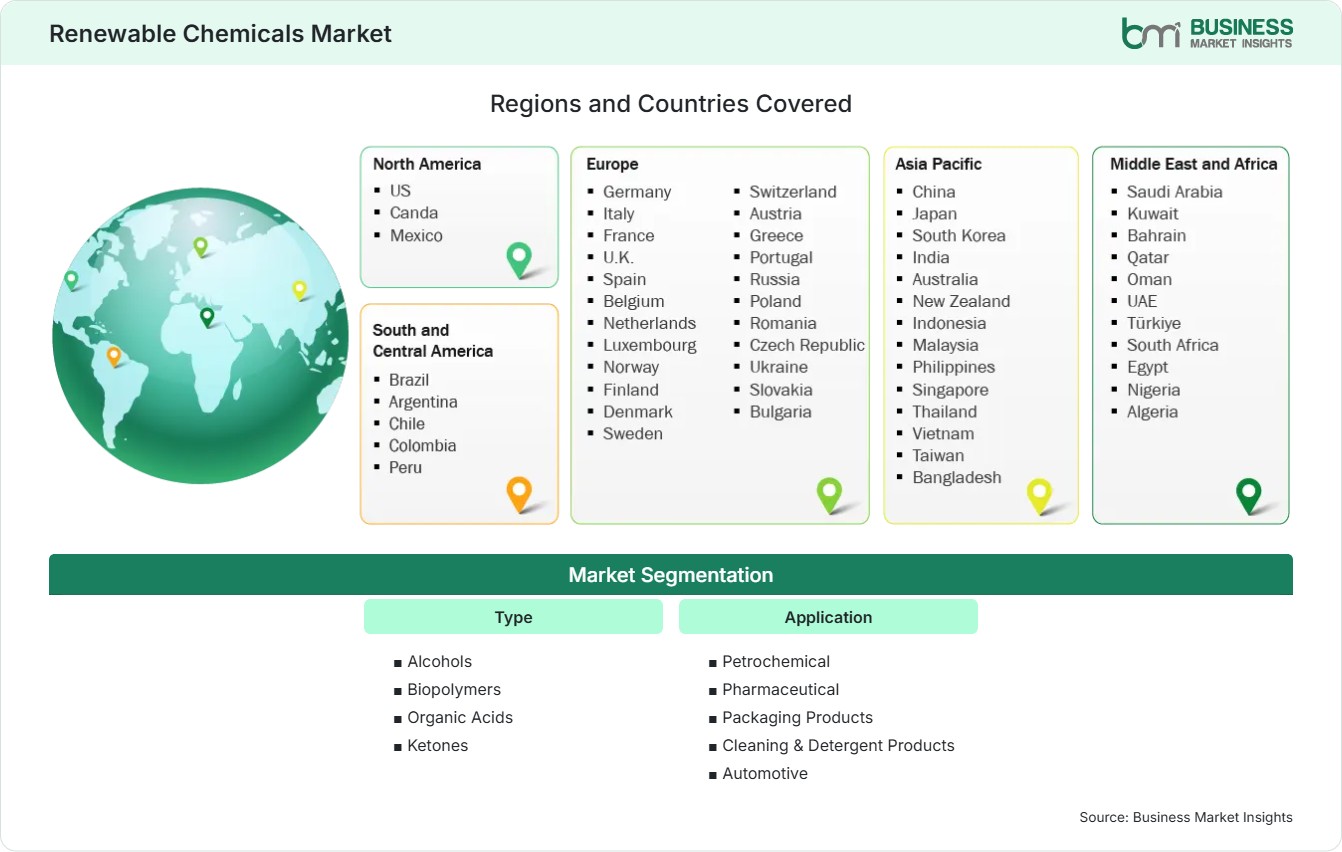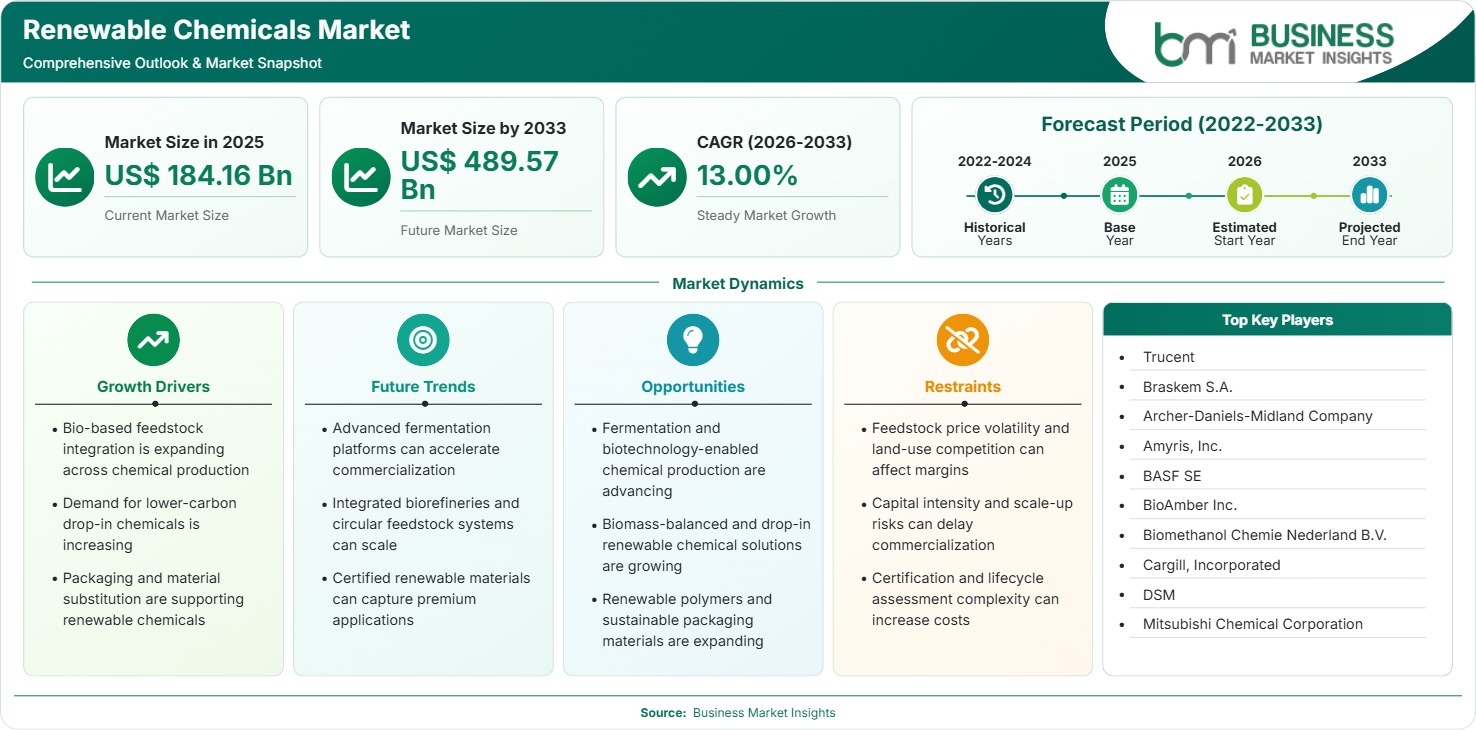
Renewable Chemicals Market Regional Highlights
North America Renewable Chemicals Market
The North America region is expected to capture a 22%-26% share of the market in 2025 and grow at a 10%-12% CAGR from 2025 to 2033. The region benefits from abundant agricultural feedstocks for agriculture, biotechnology, and the chemical industry, as well as sustainable sourcing. The US Renewable Chemicals Market leads the regional demand, while Canada provides biomass and fermentation and specialty chemical facilities. Renewable solvents, polyols, packaging materials, and specialty intermediates will be commercially viable as they can be incorporated into existing formulations. The government's bio-based procurement policies provide impetus to market growth.
- US manufacturers are prioritizing drop-in renewable ingredients that maintain performance while lowering fossil feedstock exposure, supporting investment in solvents, polymers, coatings, and industrial intermediates.
- Canada provides opportunities in biomass conversion and specialty chemicals, particularly where forestry residues, agricultural by-products, and clean electricity can support differentiated production economics.
- Biotechnology clusters and university-industry partnerships are accelerating fermentation, enzyme development, and renewable material research across advanced manufacturing applications.
- Packaging and consumer-product companies increasingly seek traceable renewable inputs that can support environmental claims without requiring extensive reformulation or new production infrastructure.
US Renewable Chemicals Market
The United States is projected to account for 17%–20% of the global market in 2025 and to grow at a 10%–12% CAGR in the Renewable Chemicals Market from 2024 to 2033. Competitive strengths of the US include strong corn and soybean production, the agricultural processing industry, and biotechnology and chemical manufacturing. ADM has bio-based solvents such as industrial ethanol, soy methyl esters, and terpenes, while Cargill has renewable chemistry platforms derived from vegetable oils and other feedstocks.
- Federal biobased procurement frameworks create an institutional demand channel for qualifying renewable products, supporting commercialization beyond consumer-facing sustainability claims.
- Domestic feedstock integration reduces transportation exposure for selected products and allows producers to connect agricultural processing assets with chemical conversion facilities.
- Semiconductor, automotive, coatings, packaging, and home-care industries provide diversified outlets for renewable specialty chemicals and performance materials.
Europe Renewable Chemicals Market
Europe is forecast to account for 23% to 27% of the Renewable Chemicals Market in 2025 and will register a 11% to 13% CAGR through 2033. Major production and technological hubs are located in Germany, France, the Netherlands, and Italy, while the Netherlands and Germany have a particular advantage in fermentation and biomass-derived chemicals. Bio-based chemicals, biopolymers, and biorefineries are among the strategic lead markets identified by the European Commission. Furthermore, its Bioeconomy Strategy to 2025 refers to a EUR 2.7 trillion bioeconomy and 17.1 million jobs in 2023.
- Germany remains important for specialty chemical innovation, certified biomass balancing, and integration of renewable feedstocks into established chemical value chains.
- The Netherlands benefits from port infrastructure, chemical clusters, biomass logistics, and access to Northern European renewable energy and industrial customers.
- France and Italy offer opportunities in bio-based materials, specialty chemicals, agricultural residues, and renewable intermediates serving consumer and industrial applications.
- European policy is increasingly focused on creating lead markets and reducing dependence on fossil feedstocks, although high energy costs remain a competitiveness constraint.
Asia Pacific Renewable Chemicals Market
The Asia Pacific region accounts for around 36%-40% of the global market in 2025 and is expected to show a CAGR of 14%-16% during 2033. China, Japan, India, South Korea, and Southeast Asia offer huge platforms for chemical manufacturing, along with rising packaging demand. Japan focuses on high-end materials and biotech solutions, whereas India offers agricultural feedstocks along with rising chemical production. China offers both extensive manufacturing facilities and sustainable polymers and intermediates.
- China provides scale advantages in chemicals, plastics, fermentation, and downstream manufacturing, enabling rapid commercialization when renewable feedstock economics become competitive.
- Japan is positioned around high-value specialty materials, precision biotechnology, advanced polymers, and renewable chemistry applications requiring stringent technical performance.
- India offers abundant agricultural resources, expanding chemical capacity, and increasing interest in bio-based materials for packaging, automotive, and industrial applications.
- Southeast Asia presents opportunities for palm, agricultural residues, sugar, and other biomass-derived feedstocks, although sustainability certification remains important for export-oriented projects.
Rest of World Renewable Chemicals Market
South and Central America provide an interesting base for renewable feedstocks, especially sugarcane, agricultural residues, and vegetable oil, and for bioenergy facilities. Brazil emerges as the major player in the region due to the integration of its sugarcane processing for ethanol, energy, and chemicals. The region is projected to reach a 6%-8% market share in the Renewable Chemicals Market in 2025, with a 9%-11% CAGR through 2033. Opportunities exist in Mexico through industrial manufacturing and closer access to North American customers.
The Middle East and Africa remain smaller regions yet strategically important, with opportunities emerging in renewables, methanol, biomass, and specialty chemicals due to the trend towards industry decarbonization. Countries with abundant renewable energy sources could enable the manufacture of chemical processes with a low carbon footprint. Countries such as Saudi Arabia, the United Arab Emirates, Brazil, and Mexico seem quite promising for project development, while South Africa shows promise in biomass and industrial chemicals. Regional supply chains remain more fragmented than in North America, Europe, or Asia Pacific, making integrated projects particularly attractive.
- Brazil combines agricultural feedstock availability with established ethanol infrastructure, creating a strong foundation for renewable chemical conversion and export-oriented production.
- Mexico can leverage manufacturing clusters and regional trade links to supply renewable materials into North American packaging, automotive, and consumer-product value chains.
- Gulf economies can combine renewable electricity, carbon management, and methanol platforms to develop renewable chemical intermediates for international markets.
- South Africa offers potential for biomass conversion and specialty chemical applications, although infrastructure and project-financing requirements can influence commercialization timelines.