
Lithographic Printing Chemicals Market Outlook: Size, Share, Trends, Growth Analysis, Competitive Landscape & Forecast, 2026–2033

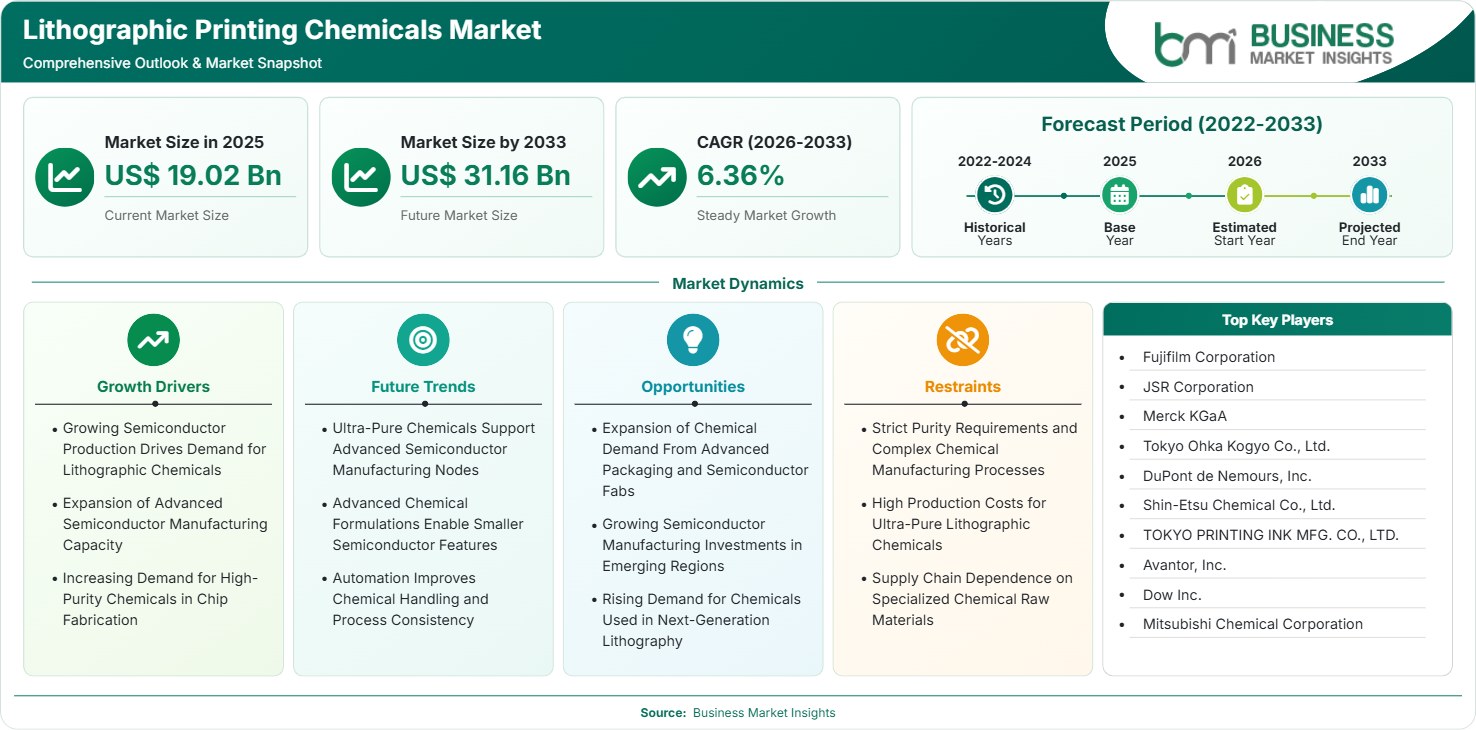
The Lithographic Printing Chemicals Market size was valued at US$ 19.02 Billion in 2025 and is projected to reach US$ 31.16 Billion by 2033, growing at a CAGR of 6.36% during 2026–2033, driven by packaging demand, press automation, sustainable formulations, and high-efficiency chemical technologies.

Report Coverage
  • Type: Fountain solutions, Cleaning solutions, other
  • Application: Publication, Packaging, Promotion, Others
US$ 19.02 Bn Market size in 2025
US$ 31.16 Bn Market Size by 2033
6.36% CAGR, 2026 - 2033
2026-2033 Forecast Period

01 AI Overview

Lithographic Printing Chemicals Market Summary

  • North America Region: North America holds a modeled 27%–30% share in 2025, with a 5.8%–6.4% CAGR through 2033, supported by packaging conversion, automated offset presses, and process-efficiency investments. The U.S. accounts for most regional demand, supported by packaging, commercial printing, and modernization of established offset facilities.
  • Fastest Growing Region: Asia Pacific holds a modeled 34%–38% share in 2025 and is expanding at 7.1%–7.8% CAGR, supported by packaging conversion, commercial printing expansion, manufacturing investment, urban consumption, press modernization, and demand for efficient low-VOC chemical formulations.
  • Leading Segment: Fountain solutions account for a modeled 48%–52% share in 2025 and are advancing at 6.7%–7.3% CAGR, supported by tighter ink-water control, faster press startups, reduced waste, automated dosing, plate protection, and alcohol-reduction initiatives.
  • High Growth Segment: Packaging represents a modeled 31%–35% share in 2025 and is growing at 7.0%–7.7% CAGR, supported by flexible brand communication, premium graphics, shorter production cycles, substrate diversity, customized print requirements, and continued packaging conversion across emerging economies.
  • Key Market Opportunity: Chemical suppliers can capture value through low-VOC formulations, concentrated products, automated dosing compatibility, recyclable-packaging applications, process monitoring, and localized supply models serving rapidly expanding packaging production clusters.
  • Major Market Players: Fujifilm Corporation, JSR Corporation; Merck KGaA, TOKYO OHKA KOGYO CO., LTD., DuPont de Nemours, Inc., Shin-Etsu Chemical Co., Ltd., TOKYO PRINTING INK MFG. CO., LTD., Avantor, Inc.; Dow Inc., Mitsubishi Chemical Corporation.
02 Strategic Insights

Lithographic Printing Chemicals Market: Strategic Insights

Lithographic Printing Chemicals Market Strategic Framework
FREE PDF
Request your free sample
Request free sample
03 Stakeholder View

Key Takeaways

  • Supply chains are shifting toward qualified regional chemical suppliers capable of maintaining consistent formulation performance, and regulatory documentation across multi-site printing operations.
  • Packaging provides the strongest application upside because converters require stable chemistry across varied substrates, high-speed presses, shorter makeready periods, and repeatable color performance for increasingly customized production runs.
  • Product innovation is moving toward concentrated fountain chemistry, alcohol-free formulations, low-VOC washes, automated dosing compatibility, and chemistry designed around press monitoring rather than standalone consumable performance.
  • Asia Pacific offers the strongest capacity-expansion case as packaging production, industrialization, domestic manufacturing, and press modernization increase chemical consumption while suppliers localize technical support and distribution networks.
  • Investment activity is favoring technology breadth and supply resilience. Chemical manufacturers are expanding production capabilities, and regional capacity to reduce supply interruptions and support increasingly demanding applications.
  • Replacement of aging offset equipment supports premium chemistry adoption because modern presses require tighter process windows, rapid startup, and consistent performance at higher production speeds.
04 Geographic Outlook

Lithographic Printing Chemicals Market Regional Highlights

North America Lithographic Printing Chemicals Market

North America Lithographic Printing Chemicals Market represents a modeled 27%–30% share in 2025 and expanding at 5.8%–6.4% CAGR through 2033. The region benefits from established commercial printing infrastructure, packaging conversion, press replacement cycles, and demand for lower-emission chemistry. The United States dominates regional consumption, while Canada contributes through packaging and commercial applications.

  • Packaging converters prioritize chemistry that maintains print consistency across coated, uncoated, recycled, and specialty substrates, increasing demand for adaptable fountain solutions and cleaning systems.
  • Press automation encourages closed-loop dosing, tighter chemical control, and lower operator intervention, improving productivity while reducing overconsumption of fountain concentrates and wash products.
  • Sustainability initiatives favor low-VOC and alcohol-reduction formulations, creating replacement opportunities as printers evaluate chemistry based on emissions, worker exposure, waste, and operating efficiency.

US Lithographic Printing Chemicals Market

The U.S. Lithographic Printing Chemicals Market represents a modeled 72%–76% share of North American consumption in 2025 and is projected to expand at 5.7%–6.3% CAGR. Demand is anchored by packaging, commercial printing, publication applications, and replacement of older press equipment. The market favors suppliers combining chemical products with technical services because press operators increasingly evaluate total production cost, downtime, waste, and regulatory compliance rather than chemical purchase price alone.

  • U.S. packaging printers are increasing demand for specialized chemistry that supports short runs, rapid changeovers, variable substrates, and high-speed production without compromising print stability.
  • Regulatory and customer sustainability requirements are encouraging alcohol-free fountain solutions, lower-VOC washes, and formulations designed to reduce chemical consumption without weakening press performance.
  • Consolidation among commercial and packaging printers creates opportunities for suppliers able to standardize chemical specifications, technical support, procurement, and process controls across multiple production sites.

Europe Lithographic Printing Chemicals Market

Europe Lithographic Printing Chemicals Market accounts for a modeled 23%–26% share in 2025 and grows at 5.4%–6.0% CAGR through 2033. Germany and the United Kingdom remain leading markets because of established printing infrastructure, packaging manufacturing, and technical expertise. Poland and Spain provide higher-growth opportunities, supported by packaging investment and production relocation.

  • Germany remains a major demand center because sophisticated commercial and packaging printers prioritize stable chemistry, automated press control, and productivity improvements across established equipment fleets.
  • The United Kingdom benefits from packaging and commercial print demand, with suppliers emphasizing low-emission formulations, efficient cleaning, and chemistry compatibility with increasingly automated production environments.
  • Poland is positioned as a higher-growth market, supported by manufacturing expansion, packaging conversion, export-oriented printing capacity, and increasing investment in modern production equipment.
  • Spain offers additional growth through food, beverage, consumer goods, and commercial packaging applications requiring reliable offset chemistry across varied substrates and production volumes.

Asia Pacific Lithographic Printing Chemicals Market

Asia Pacific holds a modeled 34%–38% share in 2025 and records the fastest regional growth at 7.1%–7.8% CAGR. China and Japan remain leading markets, while India, Vietnam, Indonesia, and Southeast Asia provide stronger expansion opportunities. Packaging manufacturing, consumer goods production, urbanization, and press modernization support chemical demand.

  • China maintains substantial consumption because of its large packaging and commercial printing base, while domestic manufacturing depth supports localized chemical supply and formulation development.
  • Japan remains a technologically advanced market, emphasizing high process consistency, specialty chemistry, automation, and environmentally improved formulations across sophisticated offset and adjacent lithography applications.
  • India is among the stronger growth markets as packaging conversion, consumer-product manufacturing, commercial printing, and investments in modern presses increase requirements for dependable process chemistry.
  • Southeast Asia is gaining investment as manufacturers diversify production, supporting printing capacity for consumer goods, food packaging, labels, and export-oriented manufacturing supply chains.

Rest of World Lithographic Printing Chemicals Market

South and Central America account for a modeled portion of the Rest of World market, supported by food, beverage, pharmaceutical, consumer goods, and commercial packaging demand. Brazil and Mexico represent leading markets, while Colombia and Chile provide higher-growth opportunities as converters modernize equipment and improve production efficiency. Imported specialty chemicals remain important, although regional distribution and technical support are becoming stronger competitive differentiators. Middle East and Africa demand is concentrated around major commercial centers and packaging manufacturing clusters. Saudi Arabia and the United Arab Emirates lead regional opportunities, while Egypt and South Africa provide broader expansion potential. Packaging investment, food manufacturing, and industrial diversification support chemical consumption, while logistics and supply reliability remain important procurement considerations.

  • Brazil benefits from a broad packaging manufacturing ecosystem and demand for dependable offset chemistry supporting food, beverage, pharmaceutical, and consumer-product applications.
  • Mexico provides strong growth potential because manufacturing localization increases packaging requirements and supports additional commercial printing demand across industrial supply chains.
  • Saudi Arabia and the United Arab Emirates offer opportunities through industrial diversification, consumer packaging, and investments in modern production infrastructure requiring consistent chemical supply.
  • South Africa remains a regional technology and distribution hub, supporting demand for specialty printing chemicals across packaging, commercial, and publication applications.
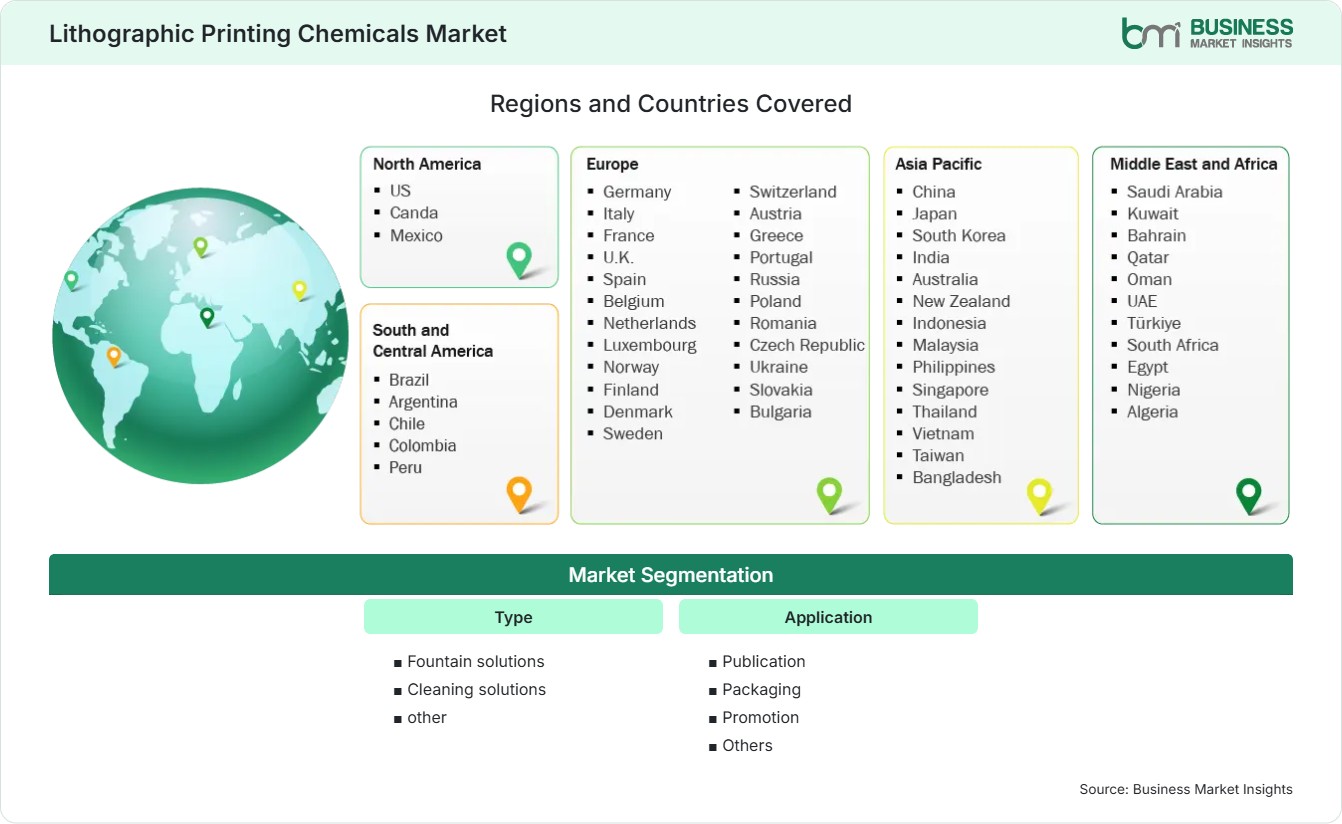
Global Market Geography
FREE PDF
Request your free sample
Request free sample
05 Segment Analysis

Lithographic Printing Chemicals Market Segmentation

Type

Fountain solutions lead with a modeled 48%–52% Lithographic Printing Chemicals Market share in 2025 and a 6.7%–7.3% CAGR through 2034, supported by automated dosing, tighter ink-water balance, alcohol reduction, and faster startup requirements. Cleaning solutions remain essential for press reliability, while specialized formulations support increasingly diverse substrates and production environments. Product differentiation increasingly emphasizes concentrated chemistry, lower emissions, and waste reduction.

  • Fountain solutions: Maintain ink-water balance, protect plates, reduce startup waste, and support high-speed presses. Demand increases for alcohol-free, low-VOC, concentrated formulations compatible with automated dosing.
  • Cleaning solutions: Enable rapid removal of ink and deposits from blankets, rollers, and press components, supporting shorter washing intervals, reduced waste, and consistent print quality.

Application

Packaging represents the leading application opportunity, supported by high-volume production, substrate diversity, shorter runs, and stronger requirements for print consistency. Publication demand remains structurally important, while promotion applications benefit from commercial communication, brochures, catalogs, and promotional materials.

  • Publication: Supports newspapers, magazines, books, and related products where reliable press stability, economical chemistry, fast cleaning, and consistent image reproduction influence production efficiency.
  • Packaging: Benefits from rising packaging conversion, substrate diversification, high-speed presses, shorter production cycles, and demand for reliable chemistry across food, beverage, pharmaceutical, and consumer-product packaging.
  • Promotion: Serves brochures, catalogs, direct marketing materials, displays, and promotional communication requiring sharp reproduction, rapid turnaround, substrate flexibility, and efficient short-to-medium production runs.
06 Market Forces

Lithographic Printing Chemicals Market Dynamics

Key Market Drivers

Growing Semiconductor Production Drives Demand for Lithographic Chemicals

Increased spending on semiconductor fabrication drives up the need for high purity lithography related chemicals in the supply chain of these specialized materials. The connection between the printing chemistry and semiconductors is more about technology and supply chain than application replacement. The two industries have similar needs regarding formulations, control of contamination, availability of quality raw materials and specialized production. This drives chemical manufacturers to improve purification, analysis and formulation of their products. Such investments strengthen supplier expertise in precision chemistry while supporting broader Lithographic Printing Chemicals Market growth.

Expansion of Advanced Semiconductor Manufacturing Capacity

The advanced expansion of semiconductor capability leads to a secondary technology pull for chemical companies that can meet the demands for high levels of specification, purity, contamination control, and logistics. For chemical suppliers, this investment promotes intensification of the processes, quality control, and regional manufacture. Such competencies can help build the technical platform and reputation of the company in the field of precision chemicals. The suppliers use such competencies to create more stable fountain concentrates and cleaning chemistry, especially for automated presses.

Increasing Demand for High-Purity Chemicals in Chip Fabrication

The need for pure chemicals will drive investments in purification, quality control, contamination avoidance, and high-end manufacturing facilities. In the printing industry, there is going to be more competition for providing consistent raw material, formulation attributes, and technical expertise. This will ensure premium positioning as well as decreased variation in production. This market growth will favor manufacturers who have analytical labs, qualified raw material sources, and technical expertise. The focus on purity will also emphasize the Lithographic Printing Chemicals Market trend towards higher quality and specialization for automation in offset processes.

Key Market Opportunities

Expansion of Chemical Demand From Advanced Packaging and Semiconductor Fabs

Packaging and semiconductor capacity expansion provides chances for the chemical suppliers to create products which will differentiate itself on the basis of productivity, stability, and environmental factors. This provides the opportunity to the suppliers to invest in areas close to the clusters of the customers, build up technical centers, and work on the formulation of chemicals which work well with dosing and high-speed presses. The customers prefer chemistry which helps in creating less wastage and quick changeover with minimum intervention from the operators. Lithographic Printing Chemicals Market Forecasts therefore favor companies combining formulation expertise with technical service, regional inventories.

Growing Semiconductor Manufacturing Investments in Emerging Regions

Emerging manufacturing regions provide opportunities for specialty chemical suppliers to have localized manufacturing and technical capabilities with the development of industrial eco-systems. There are possibilities of growth in India, Southeast Asia, and chosen parts of Central Europe, as manufacturing grows. This can be achieved by having partnerships with distributors, regional depots, laboratories for applications, and custom-made formulations for customers. The strategic objective is to reduce dependence on long-distance supply while maintaining global quality standards.

Rising Demand for Chemicals Used in Next-Generation Lithography

Next-generation lithography creates opportunities for chemical companies to transfer expertise in purity, formulation control, analytical testing, and specialty materials into adjacent applications. Such investment illustrates the value of vertically integrated chemistry capabilities. For printing chemical suppliers, the opportunity lies in developing formulations with lower environmental impact, higher concentration, longer shelf stability, and improved compatibility with automated equipment. Commercial printers increasingly require predictable chemistry at lower consumption rates, making concentrated and process-optimized products attractive.

Market Restraints and Challenges

Strict Purity Requirements and Complex Chemical Manufacturing Processes

Factor: The formulation of printing chemistry needs to be consistent in terms of its properties through different batches of raw materials, storage, transportation, and press operations. In addition, advanced chemical specialty products need to go through advanced purification and analysis. Impact: High technical specifications may result in the availability of fewer suppliers for the products; increase the cost of development and delay adoption due to the need for validation by the customers.

High Production Costs for Ultra-Pure Lithographic Chemicals

Factor: The manufacture of specialized chemicals involves special facilities, high-grade raw materials, purification facilities, analytical facilities, trained staff, and environmental and safety considerations. Cost elements involved become significant for suppliers who offer highly concentrated or super pure formulations. Impact: Increased costs of production may decrease margins and make it difficult to qualify customers and even commercially produce the product in price-sensitive printing industries.

07 Company Analysis

Competitive Landscape

The Lithographic Printing Chemicals Market analysis indicates competition is shaped by formulation breadth, technical service, regional manufacturing, purification expertise, sustainability capabilities, and relationships with printing-equipment ecosystems. Suppliers increasingly compete on total process economics rather than chemical price alone.

Company Name

Overview

Products and Services relevant to this market

Fujifilm Corporation

Global technology company with an established graphics and printing portfolio spanning plates, pressroom chemistry, inks, coatings, and workflow solutions.

Fountain solutions, press washes, specialty chemicals, alcohol-free chemistry, low-VOC formulations, coatings, and offset pressroom support.

JSR Corporation

Specialty materials producer with advanced chemical capabilities serving semiconductor, electronics, and precision manufacturing applications.

Lithography-related specialty materials, photoresists, high-performance chemicals, formulation expertise, and analytical capabilities.

Merck KGaA

Science and technology company with strong electronic materials capabilities and extensive specialty-chemical expertise across advanced manufacturing.

Semiconductor lithography materials, specialty chemicals, formulation technologies, and high-purity electronic materials.

TOKYO OHKA KOGYO CO., LTD.

Japanese specialty-chemical manufacturer focused strongly on photoresists and high-purity chemicals for precision lithography processes.

Photoresists, high-purity chemicals, lithography materials, process chemicals, and advanced manufacturing support.

DuPont de Nemours, Inc.

Diversified materials company supplying advanced printing and imaging technologies alongside specialty materials and industrial solutions.

Printing plates, photopolymer technologies, platemaking chemistry, process solutions, and technical support for print applications.

Shin-Etsu Chemical Co., Ltd.

Major Japanese chemical manufacturer with deep expertise in semiconductor lithography materials and high-purity specialty chemicals.

Photoresists, photomask materials, multilayer materials, EUV-related materials, and high-purity chemical technologies.

TOKYO PRINTING INK MFG. CO., LTD.

Japanese printing-materials specialist with expertise spanning inks and associated technologies for commercial printing applications.

Printing inks, lithographic printing materials, color technologies, formulation development, and related printing solutions.

Avantor, Inc.

Global provider of critical materials and services supporting laboratory, pharmaceutical, semiconductor, and advanced manufacturing ecosystems.

High-purity chemicals, process materials, specialty reagents, supply-chain services, and materials supporting precision manufacturing.

Dow Inc.

Diversified materials producer with specialty silicones, coatings, polymers, and advanced materials capabilities serving multiple industrial sectors.

Specialty silicones, coatings, process materials, formulation technologies, and chemical solutions supporting printing-related applications.

Mitsubishi Chemical Corporation

Diversified Japanese chemical company with broad materials expertise spanning performance products and advanced industrial applications.

Specialty chemicals, functional materials, coating-related technologies, high-performance polymers, and advanced chemical solutions.

10 Trust & Transparency

Research Methodology

The market analysis combines proprietary research with secondary data from government agencies, company disclosures, regulatory filings, industry databases and expert interviews. Market estimates are validated through data triangulation, cross-market benchmarking and analyst review.

View Full Research Methodology

11 Questions Answered

Frequently Asked Questions

How does semiconductor lithography influence the broader chemical industry?

Semiconductor lithography increases demand for purification, and specialized formulation capabilities, encouraging chemical companies to strengthen technical infrastructure.

What makes regional supply important for chemical suppliers?

Regional production and inventory reduce lead times, improve supply reliability, simplify regulatory management, and enable faster technical troubleshooting, particularly for packaging clusters operating high-speed presses with strict production schedules.

How are sustainability requirements changing product development?

Suppliers are emphasizing alcohol-free fountain chemistry, low-VOC washes, concentrated formulations, reduced chemical consumption, and products designed to lower waste while maintaining press productivity and print quality.

Why is packaging an attractive application?

Packaging supports attractive demand because production requires high print consistency across varied substrates, and increasingly sophisticated graphics for food, beverage, pharmaceutical, and consumer-product brands.

Which chemical type has the strongest growth potential in Lithographic Printing Chemicals Market report?

Fountain solutions have the strongest outlook because printers increasingly prioritize rapid startup, and compatibility with automated dosing systems.

Access the Full Lithographic Printing Chemicals Market Report

Get segment-level forecasts, regional estimates, competitive benchmarking, company profiles and downloadable Excel datasets.

Access the full Lithographic Printing Chemicals Market Report
350 pages PDF & Excel | 2026-08-20