
Fine Chemicals Market Outlook: Size, Share, Trends, Growth Analysis, Competitive Landscape & Forecast, 2026-2033

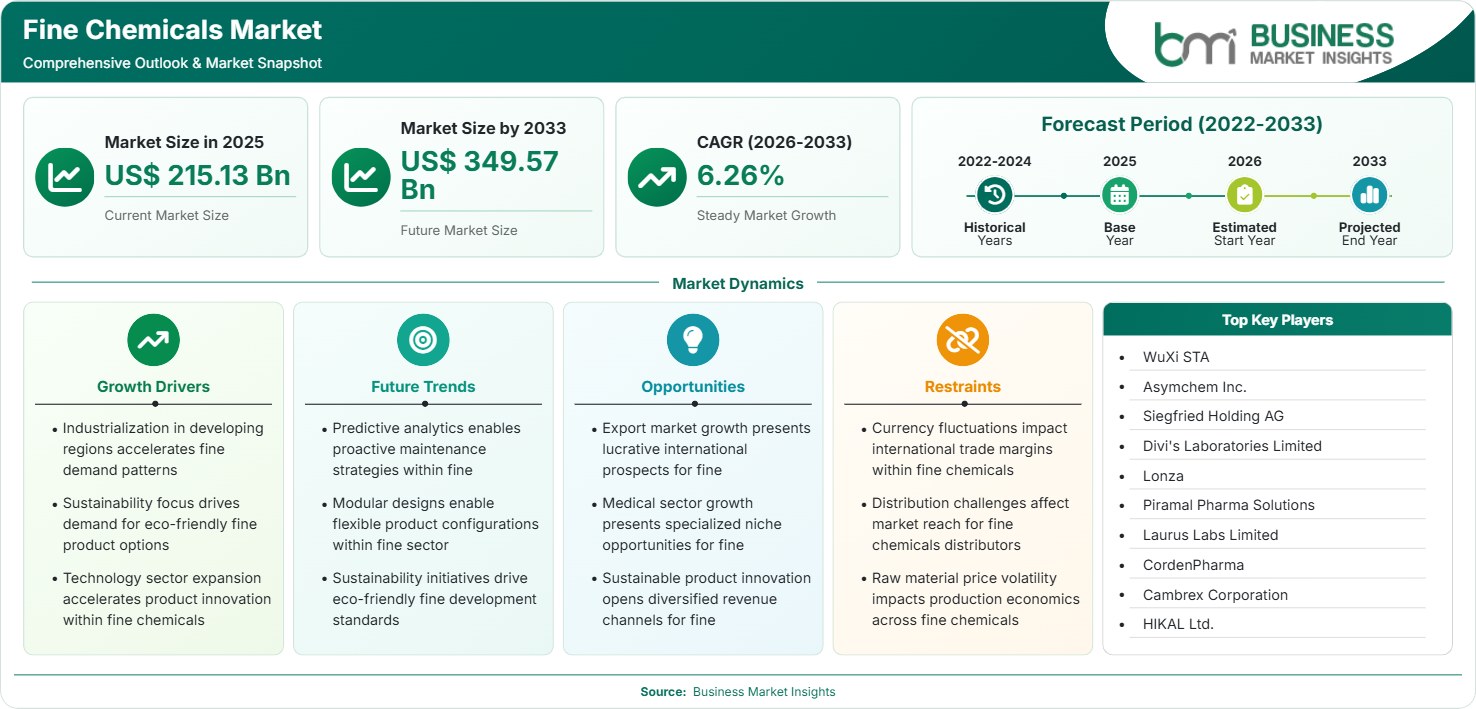
The Fine Chemicals Market size was valued at US$ 215.13 Billion in 2025 and is projected to reach US$ 349.57 Billion by 2033, growing at a CAGR of 6.26% during 2026–2033, supported by pharmaceutical outsourcing, advanced synthesis, agrochemical innovation, specialty electronics demand, and high-value formulation development.

Report Coverage
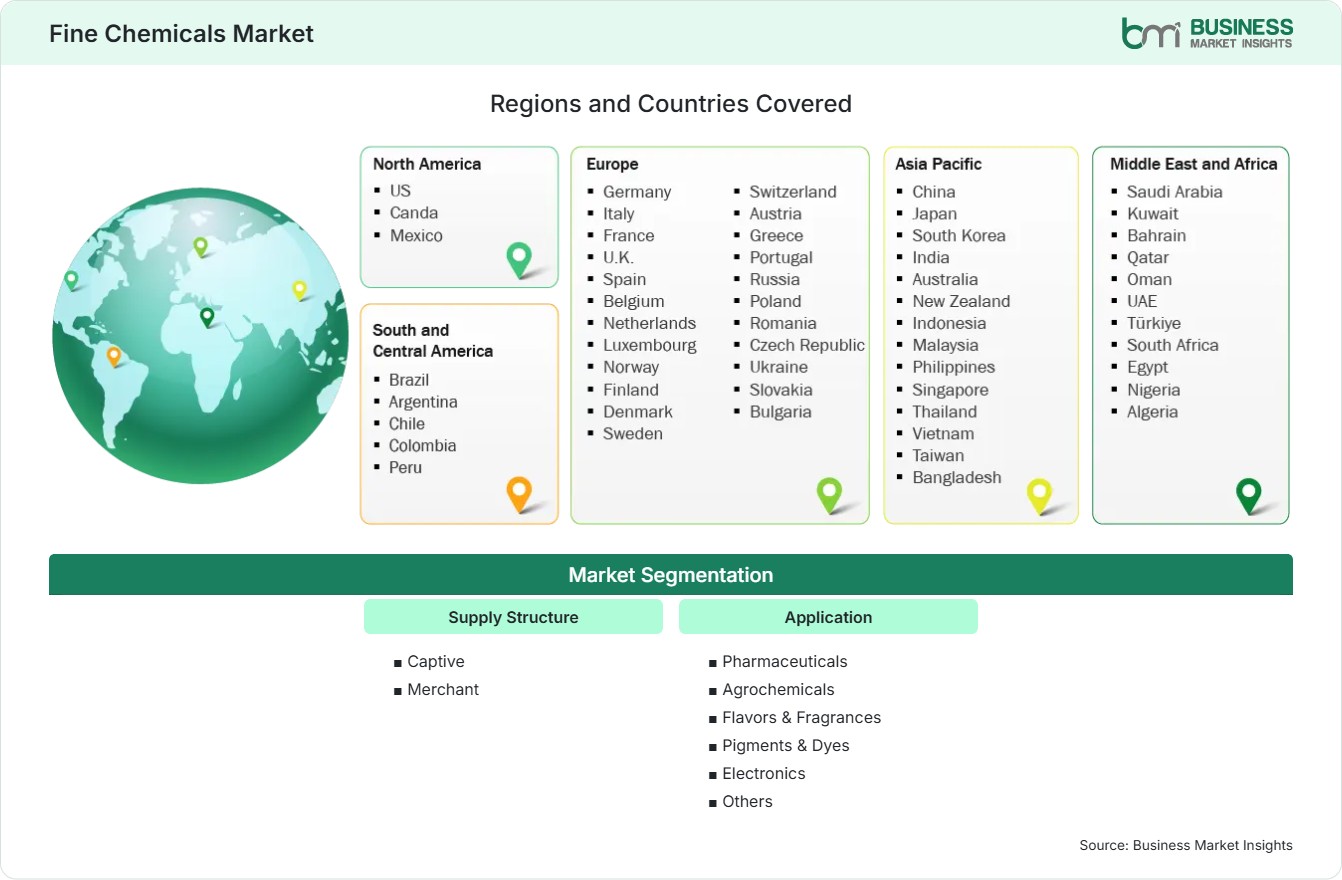
  • Supply Structure: Captive, Merchant
  • Application: Pharmaceuticals, Agrochemicals, Flavors & Fragrances, Pigments & Dyes, Electronics, Others
US$ 215.13 Bn Market size in 2025
US$ 349.57 Bn Market Size by 2033
6.26% CAGR, 2026 - 2033
2026-2033 Forecast Period

AI Overview

Fine Chemicals Market Summary

  • North America Region: North America holds a 28%–31% share in 2025 and is projected to grow at a CAGR of 5.6%–6.0% during 2026–2033, driven by pharmaceutical reshoring, advanced synthesis, biotechnology investment, regulatory compliance, and demand for resilient domestic supply chains. The U.S. market is projected to expand at a 5.8%–6.2% CAGR through 2033, supported by pharmaceutical outsourcing, domestic manufacturing investment, and specialty chemical demand.
  • Fastest Growing Region: Asia Pacific holds a 34%–38% share in 2025 and is projected to grow at a CAGR of 7.0%–7.5% during 2026–2033, supported by expanding pharmaceutical manufacturing, agrochemical production, export-oriented capacity, lower-cost synthesis, and rising domestic innovation.
  • Leading Segment: Pharmaceuticals account for a 52%–56% share in 2025 and are projected to grow at a CAGR of 6.4%–6.8% during 2026–2033, supported by outsourcing, complex molecule development, API demand, regulatory requirements, and investment in high-potency manufacturing.
  • High Growth Segment: Electronics is projected to expand at a CAGR of 8.0%–8.6% during 2026–2033, supported by semiconductor manufacturing, advanced materials, ultra-high-purity requirements, artificial intelligence infrastructure, and regional investment in chip production.
  • Key Market Opportunity: The strongest opportunity lies in integrated development and manufacturing platforms combining process chemistry, high-potency synthesis, continuous processing, digital quality systems, and geographically diversified production for regulated end markets.
  • Major Market Players: WuXi STA, Asymchem Inc., Siegfried Holding AG, Divi's Laboratories Limited, Lonza, Piramal Pharma Solutions, Laurus Labs Limited, CordenPharma, Cambrex Corporation, and HIKAL Ltd.
Strategic Insights

Fine Chemicals Market: Strategic Insights

Fine Chemicals Market Strategic Framework
FREE PDF
Request your free sample
Request free sample
Stakeholder View

Key Takeaways

  • The supply ecosystem is moving toward a hybrid model in which captive production protects strategic molecules and merchant suppliers absorb flexible, outsourced, and technically complex demand.
  • Pharmaceutical applications remain the largest value pool, while electronics offers the strongest incremental upside because advanced manufacturing requires increasingly stringent purity, contamination control, and specialty material specifications.
  • Process intensification, continuous manufacturing, automation, digital batch records, and data-driven process development are changing the economics of scale-up by reducing variability and improving reproducibility.
  • India presents a compelling investment case because pharmaceutical manufacturing depth, chemistry talent, export infrastructure, and expanding CDMO capabilities support capacity additions across intermediates and APIs.
  • Investment activity is increasingly focused on specialized manufacturing assets rather than undifferentiated capacity, with strategic partnerships and targeted acquisitions improving access to high-potency, complex chemistry, and regulated production.
  • Suppliers with multi-region manufacturing footprints can capture greater customer value by reducing geopolitical concentration risk while maintaining consistent quality and regulatory performance.
Geographic Outlook

Fine Chemicals Market Regional Highlights

North America Fine Chemicals Market

North America accounted for 28%–31% Fine Chemicals Market share in 2025 and is projected to grow at a CAGR of 5.6%–6.0% during 2026–2033. The regional opportunity is supported by pharmaceutical supply-chain resilience, domestic manufacturing investment, advanced therapeutic development, and demand for regulated, high-quality chemical inputs. The United States remains the dominant country, while Canada contributes through specialty manufacturing and research-linked chemistry. Regional buyers increasingly prioritize supplier qualification, traceability, and continuity of supply, supporting premium demand for technically differentiated merchant production and contract manufacturing services.

  • Pharmaceutical reshoring and supply-chain diversification are increasing demand for domestic or regional production of strategic intermediates, APIs, and advanced chemical building blocks.
  • High-value pharmaceutical development supports specialized synthesis, while biotechnology investment creates demand for complex chemistry, high-potency compounds, and flexible development-to-commercial manufacturing platforms.
  • Electronics and semiconductor investments are expanding requirements for ultra-high-purity chemicals, controlled contamination environments, and reliable specialty material supply.
  • The region’s mature regulatory environment favors suppliers with validated processes, robust documentation, and strong quality systems across multiple manufacturing sites.

US Fine Chemicals Market

The U.S. accounted for 68%–72% of North America’s regional Fine Chemicals Market demand in 2025 and is projected to grow at a CAGR of 5.8%–6.2% during 2026–2033. Demand is supported by pharmaceutical manufacturing investment, biotechnology development, strategic supply-chain localization, and advanced electronics production. Customers increasingly evaluate suppliers on quality, resilience, technical depth, and regulatory readiness rather than price alone. The United States therefore remains a high-value market for advanced synthesis, high-potency manufacturing, specialty intermediates, and electronics-grade chemical inputs.

  • Pharmaceutical and biotechnology companies are expanding outsourced development and manufacturing relationships to accelerate commercialization while limiting capital intensity.
  • Domestic production initiatives are strengthening demand for reliable strategic inputs and encouraging investment in specialized chemical manufacturing assets.
  • Semiconductor and advanced electronics expansion is increasing demand for high-purity materials, contamination control, and highly consistent batch performance.

Europe Fine Chemicals Market

Europe represented 24%–27% Fine Chemicals Market share in 2025 and is projected to grow at a CAGR of 5.7%–6.1% during 2026–2033. Germany, Switzerland, France, Italy, and the United Kingdom remain important production and innovation centers, while Switzerland leads in specialized pharmaceutical manufacturing. Germany is expected to grow at approximately 5.8%–6.2%, while Ireland and Switzerland are positioned for approximately 6.2%–6.7% growth as pharmaceutical investment, advanced manufacturing, and regulatory standards support high-value chemistry.

  • European manufacturers are prioritizing energy efficiency, process optimization, and lower-emission production as environmental requirements influence operating costs and capital allocation.
  • Pharmaceutical outsourcing remains important, particularly for complex APIs, intermediates, high-potency compounds, and specialized development services requiring stringent quality controls.
  • Switzerland maintains a strong position in high-value pharmaceutical chemistry through technical expertise, regulatory credibility, and specialized manufacturing infrastructure.
  • Germany and France benefit from broad industrial ecosystems spanning pharmaceuticals, agrochemicals, electronics, and specialty materials.
  • Sustainability requirements are encouraging process redesign, solvent recovery, waste reduction, and greater use of resource-efficient production technologies.

Asia Pacific Fine Chemicals Market

Asia Pacific held 34%–38% Fine Chemicals Market share in 2025 and is projected to grow at a CAGR of 7.0%–7.5% during 2026–2033, making it the fastest-growing regional market. China and India lead regional production, while Japan, South Korea, and Singapore contribute advanced technology and high-purity manufacturing capabilities. India is projected to grow at approximately 7.4%–7.9%, supported by pharmaceutical exports, CDMO expansion, and investment in specialized chemical infrastructure. China remains the largest production base.

  • China benefits from integrated chemical supply chains, large-scale production, process chemistry expertise, and extensive manufacturing infrastructure serving pharmaceutical and industrial customers.
  • India is expanding its role in pharmaceutical intermediates, APIs, CDMO services, and specialty synthesis through capacity investment and global customer partnerships.
  • Japan and South Korea contribute advanced materials capabilities, particularly for electronics, semiconductors, and high-purity chemical applications.
  • Southeast Asia is gaining attention as companies diversify manufacturing footprints and seek additional production locations outside concentrated supply chains.
  • Regional demand is supported by pharmaceutical manufacturing growth, agrochemical development, electronics investment, and expanding domestic consumption.

Rest of World Fine Chemicals Market

South and Central America represented approximately 6%–8% of global Fine Chemicals Market demand in 2025, while the Middle East and Africa contributed approximately 4%–6%. South America benefits from agrochemical demand, pharmaceutical imports, and growing local formulation capacity. Brazil remains the largest market, with growth of approximately 5.8%–6.3%, while Mexico benefits from industrial integration and nearshoring.

The Middle East and Africa offer selective opportunities in pharmaceuticals, specialty chemicals, and industrial diversification. Saudi Arabia and the United Arab Emirates are strengthening chemical and life-science ecosystems, while South Africa remains a regional pharmaceutical and industrial hub. Regional growth is supported by localization, infrastructure investment, and supply-chain development.

  • Brazil’s agricultural economy supports demand for agrochemical intermediates, crop protection inputs, and specialized chemical products.
  • Mexico benefits from manufacturing integration, proximity to North American customers, and increasing interest in regional supply-chain diversification.
  • Gulf economies are investing in industrial diversification, advanced manufacturing, and downstream chemical capabilities beyond traditional hydrocarbons.
  • South Africa provides a gateway for specialty chemical and pharmaceutical distribution across Sub-Saharan markets.
  • Local production initiatives can create opportunities for suppliers offering technology transfer, contract manufacturing, and reliable specialty chemical supply.
Global Market Geography
FREE PDF
Request your free sample
Request free sample
Segment Analysis

Fine Chemicals Market Segmentation

Supply Structure

The supply structure is divided between captive and merchant production. Merchant supply held a 57%–61% Fine Chemicals Market share in 2025 and is projected to grow at a CAGR of 6.5%–6.9% during 2026–2033, supported by outsourcing, capital efficiency, technical specialization, and flexible production. Captive manufacturing remains strategically important for proprietary molecules, supply security, and internal process control.

  • Captive: Captive production supports proprietary formulations, strategic intermediates, and supply security, with manufacturers retaining control over process knowledge, quality, scheduling, and long-term availability.
  • Merchant: Merchant suppliers benefit from outsourcing, multi-client utilization, technical expertise, and flexible capacity, serving customers seeking development support, commercial manufacturing, and reduced capital expenditure.

Application

Pharmaceuticals represented the leading application with a 52%–56% share in 2025 and are projected to grow at a CAGR of 6.4%–6.8% during 2026–2033. Complex chemistry, outsourcing, advanced APIs, and regulatory requirements support sustained demand. Electronics is the fastest-growing application, driven by purity requirements and semiconductor investment. Fine Chemicals Market trends increasingly reflect application-specific manufacturing.

  • Pharmaceuticals: Demand is supported by APIs, intermediates, complex molecules, high-potency compounds, and outsourced development and manufacturing across regulated pharmaceutical supply chains.
  • Agrochemicals: Crop protection innovation, formulation development, agricultural productivity requirements, and demand for specialized intermediates support ongoing chemical consumption and production investment.
  • Flavors & Fragrances: Premiumization, natural and synthetic ingredient innovation, formulation differentiation, and consumer product development support demand for consistent specialty aromatic compounds.
  • Pigments & Dyes: Textile, coatings, packaging, automotive, and industrial applications sustain demand for performance-oriented colorants requiring stability, consistency, and application-specific functionality.
  • Electronics: Semiconductor fabrication, advanced packaging, displays, batteries, and high-performance components require ultra-pure chemicals with strict contamination control and reproducible specifications.
Market Forces

Fine Chemicals Market Dynamics

Key Market Drivers

Pharmaceutical Outsourcing and Complex Molecule Development

Pharmaceutical outsourcing is expanding the addressable market for advanced intermediates, APIs, high-potency compounds, and process development services. Drug developers increasingly rely on external manufacturing partners to reduce capital intensity, access specialized chemistry, and accelerate clinical and commercial timelines. Complex molecules require process expertise that many sponsors cannot efficiently maintain internally. This structural shift supports Fine Chemicals Market growth by increasing demand for suppliers with validated processes, scalable assets, and regulatory capabilities. The growth of biologics-related small-molecule payloads, targeted therapies, and advanced formulations is also increasing demand for specialized synthesis. Suppliers that integrate discovery support, process development, scale-up, and commercial production can capture greater value across the customer lifecycle while improving utilization of technically differentiated assets.

Supply-Chain Resilience and Regional Manufacturing Diversification

Geopolitical risk, trade uncertainty, transportation disruption, and concentrated production networks are encouraging customers to diversify sourcing across regions. Pharmaceutical and industrial buyers increasingly evaluate suppliers according to business continuity, manufacturing redundancy, inventory strategy, and regulatory reliability. This driver supports demand for multi-site production and qualified secondary sources rather than dependence on a single low-cost location. Regionalization also creates opportunities for suppliers operating across Asia, Europe, and North America. The underlying commercial logic is straightforward: customers may accept moderate cost premiums when continuity of supply protects product launches and manufacturing schedules. As supply-chain resilience becomes a board-level consideration, Fine Chemicals Market trends increasingly favor companies with geographic breadth, validated alternate processes, and the ability to transfer production between qualified facilities.

Advanced Manufacturing and High-Purity Chemistry Adoption

Process intensification, automation, continuous manufacturing, digital quality systems, and improved analytical technologies are changing how specialty chemical production is designed and controlled. Such technologies will contribute to improving batch uniformity, minimizing process variability, maximizing resource efficiency, and enabling a quick process scale-up. The requirement for high purity of processes used in the electronics and advanced materials industry adds even more value to the technologies of contamination control and analysis. Companies using state-of-the-art equipment and technology development will be able to differentiate from their competitors on something else besides price. The effect will be especially significant when the customer demands strict specifications, low impurities content, or repeatable performance.

Key Market Opportunities

Integrated Development-to-Commercial Manufacturing Platforms

The strongest opportunity is the integration of process research, analytical development, pilot production, scale-up, regulatory support, and commercial manufacturing within a single supplier relationship. Clients are now opting for fewer handovers because each can present certain risks of the technical, documentation and scheduling variety. The suppliers who link the nascent stage of their chemistry with their commercial assets will be able to create a more seamless project experience as well as develop stronger ties with their clients. This business model is especially advantageous for complicated APIs, high potency products and intermediates. Fine Chemicals Market Forecasts therefore favor providers that combine scientific depth with reliable manufacturing execution, especially when they can serve multiple development stages across geographically diversified facilities.

High-Purity Materials for Electronics and Semiconductor Production

Electronics is creating an attractive expansion pathway for chemical manufacturers able to meet demanding purity, contamination, and consistency requirements. Semiconductor fabrication, advanced packaging, displays, batteries, and other technology applications require specialized materials whose performance can be affected by trace impurities. This results in barriers to entry as well as justification for premium pricing by qualified suppliers. Investments could be made in purification technology, analytical laboratories, specialty intermediates, and specialized production facilities. This opportunity is bolstered by investments in semiconductors and localized supply chains in the region. For the chemical companies, which have experience in process control systems, there is potential to apply this knowledge in electronics applications, while on the other hand, technology customers would gain from more suppliers.

Low-Emission and Resource-Efficient Chemical Production

There are increasing business opportunities in environmental performance due to customer scrutiny in terms of energy consumption, solvent usage, waste production, and emissions. There are possibilities in solvent recovery, catalytic reactions design, continuous process, renewable power sources incorporation, and low waste synthetic processes. Such investments may help increase the level of performance on both environmental sustainability and economics as long as they save material input. Suppliers that quantify environmental improvements can strengthen qualification with multinational customers that maintain sustainability targets across their procurement networks. The opportunity is not limited to compliance: resource-efficient production can improve productivity and reduce exposure to energy volatility. Capital directed toward process redesign may therefore generate both environmental benefits and long-term cost advantages.

Market Restraints and Challenges

Regulatory Complexity and Qualification Requirements

Factor: Suppliers for fine chemicals used in the pharmaceutical industry, electronics, and other regulated industries are subjected to various levels of qualification, documentation, validation, audit, and change control. The processes involved in this case might need prior customer approval, which can slow down the process of monetizing additional capacity.

Impact: Regulatory complexity will add cost to product development, extend time to sale, and add financial risk to any plans for capacity growth. In smaller companies, the ability to support the required quality system, analytical capabilities, and regulatory staff may be difficult. Changes to the regulatory environment may even necessitate some process change or additional testing. But having well-developed systems in place does help in such cases.

Energy, Raw-Material, and Production Cost Volatility

Factor: Manufacture of chemicals still suffers from volatility in the prices of energy, raw materials, solvents, transportation, utilities, and environmental compliance costs. This has potential implications for manufacturing economics, especially in processes that use a lot of energy.

Impact: Uncertainty about the costs can squeeze margins, make it difficult to price customers, and make expansion of production capacity less attractive where contracts are inadequate to insulate manufacturers from such risk. Small firms will have lower bargaining power and little ability to cope with sudden hikes in the cost of inputs. The customers will also be able to postpone their purchases due to increased inventory.

Company Analysis

Competitive Landscape

The Fine Chemicals Market analysis indicates that competition is increasingly based on process chemistry, regulatory reliability, manufacturing flexibility, geographic coverage, and the ability to support customers from development through commercialization. The listed companies represent a balanced competitive field spanning global CDMOs, pharmaceutical manufacturers, advanced synthesis specialists, and integrated chemical service providers.

Company Name

Overview

Products and Services relevant to this market

WuXi STA

China-based pharmaceutical development and manufacturing specialist with broad small-molecule capabilities and global customer reach.

Small-molecule APIs, intermediates, process development, analytical services, scale-up, and commercial manufacturing.

Asymchem Inc.

China-based contract development and manufacturing company focused on complex chemistry and integrated pharmaceutical services.

APIs, intermediates, process development, custom synthesis, commercial manufacturing, and specialized chemistry.

Siegfried Holding AG

Switzerland-headquartered life-science company combining pharmaceutical development, manufacturing, and chemical expertise.

APIs, intermediates, drug products, development services, and regulated manufacturing solutions.

Divi's Laboratories Limited

India-based manufacturer with strong capabilities in APIs, intermediates, and custom synthesis for global customers.

APIs, intermediates, custom synthesis, process development, and pharmaceutical manufacturing.

Lonza

Global healthcare manufacturing partner with advanced synthesis and specialized production capabilities across multiple regions.

Advanced synthesis, APIs, intermediates, development services, and contract manufacturing solutions.

Piramal Pharma Solutions

Integrated global CDMO supporting pharmaceutical development and manufacturing across complex products and modalities.

APIs, intermediates, drug substances, development, high-potency chemistry, and commercial manufacturing.

Laurus Labs Limited

India-based pharmaceutical manufacturer with capabilities spanning APIs, formulations, and development-oriented manufacturing.

APIs, intermediates, CDMO services, pharmaceutical ingredients, and process development.

CordenPharma

Global pharmaceutical manufacturing network specializing in complex molecules and regulated production services.

APIs, intermediates, peptides, lipids, drug products, and development-to-commercial manufacturing.

Cambrex Corporation

U.S.-based contract development and manufacturing company focused on small-molecule pharmaceutical products and services.

APIs, drug substances, intermediates, analytical services, development, and commercial manufacturing.

HIKAL Ltd.

India-based contract manufacturer serving pharmaceutical, crop protection, and specialty chemical customers.

APIs, intermediates, custom synthesis, process development, and specialty chemical manufacturing.

Trust & Transparency

Research Methodology

The market analysis combines proprietary research with secondary data from government agencies, company disclosures, regulatory filings, industry databases and expert interviews. Market estimates are validated through data triangulation, cross-market benchmarking and analyst review.

View Full Research Methodology

Questions Answered

Frequently Asked Questions

What should investors evaluate before funding new capacity?

The Fine Chemicals Market Report highlights that Investors should assess customer qualification timelines, utilization visibility, regulatory readiness, technical specialization, geographic resilience, energy exposure, and the proportion of capacity dedicated to high-value applications with sustainable demand.

Which capabilities can create the strongest supplier differentiation?

High-potency manufacturing, complex synthesis, continuous processing, advanced analytical systems, regulatory expertise, and integrated development-to-commercial services can create stronger differentiation than undifferentiated capacity.

How does captive manufacturing compare with merchant supply?

Captive production provides control over proprietary chemistry and supply security, while merchant supply offers flexibility, external expertise, and lower customer capital requirements. The two structures increasingly coexist within complex global supply chains.

Why are electronics applications attracting chemical manufacturers?

Electronics applications require high-purity materials, strict contamination control, and consistent specifications. Semiconductor, advanced packaging, battery, and display investments are creating opportunities for suppliers with purification, analytical, and process-control capabilities.

What is changing the competitive basis of fine chemical manufacturing?

Competition is moving beyond production cost toward process development capability, regulatory performance, supply continuity, specialized equipment, and multi-region manufacturing. Customers increasingly prefer suppliers that can support development, scale-up, validation, and commercial production within integrated platforms.

Access the Full Fine Chemicals Market Report

Get segment-level forecasts, regional estimates, competitive benchmarking, company profiles and downloadable Excel datasets.

Access the full Fine Chemicals Market Report
350 pages PDF & Excel | 2026-08-17
Similar Research

Related Market Reports