
Photoresist Chemicals Market Outlook: Size, Share, Trends, Growth Analysis, Competitive Landscape & Forecast, 2026-2033

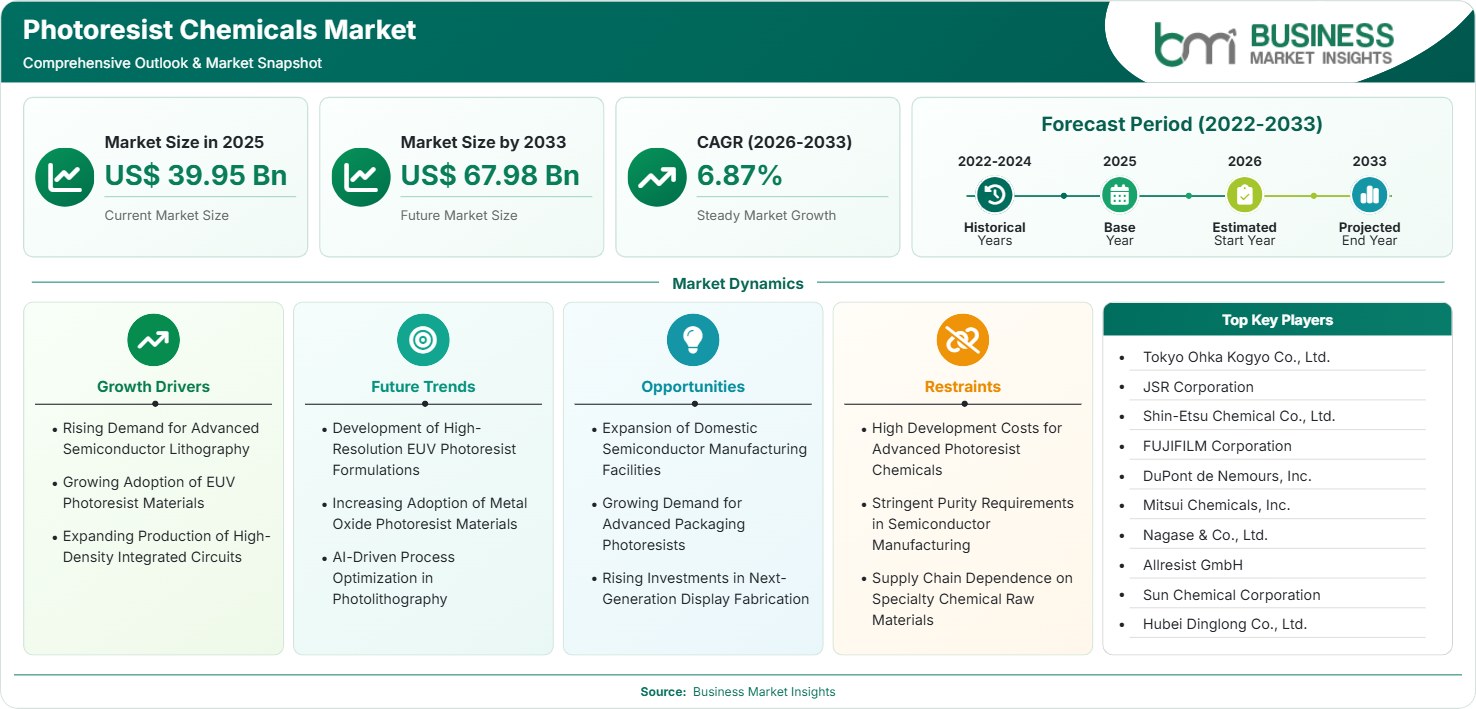
The Photoresist Chemicals Market size was valued at US$ 39.95 Billion in 2025 and is projected to reach US$ 67.98 Billion by 2033, growing at a CAGR of 6.87% during 2026–2033. Increasing semiconductor fabrication investments, rising adoption of advanced lithography technologies, expanding demand for consumer electronics, and growing production of automotive semiconductors are creating significant opportunities for photoresist chemical manufacturers globally.

Report Coverage
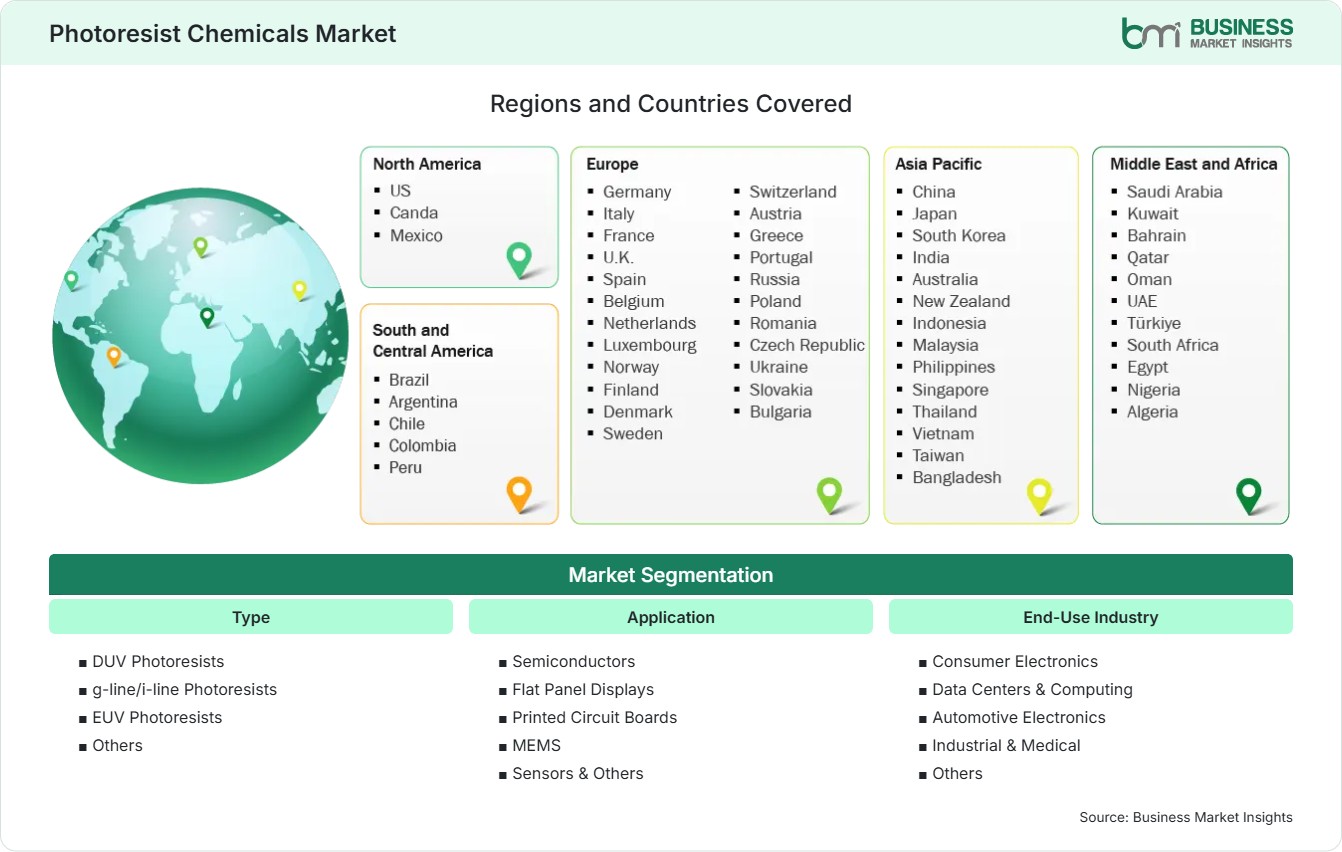
  • Type: DUV Photoresists, g-line/i-line Photoresists, EUV Photoresists, Others
  • Application: Semiconductors, Flat Panel Displays, Printed Circuit Boards, MEMS, Sensors & Others
  • End-Use Industry: Consumer Electronics, Data Centers & Computing, Automotive Electronics, Industrial & Medical, Others
US$ 39.95 Bn Market size in 2025
US$ 67.98 Bn Market Size by 2033
6.87% CAGR, 2026 - 2033
2026-2033 Forecast Period

AI Overview

Photoresist Chemicals Market Summary

  • North America Region: North America holds 24%–27% Photoresist Chemicals Market share in 2025 and is projected to expand at a 6.3%–6.8% CAGR during 2026–2033. Growth is supported by semiconductor manufacturing investments, government-backed chip production initiatives, advanced R&D activities, and increasing demand for high-performance electronic components. The United States leads the regional market through substantial semiconductor fabrication investments and advanced technology development, advancing at approximately 6.5%–7.0% CAGR through 2033.
  • Fastest Growing Region: Asia Pacific accounts for 46%–49% market share in 2025 and is expected to register the fastest 7.3%–7.9% CAGR during the forecast period. Expanding semiconductor manufacturing capacity, growing electronics production, increasing lithography investments, and strong government support for domestic chip industries continue accelerating regional growth.
  • Leading Segment: Semiconductors account for 52%–56% market share in 2025 and are anticipated to grow at a 7.0%–7.5% CAGR through 2033. Rising wafer production, adoption of advanced chip architectures, and increasing investments in leading-edge fabrication facilities continue supporting segment dominance.
  • High Growth Segment: EUV Photoresists hold 11%–14% market share in 2025 while expanding at a 9.0%–9.7% CAGR during 2026–2033. Growing deployment of extreme ultraviolet lithography, transition toward smaller process nodes, and rising production of advanced semiconductor devices continue driving demand.
  • Key Market Opportunity: Increasing commercialization of advanced lithography technologies, next-generation semiconductor nodes, AI processors, and high-performance computing applications is creating long-term opportunities for specialty photoresist chemical suppliers.
  • Major Market Players: Tokyo Ohka Kogyo Co., Ltd., JSR Corporation, Shin-Etsu Chemical Co., Ltd., FUJIFILM Corporation, DuPont de Nemours, Inc., Mitsui Chemicals, Inc., Nagase & Co., Ltd., Allresist GmbH, Sun Chemical Corporation, and Hubei Dinglong Co., Ltd.
Strategic Insights

Photoresist Chemicals Market: Strategic Insights

Photoresist Chemicals Market Strategic Framework
FREE PDF
Request your free sample
Request free sample
Stakeholder View

Key Takeaways

  • Semiconductor manufacturers remain the primary revenue contributors as advanced node fabrication, wafer capacity expansion, and investments in next-generation lithography continue increasing consumption of high-performance photoresist materials.
  • EUV photoresists present the strongest growth opportunity in the photoresist chemicals market due to rising adoption of extreme ultraviolet lithography for advanced semiconductor nodes, AI processors, memory devices, and high-performance computing applications.
  • Innovation is increasingly focused on higher-resolution photoresist formulations, defect reduction technologies, process stability improvements, and materials optimized for advanced lithography platforms.
  • Asia Pacific offers the most attractive investment environment owing to its dominant semiconductor manufacturing base, expanding foundry investments, and government-supported chip production ecosystems.
  • Strategic collaboration between chemical suppliers, lithography equipment providers, semiconductor foundries, and integrated device manufacturers is becoming increasingly important as process complexity rises.
  • The transition toward advanced packaging, heterogeneous integration, and next-generation semiconductor architectures is creating additional demand for specialized photoresist chemistries across fabrication processes.
Geographic Outlook

Photoresist Chemicals Market Regional Highlights

North America Photoresist Chemicals Market

North America accounts for 24%–27% of the Photoresist Chemicals Market share in 2025 and is projected to grow at a 6.3%–6.8% CAGR through 2033. Semiconductor manufacturing incentives, advanced research activities, and investments in domestic chip fabrication continue supporting market growth. The region benefits from strong technology development capabilities and increasing demand for advanced semiconductor materials across computing, telecommunications, defense, and electronics sectors.

  • Semiconductor manufacturing expansion continues supporting demand for advanced photoresists used in leading-edge lithography processes.
  • Government-backed domestic chip production initiatives are strengthening investments across the semiconductor materials value chain.
  • Advanced research and development activities remain critical for next-generation photoresist formulation innovation.
  • Rising adoption of AI, cloud computing, and high-performance computing devices supports long-term semiconductor demand.
  • Strategic investments in semiconductor supply-chain resilience continue encouraging local material production capabilities.

US Photoresist Chemicals Market

The United States contributes 82%–86% of North American revenue and is anticipated to register a 6.5%–7.0% CAGR through 2033. Strong semiconductor investments, technological innovation, and increasing support for domestic manufacturing continue driving market growth. Demand is further supported by advanced computing applications, defense electronics programs, and expanding semiconductor fabrication capacity.

  • New semiconductor fabrication investments continue creating opportunities for advanced photoresist suppliers.
  • AI accelerator, processor, and memory production supports demand for sophisticated lithography materials.
  • Research institutions and technology firms drive innovation in semiconductor manufacturing processes.
  • Expansion of advanced packaging facilities supports broader demand for specialty process materials.

Europe Photoresist Chemicals Market

Europe represents 18%–21% market share in 2025 and is expected to expand at a 6.4%–6.9% CAGR through 2033. Regional growth is supported by semiconductor technology investments, automotive electronics production, and industrial automation expansion. Germany leads the regional market, while Ireland records the fastest growth with a 7.0%–7.5% CAGR driven by advanced technology investments and semiconductor ecosystem development.

  • Automotive semiconductor demand continues supporting advanced material consumption across regional fabrication facilities.
  • Semiconductor investment initiatives are strengthening domestic manufacturing capabilities and supply-chain resilience.
  • Industrial automation and Industry 4.0 deployments support long-term electronics demand.
  • Research collaborations continue fostering innovation in advanced lithography technologies and semiconductor materials.
  • Sustainability initiatives encourage development of more efficient manufacturing processes across the semiconductor ecosystem.

Asia Pacific Photoresist Chemicals Market

Asia Pacific accounts for 46%–49% market share in 2025 and is forecast to register the fastest 7.3%–7.9% CAGR during 2026–2033. The region benefits from extensive semiconductor manufacturing capacity, expanding electronics production, and strong government support for domestic chip industries. China remains the largest regional market, while India is projected to witness the fastest growth with a 7.8%–8.4% CAGR through 2033.

  • China continues expanding semiconductor manufacturing capabilities and investments in advanced fabrication technologies.
  • Taiwan, South Korea, and Japan remain key hubs for semiconductor production and lithography material consumption.
  • India is emerging as a fast-growing destination for semiconductor manufacturing and electronics production investments.
  • Growing consumer electronics demand continues supporting wafer fabrication and display manufacturing activities.
  • Government incentives are strengthening regional semiconductor supply chains and domestic production ecosystems.

Rest of World Photoresist Chemicals Market

The Rest of World region represents 7%–9% Photoresist Chemicals Market share in 2025 and is projected to expand at a 5.9%–6.4% CAGR through 2033. South & Central America continue benefiting from electronics manufacturing investments, while the Middle East & Africa are gradually expanding technology and industrial electronics capabilities. Brazil leads regional demand, whereas the United Arab Emirates demonstrates the fastest growth with a 6.5%–7.0% CAGR.

  • Expansion of electronics assembly operations supports moderate demand for semiconductor materials.
  • Technology infrastructure investments continue encouraging broader adoption of advanced electronic devices.
  • Industrial digitalization initiatives create opportunities across electronics and sensor manufacturing applications.
  • Regional governments are investing in technology development and innovation ecosystems.
  • Increased demand for connected devices supports long-term growth across electronics value chains.
Global Market Geography
FREE PDF
Request your free sample
Request free sample
Segment Analysis

Photoresist Chemicals Market Segmentation

Type

Type segmentation remains critical as semiconductor manufacturers adopt increasingly sophisticated lithography technologies to support advanced chip production. DUV (ArF / KrF) Photoresists account for approximately 48%–52% share in 2025 and are projected to grow at a 6.5%–7.0% CAGR through 2033. The Photoresist Chemicals Market scope continues expanding with rising demand for advanced semiconductor fabrication, display technologies, and precision microelectronics manufacturing applications across global production facilities.

  • DUV (ArF / KrF) Photoresists: Remain the dominant category due to widespread deployment in advanced semiconductor manufacturing processes requiring high-resolution pattern transfer and production efficiency.
  • g-line / i-line Photoresists: Continue serving mature semiconductor nodes, MEMS production, and specialty electronic applications where established lithography processes remain commercially viable.
  • EUV Photoresists: Represents the fastest-growing category driven by advanced node manufacturing, high-resolution patterning requirements, and increasing adoption of extreme ultraviolet lithography systems.

Application

Application demand is primarily influenced by semiconductor production volumes, display manufacturing investments, and increasing adoption of high-performance electronic devices. Semiconductors account for approximately 52%–56% share in 2025 and are projected to expand at a 7.0%–7.5% CAGR during the forecast period. Increasing wafer starts, advanced node migration, and growing investments in fabrication facilities continue supporting long-term demand for high-performance photoresist materials.

  • Semiconductors: Represents the leading application segment benefiting from increasing chip demand, advanced lithography adoption, and global semiconductor capacity expansion.
  • Flat Panel Displays (LCD / OLED): Demand remains supported by growth in smartphones, televisions, tablets, monitors, and next-generation display technologies.
  • Printed Circuit Boards: Continues generating demand for lithographic materials used in circuit patterning and miniaturized electronics manufacturing processes.
  • MEMS, Sensors & Others: Expanding through increasing adoption of connected devices, industrial automation systems, healthcare sensors, and automotive electronics.

End-use Industry

End-user demand is shaped by digitalization trends, increasing semiconductor consumption, and the proliferation of connected technologies. The Photoresist Chemicals Market trends indicate strong demand from advanced electronics manufacturing sectors seeking greater miniaturization, performance, and production efficiency. Consumer Electronics remains the leading end-use industry with approximately 38%–42% share in 2025 and is forecast to grow at a 6.7%–7.2% CAGR through 2033.

  • Consumer Electronics: Driven by strong production of smartphones, tablets, laptops, wearable devices, gaming systems, and smart home technologies.
  • Data Centers & Computing: Increasing demand for processors, memory devices, AI accelerators, and high-performance computing infrastructure supports material consumption.
  • Automotive Electronics: Growth is driven by electric vehicles, advanced driver-assistance systems, infotainment systems, and vehicle connectivity technologies.
  • Industrial & Medical: Expanding adoption of sensors, industrial automation equipment, medical devices, and diagnostic technologies continues supporting demand.
Market Forces

Photoresist Chemicals Market Dynamics

Key Market Drivers

Rising Demand for Advanced Semiconductor Lithography

The semiconductor industry remains on course towards achieving increasingly small process nodes and complex architectures. There have been significant investments by foundry houses and integrated device manufacturers in fabrication plants that manufacture advanced computing chips, artificial intelligence processors, and memory devices. Photoresists form an integral part in ensuring that circuits are fabricated to exact dimensions in nanometers. The increased demand for consumer electronics, cloud computing infrastructure, artificial intelligence, and advanced connectivity solutions keeps fuelling global semiconductor manufacturing. This is driving the demand for performance photoresists in advanced lithography.

Growing Adoption of EUV Photoresist Materials

The use of extreme ultraviolet lithography in the production of semiconductors becomes increasingly crucial as the manufacturers strive to increase the number of transistors and optimize their performance. Extreme ultraviolet lithography allows for more accurate patterning and simplifies processes at advanced nodes. As manufacturers integrate extreme ultraviolet lithography into the production process, the need for photoresists that can meet the strict criteria increases. Photoresists manufacturers continue conducting R&D aimed at improving the resolution and sensitivity of photoresists. Adoption of extreme ultraviolet lithography in the leading semiconductor manufacturers becomes an important factor driving the photoresist chemicals market.

Expanding Production of High-Density Integrated Circuits

An increase in the need for sophisticated computer technology is leading to increased production of high density integrated circuits in different sectors of applications. These applications include artificial intelligence, cloud computing, consumer electronics, automotive, and telecommunications infrastructure, which all rely on sophisticated semiconductor devices. The manufacturers are making investments in advanced semiconductor production techniques to increase chip performance, energy efficiency, and miniaturization. Photoresists are important components in the semiconductor production process where they facilitate the accurate pattern formation. The growth in complexity and density of the integrated circuits has resulted in an increase in demand for photoresists.

Key Market Opportunities

Expansion of Domestic Semiconductor Manufacturing Facilities

Governments worldwide are increasing investments in local semiconductor manufacturing capabilities to strengthen supply-chain resilience and reduce dependence on external suppliers. Incentive programs, manufacturing subsidies, and strategic industrial policies are encouraging construction of new fabrication facilities across North America, Europe, and Asia. These projects create substantial demand for lithography materials used throughout wafer manufacturing processes. Photoresist suppliers capable of supporting advanced fabrication technologies and localized supply requirements are expected to benefit significantly. Growing investment activity within semiconductor ecosystems presents a major opportunity for specialty chemical manufacturers serving the electronics industry.

Growing Demand for Advanced Packaging Photoresists

New technologies for packaging are becoming ever more significant for semiconductor manufacturers that want to increase performance, functionality, and energy efficiency of their products. Technologies such as 2.5D packaging, 3D packaging, wafer-level packaging, and heterogeneous packaging use specific kinds of photoresists that are able to facilitate intricate processes. There is growing demand because the new packaging technologies become essential for AI accelerators, memories, and future computers. Companies manufacture special formulations of photoresists to increase manufacturing precision and yield. The development of such technologies is still providing interesting prospects for photoresist chemical companies.

Rising Investments in Next-Generation Display Fabrication

Investments in OLED, microLED, flexible displays, and advanced display manufacturing technologies continue creating new opportunities for photoresist suppliers. Display manufacturers are expanding production capacity to address growing demand from smartphones, televisions, automotive displays, wearable devices, and industrial applications. Advanced photoresist materials play a critical role in achieving precise patterning and display performance requirements. Long-term Photoresist Chemicals Market Forecasts remain favorable as next-generation display technologies gain commercial adoption. Continued innovation in display manufacturing is expected to sustain demand for high-performance lithographic materials over the coming years.

Market Restraints and Challenges

High Development Costs for Advanced Photoresist Chemicals

Factor: Advanced photoresist development requires significant investments in materials science, formulation engineering, lithography testing, process validation, and semiconductor manufacturer qualification programs. Continuous innovation is necessary to meet evolving node requirements and performance specifications.

Impact: High research and development costs can increase barriers to entry and limit participation among smaller suppliers. Extensive qualification timelines further increase commercialization risks and capital requirements. Manufacturers must therefore balance innovation investments with profitability objectives while maintaining technological competitiveness.

Stringent Purity Requirements in Semiconductor Manufacturing

Factor: Semiconductor fabrication processes require ultra-high-purity materials to prevent defects, contamination, and yield losses during production. Even minor impurities can negatively affect device performance and manufacturing efficiency.

Impact: Strict quality requirements increase manufacturing complexity, process control requirements, and production costs for photoresist suppliers. Maintaining consistent purity standards across global production volumes remains challenging, particularly as semiconductor manufacturers transition toward more advanced process nodes and increasingly demanding fabrication environments.

Company Analysis

Competitive Landscape

The Photoresist Chemicals Market analysis indicates intense competition among specialty chemical manufacturers, lithography material suppliers, and semiconductor process material providers. Leading companies are focusing on advanced EUV photoresist development, next-generation lithography materials, semiconductor ecosystem partnerships, and localized manufacturing expansion. Product performance, purity standards, research capabilities, and long-term relationships with semiconductor foundries remain the primary competitive differentiators across the market.

Company Name

Overview

Products and Services Relevant to this Market

Tokyo Ohka Kogyo Co., Ltd.

Leading supplier of semiconductor process chemicals with strong expertise in advanced lithography materials and photoresist technologies.

DUV photoresists, EUV photoresists, semiconductor process chemicals, cleaning agents, and advanced lithography materials.

JSR Corporation

Global materials company specializing in semiconductor materials and advanced lithographic solutions for chip manufacturing.

Photoresists, EUV materials, CMP materials, semiconductor process chemicals, and advanced material solutions.

Shin-Etsu Chemical Co., Ltd.

Major supplier of semiconductor-grade materials supporting advanced wafer fabrication and lithography applications.

Photoresist materials, silicon wafers, lithography chemicals, semiconductor materials, and specialty process solutions.

FUJIFILM Corporation

Diversified technology company with a strong portfolio of advanced electronic materials and semiconductor process products.

Advanced photoresists, semiconductor chemicals, display materials, electronic materials, and lithography solutions.

DuPont de Nemours, Inc.

Global materials science company serving semiconductor, electronics, and advanced manufacturing industries through specialized materials.

Photoresists, semiconductor materials, packaging materials, electronic chemicals, and advanced lithography solutions.

Mitsui Chemicals, Inc.

Specialty chemicals manufacturer focused on advanced electronic materials and semiconductor production technologies.

Semiconductor chemicals, photoresist materials, specialty polymers, electronic materials, and advanced process solutions.

Nagase & Co., Ltd.

Technology-oriented trading and materials company supporting semiconductor and electronics manufacturing value chains.

Photoresist materials, semiconductor chemicals, electronic materials distribution, specialty chemicals, and process support services.

Allresist GmbH

Specialized manufacturer focused on high-performance photoresists and lithography materials for research and industrial applications.

Photoresists, electron beam resists, lithography materials, coating technologies, and specialty semiconductor materials.

Sun Chemical Corporation

Global producer of specialty chemicals and advanced materials supporting electronics and industrial manufacturing.

Electronic materials, semiconductor chemicals, photoresist-related materials, specialty formulations, and process chemicals.

Hubei Dinglong Co., Ltd.

Electronic materials manufacturer expanding its presence across semiconductor consumables and lithography material markets.

Photoresist materials, semiconductor process chemicals, electronic materials, polishing materials, and integrated semiconductor solutions.

Trust & Transparency

Research Methodology

The market analysis combines proprietary research with secondary data from government agencies, company disclosures, regulatory filings, industry databases and expert interviews. Market estimates are validated through data triangulation, cross-market benchmarking and analyst review.

View Full Research Methodology

Questions Answered

Frequently Asked Questions

What does the Photoresist Chemicals Market Report cover?

The report provides comprehensive insights into market size, share, segmentation, regional analysis, competitive landscape, growth drivers, opportunities, restraints, and forecast trends through 2033.

Which region dominates the Market?

Asia Pacific dominates the market owing to its strong semiconductor manufacturing base, extensive electronics production ecosystem, and significant investments in advanced wafer fabrication facilities.

Why are photoresist chemicals important in semiconductor manufacturing?

Photoresist chemicals enable precise circuit pattern transfer during lithography processes, making them essential for producing semiconductors, memory chips, processors, sensors, and advanced electronic devices.

Which type segment is growing the fastest?

EUV Photoresists represent the fastest-growing type segment due to increasing deployment of extreme ultraviolet lithography in advanced semiconductor manufacturing and the industry's transition to smaller process nodes.

What is driving growth in the Photoresist Chemicals Market?

Growth is primarily driven by rising semiconductor fabrication investments, increasing adoption of advanced lithography technologies, growing demand for AI and high-performance computing chips, and expansion of global electronics production.

Access the Full Photoresist Chemicals Market Report

Get segment-level forecasts, regional estimates, competitive benchmarking, company profiles and downloadable Excel datasets.

Access the full Photoresist Chemicals Market Report
350 pages PDF & Excel | 2026-08-06