
3D Printing Material Market Outlook: Size, Share, Trends, Growth Analysis, Competitive Landscape & Forecast, 2026-2033

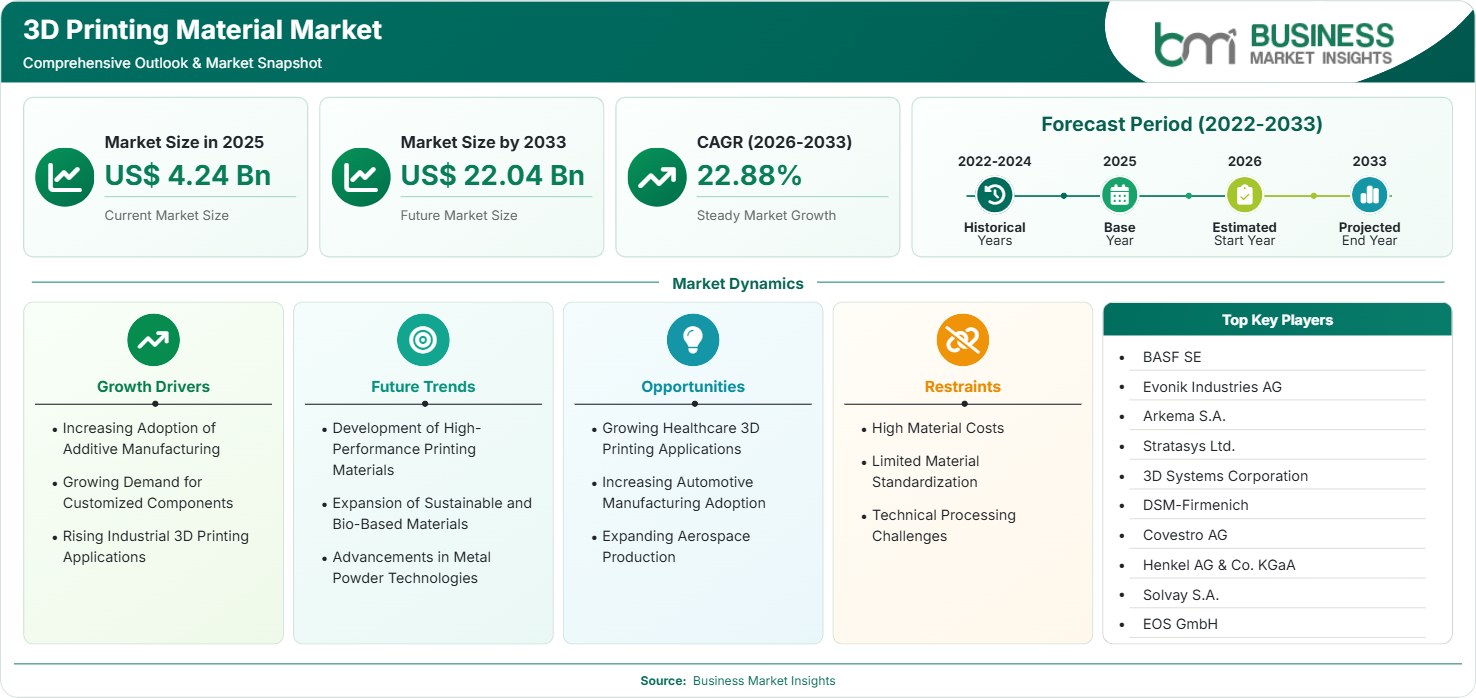
The 3D Printing Material Market size was valued at US$ 4.24 Billion in 2025 and is projected to reach US$ 22.04 Billion by 2033, growing at a CAGR of 22.88% during 2026–2033. Rising industrial additive manufacturing adoption, advanced material innovation, and expanding healthcare, aerospace, and automotive applications continue creating strong commercialization opportunities globally.

Report Coverage
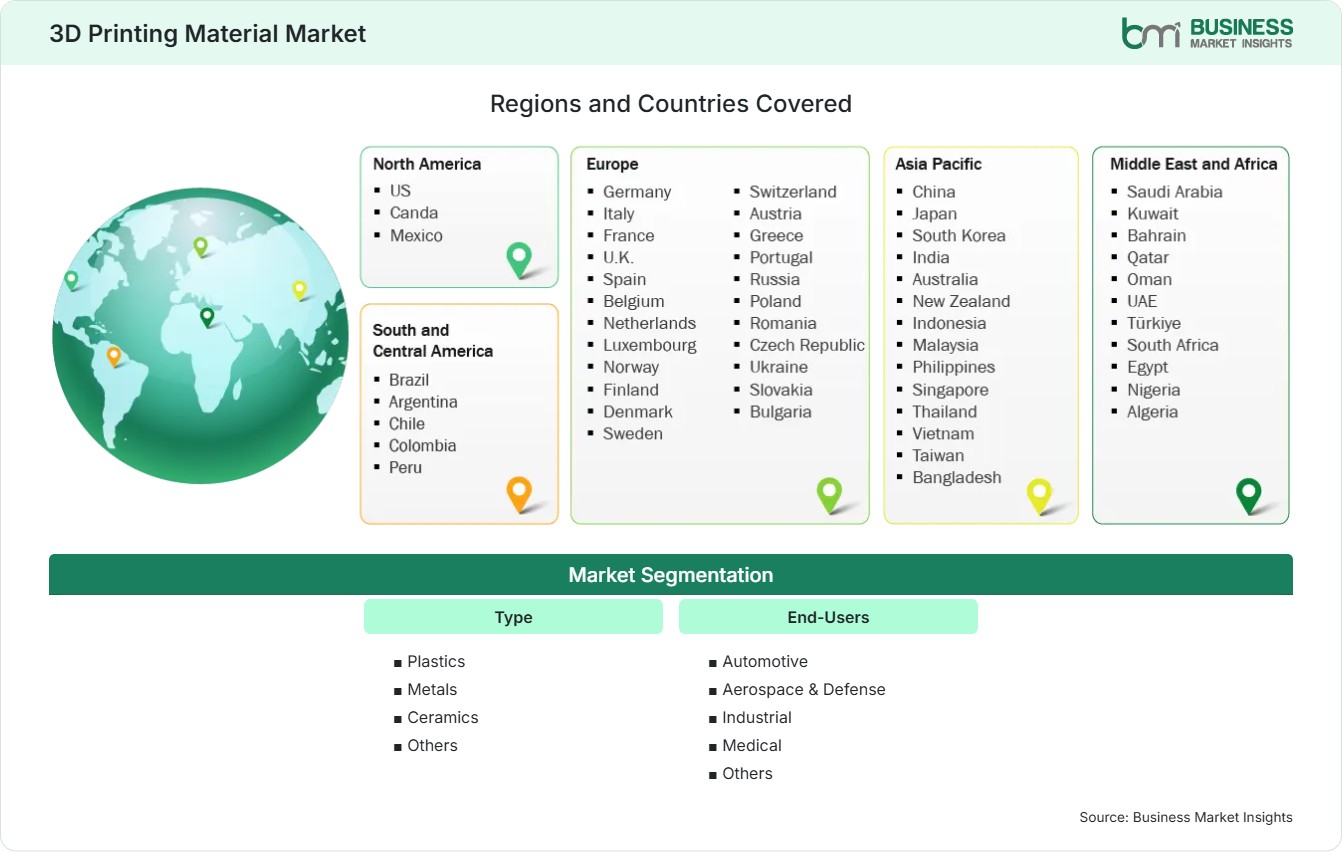
  • Type: Plastics, Metals, Ceramics, Others
  • End-Users: Automotive, Aerospace & Defense, Industrial, Medical, Others
US$ 4.24 Bn Market size in 2025
US$ 22.04 Bn Market Size by 2033
22.88% CAGR, 2026 - 2033
2026-2033 Forecast Period

AI Overview

3D Printing Material Market Summary

  • North America Region: North America holds 38%–41% market share in 2025, growing with a CAGR of 21.0%–22.0% during 2026–2033. Strong aerospace manufacturing, healthcare innovation, industrial automation, and research investments accelerate advanced material commercialization while expanding high-value additive manufacturing applications across multiple industries. The U.S. dominates regional demand with a projected CAGR of 21.5%–22.5%, supported by industrial innovation and strong R&D investments.
  • Fastest Growing Region: Asia Pacific holds 25%–28% market share in 2025, expanding at the fastest CAGR of 24.0%–25.0% through 2033. Manufacturing expansion, government support, localized supply chains, automotive electrification, and increasing industrial digitalization continue accelerating adoption of advanced additive manufacturing materials throughout regional industries.
  • Leading Segment: Plastics account for 46%–49% market share in 2025 and are projected to grow at a CAGR of 22.0%–23.0%. Broad printer compatibility, economical processing, lightweight properties, and continuous polymer innovation sustain widespread industrial utilization across consumer products, automotive, healthcare, and prototyping applications.
  • High Growth Segment: Aerospace & Defense represents 23%–26% market share in 2025 while expanding at a CAGR of 25.0%–26.0%. Lightweight structures, certified high-performance materials, aircraft production, and increasing defense modernization investments continuously strengthen adoption of advanced additive manufacturing materials for mission-critical aerospace applications.
  • Key Market Opportunity: Expanding industrial-scale additive manufacturing, sustainable material development, recyclable polymers, bio-based feedstocks, and customized production capabilities create significant commercial opportunities for material manufacturers addressing next-generation manufacturing requirements across multiple industries worldwide.
  • Major Market Players: BASF SE, Evonik Industries AG, Arkema S.A., Stratasys Ltd., 3D Systems Corporation, DSM-Firmenich, Covestro AG, Henkel AG & Co. KGaA, Solvay S.A., EOS GmbH.
Strategic Insights

3D Printing Material Market: Strategic Insights

3D Printing Material Market Strategic Framework
FREE PDF
Request your free sample
Request free sample
Stakeholder View

Key Takeaways

  • The value chain is evolving beyond raw material supply toward integrated ecosystems where chemical manufacturers, printer OEMs, software developers, and service providers collaborate to deliver certified, application-specific materials that improve print consistency and accelerate industrial adoption.
  • Aerospace & Defense and Medical applications present the strongest long-term growth potential as manufacturers increasingly require lightweight, biocompatible, and high-performance materials capable of meeting stringent regulatory and operational requirements while enabling customized production.
  • Material innovation is shifting from conventional thermoplastics toward high-performance polymers, advanced metal powders, ceramic composites, recycled feedstocks, and bio-based materials that improve sustainability without compromising mechanical performance or processing efficiency.
  • Asia Pacific offers the most attractive investment opportunity owing to expanding manufacturing capacity, government-backed industrial digitalization programs, growing electric vehicle production, and increasing localization of additive manufacturing supply chains across China, India, Japan, and South Korea.
  • Strategic partnerships, acquisitions, and joint research initiatives between specialty chemical companies, printer manufacturers, and industrial users continue accelerating commercialization of certified materials while strengthening intellectual property portfolios and expanding global distribution capabilities.
  • Sustainability is becoming a competitive differentiator as manufacturers invest in recyclable materials, lower-carbon production technologies, circular material recovery systems, and environmentally responsible product development to satisfy evolving industrial procurement standards.
Geographic Outlook

3D Printing Material Market Regional Highlights

North America 3D Printing Material Market

North America accounts for 38%–41% of global revenue in 2025 and is expected to expand at a CAGR of 21.0%–22.0% through 2033. The region maintains the largest 3D Printing Material Market share due to advanced industrial manufacturing, strong aerospace and healthcare sectors, and continuous investments in material science research. Growing adoption of industrial additive manufacturing, government-funded innovation programs, and commercialization of high-performance polymers and metal powders continue strengthening regional competitiveness across multiple end-use industries.

  • Aerospace manufacturers increasingly utilize certified metal powders and engineering polymers to produce lightweight aircraft components with improved mechanical performance, shorter production cycles, and reduced material waste.
  • Healthcare organizations continue expanding adoption of biocompatible printing materials for customized implants, surgical guides, prosthetics, and dental applications requiring high precision and regulatory compliance.
  • Chemical manufacturers invest heavily in specialty resin development, sustainable polymers, and recyclable feedstocks to improve industrial scalability while supporting circular manufacturing initiatives.
  • Industrial automation and Industry 4.0 integration encourage broader utilization of advanced printing materials capable of delivering consistent quality across serial production environments.

US 3D Printing Material Market

The United States contributes 74%–77% of North American revenue in 2025 and is projected to register a CAGR of 21.5%–22.5% through 2033. Strong domestic manufacturing, aerospace innovation, defense procurement, and healthcare investments continue driving rapid commercialization of high-performance additive manufacturing materials across industrial production facilities.

  • Major chemical companies continue introducing advanced polymers and specialty resins designed for industrial-scale additive manufacturing applications.
  • Defense modernization programs encourage qualification of lightweight metal alloys and engineered composites for mission-critical aerospace and military components.
  • Medical device manufacturers increasingly adopt certified materials supporting personalized healthcare products, orthopedic implants, and dental restoration technologies.

Europe 3D Printing Material Market

Europe 3D Printing Material Market share represents 28%–31% of global revenue in 2025 and is projected to grow at a CAGR of 22.0%–23.0% through 2033. Regional expansion is supported by sustainable manufacturing policies, aerospace production, advanced automotive engineering, and material innovation. Germany remains the leading regional market, while the United Kingdom records the fastest growth owing to increasing investments in industrial digitalization, medical technologies, and advanced additive manufacturing research.

  • Germany leads regional demand through its strong industrial base, specialty chemical manufacturers, automotive production, and continuous investments in engineered polymers and metal powder development.
  • The United Kingdom records the highest growth supported by aerospace innovation, healthcare manufacturing, and government-backed initiatives promoting digital production technologies across industrial sectors.
  • France continues expanding adoption through aerospace manufacturing, medical device production, and increasing utilization of sustainable additive manufacturing materials for high-value industrial applications.
  • Environmental regulations and circular economy initiatives encourage development of recyclable polymers, bio-based feedstocks, and low-emission material production technologies throughout European manufacturing ecosystems.

Asia Pacific 3D Printing Material Market

Asia Pacific accounts for 25%–28% of global revenue in 2025 and is forecast to expand at the fastest CAGR of 24.0%–25.0% through 2033. China leads regional consumption, while India demonstrates the strongest growth due to manufacturing expansion, industrial automation, healthcare investments, and government support for advanced manufacturing technologies. Rapid industrialization and localized production continue accelerating demand for high-performance additive manufacturing materials across diverse end-use industries.

  • China remains the largest regional market owing to extensive manufacturing capacity, strong electronics production, automotive expansion, and growing domestic additive manufacturing capabilities.
  • India records the fastest growth as government initiatives encourage digital manufacturing, medical technology innovation, aerospace localization, and adoption of Industry 4.0 production practices.
  • Japan and South Korea continue investing in advanced polymers, specialty resins, precision engineering materials, and industrial research supporting high-value additive manufacturing applications.
  • Regional manufacturers increasingly establish localized material production facilities to improve supply chain resilience, reduce import dependence, and strengthen industrial competitiveness.

Rest of World 3D Printing Material Market

The Rest of the World contributes 7%–9% of global revenue in 2025 and is expected to register a CAGR of 20.0%–21.0% through 2033. Growth across South & Central America, the Middle East, and Africa is supported by industrial diversification, healthcare modernization, aerospace investments, and expanding manufacturing capabilities. Rising awareness of additive manufacturing technologies continues creating new opportunities for specialty material suppliers throughout emerging economies.

  • Brazil leads South & Central America through growing industrial manufacturing, medical device production, and increasing adoption of additive manufacturing technologies across automotive and aerospace sectors.
  • The United Arab Emirates records the strongest Middle Eastern growth supported by industrial diversification, aerospace investments, healthcare innovation, and advanced manufacturing initiatives.
  • Saudi Arabia continues investing in smart manufacturing infrastructure, industrial localization, and research partnerships that encourage commercialization of advanced additive manufacturing materials.
  • Regional universities, research institutions, and manufacturing companies increasingly collaborate to develop application-specific materials, strengthen technical expertise, and accelerate industrial adoption across emerging markets.
Global Market Geography
FREE PDF
Request your free sample
Request free sample
Segment Analysis

3D Printing Material Market Segmentation

Type

The Type segment accounts for the largest proportion of the market as material innovation directly determines print quality, mechanical properties, application suitability, and production efficiency. The segment held 100% of the market by definition, with Plastics contributing the largest share of 46%–49% in 2025. The segment is expected to expand at a CAGR of 22.0%–23.0% through 2033 as industries increasingly diversify into advanced polymers, engineered metals, and ceramic materials. The 3D Printing Material Market scope continues expanding with broader industrial adoption and sustainable material development.

  • Plastics: Widely utilized because of excellent processability, affordability, lightweight characteristics, and compatibility with multiple additive manufacturing technologies supporting rapid prototyping, customized manufacturing, and industrial-scale production.
  • Metals: Increasingly adopted for aerospace, medical, automotive, and industrial applications requiring superior mechanical strength, thermal resistance, dimensional accuracy, and long-term operational durability under demanding environments.
  • Ceramics: Gain momentum in dental, electronics, biomedical, and high-temperature industrial applications due to excellent wear resistance, electrical insulation, chemical stability, and precision manufacturing capabilities.

End-Users

End-user demand continues expanding as additive manufacturing becomes an essential production technology across numerous industrial sectors. The Industrial segment represents the largest share of 31%–34% in 2025 owing to extensive prototyping, tooling, and production applications, while the overall segment is projected to grow at a CAGR of 23.0%–24.0% through 2033. Increasing digital manufacturing adoption, supply chain localization, and 3D Printing Material Market trends continue driving material innovation across diverse commercial applications.

  • Automotive: Manufacturers increasingly utilize advanced printing materials for lightweight vehicle components, tooling, customized prototypes, and electric vehicle development while reducing production lead times and material waste.
  • Aerospace & Defense: High-performance polymers and certified metal powders support lightweight structural components, engine parts, and mission-critical applications requiring superior strength, thermal performance, and regulatory compliance.
  • Industrial: Broad manufacturing applications include production tooling, jigs, fixtures, spare parts, customized components, and low-volume manufacturing requiring flexibility, durability, and improved operational efficiency.
  • Medical: Biocompatible materials enable production of customized implants, prosthetics, dental restorations, anatomical models, and surgical instruments while supporting personalized healthcare solutions and precision treatment approaches.
Market Forces

3D Printing Material Market Dynamics

Key Market Drivers

Increasing Adoption of Additive Manufacturing

The rapid expansion of additive manufacturing across industrial sectors continues driving demand for advanced printing materials capable of delivering consistent mechanical performance and production efficiency. Serial production, tooling, and customized components are progressively being produced using additive manufacturing processes in order to cut down on waste and minimize development timelines. As per various industry groups like ASTM International and SME, qualification criteria for industrial additive manufacturing keep on growing, leading to improved business confidence. 3D Printing Material Market growth will be driven by increased usage of engineered polymers, metals, and specialty resins, which can aid quality manufacturing in aerospace, automotive, healthcare, and other industrial sectors.

Growing Demand for Customized Components

Industries increasingly require application-specific products that cannot be economically produced through conventional manufacturing techniques. Medical implants, dental prosthetics, aerospace parts, tools, and consumer goods require the increasing use of customized materials in additive manufacturing that will provide higher strength, flexibility, and heat resistance. With the help of innovations in polymer chemistry, development of metal alloys and composites, manufacturers can create complicated shapes with precise dimensions and performance characteristics. The acceptance of mass customization in medicine, manufacturing industries, and automobile manufacturing will keep pushing the demand for innovative materials further.

Rising Industrial 3D Printing Applications

Industries are shifting from prototyping to production-oriented additive manufacturing, thus consuming more certified engineering materials. The industries use state-of-the-art materials for spare parts, jig and fixture, mold, production tooling, and final components where toughness and precision are necessary. Automation in 3D printing, digital manufacturing, and quality control will further fuel the industrial usage of 3D printing. The 3D printing material market trends are becoming more oriented towards the use of materials that can provide reliable performance, better process reliability, sustainability, and compatibility with high volume manufacturing facilities.

Key Market Opportunities

Growing Healthcare 3D Printing Applications

Healthcare continues creating substantial opportunities for advanced additive manufacturing materials through personalized medicine, patient-specific implants, prosthetics, dental devices, and surgical planning models. Increasing regulatory acceptance, biocompatible polymer development, and metal implant innovations enable manufacturers to expand commercial offerings. Aging populations, rising orthopedic procedures, and growing demand for customized medical solutions strengthen long-term growth potential. 3D Printing Material Market Forecasts indicate sustained investment in healthcare-focused material research as hospitals, medical device manufacturers, and research institutions increasingly adopt additive manufacturing technologies for precision treatment and improved patient outcomes.

Increasing Automotive Manufacturing Adoption

Automotive manufacturers continue expanding additive manufacturing from prototyping into production applications supporting lightweight vehicle development, electric mobility, customized interiors, and rapid tooling. Demand for engineering polymers, composite materials, and metal powders is increasing as manufacturers seek shorter development cycles and lower production costs. Growing electric vehicle production further encourages innovation in heat-resistant, lightweight, and recyclable materials capable of supporting next-generation mobility solutions while improving manufacturing flexibility and operational efficiency across global automotive supply chains.

Expanding Aerospace Production

High performance additive manufacturing materials are still creating immense opportunities in the fields of commercial aviation recovery, defense industry modernization, and expanding space exploration. There is an ever-increasing need for metal powders, high end polymers and composites that will be able to reduce weight yet maintain strength of the components. Investment in manufacturing of satellites, reusable rocket launch systems and advanced aircraft is also contributing towards increased demand for special materials.

Market Restraints and Challenges

High Material Costs

Factor: Specialty polymers, certified metal powders, and advanced composite feedstocks require sophisticated production processes, extensive quality control, and rigorous certification, resulting in substantially higher prices than conventional manufacturing materials. Impact: Elevated material costs increase production expenses, reduce economic feasibility for price-sensitive industries, and limit adoption among small and medium-sized manufacturers. Organizations must carefully evaluate return on investment before transitioning to additive manufacturing, particularly for high-volume applications where traditional manufacturing methods may remain more cost-effective.

Limited Material Standardization

Factor: Material properties, qualification procedures, and certification standards continue varying across printer platforms, industries, and geographic markets, creating inconsistencies in performance validation and interoperability. Impact: Limited standardization increases product qualification time, complicates regulatory approvals, and slows commercialization of new materials. Manufacturers frequently conduct additional testing and validation before industrial deployment, delaying product launches while increasing development costs and technical complexity across highly regulated sectors such as aerospace and healthcare.

Company Analysis

Competitive Landscape

The competitive environment is characterized by continuous investments in specialty polymers, metal powders, sustainable feedstocks, and application-specific materials supporting industrial additive manufacturing. 3D Printing Material Market analysis indicates that leading participants are expanding production capacity, strengthening research collaborations, and developing certified materials for aerospace, healthcare, automotive, and industrial applications to improve product performance and address evolving customer requirements.

Company Name

Overview

Products and Services Relevant to this Market

BASF SE

Global specialty chemical manufacturer investing extensively in advanced additive manufacturing materials and industrial collaborations for high-performance applications.

Engineering polymers, photopolymer resins, metal printing materials, additive manufacturing research, material development, and technical support.

Evonik Industries AG

Leading specialty chemicals company with extensive expertise in high-performance polymer materials for industrial additive manufacturing.

PA12 powders, specialty polymers, biomaterials, industrial printing materials, application development, and material optimization services.

Arkema S.A.

Global producer of advanced specialty materials supporting industrial, aerospace, healthcare, and consumer additive manufacturing applications.

High-performance resins, specialty polymers, UV-curable materials, sustainable printing materials, and technical material solutions.

Stratasys Ltd.

Major additive manufacturing technology provider offering integrated printing platforms and proprietary industrial materials.

Industrial thermoplastics, engineering polymers, production-grade materials, application consulting, and additive manufacturing solutions.

3D Systems Corporation

Pioneer in additive manufacturing technologies with broad material portfolios serving industrial and healthcare sectors.

Photopolymer resins, metal materials, healthcare printing materials, industrial production solutions, and engineering support.

DSM-Firmenich

Advanced materials innovator focused on sustainable engineering polymers and specialty additive manufacturing materials.

High-performance polymers, bio-based materials, engineering plastics, customized formulations, and industrial material development.

Covestro AG

Global supplier of polymer materials emphasizing sustainable innovation and high-performance additive manufacturing applications.

Polyurethane materials, engineering polymers, specialty resins, recyclable feedstocks, and advanced material technologies.

Henkel AG & Co. KGaA

Develops industrial material solutions for demanding additive manufacturing environments worldwide.

Photopolymer resins, industrial adhesives, engineering materials, functional coatings, and manufacturing support solutions.

Solvay S.A.

Leading supplier of specialty polymers serving aerospace, automotive, and industrial additive manufacturing markets.

High-temperature polymers, composite materials, engineering plastics, specialty chemicals, and advanced manufacturing materials.

EOS GmbH

Industrial additive manufacturing leader supporting comprehensive material qualification and production-scale applications.

Metal powders, polymer materials, industrial printing systems, process optimization, and material qualification services.

Trust & Transparency

Research Methodology

The market analysis combines proprietary research with secondary data from government agencies, company disclosures, regulatory filings, industry databases and expert interviews. Market estimates are validated through data triangulation, cross-market benchmarking and analyst review.

View Full Research Methodology

Questions Answered

Frequently Asked Questions

What is the biggest challenge affecting material manufacturers?

High material costs and limited standardization remain key challenges. Companies must balance product performance, certification requirements, and manufacturing economics while developing materials compatible with multiple additive manufacturing platforms.

What does the 3D Printing Material Market Report indicate about future industry development?

The report highlights continued expansion driven by sustainable material innovation, industrial-scale additive manufacturing, healthcare applications, aerospace investments, and digital manufacturing technologies supporting long-term commercialization.

Why are specialty polymers becoming increasingly important?

Specialty polymers provide higher strength, heat resistance, chemical stability, and durability compared with conventional materials. These characteristics enable manufacturers to produce complex components meeting demanding industrial and regulatory performance requirements.

Which industries generate the highest demand for 3D printing materials?

Automotive, aerospace & defense, industrial manufacturing, and healthcare represent the largest consumers. These industries increasingly adopt additive manufacturing for lightweight components, customized products, rapid prototyping, tooling, and end-use production.

What are the primary materials used in the 3D Printing Material Market?

The market primarily includes plastics, metals, ceramics, and other specialty materials. Plastics dominate due to affordability and versatility, while metals and ceramics support high-performance aerospace, healthcare, and industrial applications requiring superior mechanical properties.

Access the Full 3D Printing Material Market Report

Get segment-level forecasts, regional estimates, competitive benchmarking, company profiles and downloadable Excel datasets.

Access the full 3D Printing Material Market Report
350 pages PDF & Excel | 2026-08-25