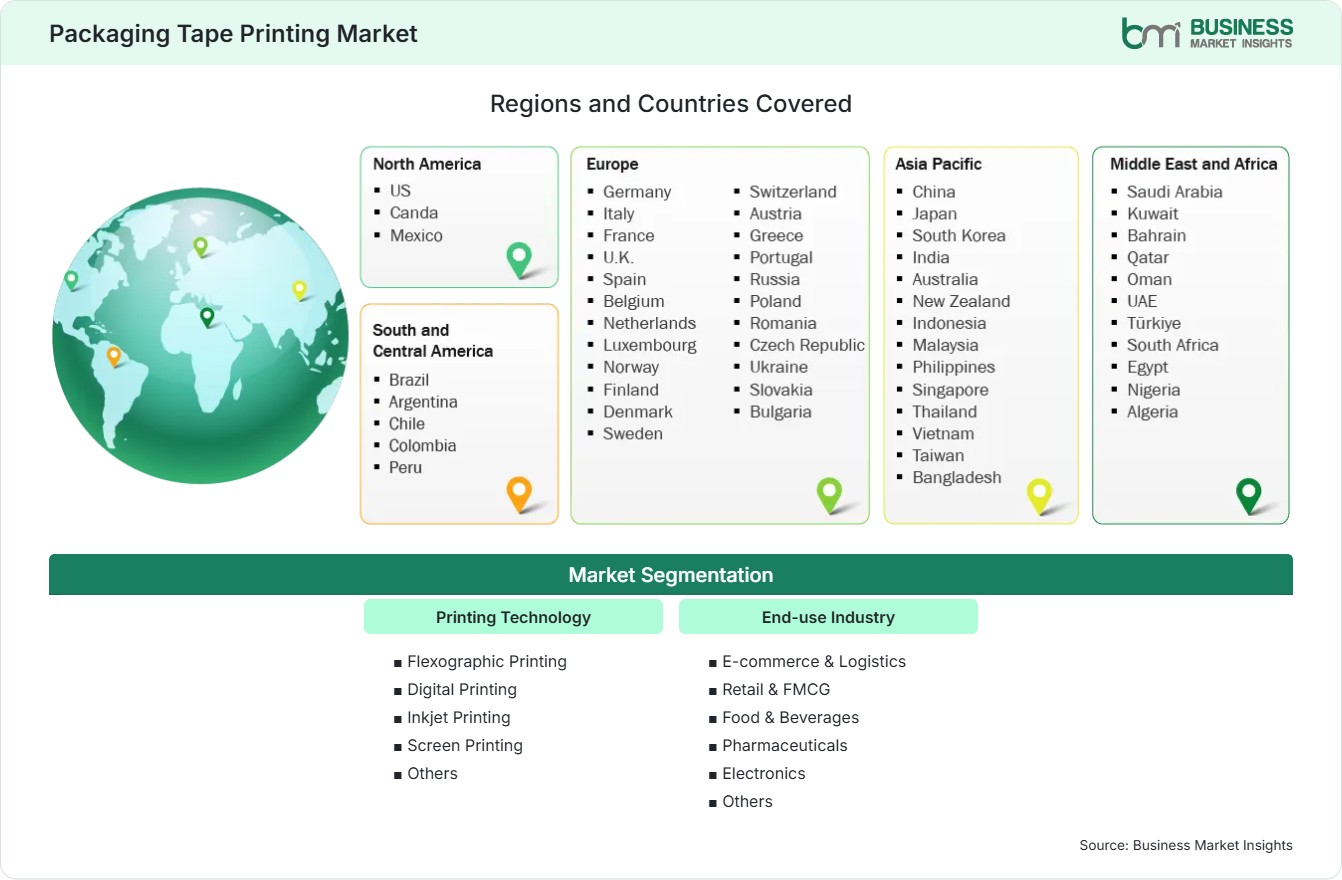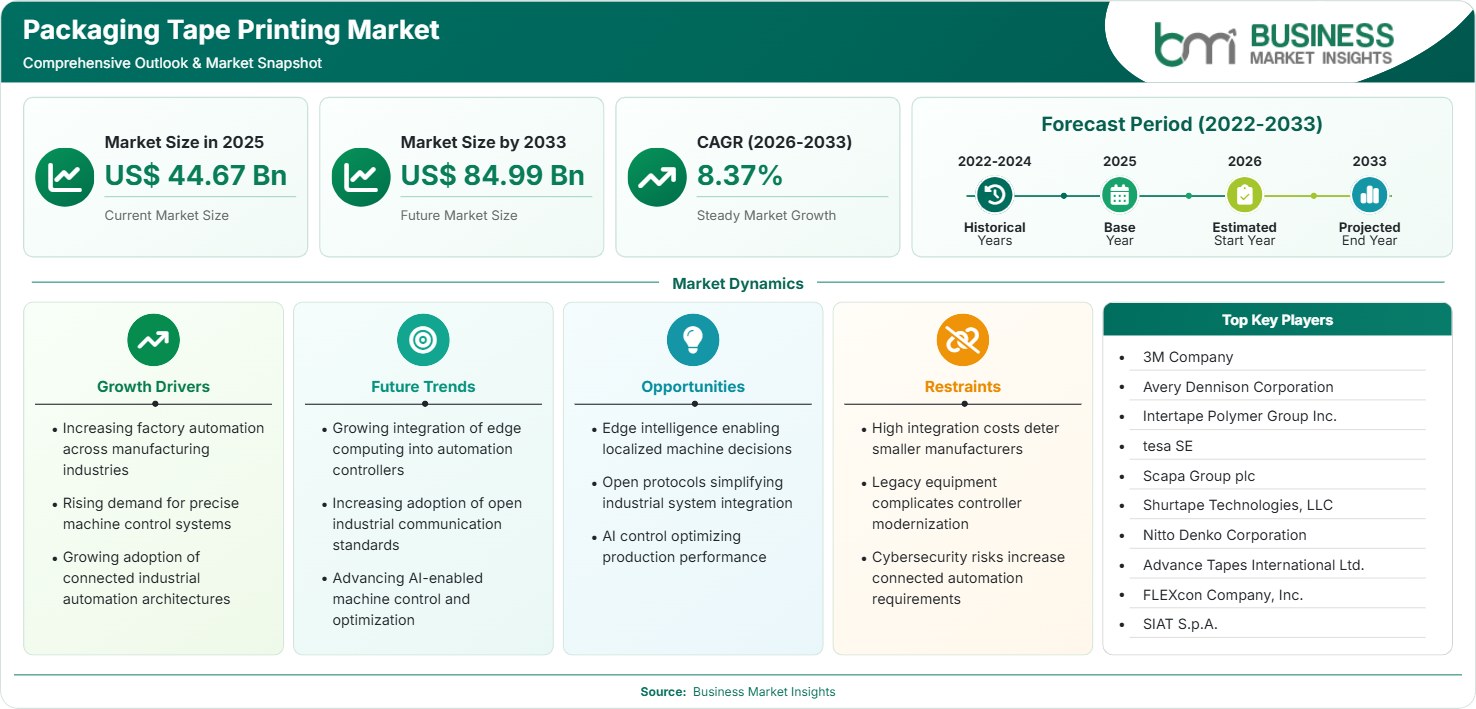
Packaging Tape Printing Market Regional Highlights
North America Packaging Tape Printing Market
North America accounted for a 31%–34% share of global revenue in 2025 and is projected to expand at a 7.5%–8.0% CAGR through 2033. The region benefits from mature e-commerce infrastructure, automated distribution centers, established adhesive-tape manufacturers, and strong brand investment in secondary packaging. The Packaging Tape Printing Market share remains concentrated in the U.S., which represents the majority of regional demand. Canada contributes through food, beverage, retail, and cross-border logistics applications. Rising security requirements and customized fulfillment support sustained demand for printed sealing solutions.
- E-commerce fulfillment centers increasingly use printed tapes for shipment recognition, brand reinforcement, and handling communication, especially where cartons pass through automated sorting systems and high-volume distribution networks.
- Large retailers favor standardized branded tape programs because they simplify packaging specifications across suppliers while maintaining consistent visual identity across stores, warehouses, and direct-to-consumer shipments.
- Sustainable packaging programs are encouraging paper-backed and water-based solutions, particularly among companies seeking lower-impact secondary packaging without sacrificing sealing strength or print readability.
- The U.S. remains the regional leader, while Canada offers incremental demand from food distribution, consumer products, logistics providers, and industrial packaging applications.
US Packaging Tape Printing Market
The U.S. represented 78%–82% of North American demand in 2025 and is expected to grow at a 7.6%–8.1% CAGR through 2033. The Packaging Tape Printing market benefits from extensive parcel distribution, automated fulfillment, established packaging converters, and strong demand for branded shipment presentation. Large retailers and third-party logistics providers increasingly value printed tapes that combine identification with sealing. Growth also reflects investment in digital printing systems capable of economical short runs, rapid artwork changes, and customized campaigns for direct-to-consumer brands.
- Major fulfillment operators increasingly prioritize machine-compatible tapes that maintain print legibility and adhesion during automated carton handling, reducing packaging interruptions and minimizing damage-related rework.
- Pharmaceutical and electronics shippers are increasing demand for specialized printed messages and security-oriented designs that support traceability, handling instructions, and tamper awareness.
- Smaller brands are adopting custom printed tapes as a comparatively economical alternative to fully customized cartons, supporting demand from subscription commerce, specialty foods, cosmetics, and direct-to-consumer businesses.
Europe Packaging Tape Printing Market
Europe had a 25%-28% market share in 2025 and is expected to grow at a 7.8%-8.4% CAGR through 2033 in the Packaging Tape Printing market. The reasons Europe is a key market region include machinery for packaging, chemicals, and manufacturing. Other European countries include Italy and the U.K., which have strong conversion capacity. Spain and Poland also offer better growth prospects, with CAGRs of 8.6% to 9.2% and 8.3% to 8.9%, respectively. Sustainability requirements, recyclable substrates, water-based inks, and efficient automated packaging are shaping procurement decisions across consumer goods and industrial supply chains.
- Germany benefits from sophisticated converting equipment, strong industrial packaging demand, and proximity to major European consumer goods manufacturing clusters requiring consistent printed sealing solutions.
- Italy remains important for tape-converting expertise and specialized packaging machinery, supporting domestic consumption and exports to other European markets.
- Spain is positioned for faster growth as food exports, retail distribution, e-commerce fulfillment, and consumer packaging modernization increase demand for customized sealing materials.
- Sustainability remains a central procurement criterion, encouraging suppliers to develop paper-based tapes, solvent-free adhesives, recyclable constructions, and lower-impact printing processes.
Asia Pacific Packaging Tape Printing Market
Asia Pacific is projected to hold a share of 27% to 30% in 2025 and to grow at a CAGR of 9.1% to 9.8% from 2025 to 2033, making it the fastest-growing region for the Packaging Tape Printing market. China dominates the regional consumption and production, while India is seen as an emerging market in the region. Japan adds premium demand owing to its sophisticated supply chains in packaging and electronics. The growth in India is expected to be 10.0% to 10.8%CAGR, supported by e-commerce, organized retail, manufacturing, and the expansion of logistics infrastructure.
- China benefits from extensive packaging-film manufacturing, export-oriented production, and high-volume e-commerce distribution, creating a broad customer base for printed polypropylene and PVC tapes.
- India is expanding domestic converting capacity as organized retail, online commerce, pharmaceuticals, food processing, and small-business shipping increase requirements for customized secondary packaging.
- Japan emphasizes precision, consistent print quality, automated application, and high-performance adhesive systems, supporting premium printed tapes for electronics, industrial products, and consumer goods.
- Southeast Asian markets are attracting packaging investments as manufacturers diversify production footprints, creating opportunities for local tape converters serving export-oriented factories and regional distribution networks.
Rest of World Packaging Tape Printing Market
Rest of World accounted for 10%–13% in 2025 and is expected to expand at a 7.0%–7.6% CAGR in the Packaging Tape Printing market through 2033. South and Central America benefit from food exports, retail modernization, and expanding logistics networks. Brazil leads regional demand, while Mexico benefits from manufacturing and cross-border commerce. The Middle East and Africa are supported by consumer goods distribution, industrial projects, and improving warehousing infrastructure, with the Gulf markets providing comparatively attractive premium packaging opportunities.
Latin American converters increasingly serve food, beverage, agricultural, and consumer goods exporters requiring branded and handling-oriented tapes. Brazil remains the largest opportunity, while Mexico benefits from manufacturing relocation and integrated North American supply chains.
- Brazil's large consumer base and food-processing industry support recurring demand for printed sealing tapes across retail and distribution channels.
- Mexico benefits from nearshoring-related manufacturing growth, increasing packaging requirements for automotive, electronics, appliances, and consumer products.
- Gulf markets are adopting higher-quality branded packaging as organized retail, imported consumer goods, and fulfillment infrastructure expand across major commercial centers.
- African markets offer longer-term opportunities as formal retail, parcel delivery, food processing, and industrial distribution gradually increase demand for standardized packaging materials.