
Packaging Printing Market Outlook: Size, Share, Trends, Growth Analysis, Competitive Landscape & Forecast, 2026-2033

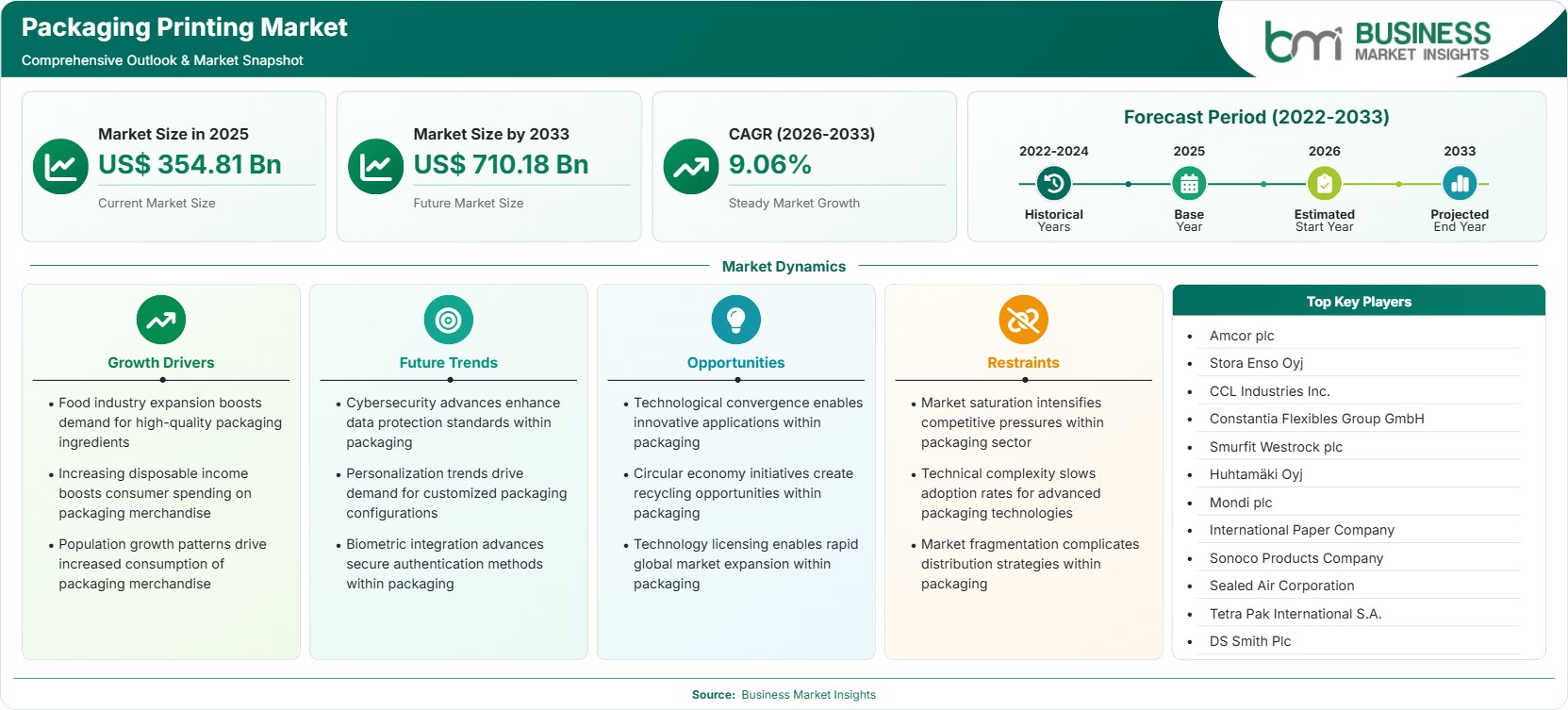
The Packaging Printing Market size was valued at US$ 354.81 Billion in 2025 and is projected to reach US$ 710.18 Billion by 2033, growing at a CAGR of 9.06% during 2026–2033. Rising packaged food consumption, e-commerce expansion, premium branding requirements, digital print adoption, sustainable packaging initiatives, smart labeling technologies, and investments in recyclable materials are creating significant opportunities across global packaging value chains.

Report Coverage
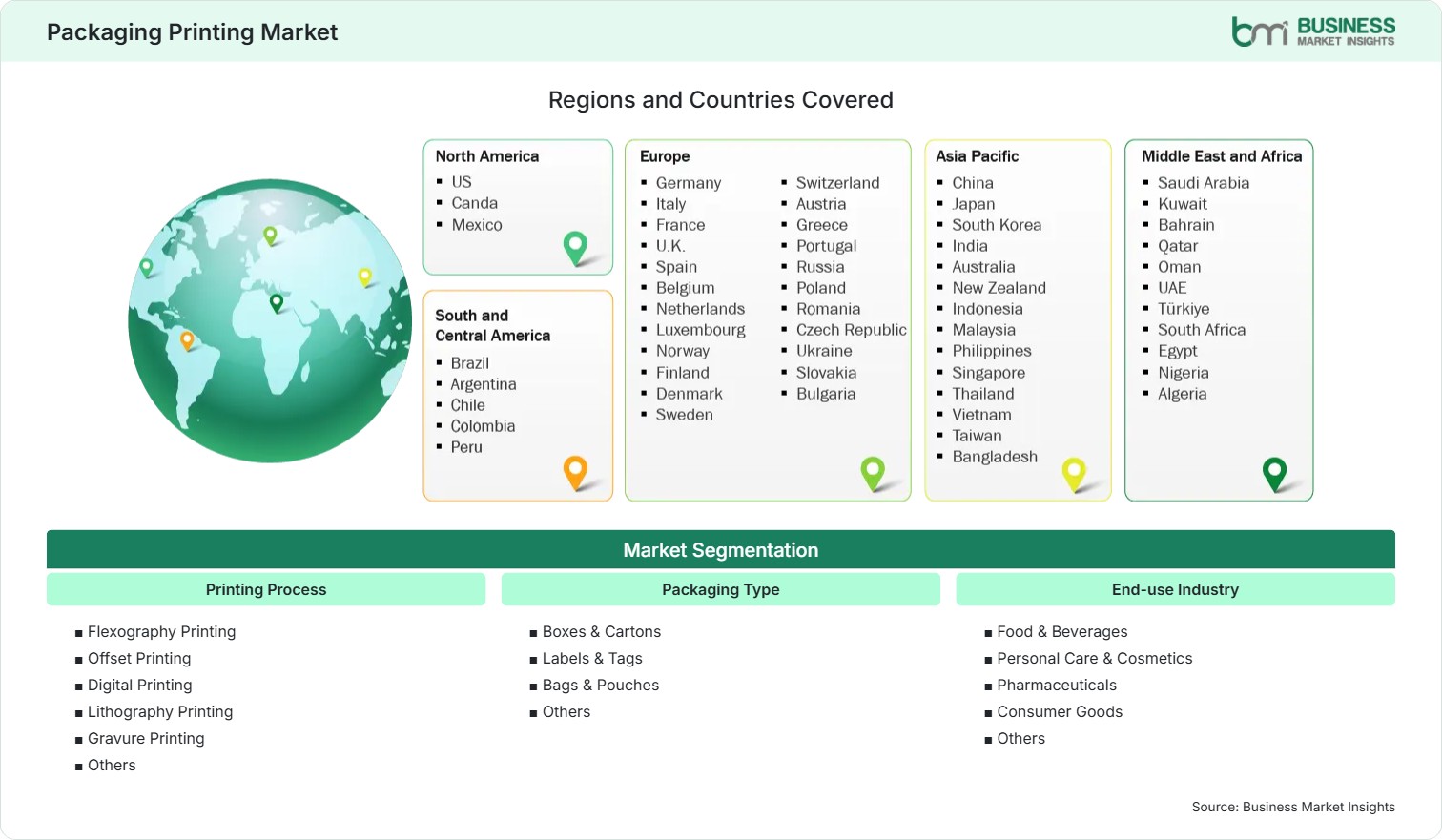
  • Printing Process: Flexography Printing, Offset Printing, Digital Printing, Lithography Printing, Gravure Printing, Others
  • Packaging Type: Boxes & Cartons, Labels & Tags, Bags & Pouches, Others
  • End-use Industry: Food & Beverages, Personal Care & Cosmetics, Pharmaceuticals, Consumer Goods, Others
US$ 354.81 Bn Market size in 2025
US$ 710.18 Bn Market Size by 2033
9.06% CAGR, 2026 - 2033
2026-2033 Forecast Period

AI Overview

Packaging Printing Market Summary

  • North America Region: North America holds a packaging printing market share of 31%–34% in 2025, growing with a CAGR of 8.2%–8.8% during 2026–2033. Growth is supported by premium packaging demand, advanced printing automation, digital workflow adoption, sustainable material usage, smart labels, brand differentiation initiatives, e-commerce packaging expansion, and regulatory compliance investments across industries. The U.S. dominates regional demand, supported by consumer goods innovation and an estimated CAGR of 8.4%–9.0%.
  • Fastest Growing Region: Asia Pacific holds a market share of 27%–30% in 2025, growing with a CAGR of 10.8%–11.5% during 2026–2033. Industrialization, rising packaged food consumption, expanding retail networks, urbanization, growing pharmaceutical manufacturing, increasing export-oriented production, digital printing investments, and sustainability-driven packaging modernization continue accelerating regional market development.
  • Leading Segment: Flexography Printing holds a market share of 34%–37% in 2025, growing with a CAGR of 8.8%–9.4% during 2026–2033. High-speed production capabilities, compatibility with diverse substrates, cost efficiency, improved ink technologies, flexible packaging demand, label production expansion, and sustainability-focused operations support widespread commercial adoption.
  • High Growth Segment: Digital Printing holds a market share of 17%–20% in 2025, growing with a CAGR of 11.8%–12.5% during 2026–2033. Demand for short-run production, variable data printing, customization requirements, faster turnaround times, reduced waste generation, smart packaging integration, and brand personalization initiatives support accelerated expansion.
  • Key Market Opportunity: Growing demand for sustainable and digitally enabled packaging solutions creates opportunities for smart labels, QR-enabled packaging, recyclable substrates, on-demand production capabilities, premium branding applications, and supply-chain traceability innovations.
  • Major Market Players: Amcor plc, Stora Enso Oyj, CCL Industries Inc., Constantia Flexibles Group GmbH, Smurfit Westrock plc, Huhtamäki Oyj, Mondi plc, International Paper Company, Sonoco Products Company, Sealed Air Corporation, Tetra Pak International S.A., DS Smith Plc, Rengo Co., Ltd., and American Packaging Corporation.
Strategic Insights

Packaging Printing Market: Strategic Insights

Packaging Printing Market Strategic Framework
FREE PDF
Request your free sample
Request free sample
Stakeholder View

Key Takeaways

  • The value chain is becoming highly integrated with material suppliers, packaging converters, ink suppliers, and brand owners working together for better sustainability performance, traceability, efficiency in production, and functionalities of packaging.
  • Flexible packaging, customized labels, digitally printed cartons, and applications for smart packaging hold the most potential from a revenue standpoint as consumer brands emphasize on differentiation and customer engagement.
  • Digitalization is transforming the production environment with the help of color management using AI, automated inspection systems, cloud-based workflow, and variable data printing.
  • India, Vietnam, Indonesia, and Mexico are highly attractive investment destinations due to growing manufacturing operations, food consumption, and increasing purchasing power of consumers.
  • Packaging printing market trend suggest that the strategic acquisitions continue accelerating as packaging leaders seek technological capabilities, geographic expansion, sustainability expertise, and stronger positions within high-growth end-use industries.
  • Sustainability-focused innovation is increasingly influencing purchasing decisions, encouraging investments in recyclable substrates, compostable packaging formats, low-migration inks, and resource-efficient printing technologies.
Geographic Outlook

Packaging Printing Market Regional Highlights

North America Packaging Printing Market

North America accounted for approximately 31%–34% Packaging Printing Market share in 2025 and is projected to expand at a CAGR of 8.2%–8.8% through 2033. The region benefits from strong packaged food demand, established consumer goods industries, advanced printing infrastructure, and rapid adoption of digital printing technologies. Sustainability regulations and retailer requirements continue encouraging investments in recyclable packaging formats. Premium product branding, e-commerce growth, and smart packaging applications are creating additional opportunities for packaging converters and printing solution providers throughout the region.

  • Food and beverage manufacturers increasingly require shorter production runs, personalized packaging, and rapid design modifications, encouraging investment in digital and hybrid printing platforms capable of improving flexibility and operational efficiency.
  • Sustainability commitments from major consumer brands are accelerating demand for water-based inks, recyclable substrates, fiber-based packaging formats, and production systems designed to minimize material waste.
  • E-commerce shipments continue increasing demand for printed corrugated boxes, protective packaging solutions, and high-quality branding elements that improve customer experience and product visibility.
  • Automation technologies, including AI-driven quality inspection and predictive maintenance systems, are helping converters improve throughput while reducing production costs and downtime.

US Packaging Printing Market

The United States represents approximately 72%–76% of North American packaging printing market demand and is forecast to expand at a CAGR of 8.4%–9.0% through 2033. Large multinational consumer goods companies increasingly prioritize sustainable packaging formats and enhanced visual branding. Digital transformation initiatives, automation investments, and growing demand for customized packaging solutions continue driving modernization across the domestic printing ecosystem.

  • Consumer packaged goods manufacturers are increasingly adopting variable data printing to support personalized marketing campaigns and strengthen customer engagement initiatives.
  • Growth in direct-to-consumer distribution models is increasing demand for visually appealing shipping cartons and protective packaging solutions across retail categories.
  • Regulatory requirements concerning food safety labeling and pharmaceutical traceability continue encouraging investments in advanced print management technologies.
  • Investments in sustainable packaging innovation are supporting commercialization of recyclable materials, low-impact inks, and environmentally responsible production processes.

Europe Packaging Printing Market

Europe held approximately 24%–27% of global packaging printing market revenue in 2025 and is expected to grow at a CAGR of 8.5%–9.1% through 2033. Germany remains the leading regional market, while Poland and Eastern European economies represent high-growth opportunities with CAGR ranges between 9.3%–10.1%. Investments in recyclable packaging materials, digital printing systems, and smart labeling technologies are supporting innovation throughout the regional packaging sector.

  • The European Union’s sustainability agenda is encouraging adoption of recyclable and reusable packaging formats, creating demand for compatible printing technologies and materials.
  • Germany continues leading regional production due to its strong manufacturing base, advanced printing capabilities, and concentration of major packaging suppliers.
  • Brand owners increasingly utilize premium packaging designs to differentiate products within competitive retail environments and strengthen consumer engagement.
  • Expansion of digital printing technologies enables faster product launches, improved customization, and greater operational flexibility for packaging converters.

Asia Pacific Packaging Printing Market

Asia Pacific accounted for approximately 27%–30% of global revenue in 2025 and is projected to register the fastest CAGR of 10.8%–11.5% through 2033. China remains the largest regional packaging printing market owing to its extensive manufacturing ecosystem and packaging production capacity, while India represents the fastest-growing country with an estimated CAGR of 11.5%–12.2%.

  • China’s leadership is supported by large-scale packaging manufacturing facilities, strong export-oriented industries, and continuous investments in automated printing technologies.
  • India is witnessing rapid adoption of flexible packaging and digital printing systems due to growing retail penetration, e-commerce activity, and organized food distribution networks.
  • Southeast Asian countries are attracting investments from global consumer goods companies seeking cost-efficient manufacturing and packaging production capabilities.
  • Increasing pharmaceutical production across Asia Pacific is driving demand for high-quality labeling, anti-counterfeiting technologies, and serialization-enabled packaging solutions.

Rest of World Packaging Printing Market

Rest of World represented approximately 13%–16% of global packaging printing market revenue in 2025 and is anticipated to grow at a CAGR of 8.9%–9.6% through 2033. South & Central America continues benefiting from rising packaged food consumption and retail modernization. Meanwhile, the Middle East and Africa are witnessing increasing investments in food processing, healthcare manufacturing, and consumer goods production.

  • Brazil continues strengthening packaging demand through food exports, consumer goods manufacturing expansion, and investments in retail supply chain modernization.
  • The UAE is becoming a regional hub for premium packaging, luxury goods branding, and technologically advanced labeling solutions.
  • Rising healthcare infrastructure investments across African economies are increasing demand for pharmaceutical packaging and regulatory-compliant printing applications.
Global Market Geography
FREE PDF
Request your free sample
Request free sample
Segment Analysis

Packaging Printing Market Segmentation

Printing Process

The printing process segment accounted for approximately 100% market participation, with Flexography Printing holding the largest share of 34%–37% in 2025 and growing at a CAGR of 8.8%–9.4% through 2033. The Packaging Printing Market scope continues expanding as converters prioritize efficiency, sustainability, substrate versatility, and high-volume production capabilities. Demand for customized packaging and shorter production cycles is accelerating adoption of advanced digital technologies.

  • Flexography Printing: Widely adopted across flexible packaging, corrugated materials, and labels due to operational efficiency, broad substrate compatibility, fast production speeds, and improving print quality capabilities.
  • Offset Printing: Preferred for premium cartons and high-resolution graphics, offering strong image reproduction, color consistency, and cost effectiveness for medium-to-large production volumes.
  • Digital Printing: Growing rapidly as brands increasingly demand personalization, shorter production runs, variable data capabilities, quick turnaround times, and reduced inventory management requirements.
  • Lithography Printing: Utilized extensively for premium packaging applications requiring exceptional graphic quality, brand consistency, and sophisticated visual presentation across retail environments.
  • Gravure Printing: Maintains importance in large-volume flexible packaging applications where exceptional image quality, consistency, and production efficiency remain essential competitive advantages.

Packaging Type

Packaging type segmentation is led by Boxes & Cartons, accounting for approximately 38%–41% of market revenue in 2025 and expected to grow at a CAGR of 8.7%–9.3% through 2033.

  • Boxes & Cartons: Strong demand from food, beverage, pharmaceutical, and consumer goods industries supports continuous innovation in graphic quality, sustainability performance, and production efficiency.
  • Labels & Tags: Increasing requirements for product traceability, regulatory compliance, authentication technologies, and branding applications continue supporting widespread adoption across industries.
  • Bags & Pouches: Flexible packaging formats remain popular because of lightweight construction, reduced material usage, lower transportation costs, and enhanced consumer convenience.

End-use Industry

Food & Beverages represented the leading end-use industry with approximately 36%–39% market share in 2025 and a projected CAGR of 8.9%–9.5% through 2033. Rising packaged food consumption, stringent labeling regulations, growing convenience food demand, and retail expansion continue strengthening market demand across developed and emerging economies.

  • Food & Beverages: Product differentiation, nutritional labeling requirements, sustainability commitments, and increasing packaged food consumption continue driving printing demand across global markets.
  • Personal Care & Cosmetics: Premium branding strategies and visually appealing packaging designs support greater investment in advanced decorative printing technologies and specialty finishing applications.
  • Pharmaceuticals: Serialization mandates, anti-counterfeiting measures, traceability requirements, and regulatory compliance obligations continue creating demand for high-precision packaging printing solutions.
  • Consumer Goods: Manufacturers increasingly utilize packaging as a marketing tool to enhance shelf visibility, strengthen brand recognition, and improve consumer engagement.
Market Forces

Packaging Printing Market Dynamics

Key Market Drivers

Expansion of Global Packaged Food and Beverage Consumption

Packaging of food and beverages still remains one of the major factors driving demand for modern printing solutions around the world. The global food industry estimates show that the volume of sales of packaged foods keeps rising in developing countries owing to urbanization, evolving lifestyles, and growing disposable income levels. Retailers and food companies need high-quality images, traceability codes, nutrition facts, and promotional material to make the packaging more appealing and compliant with the regulations. Packaging Printing Market growth depends on growing demand for convenience foods, prepared dishes, and packaged beverages. With the globalization of major food brands, investments in flexible packaging and printing keep boosting the market demand.

Rapid Growth of E-Commerce and Direct-to-Consumer Distribution

The expansion of global e-commerce goes on changing the packaging needs through higher demands for corrugated boxes, labels, packing material, and customization of branding needs. The online retail businesses are realizing the importance of packaging through the customer experience angle, which motivates them to spend more on better graphics and personalized messages. Higher volumes of shipments make it necessary to adopt efficient printing techniques that can handle quick turnaround times and varied design needs. Digitalization of the process increases the efficiency. The entry of e-commerce platforms in the emerging markets is making it essential for the packaging providers to upgrade their production capacity.

Technological Advancements in Digital and Smart Printing

Innovations are being continuously made in areas such as digital printing technology, artificial intelligence-assisted inspection technology, automation technology, and intelligent labeling technology, thus changing the competitive dynamics of the industry. Current printing machines have advantages such as faster set-up, less waste production, and increased production flexibility. Packaging converters can enjoy increased ease of operation and customization. This technology has also kept contributing to increasing efficiency and enabling value-added packaging applications.

Key Market Opportunities

Acceleration of Sustainable Packaging Investments

Global sustainability initiatives continue creating substantial opportunities for environmentally responsible packaging solutions. Regulatory authorities, retailers, and consumer brands increasingly prioritize recyclable materials, reduced plastic consumption, and circular economy objectives. Packaging Printing Market Forecasts indicate rising investments in water-based inks, biodegradable substrates, and energy-efficient production systems. Growing environmental awareness among consumers is further encouraging adoption of packaging formats that combine sustainability performance with premium branding and product protection capabilities.

Growth of Smart Packaging and Connected Labels

The integration of digital technologies into packaging formats creates new revenue opportunities across multiple industries. Smart labels, QR-enabled packaging, NFC technologies, and track-and-trace systems improve product authentication, consumer engagement, and supply chain transparency. Pharmaceutical, food, and premium consumer goods manufacturers increasingly utilize connected packaging to enhance customer interactions and support regulatory compliance. Advances in printing technologies are enabling cost-effective implementation of these features at scale. The convergence of packaging, data analytics, and digital communication is expected to create significant long-term growth opportunities.

Expansion of Emerging Market Manufacturing Ecosystems

Rapid industrialization across Asia, Latin America, and parts of Africa is generating increasing demand for modern packaging infrastructure. Growing domestic consumption, export-oriented manufacturing, and foreign direct investment continue supporting packaging industry development. Rising demand for packaged foods, pharmaceuticals, and personal care products creates opportunities for printing companies to establish localized production capabilities. Investments in modern converting facilities, digital printing systems, and sustainable packaging technologies are expected to accelerate market penetration and strengthen regional supply chains.

Market Restraints and Challenges

Volatility in Raw Material and Input Costs

Factor: Fluctuating prices of paper, paperboard, polymers, specialty inks, adhesives, and energy resources continue affecting production economics. Impact: Packaging manufacturers frequently encounter margin pressures and pricing challenges when raw material costs increase unexpectedly. Supply chain disruptions, geopolitical tensions, and energy market instability can further intensify procurement risks. Smaller converters often face greater exposure because of limited purchasing power and reduced flexibility in contract negotiations. Managing cost volatility while maintaining product quality, sustainability commitments, and competitive pricing remains a significant operational challenge for packaging printing companies globally.

Stringent Environmental Compliance Requirements

Factor: Expanding regulations governing waste management, recyclability, chemical usage, and packaging sustainability require continuous operational adaptation. Impact: Compliance investments can increase capital expenditures and implementation complexity for packaging converters. Companies must frequently upgrade equipment, reformulate inks, and redesign packaging structures to satisfy evolving regulatory requirements. While these regulations support long-term sustainability objectives, they can create short-term financial burdens and operational disruptions. Organizations lacking sufficient technological capabilities may face competitive disadvantages as environmental standards continue becoming more demanding across global markets.

Company Analysis

Competitive Landscape

The competitive environment remains moderately consolidated, with multinational packaging producers investing heavily in automation, sustainability, digital workflows, and capacity expansion. Packaging Printing Market analysis indicates that companies are focusing on recyclable packaging solutions, advanced printing technologies, smart labeling capabilities, and strategic acquisitions to strengthen global market positions.

Company Name

Overview

Products and Services Relevant to this Market

Amcor Plc

Global packaging leader serving food, beverage, healthcare, and consumer goods industries through extensive manufacturing and innovation capabilities.

Flexible packaging, printed packaging solutions, recyclable materials, labels, pouches, cartons, and sustainability-focused packaging technologies.

Stora Enso Oyj

Major renewable materials company with strong presence in fiber-based packaging and sustainable packaging innovation.

Printed paperboard packaging, renewable packaging materials, cartons, labels, and advanced sustainable packaging solutions.

CCL Industries Inc.

Global leader in specialty labeling and packaging solutions serving multiple end-use industries worldwide.

Pressure-sensitive labels, shrink sleeves, security labels, digital printing solutions, and packaging decoration technologies.

Constantia Flexibles

International flexible packaging manufacturer focused on innovation, sustainability, and high-performance packaging applications.

Flexible packaging, printed laminates, aluminum-based packaging, pharmaceutical packaging, and advanced decorative printing solutions.

Smurfit Kappa

Leading corrugated packaging provider with extensive operations across Europe and the Americas.

Printed corrugated packaging, display packaging, retail-ready packaging, and sustainable paper-based packaging solutions.

Huhtamaki Oyj

Global packaging specialist emphasizing food service and consumer packaging applications.

Printed food packaging, flexible packaging, labels, sustainable fiber packaging, and customized packaging solutions.

WestRock

Large-scale packaging manufacturer serving industrial, food, beverage, and consumer goods sectors.

Corrugated packaging, folding cartons, digital printing solutions, graphic packaging, and specialty packaging products.

Mondi

Integrated packaging and paper company with strong sustainability and innovation capabilities.

Flexible packaging, paper packaging, printed industrial packaging, labels, and recyclable packaging solutions.

International Paper Company

Major producer of fiber-based packaging products and industrial packaging materials globally.

Corrugated packaging, printed boxes, containerboard solutions, and packaging materials supporting branding applications.

Sonoco Products Company

Diversified packaging manufacturer serving industrial, healthcare, food, and consumer goods industries.

Composite cans, flexible packaging, printed labels, rigid packaging, and packaging performance solutions.

Sealed Air

Global packaging solutions provider emphasizing protective packaging and food packaging technologies.

Printed protective packaging, food packaging systems, automated packaging solutions, and branding-enhancing materials.

Tetra Pak

Leading provider of food processing and packaging technologies worldwide.

Printed aseptic cartons, food packaging systems, sustainable packaging materials, and integrated packaging solutions.

DS Smith

International provider of sustainable packaging products and recycling solutions.

Corrugated packaging, printed display packaging, retail-ready packaging, and circular economy-focused packaging services.

Rengo Co., Ltd.

Japanese packaging manufacturer with strong capabilities in paperboard and corrugated packaging production.

Printed corrugated packaging, cartons, paper packaging products, and packaging design services.

American Packaging Corporation

Specialized packaging manufacturer focused on flexible packaging and customized printing applications.

Flexible packaging, rotogravure printing, laminations, pouches, labels, and specialty packaging solutions.

Trust & Transparency

Research Methodology

The market analysis combines proprietary research with secondary data from government agencies, company disclosures, regulatory filings, industry databases and expert interviews. Market estimates are validated through data triangulation, cross-market benchmarking and analyst review.

View Full Research Methodology

Questions Answered

Frequently Asked Questions

What insights does a Packaging Printing Market Report provide for stakeholders?

The report helps stakeholders evaluate competitive positioning, technology adoption patterns, regional opportunities, investment priorities, regulatory developments, and long-term demand trends influencing strategic business decisions.

How does sustainability influence investment decisions?

Packaging producers increasingly prioritize recyclable materials, water-based inks, lightweight structures, and circular economy initiatives. Sustainability performance has become a major purchasing criterion for retailers, regulators, and global consumer brands.

Which end-use industry generates the highest revenue contribution?

Food and beverages remain the leading end-use industry because of high packaging volumes, strict labeling requirements, continuous product launches, and growing demand for convenience food products across developed and emerging economies.

What role does digital printing play in industry transformation?

Digital printing enables short production runs, variable data printing, faster product launches, reduced inventory requirements, and greater customization. These advantages support increasingly dynamic marketing strategies and personalized consumer experiences.

What factors are accelerating demand for advanced packaging printing technologies?

Demand is increasing due to growth in packaged food consumption, e-commerce shipments, premium branding requirements, digital printing adoption, sustainability regulations, and the need for enhanced consumer engagement through innovative packaging formats.

Access the Full Packaging Printing Market Report

Get segment-level forecasts, regional estimates, competitive benchmarking, company profiles and downloadable Excel datasets.

Access the full Packaging Printing Market Report
350 pages PDF & Excel | 2026-09-02
Similar Research

Related Market Reports