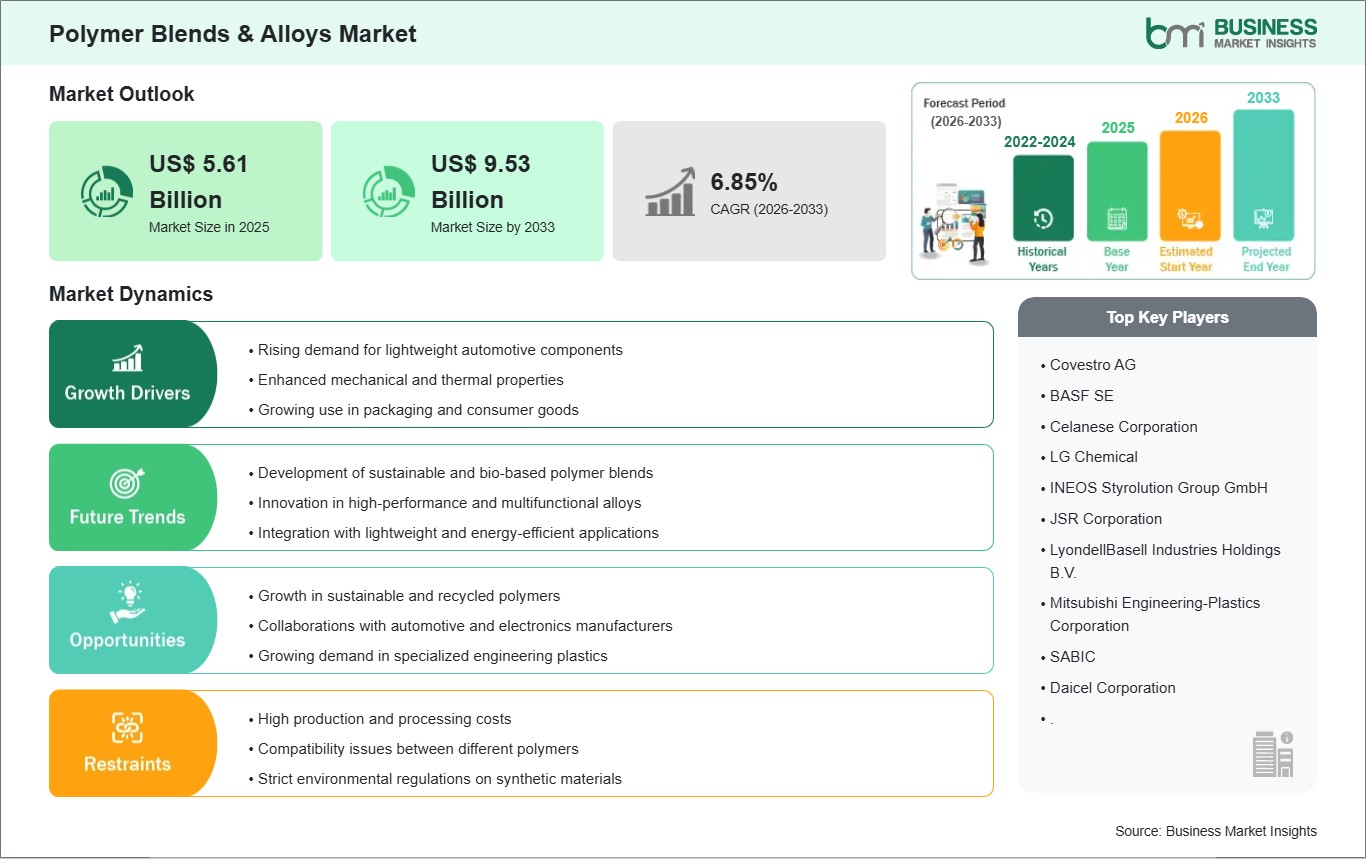
The Polymer Blends & Alloys Market size is expected to reach US$ 9.53 billion by 2033 from US$ 5.61 billion in 2025. The market is estimated to record a CAGR of 6.85% from 2026 to 2033.
The market for polymer blends and alloys is growing at a consistent rate, mainly because of the increased need for materials that possess favorable properties of different types of polymers. The blends and alloys of polymers allow for a range of mechanical, thermal, and chemical properties, making them an attractive option for various industries. The increased need for lightweight materials to improve efficiency, along with the need for engineering plastics, has put polymer blends and alloys at the heart of innovation in various industries. Technological developments form an integral part of the growth of the blends and alloys market. Various technologies, such as compatibilization, reactive blending, and extrusion, are being utilized to create blends and alloys with specific properties. Specialty alloy blends, such as ABS/PC, PP/PE, and PBT/PC, are gaining popularity for specific applications.
The rising market for additive manufacturing and 3D printing technologies will further open opportunities for polymer blends with improved mechanical and visual properties. The competitive dynamics in the market have been marked by capacity additions, strategic partnerships, and innovation-based differentiation. The market players have been shifting their focus towards more sustainable polymer alloys, which include recycled content and bio-based materials, to meet regulatory and consumer-driven sustainability needs. The market players have also been emphasizing application-specific solutions, which include strategic partnerships with automotive, electronics, and industrial companies to develop application-specific blends.
The market for polymer blends and alloys, in total, has tremendous growth opportunities and is expected to grow steadily, driven by technological advancements, sustainability initiatives, and increasing demand for versatile and high-performance polymers.

Key segments that contributed to the derivation of the polymer blends & alloys market analysis are type and application.
The global market for polymer blends and alloys is growing rapidly due to the increasing focus of the automotive industry on lightweight materials. Automobile manufacturers across the world are facing a challenge of reducing fuel consumption and pollution in accordance with stringent environmental regulations. Polymer blends, including polypropylene-polyamide and polyethylene-polycarbonate alloys, possess excellent strength-to-weight ratios and resistance to heat and chemicals, making them suitable alternatives to metal in various parts of automobiles, including engine covers, internal body parts, bumpers, and structural components. Automotive applications have thus become one of the major consumers of polymer blends.
Constant improvements in material technology have enabled polymer blends to achieve high performance standards required in modern automobiles. Engineering plastics blended with thermoplastic elastomers or filled with glass fibers possess excellent impact resistance, dimensional stability, and durability, thus allowing automobile manufacturers to produce safer and longer-lasting automotive parts. These materials are increasingly being incorporated into hybrid and electric automobiles, in which weight reduction plays a crucial role in determining battery efficiency and performance. The advantages of low maintenance costs, reduced noise and vibration, and design flexibility make polymer blends a highly attractive material in the automotive industry.
The global push toward electric and hybrid mobility is also accelerating polymer blends adoption. Regions such as Europe, North America, and Asia Pacific are witnessing high investments in lightweight automotive designs, particularly in countries like Germany, the U.S., China, and Japan. Vehicle manufacturers are collaborating with polymer suppliers to optimize blends for high-performance applications while meeting sustainability goals. Overall, the rising demand for lightweight, durable, and cost-effective automotive components is expected to continue driving global polymer blends and alloys market growth over the next decade.
Sustainability initiatives and the concept of a circular economy are driving growth in the polymer blends and alloys market globally. Increasing environmental awareness among consumers, along with government regulations on plastic disposal, is encouraging polymer producers to use recycled materials in their blends. Recycled PET, recycled HDPE, and PLA are some of the recycled polymer resins being blended with engineering plastics to formulate sustainable alloys with superior properties while reducing their carbon footprint on the environment.
Furthermore, key polymer producers are investing in technologies to enhance the compatibility of recycled materials with virgin materials, which enables the development of high-performance recycled polymer blends for demanding applications. Compatibilizers and additives are used to enhance the properties of recycled alloys, such as their strength, impact resistance, and processability, to expand their use in various applications. The use of recycled and post-consumer polymer resins is now being encouraged through various eco-labels and certifications, which help brands meet sustainability commitments while attracting environmentally aware consumers.
Additionally, global efforts to reduce single-use plastics and enhance material recyclability are contributing to the growth of polymer blends adoption worldwide. In Europe and North America, recycled polymer blends are being integrated into packaging, automotive parts, and electronic devices, while in Asia Pacific, there is a high rate of adoption driven by large-scale recycling infrastructure development. Moreover, collaborations between polymer producers, brands, and recycling companies are boosting the commercialization of sustainable polymer blends. As environmental laws become more stringent and consumers become more environmentally conscious, the market for sustainable polymer blends is expected to grow steadily, further cementing its place as a vital element in plastic innovation worldwide.

The polymer blends & alloys market demonstrates steady growth, with size and share analysis highlighting evolving trends and competitive dynamics among key players. The report examines subsegments categorized within type and application, offering insights into their contribution to overall market performance.
By Type, the PC‑based blends & alloys subsegment dominated the market in 2025, driven by demand for high‑performance blended polymers in automotive components and consumer electronics.
Based on Application, the automotive subsegment dominated the market in 2025, owing to increased adoption of lightweight polymer blends & alloys for fuel‑efficient and durable automotive parts.
| Report Attribute | Details |
|---|---|
| Market size in 2025 | US$ 5.61 Billion |
| Market Size by 2033 | US$ 9.53 Billion |
| Global CAGR (2026 - 2033) | 6.85% |
| Historical Data | 2022-2024 |
| Forecast period | 2026-2033 |
| Segments Covered | By Type
|
|
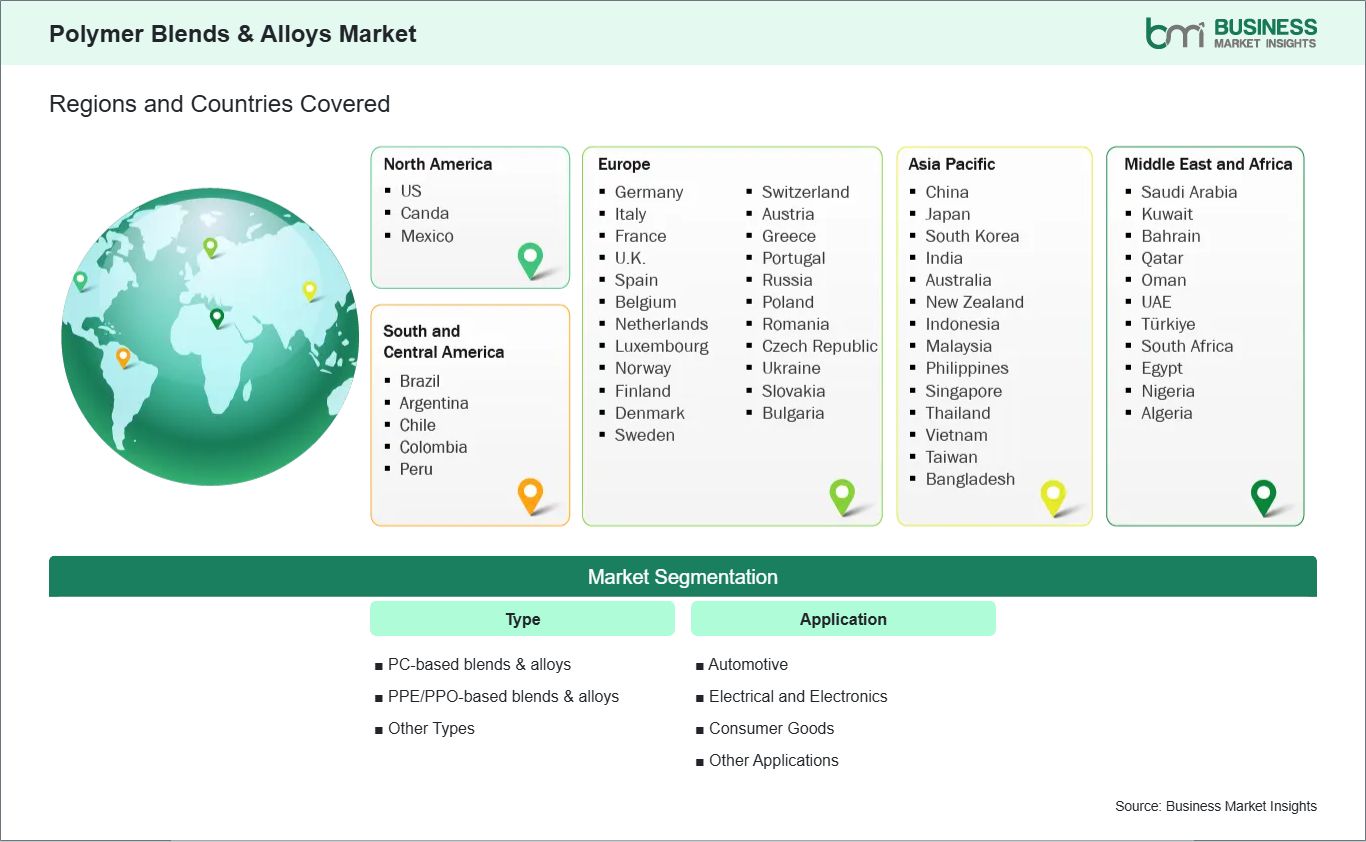
Regions and Countries Covered
| |
| North America | US, Canada, Mexico |
| Europe | Belgium, Austria, Finland, Denmark, Greece, Poland, Romania, Russia, Ukraine, Czech Republic, Slovakia, Bulgaria, Italy, Luxembourg, Germany, Switzerland, France, Netherlands, Norway, Portugal, Spain, Sweden, United Kingdom |
| Asia-Pacific | Australia, China, India, Japan, South Korea, Indonesia, Malaysia, Philippines, Singapore, Thailand, Vietnam, Bangladesh, New Zealand, Taiwan |
| South and Central America | Brazil, Argentina, Peru, Chile, Colombia |
| Middle East and Africa | Bahrain, Kuwait, Oman, Qatar, Saudi Arabia, United Arab Emirates, Turkiye, South Africa, Egypt, Algeria, Nigeria |
| Market leaders and key company profiles |
|
The "Polymer Blends & Alloys Market Size and Forecast (2022 - 2033)" report provides a detailed analysis of the market covering below areas:
The geographical scope of the Polymer Blends & Alloys Market report is divided into North America, Asia Pacific, Europe, Middle East & Africa, and South & Central America. North America held the largest share in 2025.
Regionally, the polymer blends and alloys market demonstrates diverse growth patterns shaped by industrial activity, technological adoption, and application demand. North America dominates the market, with the U.S. leading in automotive, electronics, and consumer goods applications. The region emphasizes high-performance engineering blends for lightweight vehicle components, electronic housings, and packaging materials. Advanced R&D infrastructure, regulatory alignment, and strong OEM collaborations reinforce North America’s market leadership.
In the Asia Pacific, rapid industrialization, rising automotive production, and expanding electronics and packaging industries are primary growth drivers. China, India, Japan, and South Korea contribute significantly, focusing on both domestic consumption and export markets. The region’s cost-competitive manufacturing, coupled with rising demand for high-performance and sustainable blends, positions Asia Pacific as a key growth hub.
Europe emphasizes regulatory compliance, sustainability, and high-performance engineering applications. Germany, France, and Italy lead in automotive, construction, and industrial applications, with manufacturers investing in high-strength, impact-resistant, and bio-based polymer alloys. Collaborations with OEMs and research institutions drive innovation and product differentiation.
The Middle East & Africa market is emerging, primarily driven by industrial machinery, construction, and infrastructure projects. Investments in localized production and maintenance-free, high-performance blends in countries such as the UAE, Saudi Arabia, and South Africa are gradually expanding regional adoption.
South & Central America is developing steadily, with Brazil and Argentina leading adoption in automotive, packaging, and industrial applications. Strategic partnerships with North American and European manufacturers, along with local production initiatives, are gradually strengthening supply chains and supporting long-term market growth in the region.

The Polymer Blends & Alloys Market is evaluated by gathering qualitative and quantitative data post primary and secondary research, which includes important corporate publications, association data, and databases. A few of the key developments in the polymer blends & alloys market are:
The Polymer Blends & Alloys Market is valued at US$ 5.61 Billion in 2025, it is projected to reach US$ 9.53 Billion by 2033.
As per our report Polymer Blends & Alloys Market, the market size is valued at US$ 5.61 Billion in 2025, projecting it to reach US$ 9.53 Billion by 2033. This translates to a CAGR of approximately 6.85% during the forecast period.
The Polymer Blends & Alloys Market report typically cover these key segments-
The historic period, base year, and forecast period can vary slightly depending on the specific market research report. However, for the Polymer Blends & Alloys Market report:
The Polymer Blends & Alloys Market is populated by several key players, each contributing to its growth and innovation. Some of the major players include:
The Polymer Blends & Alloys Market report is valuable for diverse stakeholders, including:
Essentially, anyone involved in or considering involvement in the Polymer Blends & Alloys Market value chain can benefit from the information contained in a comprehensive market report.
Please tell us your area of interest
(Market Segments/ Regions and Countries/ Companies)