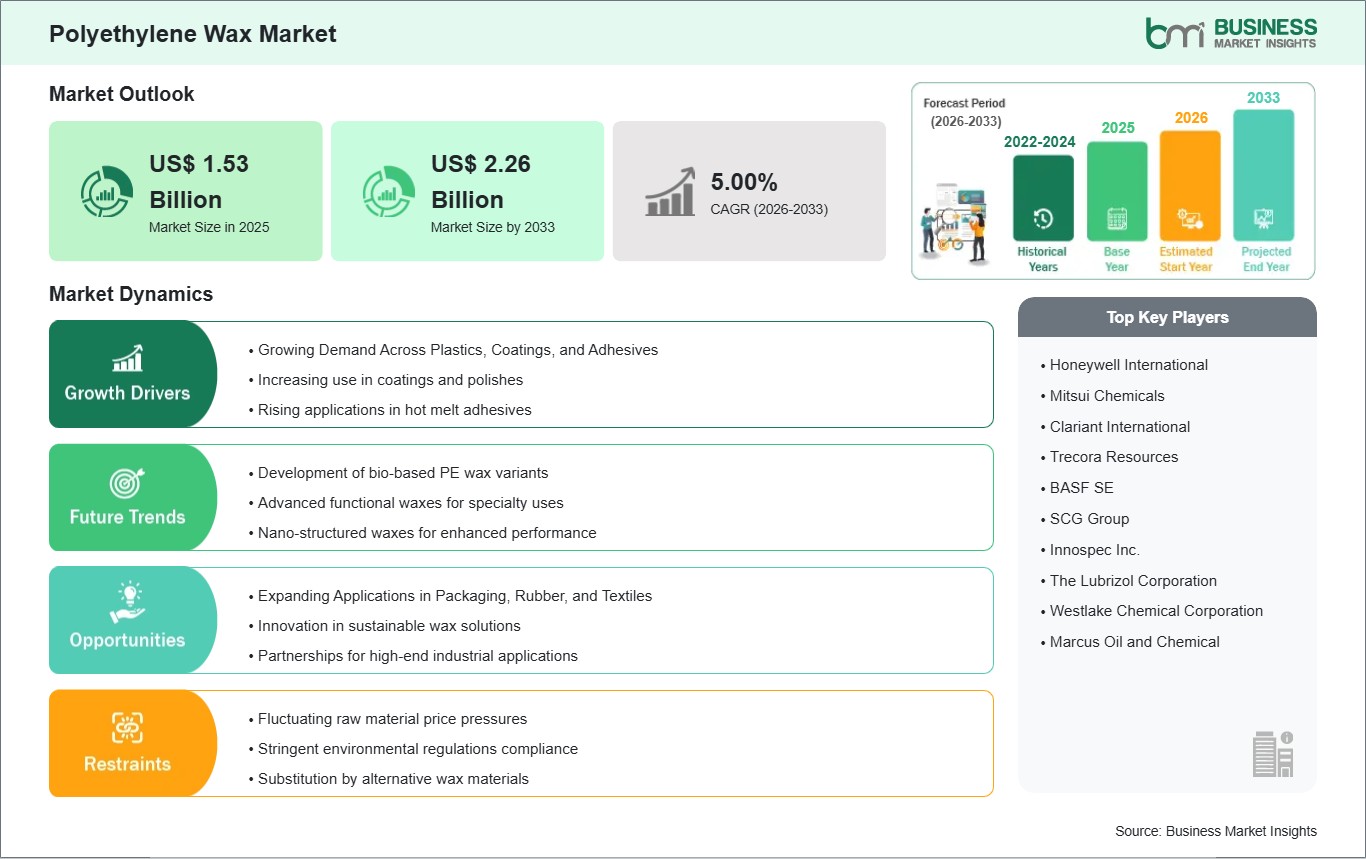
The Polyethylene Wax Market size is expected to reach US$ 2.26 billion by 2033 from US$ 1.53 billion in 2025. The market is estimated to record a CAGR of 5.00% from 2026 to 2033.
The market for polyethylene wax is growing steadily due to increasing industry demand for multifunctional additives that can enhance product performance in plastics, coatings, adhesives, and rubber. Polyethylene waxes are highly sought due to their thermal stability, lubricity, and performance-enhancing properties. The growing demand for performance plastics is also contributing to market growth, especially in packaging, automotive, and electronic devices. This is because manufacturers need smooth flow characteristics, gloss, and durability in plastics.
Moreover, polyethylene waxes are also being used in masterbatches, inks, and polishes to enhance dispersion, scratch resistance, and smoothness. Advances in technology have also allowed for the production of multifunctional waxes that can meet specific performance requirements. This is because various polymerization techniques can produce waxes with specific molecular weights and surface chemistry. The market is highly competitive, with established chemical manufacturers investing in R&D to introduce eco-friendly, low-VOC, and energy-efficient formulations.
Factors such as growing industrial automation, stringent quality standards, and the need for consistent product performance are influencing adoption patterns. Regional demand is also shaped by the rapid expansion of manufacturing sectors, particularly in automotive and packaging, while challenges such as raw material price volatility and regulatory restrictions on certain additives can impact market growth.
Overall, the polyethylene wax market reflects the convergence of innovation, performance-driven requirements, and sustainability trends, positioning it as a critical material across multiple industrial applications.

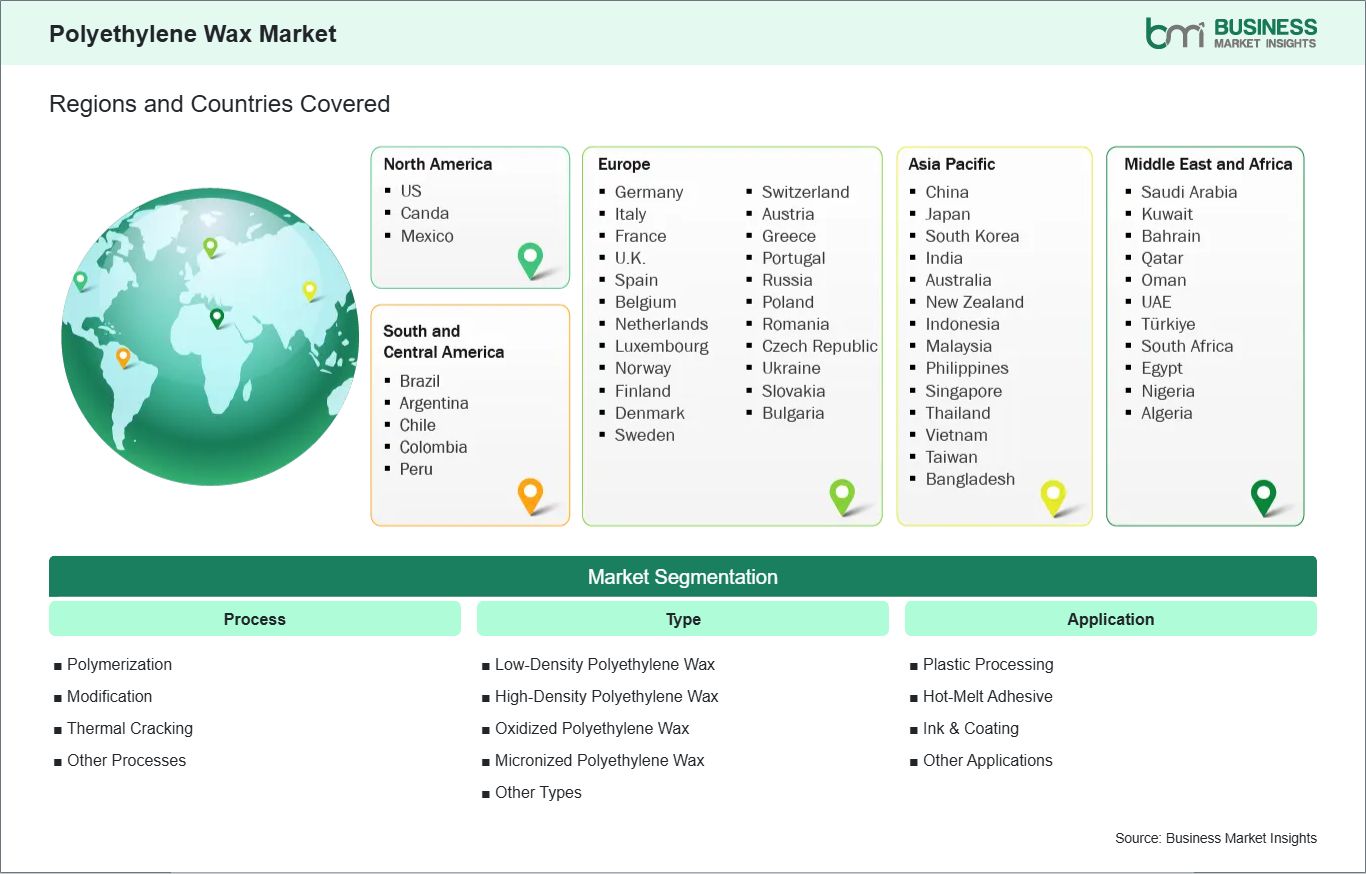
Key segments that contributed to the derivation of the polyethylene wax market analysis are process, type, and application.
The market for polyethylene wax is expanding considerably owing to the increasing usage of the product in plastics, coatings, and adhesives. This is because the product has the ability to enhance the processing of the materials and improve the surface characteristics of the materials. It also has the ability to provide slip and anti-block properties in the materials. Polyethylene wax is widely used in the production of plastics and other materials such as masterbatches and polyolefin films. This is because the product has the ability to provide the materials with the necessary flow and anti-stick properties.
In the coatings and adhesives sector, the product is widely used owing to its ability of the product to provide the materials with the necessary properties such as scratch resistance and gloss. This has made the product widely used in the production of paints and coatings. This is because the market is expanding considerably owing to the increasing demand for the products in various sectors. In addition, the product has the ability to provide the materials with the necessary durability and long-term performance.
Sustainability and efficiency are also contributing to market growth. Polyethylene wax enables lower energy consumption during processing by improving flow properties and reducing friction in extrusion or molding processes. Its compatibility with recyclable polymers and ability to extend the life of plastic products aligns with the global push for environmentally friendly materials. As industries increasingly prioritize cost efficiency, performance, and sustainability, polyethylene wax is emerging as a crucial additive across multiple applications.
The use of polyethylene wax in packaging is also increasing with its potential to enhance film properties like gloss, slip, and anti-blocking. This is very important in the packaging industry to ensure smooth processing, high-speed converting, and appealing appearance. With the increasing demand for flexible packaging, polyethylene wax has now become an indispensable element in the packaging industry.
In the field of rubber, polyethylene wax finds its application as a lubricant in the processing of rubber. It improves the processing efficiency in the extrusion and molding of tires, seals, and other rubber parts. It also improves the surface finish, shows good filler dispersion, and reduces scorch. The multifunctionality of polyethylene wax in the processing and performance enhancement of rubber has made its use indispensable in the growing market for rubber. Similarly, in textiles, polyethylene wax finds its application in the enhancement of yarns, fabrics, and nonwovens with good lubricating, softening, and anti-static properties.
Technological advancements in polyethylene wax production and formulation are further expanding its applications. Manufacturers are developing specialized grades with varying molecular weights, melting points, and functionalities to meet specific industry needs. Innovations aimed at low-VOC and environmentally friendly waxes are attracting end-users focused on sustainability. As industries increasingly seek high-performance, multifunctional, and eco-conscious additives, polyethylene wax is positioned as a key ingredient in enhancing efficiency, durability, and aesthetics across diverse applications.
The polyethylene wax market demonstrates steady growth, with size and share analysis highlighting evolving trends and competitive dynamics among key players. The report examines subsegments categorized within process, type, and application, offering insights into their contribution to overall market performance.
By Process, the polymerization subsegment dominated the market in 2025, driven by its wide adoption for manufacturing consistent polyethylene wax grades with tailored properties.
Based on Type, the high‑density polyethylene wax subsegment dominated the market in 2025, supported by its use as a lubricant and modifier across plastics, adhesives, and coatings applications.
In Terms of Application, the plastic processing subsegment dominated the market in 2025, owing to the strong demand for polyethylene wax as a processing aid and lubricant in PVC, masterbatch, and other polymer formulations.
| Report Attribute | Details |
|---|---|
| Market size in 2025 | US$ 1.53 Billion |
| Market Size by 2033 | US$ 2.26 Billion |
| Global CAGR (2026 - 2033) | 5.00% |
| Historical Data | 2022-2024 |
| Forecast period | 2026-2033 |
| Segments Covered | By Process
|
|
Regions and Countries Covered
| |
| North America | US, Canada, Mexico |
| Europe | Belgium, Austria, Finland, Denmark, Greece, Poland, Romania, Russia, Ukraine, Czech Republic, Slovakia, Bulgaria, Italy, Luxembourg, Germany, Switzerland, France, Netherlands, Norway, Portugal, Spain, Sweden, United Kingdom |
| Asia-Pacific | Australia, China, India, Japan, South Korea, Indonesia, Malaysia, Philippines, Singapore, Thailand, Vietnam, Bangladesh, New Zealand, Taiwan |
| South and Central America | Brazil, Argentina, Peru, Chile, Colombia |
| Middle East and Africa | Bahrain, Kuwait, Oman, Qatar, Saudi Arabia, United Arab Emirates, Turkiye, South Africa, Egypt, Algeria, Nigeria |
| Market leaders and key company profiles |
|
The "Polyethylene Wax Market Size and Forecast (2022 - 2033)" report provides a detailed analysis of the market covering below areas:
The geographical scope of the Polyethylene Wax Market report is divided into North America, Asia Pacific, Europe, Middle East & Africa, and South & Central America. North America held the largest share in 2025.
The polyethylene wax market exhibits distinct regional characteristics based on industrial activity, regulatory frameworks, and end-use demand, with North America dominating the market due to its mature manufacturing base, advanced polymer industry, and high adoption in automotive, coatings, and packaging sectors. The United States and Canada leverage robust R&D capabilities and strict quality standards, driving the preference for high-performance polyethylene waxes in industrial and consumer applications.
In Europe, market growth is supported by sustainability initiatives, regulatory compliance, and advanced chemical processing industries, particularly in Germany, France, and Italy, where specialty waxes are incorporated in coatings, adhesives, and polymer blends.
Asia Pacific is witnessing rapid expansion, fueled by industrialization, urbanization, and increasing demand from packaging, automotive, and electronics sectors in China, India, and Japan, with cost-efficiency and scalability shaping adoption.
The Middle East & Africa region is gradually increasing consumption, supported by construction, industrial coatings, and infrastructure development, with imports and collaborations facilitating access to high-performance wax formulations.
South & Central America is experiencing steady growth, led by Brazil, Mexico, and Argentina, driven by industrial manufacturing, packaging, and automotive applications, though market penetration is influenced by price sensitivity and limited local production capacity. Overall, regional trends reflect a combination of industrial maturity, technological readiness, and application-specific requirements that shape the global polyethylene wax market landscape.

The Polyethylene Wax Market is evaluated by gathering qualitative and quantitative data post primary and secondary research, which includes important corporate publications, association data, and databases. A few of the key developments in the polyethylene wax market are:
The Polyethylene Wax Market is valued at US$ 1.53 Billion in 2025, it is projected to reach US$ 2.26 Billion by 2033.
As per our report Polyethylene Wax Market, the market size is valued at US$ 1.53 Billion in 2025, projecting it to reach US$ 2.26 Billion by 2033. This translates to a CAGR of approximately 5.00% during the forecast period.
The Polyethylene Wax Market report typically cover these key segments-
The historic period, base year, and forecast period can vary slightly depending on the specific market research report. However, for the Polyethylene Wax Market report:
The Polyethylene Wax Market is populated by several key players, each contributing to its growth and innovation. Some of the major players include:
The Polyethylene Wax Market report is valuable for diverse stakeholders, including:
Essentially, anyone involved in or considering involvement in the Polyethylene Wax Market value chain can benefit from the information contained in a comprehensive market report.
Please tell us your area of interest
(Market Segments/ Regions and Countries/ Companies)