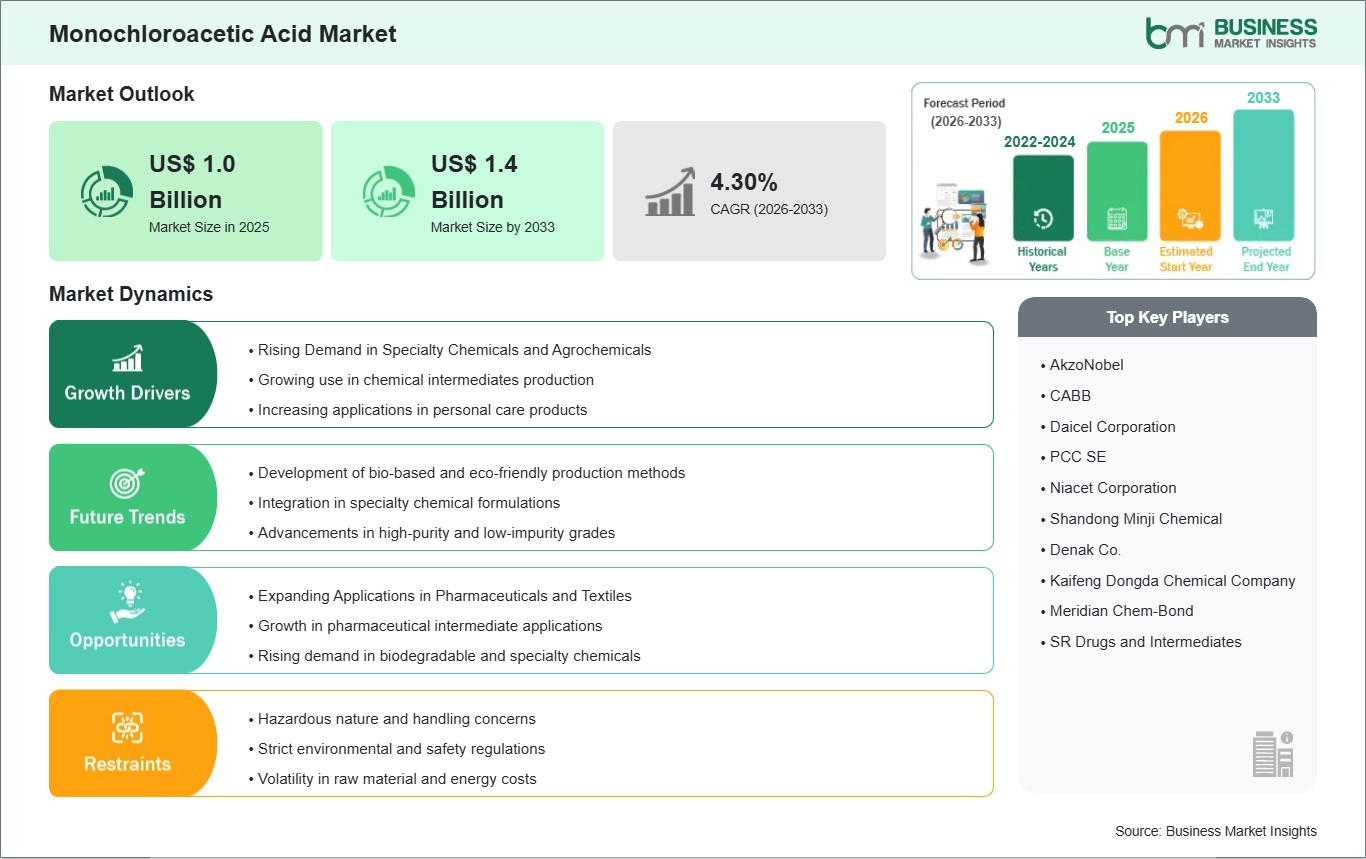
The Monochloroacetic Acid Market size is expected to reach US$ 1.4 Billion by 2033 from US$ 1.0 Billion in 2025. The market is estimated to record a CAGR of 4.30% from 2026 to 2033.
The market for monochloroacetic acid is growing steadily due to the critical role it plays as an important intermediate in the manufacture of various important compounds, such as pharmaceuticals, agrochemicals, surfactants, and specialty chemicals. Monochloroacetic acid plays a vital role in the manufacture of carboxymethyl cellulose, herbicides, and other derivatives, making it an important raw material in many industries. The growth in the agrochemical industry, especially in the manufacture of herbicides and pesticides, is also an important factor in the growth of the market for monochloroacetic acid. This is due to the increased efficiency required in the farming industry. The increased demand from the pharmaceutical industry for APIs and intermediates that employ monochloroacetic acid as a raw material is also an important factor in the growth of the market.
The increased efficiency in the production process through the introduction of modern technologies, such as continuous flow synthesis and green chemistry for chlorination processes, also plays an important role in the growth in the market. The regulatory and safety requirements are influencing the manufacturing practices, especially in the handling of corrosive chemicals and emission management. Market growth is also supported by various strategic moves made by key players, including expansions, forward integration, and forming partnerships with downstream chemical manufacturers to ensure raw material supply. However, the market faces challenges like raw material cost volatility, environmental issues associated with chlorine-based processes, and the need to maintain rigorous handling and storage practices. The outlook for the market is favorable, backed by robust demand from agrochemicals, specialty chemicals, and pharmaceuticals, and constant innovations in the processes and safety management practices.

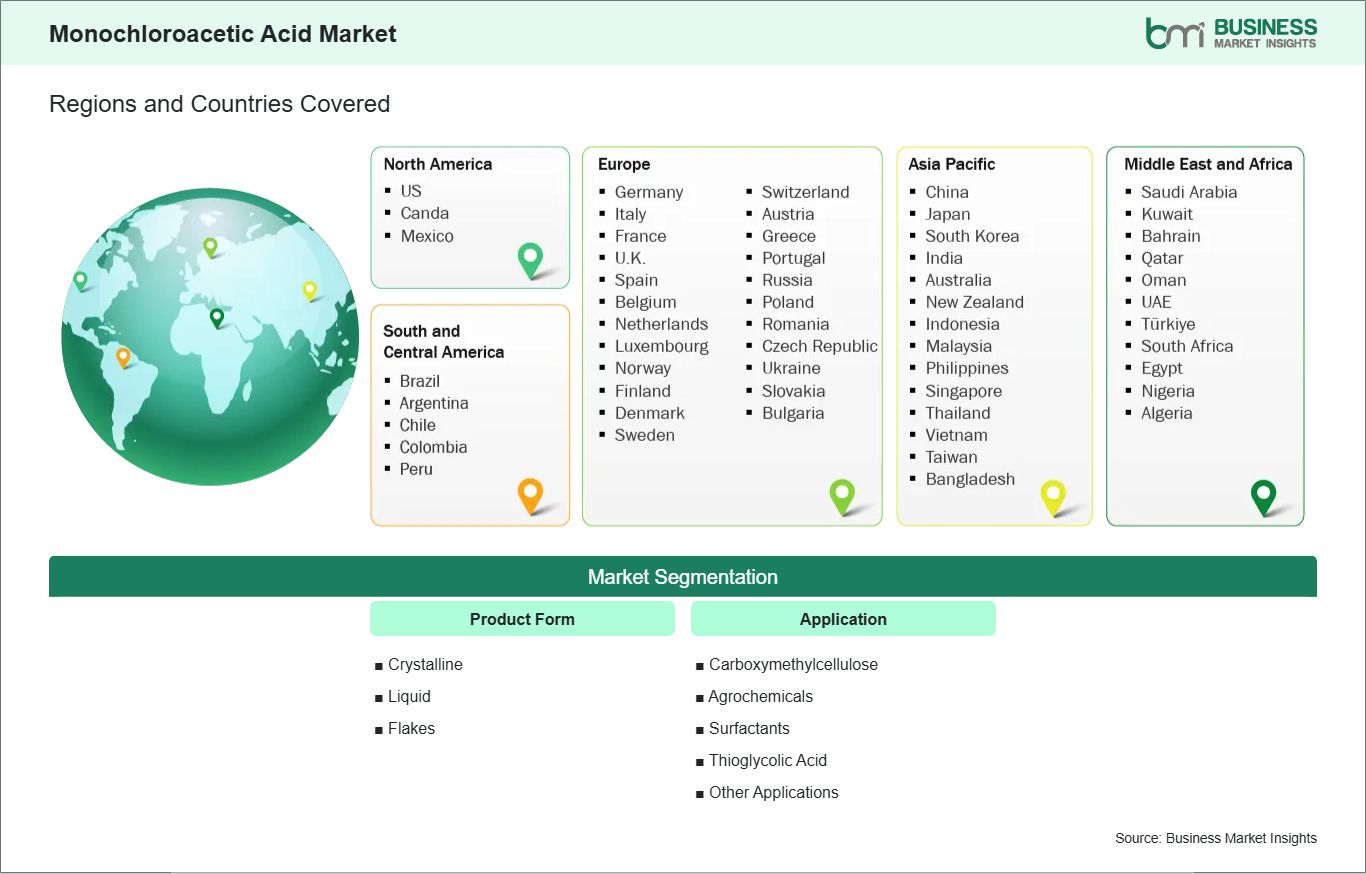
Key segments that contributed to the derivation of the monochloroacetic acid market analysis are product form and application.
The market for monochloroacetic acid is witnessing an increase in demand owing to its rising application in the production of various specialty chemicals and agrochemicals. As a chemical intermediate, monochloroacetic acid is utilized in the production of herbicides, insecticides, and fungicides, among other agrochemicals. Its chemical properties enable agrochemical companies to design and develop highly efficient agrochemicals, meeting the rising demand for efficient and reliable agrochemicals in the market.
In addition to agrochemicals, monochloroacetic acid is an essential chemical in the production of various specialty chemicals, such as carboxymethyl cellulose, thioglycolic acid, and other chemical compounds and their derivatives. Its chemical properties enable companies to design and develop high-quality chemical compounds with consistent quality, meeting the rising demand for high-quality chemical compounds in the market. Its versatility enables companies to design and develop customized chemical compounds to meet various industrial needs and requirements.
The market growth is further supported by increasing global food demand and the need for higher-efficiency agrochemical products. Monochloroacetic acid`s role in producing key chemical intermediates for both industrial and consumer applications ensure its continued relevance across multiple sectors. Its combination of reliability, chemical efficiency, and broad applicability positions it as a critical material for modern chemical manufacturing, agricultural productivity, and specialty chemical production.
Monochloroacetic acid is increasingly used in the pharmaceutical and textile industries due to its ability to form essential chemical intermediates. In pharmaceuticals, it is used in the synthesis of active ingredients and excipients, supporting the production of medicines with precise chemical properties and therapeutic effectiveness. Its high reactivity enables the creation of compounds that meet strict regulatory and quality standards.
In the textile industry, monochloroacetic acid plays an important role in the production of carboxymethyl cellulose, which acts as a thickening, stabilizing, and binding agent in the processing of fabrics. The compound plays a vital role in enhancing the retention of colors, softness, and overall performance of the material. This shows that monochloroacetic acid plays a significant role in the production of high-quality textiles.
The increased application of monochloroacetic acid in various industries, such as agrochemicals, pharmaceuticals, and textiles, is attributed to the compound`s multifunctional properties and versatility. The compound plays a vital role in the production of specialty chemicals for enhancing efficiency in various industries. The increasing need for reliable, efficient, and high-performance chemicals in various industries worldwide makes monochloroacetic acid an important compound in the production and manufacturing industry.
The monochloroacetic acid market demonstrates steady growth, with size and share analysis highlighting evolving trends and competitive dynamics among key players. The report examines subsegments categorized within product form and application, offering insights into their contribution to overall market performance.
By Product Form, the crystalline subsegment dominated the market in 2025, driven by its stability, purity, and wide industrial use.
Based on Application, the carboxymethylcellulose (CMC) subsegment dominated the market in 2025, supported by its increasing use in food, pharmaceuticals, and industrial applications.
| Report Attribute | Details |
|---|---|
| Market size in 2025 | US$ 1.0 Billion |
| Market Size by 2033 | US$ 1.4 Billion |
| Global CAGR (2026 - 2033) | 4.30% |
| Historical Data | 2022-2024 |
| Forecast period | 2026-2033 |
| Segments Covered | By Product Form
|
|
Regions and Countries Covered
| |
| North America | US, Canada, Mexico |
| Europe | Belgium, Austria, Finland, Denmark, Greece, Poland, Romania, Russia, Ukraine, Czech Republic, Slovakia, Bulgaria, Italy, Luxembourg, Germany, Switzerland, France, Netherlands, Norway, Portugal, Spain, Sweden, United Kingdom |
| Asia-Pacific | Australia, China, India, Japan, South Korea, Indonesia, Malaysia, Philippines, Singapore, Thailand, Vietnam, Bangladesh, New Zealand, Taiwan |
| South and Central America | Brazil, Argentina, Peru, Chile, Colombia |
| Middle East and Africa | Bahrain, Kuwait, Oman, Qatar, Saudi Arabia, United Arab Emirates, Turkiye, South Africa, Egypt, Algeria, Nigeria |
| Market leaders and key company profiles |
|
The "Monochloroacetic Acid Market Size and Forecast (2022 - 2033)" report provides a detailed analysis of the market covering below areas:
The geographical scope of the Monochloroacetic Acid Market report is divided into North America, Asia Pacific, Europe, Middle East & Africa, and South & Central America. North America held the largest share in 2025.
Regional-level dynamics in the monochloroacetic acid market reveal differentiated growth influenced by industrial capacity, regulatory environments, and end-use sector demand. North America is the dominant region, supported by well-established chemical manufacturing infrastructure, strong demand from agrochemical and pharmaceutical industries, and adherence to stringent safety and environmental regulations. The United States leads in adopting advanced manufacturing technologies for efficient and compliant MCAA production.
Europe exhibits steady growth, driven by stringent environmental regulations, high-quality standards, and sustained demand from the specialty chemicals and pharmaceutical sectors, with Germany, France, and Italy as major contributors.
Asia Pacific is the fastest-growing region, led by China, India, and Japan, due to large-scale chemical manufacturing, rapid growth in agrochemical production, and expanding pharmaceutical industries. Increasing investments in process optimization and emission reduction technologies further strengthen regional growth.
Middle East & Africa shows moderate growth, driven by industrial expansion and emerging pharmaceutical and chemical processing sectors, though limited production capacity constrains rapid adoption.
South & Central America is an emerging market, particularly in Brazil and Argentina, where agricultural growth and chemical production are gradually increasing MCAA demand, despite cost sensitivity and infrastructure limitations.
Across all regions, growth is shaped by industrial modernization, regulatory compliance, and rising demand in agrochemical, pharmaceutical, and specialty chemical applications.

The Monochloroacetic Acid Market is evaluated by gathering qualitative and quantitative data post primary and secondary research, which includes important corporate publications, association data, and databases. A few of the key developments in the monochloroacetic acid market are:
The Monochloroacetic Acid Market is valued at US$ 1.0 Billion in 2025, it is projected to reach US$ 1.4 Billion by 2033.
As per our report Monochloroacetic Acid Market, the market size is valued at US$ 1.0 Billion in 2025, projecting it to reach US$ 1.4 Billion by 2033. This translates to a CAGR of approximately 4.30% during the forecast period.
The Monochloroacetic Acid Market report typically cover these key segments-
The historic period, base year, and forecast period can vary slightly depending on the specific market research report. However, for the Monochloroacetic Acid Market report:
The Monochloroacetic Acid Market is populated by several key players, each contributing to its growth and innovation. Some of the major players include:
The Monochloroacetic Acid Market report is valuable for diverse stakeholders, including:
Essentially, anyone involved in or considering involvement in the Monochloroacetic Acid Market value chain can benefit from the information contained in a comprehensive market report.
Please tell us your area of interest
(Market Segments/ Regions and Countries/ Companies)