
Generative AI in Life Sciences Market Outlook: Size, Share, Trends, Growth Analysis, Competitive Landscape & Forecast, 2026-2033

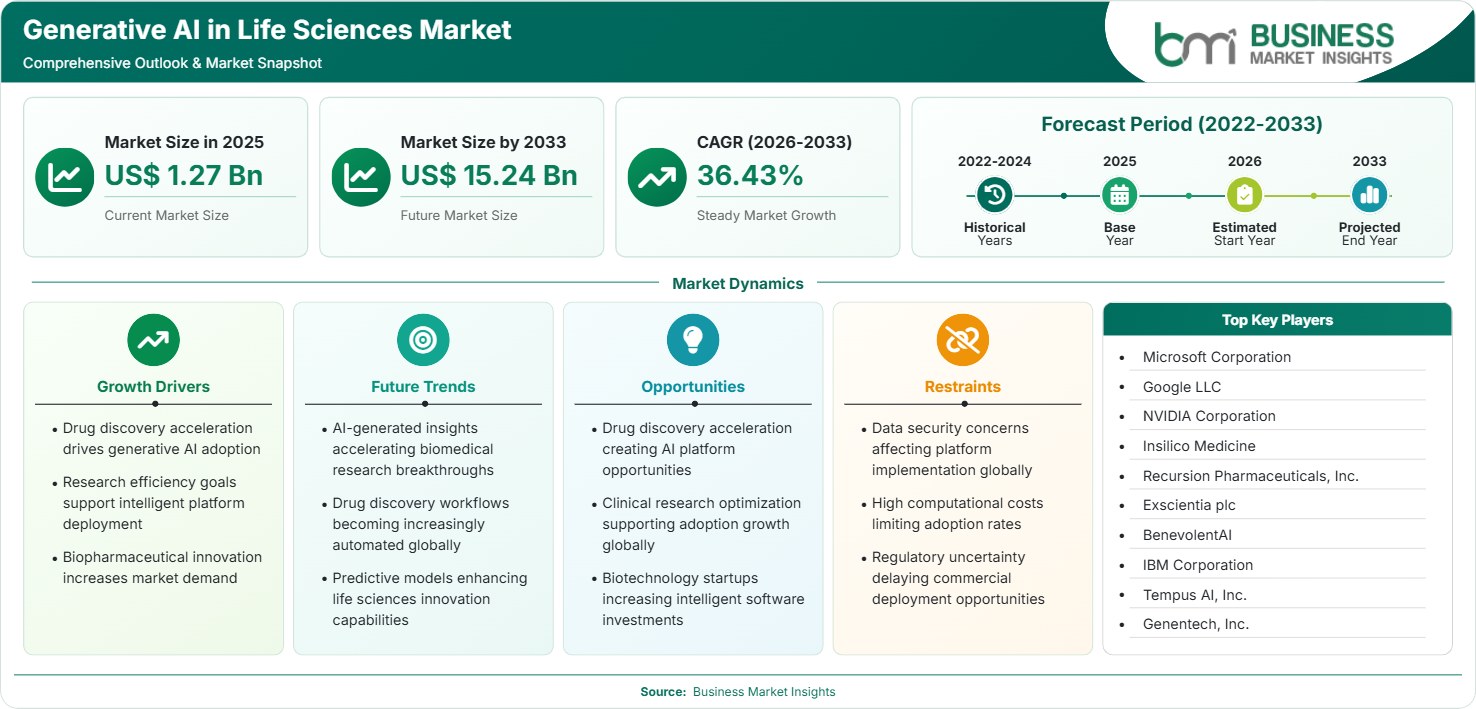
The Generative AI in Life Sciences Market size was valued at US$ 1.27 Billion in 2025 and is projected to reach US$ 15.24 Billion by 2033, growing at a CAGR of 36.43% during 2026–2033. Rising AI-enabled drug discovery adoption, expanding biomedical data volumes, accelerated clinical development workflows, and increasing biopharmaceutical R&D investments are creating substantial commercialization and innovation opportunities.

Report Coverage
  • Component: Software/Platforms, Services
  • Deployment: Cloud-Based, On-Premise, Hybrid
  • Technology: LLMs, NLP, Generative Molecular/Protein Models, Others
  • Product Type: Standalone, Integrated
  • Application: Drug Discovery & Design, Clinical Trial Design & Operations, Others
US$ 1.27 Bn Market size in 2025
US$ 15.24 Bn Market Size by 2033
36.43% CAGR, 2026 - 2033
2026-2033 Forecast Period

AI Overview

Generative AI in Life Sciences Market Summary

  • North America Region: Holds a 42%–46% share in 2025, advancing at a CAGR of 34%–37% through 2033. Strong life sciences research infrastructure, AI funding availability, cloud adoption, and pharmaceutical innovation ecosystems continue to support platform deployment and commercial expansion. The U.S. market benefits from extensive biopharma R&D spending and is projected to record a CAGR of 35%–38% through 2033.
  • Fastest Growing Region: Asia Pacific accounts for 23%–27% market share in 2025 and is expanding at a CAGR of 39%–43% during 2026–2033. Government-backed AI programs, biotechnology investments, digital health modernization, and increasing trial activity are accelerating advanced technology adoption.
  • Leading Segment: Software/Platforms command a 65%–69% share in 2025 and are expected to grow at a CAGR of 35%–38%. Demand is supported by scalable model development environments, predictive biology capabilities, workflow automation, and enterprise integration requirements across drug development functions.
  • High Growth Segment: Drug Discovery & Design represents 31%–35% of the Generative AI in Life Sciences Market share in 2025 and is forecast to expand at a CAGR of 40%–44%. Organizations increasingly leverage generative models to optimize molecule generation, target identification, and candidate prioritization processes.
  • Key Market Opportunity: Deployment of domain-specific foundation models trained on genomic, proteomic, molecular, and clinical datasets offers significant opportunities to improve therapeutic discovery productivity, reduce development risk, and enhance translational research outcomes.
  • Major Market Players: Microsoft Corporation, Google LLC, NVIDIA Corporation, Insilico Medicine, Recursion Pharmaceuticals, Inc., Exscientia plc, BenevolentAI, IBM Corporation, Tempus AI, Inc., and Genentech, Inc.
Strategic Insights

Generative AI in Life Sciences Market: Strategic Insights

Generative AI in Life Sciences Market Strategic Framework
FREE PDF
Request your free sample
Request free sample
Stakeholder View

Key Takeaways

  • The value chain is increasingly integrated with cloud providers, AI infrastructure vendors, pharma companies, CROs, and research institutes, all working together to build interoperable drug development ecosystems.
  • Drug discovery and molecular design are the applications with the clearest commercial upside as companies look to accelerate their lead optimization, target validation, and preclinical candidate selection.
  • Foundation biological models trained on proprietary molecular, genomic and clinical datasets are becoming a key differentiator across pharma R&D programs.
  • Asia Pacific is a very attractive investment case on the basis of the strong growth of biotech, the increasing digitization of healthcare and the government's own initiatives in AI.
  • Strategic alliances between tech developers and pharma continue to attract investment, and acquisitions are increasingly being used as a means of acquiring proprietary datasets, algorithms, and computational biology capability.
  • Organizations that are able to combine explainable AI, validated scientific workflows, and regulatory-compliant deployment frameworks are expected to see the best adoption and commercialization outcomes.
Geographic Outlook

Generative AI in Life Sciences Market Regional Highlights

North America Generative AI in Life Sciences Market

North America accounts for approximately 42%–46% of Generative AI in Life Sciences Market revenue in 2025 and remains the largest regional ecosystem, advancing at a CAGR of 34%–37% through 2033. The region benefits from strong pharmaceutical innovation, advanced cloud infrastructure, abundant venture capital availability, and widespread digital transformation initiatives.

  • The big pharma companies are still ramping up their AI-enabled discovery programs, with a view to the commercialization of more sophisticated biology models and to the acceleration of candidate optimization.
  • A growing number of collaborations between the cloud providers, biotech companies and academic institutions to enhance computational resources and improve access to high-quality biomedical datasets.
  • Regulatory engagement on responsible AI adoption is designed to build confidence within the enterprise whilst enabling innovation in both therapeutic discovery and in the translational research environment.
  • Growing demand for personalized medicine has led to increased interest in predictive biological modeling and the integration of multi-modal data.
  • The Generative AI in Life Sciences Market share remains highest in this region due to superior infrastructure, funding access, and concentration of leading innovators.

US Generative AI in Life Sciences Market

The United States represents approximately 78%–82% of regional Generative AI in Life Sciences Market revenue within North America and is projected to achieve a CAGR of 35%–38% through 2033. Strong research funding, extensive biotechnology activity, and leadership in artificial intelligence innovation underpin market expansion.

  • The leading tech players are working very closely with pharma companies to bring their generative capabilities into the research and therapy development space.
  • National investment in biomedical innovation underpins the generation of large-scale data and enables the training of specialist scientific models.
  • The existence of globally recognized biotech clusters acts to accelerate the flow of knowledge, the development of talent and the commercialization of innovation.
  • Expanding the uptake of multimodal AI solutions will improve productivity across preclinical, clinical and post-market research functions.

Europe Generative AI in Life Sciences Market

Europe captures an estimated 24%–28% Generative AI in Life Sciences Market revenue share in 2025 and is anticipated to grow at a CAGR of 33%–36% through 2033. Strong academic research capabilities, supportive innovation funding, and expanding biotechnology ecosystems contribute to regional growth.

  • European research consortia are increasingly involved in data-sharing initiatives, which in turn lead to better model training and better scientific validation.
  • Biotech clusters in Germany, Switzerland, France and the UK are continuing to attract funding for AI-enabled therapeutic innovation.
  • Ethical AI governance frameworks promote responsible use and, in turn, build confidence in the long term for enterprise adoption.
  • Growing interest in rare disease research opens up the possibility of using advanced molecular modeling and predictive therapeutic development.
  • Cross-border collaboration between academic and commercial organizations enables faster innovation and technology transfer.

Asia Pacific Generative AI in Life Sciences Market

Asia Pacific accounts for approximately 23%–27% of global Generative AI in Life Sciences Market revenue in 2025 and is the fastest-expanding regional market, advancing at a CAGR of 39%–43% through 2033. Rapid biotechnology development, growing healthcare digitization, and government-supported AI initiatives are accelerating commercial adoption.

  • National AI strategies in China, Japan, South Korea, Singapore, and India are all continuing to drive investment in life sciences innovation and in research automation capabilities.
  • Expanding the pharmaceutical manufacturing and biotech ecosystems creates the right environment for more sophisticated data-driven drug discovery workflows and platform deployments.
  • Academics are increasingly working with the commercial sector to build regional datasets, which in turn improves the relevance of the models for population-specific therapeutics.
  • Growing contract research activity is driving the uptake of automated analytics and intelligent clinical development optimization technologies.
  • Significant venture funding coupled with government-supported innovation programs is rapidly advancing the commercialization of next-generation biomedical AI.

Rest of World Generative AI in Life Sciences Market

The Rest of World region accounts for approximately 8%–12% of global Generative AI in Life Sciences Market revenue in 2025 and is projected to expand at a CAGR of 35%–39% through 2033. South & Central America are witnessing increasing biotechnology investments, particularly in Brazil, where pharmaceutical modernization initiatives support adoption of advanced computational research platforms.

  • Brazil is still the leading market in South & Central America, driven by the growth of its pharma R&D capabilities and the increasing amount of work being done in partnership with international technology providers.
  • Healthcare digitalization initiatives across the GCC are promoting the integration of advanced analytics and biomedical intelligence solutions.
  • Growing academic research activity is developing local expertise and improving the use of AI-enabled scientific discovery platforms.
  • Public-private partnerships are increasingly being used to facilitate technology transfer, skills development and the expansion of the innovation ecosystem in the emerging economies.
  • Regional organizations are focusing their investment on data infrastructure to underpin the future deployment of advanced life sciences computational platforms.
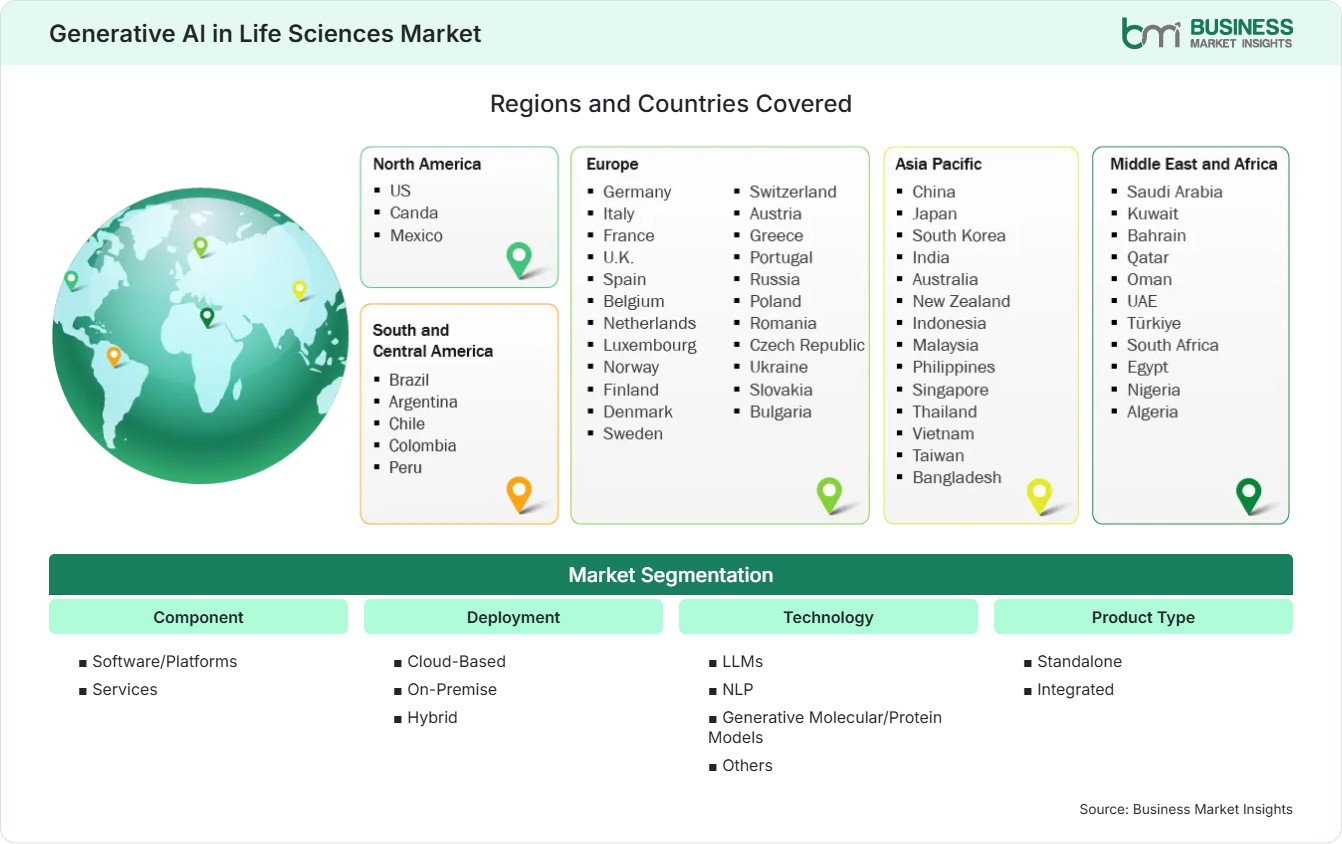
Global Market Geography
FREE PDF
Request your free sample
Request free sample
Segment Analysis

Generative AI in Life Sciences Market Segmentation

Component

The Component segment reflects broad adoption of software-driven platforms and specialized service offerings supporting research workflows. This segment holds approximately 100% of component revenue, with Software/Platforms leading at 65%–69% share in 2025, while the overall category advances at a CAGR of 35%–38% through 2033. The Generative AI in Life Sciences Market scope continues to expand as organizations seek scalable deployment models and domain-specific capabilities.

  • Software/Platforms: Enterprise demand centers on molecular generation, biological prediction, scientific knowledge extraction, and workflow automation capabilities integrated across pharmaceutical research and development processes.
  • Services: Consulting, implementation, validation, model customization, regulatory support, and managed operations services help organizations operationalize advanced AI capabilities and accelerate value realization.

Deployment

Deployment preferences are evolving as organizations balance security, scalability, and regulatory requirements. The segment demonstrates strong expansion with a projected CAGR of 35%–38%, supported by increasing computational demands. Cloud architectures account for the largest deployment footprint in 2025 because of flexible infrastructure access, simplified scaling, and accelerated innovation cycles across distributed research environments.

  • Cloud-Based: Organizations favor cloud infrastructure for scalable computing resources, collaborative research environments, rapid model training, and access to continually updated AI development tools.
  • On-Premise: Highly regulated organizations continue deploying internal systems to maintain data sovereignty, support compliance objectives, and protect valuable intellectual property assets.
  • Hybrid: Hybrid environments provide flexible integration capabilities by combining security-focused local infrastructure with scalable cloud computing resources for advanced research workloads.

Technology

Technology innovation remains central to competitive differentiation. The segment recorded substantial adoption in 2025 and continues advancing at a CAGR of 37%–41% through 2033. Large foundation models and specialized biological architectures increasingly support knowledge generation, scientific reasoning, and molecular prediction applications.

  • Large Language Models (LLMs): Widely utilized for literature analysis, scientific content generation, hypothesis development, knowledge retrieval, and regulatory document support across research workflows.
  • Natural Language Processing (NLP): Enables extraction of insights from biomedical publications, clinical records, patents, and unstructured scientific datasets that inform research decisions.
  • Generative Molecular/Protein Models: Support design of novel compounds, proteins, and biological sequences while improving efficiency in therapeutic candidate identification and optimization.

Product Type

Product strategies increasingly emphasize interoperability, workflow integration, and enterprise usability. Integrated solutions account for the majority of adoption and support a CAGR of 36%–40% through 2033. Organizations prioritize technologies capable of seamlessly connecting research datasets, laboratory systems, and computational environments to improve scientific productivity and decision-making effectiveness.

  • Standalone: Frequently adopted for targeted use cases requiring specialized functionality in molecular design, document intelligence, or predictive biological analysis environments.
  • Integrated: Integrated offerings streamline cross-functional workflows by connecting laboratory information, computational tools, and research systems within unified operational environments.

Application

The application landscape is led by drug discovery activities, reflecting strong demand for accelerated therapeutic innovation. Drug Discovery & Design maintains a 31%–35% Generative AI in Life Sciences Market trends contribution in 2025 and records the highest CAGR of 40%–44% through 2033. Organizations increasingly deploy these technologies to improve speed, precision, and efficiency across critical development stages.

  • Drug Discovery & Design: Extensive adoption is driven by requirements for faster target identification, molecular optimization, lead generation, and reduction of experimental screening burdens.
  • Clinical Trial Design & Operations: AI-supported protocol optimization, recruitment planning, patient stratification, and operational forecasting help improve trial execution effectiveness and efficiency.

End User

End-user adoption reflects broadening acceptance across commercial and research-focused organizations. Pharmaceutical & biotechnology companies maintain the largest revenue contribution, supported by extensive R&D budgets and innovation requirements. The Generative AI in Life Sciences Market segment is projected to expand at a CAGR of 35%–39% through 2033 as organizations continue integrating advanced computational capabilities throughout product development lifecycles.

  • Pharmaceutical & Biotechnology Companies: Adoption focuses on accelerating drug development timelines, enhancing pipeline productivity, and improving research decision quality through advanced predictive modeling.
  • CROs: Contract research organizations utilize these technologies to improve operational efficiency, differentiate service capabilities, and optimize development programs for clients.
  • Academic & Research Institutes: Research institutions increasingly employ advanced computational platforms to support scientific discovery, translational research initiatives, and collaborative innovation programs.
Market Forces

Generative AI in Life Sciences Market Dynamics

Key Market Drivers

Escalating Drug Discovery Costs Driving AI Adoption

Pharmaceutical organizations face increasing pressure to improve research productivity while controlling development expenditure. Traditional drug discovery processes often require extensive laboratory validation and lengthy screening cycles, pushing companies toward computational approaches that improve efficiency. Generative models enable rapid molecular generation, predictive screening, and candidate prioritization, reducing early-stage research bottlenecks. This factor continues to support Generative AI in Life Sciences Market growth by helping developers accelerate innovation timelines while improving resource allocation across discovery and development functions.

Expansion of Biomedical Data Ecosystems

The explosion in the volume of data in biomedical data repositories is improving the performance of the more sophisticated computational models. The life sciences organizations are producing enormous amounts of data in the form of sequencing data, imaging data, EHRs, scientific literature, and real-world evidence. Generative technologies can take that disparate data and generate insights to support target identification and drug development. The increasing number of data interoperability initiatives and the growth of cloud-based research infrastructure are all helping to improve access and utility.

Growing Strategic Partnerships Between Technology and Biopharma Firms

Collaboration activity between technology companies and pharmaceutical enterprises is accelerating innovation across scientific research environments. AI providers contribute infrastructure, algorithms, and computational expertise, while life sciences organizations offer proprietary biological data and therapeutic domain knowledge. The increasing number of joint ventures, licensing agreements, and co-development programs demonstrates how Generative AI in Life Sciences Market growth continues to benefit from ecosystem-based innovation approaches that combine scientific expertise with advanced digital capabilities.

Key Market Opportunities

Domain-Specific Foundation Models for Precision Research

A significant opportunity exists in developing foundation models specifically trained on biological, genomic, molecular, and clinical datasets. Unlike general-purpose systems, domain-specialized architectures can better capture complex biological relationships and improve scientific accuracy. The emergence of proprietary biological foundation models is expected to become a major source of competitive differentiation. Growing demand for scientifically validated platforms supports favorable long-term Generative AI in Life Sciences Market Forecasts across both established and emerging pharmaceutical markets.

Expansion Across Clinical Trial Optimization Workflows

Clinical development environments offer huge scope for growth as organizations look to improve their operational efficiency and patient recruitment. Generative technologies can assist with protocol design, anticipate recruitment issues, identify appropriate patient populations, and help with site selection. This in turn can lead to reduced delays and better trial outcomes. As the move to decentralized and digital trials continues, more sophisticated computational platforms will become increasingly important for decision support and operational planning.

Emerging Market Adoption and Research Modernization

Many healthcare and biotech ecosystems in the developing world remain underpenetrated despite improvements in digital infrastructure and increased scientific investment. There's a real push in a number of countries across Asia, the Middle East and Latin America to build up their research capacity via AI strategies, innovation funding and development of their biotech ecosystems. Many organizations in these regions are actively seeking more sophisticated computational tools to improve their competitiveness and accelerate their innovation. As the data becomes more available and the cloud infrastructure improves, the barriers to adoption are going to fall.

Market Restraints and Challenges

Data Quality and Validation Constraints

Factor: Biomedical datasets are notoriously riddled with inconsistencies, bias, incomplete records, and variable standards between institutions. Impact: Model accuracy, reproducibility, and regulatory confidence will all be undermined if the quality of the training data is poor. The life sciences applications space has such a high requirement for scientific rigor that, in a therapeutic development environment in particular, inaccuracies in the data can have a real impact on the decisions that are made and the resources that are deployed.

Regulatory, Ethical, and Intellectual Property Risks

Factor: The regulatory expectations around transparency, explainability, privacy, and IP protection continue to evolve across jurisdictions. Impact: This can lead organizations to put off implementation decisions altogether, as they're unsure what their compliance obligations will be or what level of legal liability they will face. The pharma companies in particular will be under pressure to show reliability and scientific validity whilst at the same time protecting their own IP and the data of their patients.

Company Analysis

Competitive Landscape

The competitive environment is characterized by strong collaboration among AI infrastructure providers, computational biology specialists, and pharmaceutical innovators. Current Generative AI in Life Sciences Market analysis indicates that platform differentiation increasingly depends on proprietary datasets, biological foundation models, cloud scalability, and scientific validation capabilities.

Company Name

Overview

Products and Services relevant to this market

Microsoft Corporation

Major technology provider enabling enterprise-scale AI deployment across healthcare and life sciences research environments.

Azure AI infrastructure, healthcare cloud platforms, generative AI tools, data management, and enterprise analytics solutions.

Google LLC

Global AI leader supporting advanced research and biomedical innovation through scalable cloud technologies.

Vertex AI, foundation models, healthcare analytics solutions, life sciences data services, and cloud infrastructure.

NVIDIA Corporation

Key provider of accelerated computing technologies powering advanced model training and scientific simulations.

GPU platforms, AI frameworks, healthcare computing solutions, molecular modeling infrastructure, and research acceleration technologies.

Insilico Medicine

AI-native biotechnology company focused on therapeutic discovery and development innovation.

Generative drug discovery platforms, target identification systems, molecule design tools, and research services.

Recursion Pharmaceuticals, Inc.

Biotechnology firm utilizing large-scale computational biology and machine learning approaches.

AI-driven drug discovery platforms, biological data analytics, experimental mapping, and therapeutic development capabilities.

Exscientia plc

Specialist in AI-enabled pharmaceutical research and precision medicine innovation.

Drug design platforms, predictive biology models, precision medicine tools, and therapeutic development services.

BenevolentAI

Artificial intelligence company focused on accelerating biomedical research and discovery processes.

Knowledge graph technologies, drug discovery platforms, scientific intelligence systems, and target identification solutions.

IBM Corporation

Enterprise technology provider supporting AI adoption within regulated healthcare and research environments.

Watson platforms, AI analytics, cloud services, data governance solutions, and scientific computing infrastructure.

Tempus AI, Inc.

Data-driven healthcare technology company leveraging advanced analytics and clinical intelligence.

Precision medicine platforms, clinical data analytics, genomic intelligence services, and AI-driven healthcare solutions.

Genentech, Inc.

Leading biotechnology innovator actively integrating advanced computational approaches within research operations.

Drug discovery programs, translational research capabilities, biological datasets, and therapeutic development initiatives.

Trust & Transparency

Research Methodology

The market analysis combines proprietary research with secondary data from government agencies, company disclosures, regulatory filings, industry databases and expert interviews. Market estimates are validated through data triangulation, cross-market benchmarking and analyst review.

View Full Research Methodology

Questions Answered

Frequently Asked Questions

Which technology category is expected to have the greatest long-term influence?

Generative molecular and protein models are expected to have substantial influence because they directly support therapeutic innovation, molecular optimization, and biologically informed discovery processes.

What is covered in a Generative AI in Life Sciences Market Report?

A comprehensive report evaluates market size, competitive positioning, regional developments, technology evolution, application adoption, investment trends, regulatory factors, and future growth opportunities.

How does generative AI support personalized medicine initiatives?

The technology can analyze complex genomic, clinical, and biomarker datasets to identify patient-specific patterns that support precision therapeutic design and treatment optimization strategies.

Which end users are adopting these technologies fastest?

Pharmaceutical and biotechnology companies currently represent the largest adopters due to substantial R&D investments, while CROs are emerging as important users seeking workflow efficiency and service differentiation.

What makes generative AI different from traditional AI in life sciences?

Generative systems create novel molecules, proteins, biological sequences, and scientific hypotheses, while traditional approaches primarily perform classification, prediction, or pattern recognition tasks using existing datasets.

Access the Full Generative AI in Life Sciences Market Report

Get segment-level forecasts, regional estimates, competitive benchmarking, company profiles and downloadable Excel datasets.

Access the full Generative AI in Life Sciences Market Report
350 pages PDF & Excel | 2026-11-10
Similar Research

Related Market Reports