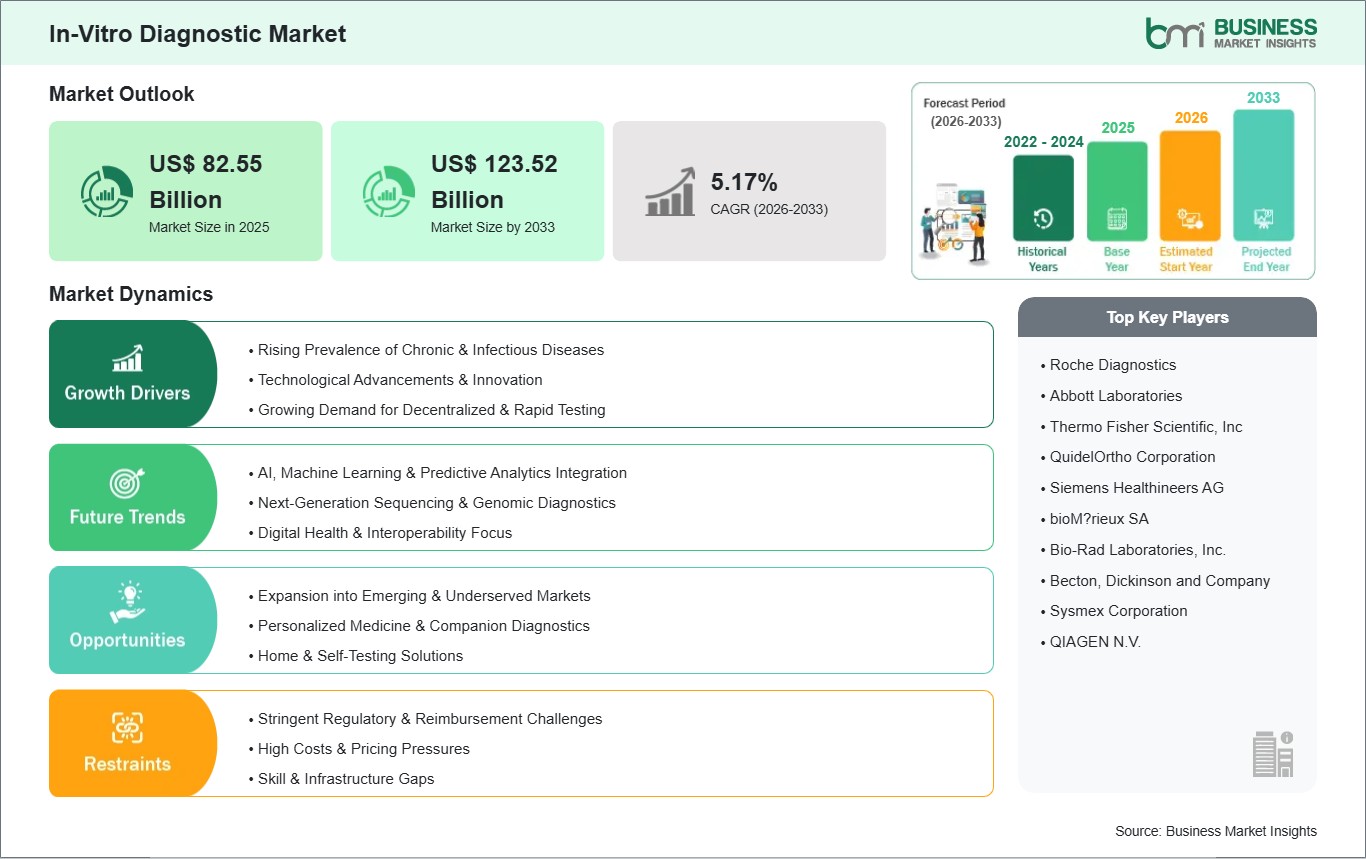
The In-Vitro Diagnostic market size is expected to reach US$ 123.52 billion by 2033 from US$ 82.55 billion in 2025. The market is estimated to record a CAGR of 5.17% from 2026 to 2033.
The in-vitro diagnostics (IVD) market includes products, instruments, and services used for the analysis of samples such as blood, urine, and tissues to detect diseases, conditions, and infections outside the living body. The market is primarily influenced by the increasing prevalence of chronic diseases such as diabetes, cancer, and cardiovascular disorders; growing number of infectious disease outbreaks; aging population; as well as a rising global focus on the early detection, personalized medicine, and preventive healthcare.
It basically segments into reagents & kits which hold the largest share due to the recurring consumption; infectious diseases and oncology as the major applications; immunoassays and molecular diagnostics as the main sources of technologies; clinical laboratories/hospitals as the major end, users with the point, of, care (POC) testing rapidly expanding for decentralized access. The technological improvements in next, generation sequencing, digital pathology, AI, driven analytics, multiplex assays, and rapid POC devices are some of the factors that are helping to improve the accuracy, speed, and usability. At the same time, companion diagnostics are helping to guide targeted therapies.
Geographically, the North America is leading the market due to the existence of the advanced healthcare infrastructure, the favorable regulatory environment, and the high rate of adoption of innovative technologies, hence Europe is in the second position. Asia, Pacific is showing the highest speed of movement and this is a result of factors such as more people having access to healthcare, the growing middle class which is increasing the household disposable income, and the governments preventive healthcare programs in countries such as China and India. On the other hand, the markets in Latin America and Africa are struggling to keep up; however, they have enormous opportunities as a result of their gradually improving diagnostics infrastructure.
Major companies such as Roche Diagnostics, Abbott Laboratories, Siemens Healthineers, Danaher Corporation, Thermo Fisher Scientific, and bioMrieux are striving for the major market share by investing heavily into R&D, making insightful acquisitions, and integrating digital technologies. The market for IVD is, in essence, moving in the direction of precision, portability, and connectivity while still maintaining a balance between the solid core of lab testing and the breakthrough possibilities of molecular and home, based diagnostics.

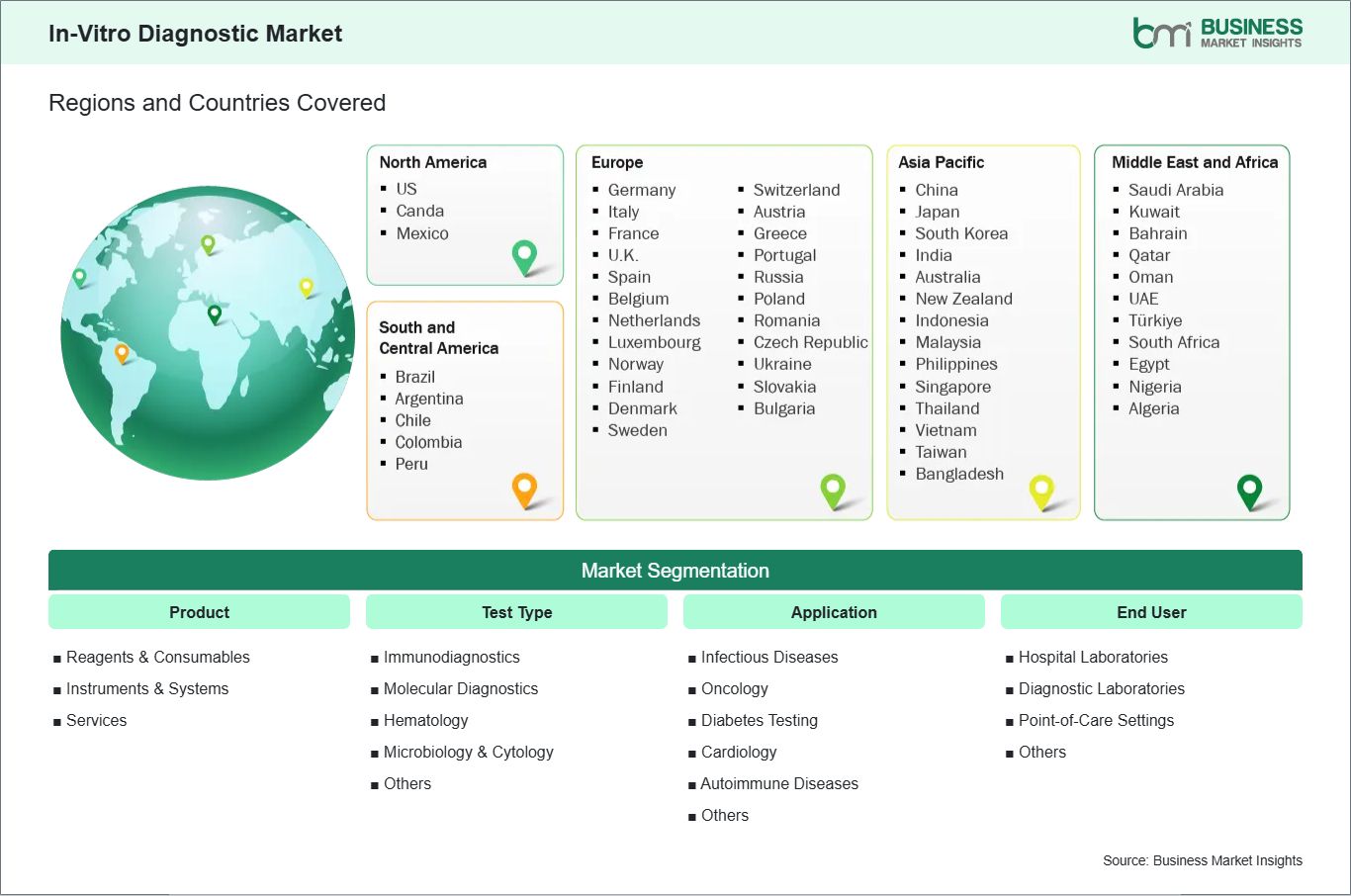
Key segments that contributed to the derivation of the In-Vitro Diagnostic market analysis are product, test type, application, and end user.
The substantial increase in lifestyle diseases such as diabetes, cancer, cardiovascular disorders, and infectious diseases is the leading factor driving the global in, vitro diagnostics market growth. These diseases have a massive impact on the health of people worldwide, and diabetes affects more than 500 million adults. The number of patients is expected to increase with aging populations, obesity, urbanization, and lifestyle changes. Therefore, the demand for the monitoring and early detection of such diseases has also grown significantly. These diseases require frequent and regular testing of glycemic control, tumor markers, cardiac biomarkers, and pathogen identification, which are the techniques used in IVD that are now the most preferred in the prevention of complications, treatment guidance, and outcome improvement.
Moreover, the problem of infectious diseases, which includes the return of pandemics and antimicrobial resistance, is a cause of the increased demand for rapid immunoassays, molecular diagnostics, and POC tests. The aging population in the developed regions is causing an increase in the number of patients with chronic diseases, whereas the emerging economies are suffering from the double burden of infectious and non, communicable diseases. Healthcare guidelines issued by organizations such as WHO and IDF, among others, strongly recommend early screening and personalized monitoring, which in turn leads to increased usage of reagents and kits.
Technological integrations, such as multiplex panels detecting several pathogens at the same time, are improving the efficiency of these processes in high, burden settings. Testing which is supported by reimbursement in many countries, is kept at a good level due to the awareness campaigns that attract people to preventive diagnostics. Major market players such as Roche, Abbott, and Siemens Healthineers are coming up with new ideas to satisfy this request of the market with their high, sensitivity assays.
The IVD market is a transformational opportunity for the IVD market due to advancements in point, of, care (POC) testing and molecular diagnostics. decentralized, rapid, and precise testing beyond conventional labs is possible with the help of these technologies. POC instruments provide results within a few minutes in a home, clinic, or remote location. They are capable of meeting the demands of timely interventions in chronic management, infectious outbreaks, and emergency care, thus lessening the healthcare load and making access better in the areas that are not well served.
The molecular technologies such as next, generation sequencing (NGS), PCR, and CRISPR, based assays that are used in oncology, genetic disorders, and pathogen detection, respectively, have the highest sensitivity possible. They also enable precision medicine and companion diagnostics for targeted therapies. Besides this, AI integration is helping in enhancing data analysis, error reduction, and predictive insights. At the same time, being connected via smartphones and cloud platforms is making telemedicine and real, time monitoring possible.
This opportunity aligns with post-pandemic shifts toward home-based and near-patient testing, rising demand for personalized treatments, and government investments in healthcare infrastructure, particularly in emerging markets such as Asia-Pacific and Africa. Portable, user-friendly multiplex tests expand applications in infectious diseases and oncology, the fastest-growing segments. Companies such as Abbott, bioMérieux, and Thermo Fisher are capitalizing through launches of innovative platforms, partnerships, and acquisitions. Regulatory support for OTC and digital diagnostics accelerates adoption.

By product, the in-vitro diagnostic market is segmented into reagents & consumables, instruments & systems, services. The reagents & consumables segment dominated the market in 2025. The high volume of routine testing for chronic and infectious diseases, which require frequent replenishment; affordability as compared to instrument, heavy laboratories; the technological advancements allowing multiplex and high, sensitivity assays; and the growth of point, of, care and home testing, which, for the most part, are consumables, based decentralized diagnostics.
By test type, the market is segmented into immunodiagnostics, molecular diagnostics, hematology, microbiology & cytology, and others. The immunodiagnostics segment held the largest share of the market in 2025. Its dominance is attributed to the versatility, short turnaround time, and low cost, of the immunoassays aimed at the detection of antigens, antibodies, and biomarkers. ELISA, chemiluminescence, and lateral flow assays are some of the technologies that facilitate high, throughput screening.
By application, the market is segmented into infectious diseases, oncology, diabetes testing, cardiology, autoimmune diseases, and others. The infectious diseases segment held the largest share of the market in 2025. The growth is strongly influenced by continuous worldwide outbreaks, antimicrobial resistance, and the demand for quick identification of pathogens. The scope of this is the testing of viral, bacterial, fungal, and parasitic infections by means of immunoassays, molecular methods, and microbiology.
By end user, the market is segmented into hospital laboratories, diagnostic laboratories, point-of-care settings, others. The hospital laboratories segment held the largest share of the market in 2025. They are responsible for diverse IVD needs from the emergency department to inpatient monitoring. The leading factors are the rise in hospital admissions due to chronic and critical conditions, implementation of advanced automated systems for efficiency, availability of skilled pathologists, strict regulatory compliance, and the healthcare professionals move towards consolidated testing for cost control and faster turnaround in multidisciplinary healthcare environments.
| Report Attribute | Details |
|---|---|
| Market size in 2025 | US$ 82.55 Billion |
| Market Size by 2033 | US$ 123.52 Billion |
| Global CAGR (2026 - 2033) | 5.17% |
| Historical Data | 2022 - 2024 |
| Forecast period | 2026-2033 |
| Segments Covered | By Product
|
| Regions and Countries Covered | North America
|
| Market leaders and key company profiles |
|
The In-Vitro Diagnostic Market Size and Forecast (2025-2033) report provides a detailed analysis of the market covering below areas:
The geographical scope of the In-Vitro Diagnostic market report is divided into five regions: North America, Asia Pacific, Europe, Middle East & Africa, and South & Central America. The In-Vitro Diagnostic market in Asia Pacific is expected to grow significantly during the forecast period.
The Asia-Pacific In-Vitro Diagnostic market is segmented into China, Japan, South Korea, India, Australia, New Zealand, Indonesia, Malaysia, the Philippines, Singapore, Thailand, Vietnam, Taiwan, Bangladesh, and the Rest of Asia. The Asia, Pacific is the major contributor to the rapid growth of in-vitro diagnostics (IVD) market. The growth is primarily due to the increasing incidence of chronic diseases such as diabetes, cancer, and cardiovascular diseases and the infectious disease burdens being kept up with, e.g., tuberculosis, hepatitis, and respiratory infections. Countries such as China, India, and Japan are the main drivers of this growth. China and India are witnessing large numbers of diabetes and cancer cases due to rapid urbanization and lifestyle changes, while Japan's state, of, the art healthcare system and aging population are contributing to the increase in demand for precision and molecular testing.
The increasing elderly population in the region, therefore, contributes to the need for continuous monitoring, early diagnosis, and personalized medicine, which are further advertised by increasing health awareness, preventive screening programs, and post, pandemic rapid diagnostics promotion. The transition to point, of, care (POC) and decentralized testing is very popular and will probably continue to grow due to innovations in immunoassays, molecular diagnostics (including NGS and PCR), AI, integrated platforms, and smartphone, compatible devices that facilitate access to the remote and less privileged areas. As a result of government funding for healthcare infrastructure, expanding health insurance coverage, and public health programs in emerging economies, the use of reagents, kits, and automated systems is becoming more widespread. Large companies such as Roche Diagnostics, Abbott, Siemens Healthineers, Sysmex, as well as local innovators, are committing resources towards cooperations, localized production, and digital solutions in order to tackle issues such as price sensitivity and regulatory diversity. There are also many possibilities in the field of companion diagnostics, testing at home, as well as the application of oncology/infectious diseases, thus making Asia, Pacific a vibrant center for innovative, fair IVD progress.

The In-Vitro Diagnostic market is evaluated by gathering qualitative and quantitative data post primary and secondary research, which includes important corporate publications, association data, and databases. A few of the key developments in the in-vitro diagnostic market are:
The In-Vitro Diagnostic Market is valued at US$ 82.55 Billion in 2025, it is projected to reach US$ 123.52 Billion by 2033.
As per our report In-Vitro Diagnostic Market, the market size is valued at US$ 82.55 Billion in 2025, projecting it to reach US$ 123.52 Billion by 2033. This translates to a CAGR of approximately 5.17% during the forecast period.
The In-Vitro Diagnostic Market report typically cover these key segments-
The historic period, base year, and forecast period can vary slightly depending on the specific market research report. However, for the In-Vitro Diagnostic Market report:
The In-Vitro Diagnostic Market is populated by several key players, each contributing to its growth and innovation. Some of the major players include:
The In-Vitro Diagnostic Market report is valuable for diverse stakeholders, including:
Essentially, anyone involved in or considering involvement in the In-Vitro Diagnostic Market value chain can benefit from the information contained in a comprehensive market report.
Please tell us your area of interest
(Market Segments/ Regions and Countries/ Companies)