
Generative AI for Clinical Documentation Market Outlook: Size, Share, Trends, Growth Analysis, Competitive Landscape & Forecast, 2026-2033

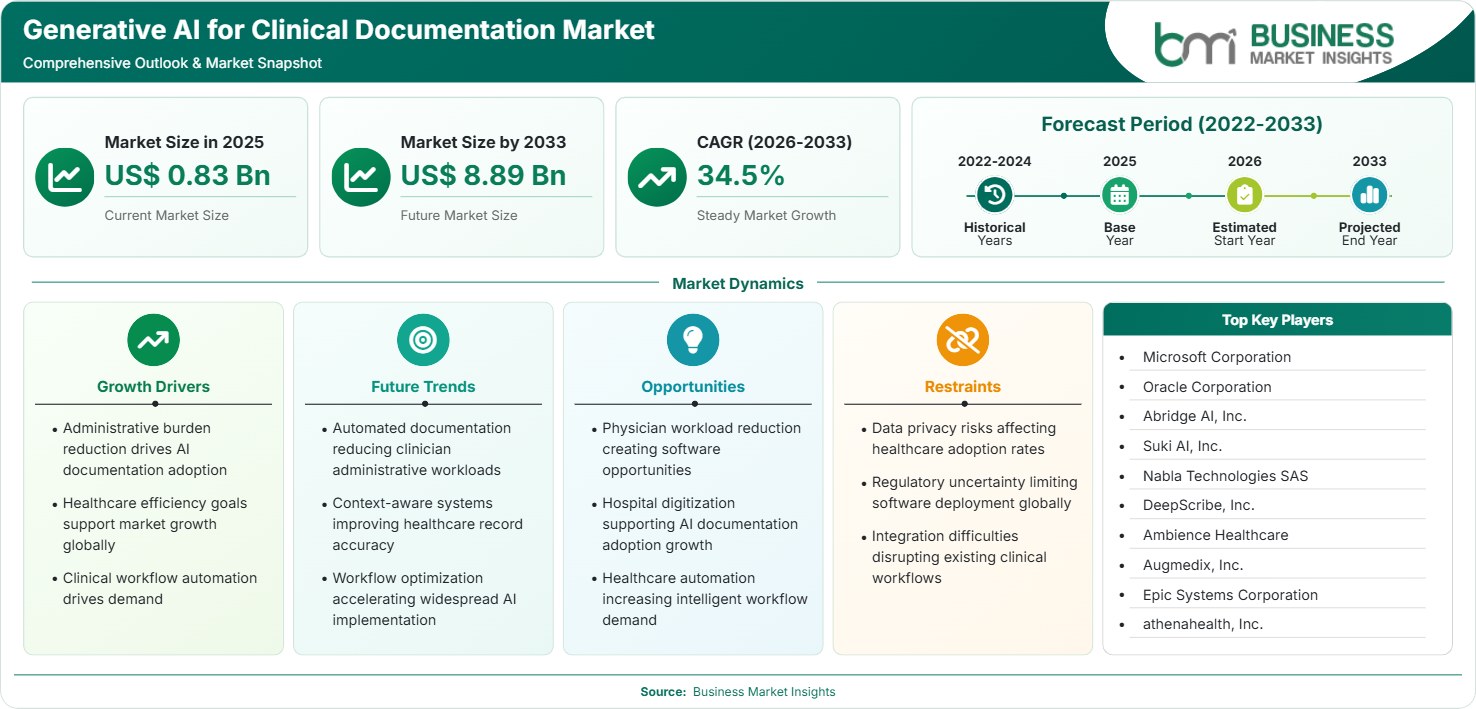
The Generative AI for Clinical Documentation Market size was valued at US$ 0.83 Billion in 2025 and is projected to reach US$ 8.89 Billion by 2033, growing at a CAGR of 34.5% during 2026–2033. Key drivers include clinician burnout reduction, EHR integration, ambient documentation adoption, reimbursement optimization, and healthcare AI investments. Opportunities arise from specialty-specific copilots, multilingual documentation, and enterprise-wide deployments.

Report Coverage
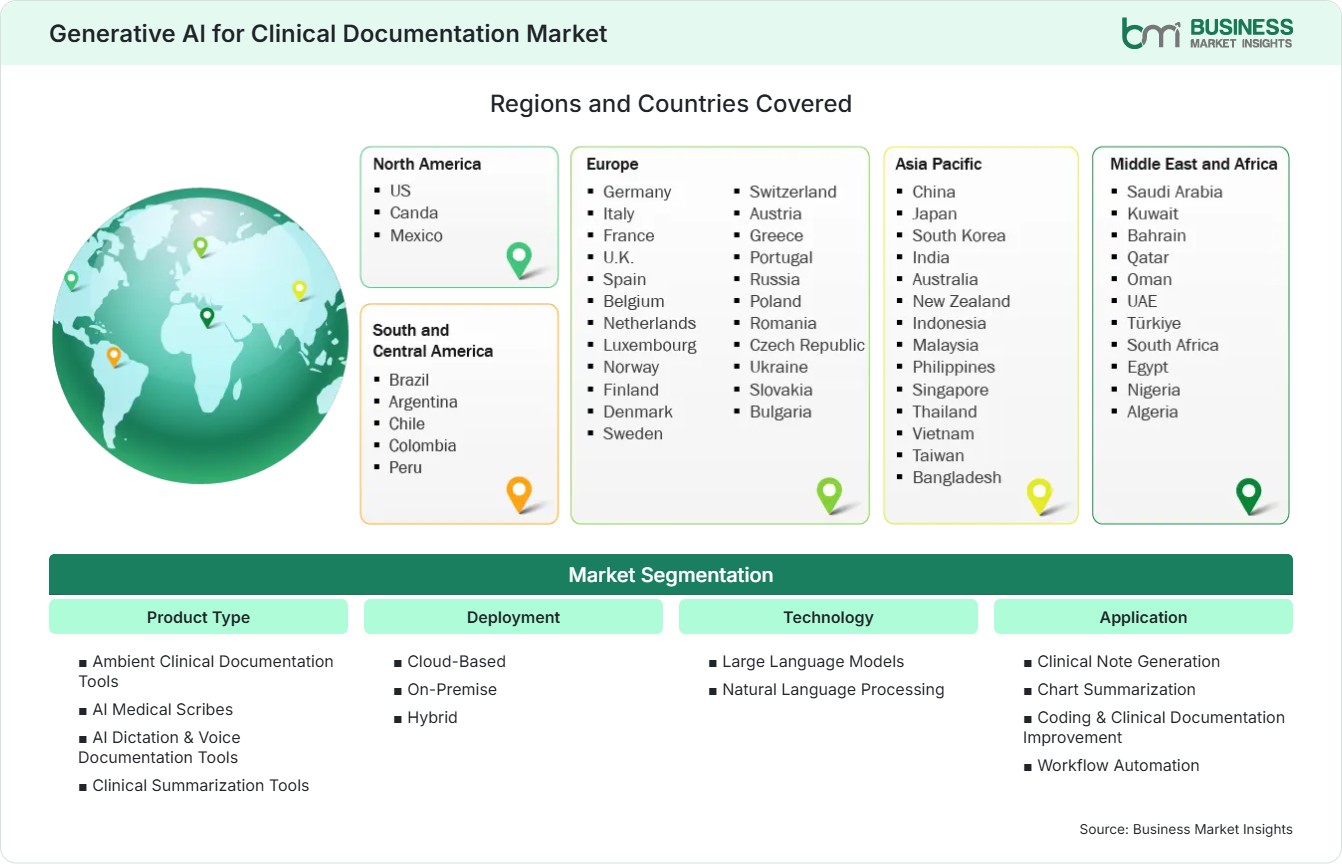
  • Product Type: Ambient Clinical Documentation Tools, AI Medical Scribes, AI Dictation & Voice Documentation Tools, Clinical Summarization Tools
  • Deployment: Cloud-Based, On-Premise, Hybrid
  • Technology: Large Language Models, Natural Language Processing
  • Application: Clinical Note Generation, Chart Summarization, Coding & Clinical Documentation Improvement, Workflow Automation
  • End User: Hospitals & ASCs, Specialty Clinics, Others
US$ 0.83 Bn Market size in 2025
US$ 8.89 Bn Market Size by 2033
34.5% CAGR, 2026 - 2033
2026-2033 Forecast Period

AI Overview

Generative AI for Clinical Documentation Market Summary

  • North America Region: Holds a market share of 45%–49% in 2025 and is projected to grow at a CAGR of 32%–35% during 2026–2033. Growth is supported by EHR digitization, clinician productivity initiatives, ambient AI deployment, enterprise healthcare spending, reimbursement optimization, workflow automation, physician burnout reduction, and clinical data interoperability advancements. The U.S. market benefits from large health-system AI adoption and is expected to expand at a CAGR of 33%–36%.
  • Fastest Growing Region: Asia Pacific accounts for 20%–24% share in 2025 and is forecast to grow at 37%–41% CAGR during 2026–2033. Key drivers include hospital digital transformation, expanding telehealth networks, government-backed AI initiatives, growing healthcare infrastructure, rising physician shortages, cloud adoption, and multilingual documentation requirements.
  • Leading Segment: Cloud-Based deployment holds 58%–62% of the Generative AI for Clinical Documentation Market share in 2025 and is expected to expand at a 35%–38% CAGR. Growth is driven by scalability, lower implementation costs, rapid software updates, interoperability capabilities, improved accessibility, enterprise AI strategies, and healthcare workforce efficiency goals.
  • High Growth Segment: Ambient Clinical Documentation Tools represent a 28%–32% share in 2025 and are projected to grow at 38%–42% CAGR. Demand is fueled by clinician burnout concerns, real-time note automation, conversational AI improvements, workflow enhancement initiatives, and increasing health-system investments.
  • Key Market Opportunity: Large-scale deployment of AI copilots across hospital systems can reduce documentation workloads, improve coding accuracy, support reimbursement optimization, enhance patient engagement, and create scalable productivity gains across clinical workflows.
  • Major Market Players: Microsoft Corporation, Oracle Corporation, Abridge AI, Inc., Suki AI, Inc., Nabla Technologies SAS, DeepScribe, Inc., Ambiance Healthcare, Augmedix, Inc., Epic Systems Corporation, athenahealth, Inc.
Strategic Insights

Generative AI for Clinical Documentation Market: Strategic Insights

Generative AI for Clinical Documentation Market Strategic Framework
FREE PDF
Request your free sample
Request free sample
Stakeholder View

Key Takeaways

  • The ecosystem is now increasingly tying together EHR vendors, cloud infrastructure providers, healthcare AI developers, and provider organizations into a highly integrated clinical workflow value chain.
  • Applications for ambient documentation and workflow automation provide the greatest commercial benefit since the companies want to achieve measurable increases in productivity and reduce their administrative workloads.
  • Innovation is now moving in the direction of multimodal AI, language models that are specially trained, clinical reasoning that takes into account context, and real-time documentation assistants that are incorporated directly into the way physicians work.
  • Asia Pacific is a highly attractive place in which to make an investment because of its healthcare digitization programs, the growing demand for clinical capacity, and its supportive policies towards AI innovation.
  • Venture financing, strategic partnerships, and acquisitions in healthcare AI are still influencing companies' competitive positions and speeding up their ability to deploy on an enterprise scale.
  • Documentation automation is nowadays being assessed not just in terms of the efficiency gains it provides but also with regard to coding accuracy, revenue-cycle optimization, and clinical quality outcomes.
Geographic Outlook

Generative AI for Clinical Documentation Market Regional Highlights

North America Generative AI for Clinical Documentation Market

North America accounts for approximately 45%–49% of market revenue in 2025 and is expected to expand at 32%–35% CAGR. Strong EHR penetration, advanced digital infrastructure, and substantial healthcare IT spending support leadership. The Generative AI for Clinical Documentation Market share remains concentrated among major health systems deploying enterprise-wide AI solutions. Strong vendor partnerships and clinician productivity initiatives continue driving adoption.

  • Healthcare systems are now using ambient AI documentation systems to lessen the administrative workload on physicians and boost their productivity.
  • The integration with the main EHR platforms speeds up adoption within large provider networks.
  • Frameworks for clinical governance and for complying with privacy requirements aid companies when making purchasing decisions.
  • Getting reimbursement and improving coding are still the main priorities for implementation.

US Generative AI for Clinical Documentation Market

The United States represents 78%–82% of North American Generative AI for Clinical Documentation Market revenue and is projected to grow at 33%–36% CAGR. Large integrated delivery networks are implementing AI-powered documentation assistants across diverse specialties. Healthcare organizations increasingly focus on reducing clinician burnout while improving coding accuracy and patient engagement through automation-enabled workflows.

  • Academic medical centers are at the forefront of the adoption of advanced ambient documentation technologies.
  • Increasingly, enterprise deployments involve thousands of clinicians who are part of a single health system.
  • The ability of AI to provide coding support improves performance in the revenue cycle and increases the completeness of documentation.
  • The competition among vendors leads to constant innovation and results in product differentiation.

Europe Generative AI for Clinical Documentation Market

Europe captures 24%–28% Generative AI for Clinical Documentation Market share in 2025 and is expected to achieve 31%–34% CAGR. Regulatory focus on trustworthy AI and digital health transformation supports adoption. Germany leads regional revenues while the United Kingdom demonstrates strong growth potential. Public-sector digitization initiatives and workforce efficiency objectives remain major adoption drivers.

  • Germany is at the forefront of enterprise deployments that are supported by investments in healthcare digitalization.
  • The United Kingdom is one of the fastest-growing national markets, with a compound annual growth rate exceeding 33%.
  • The need to protect data has led to the creation of governance practices that are specific to the healthcare sector.
  • Provider organizations are now evaluating AI to optimize their workforce and improve the quality of their documentation.

Asia Pacific Generative AI for Clinical Documentation Market

Asia Pacific holds 20%–24% Generative AI for Clinical Documentation Market share and records the fastest growth at 37%–41% CAGR. Expanding healthcare infrastructure, physician shortages, and digital transformation efforts support adoption. China and Japan represent major revenue contributors, while India emerges as a high-growth investment market. The region benefits from growing cloud deployment acceptance.

  • Strategies for AI that are supported by the government increase investment in healthcare technology.
  • The need for documentation in more than one language offers scope for specialized solutions.
  • Healthcare architectures that are cloud-based allow for scalable deployments throughout provider networks.
  • India is showing quick adoption as a result of its digital health expansion initiatives.
  • The shortage of clinical staff is leading to greater interest in automation technologies.

Rest of World Generative AI for Clinical Documentation Market

Rest of World accounts for 8%–11% of the Generative AI for Clinical Documentation Market share and is projected to grow at 30%–34% CAGR. South America benefits from healthcare modernization programs, while Middle East healthcare providers actively invest in AI-enabled clinical infrastructure. Brazil leads regional revenues, whereas UAE and Saudi Arabia display notable growth momentum.

  • Brazil is still the greatest potential in South and Central America.
  • The GCC countries are still investing in projects aimed at transforming their healthcare systems through the use of AI.
  • The adoption of private hospitals is taking place in the developing markets.
  • Cloud deployment models make it easier for new users to carry out implementation.
Global Market Geography
FREE PDF
Request your free sample
Request free sample
Segment Analysis

Generative AI for Clinical Documentation Market Segmentation

Product Type

Product Type represents a highly dynamic category, with Ambient Clinical Documentation Tools holding the largest share at 28%–32% and expanding at 38%–42% CAGR. The Generative AI for Clinical Documentation Market scope continues to expand as providers seek automation solutions capable of reducing manual note creation while improving efficiency and documentation quality.

  • Ambient Clinical Documentation Tools: Enable passive capture of patient-provider interactions and automated generation of structured clinical notes with minimal workflow disruption.
  • AI Medical Scribes: Support real-time documentation assistance through conversational AI, enabling providers to focus more on patient interactions.
  • AI Dictation & Voice Documentation Tools: Improve speech-to-text accuracy and streamline documentation processes through healthcare-specific language recognition.
  • Clinical Summarization Tools: Convert lengthy clinical records into concise, actionable summaries supporting decision-making and continuity of care.

Deployment

Deployment models continue evolving, with Cloud-Based solutions accounting for 58%–62% of the Generative AI for Clinical Documentation Market share and recording a 35%–38% CAGR. Healthcare organizations prioritize scalable, interoperable, and cost-efficient deployment frameworks that support rapid implementation and continuous AI model improvements.

  • Cloud-Based: Provides scalability, centralized updates, lower upfront costs, and improved interoperability across healthcare systems.
  • On-Premise: Preferred by organizations requiring greater control over sensitive clinical data and infrastructure.
  • Hybrid: Balances security requirements with scalability benefits through flexible deployment architectures.

Technology

Large Language Models dominate investment activity, supported by advances in contextual reasoning and healthcare-specific language generation. Adoption continues to expand as providers seek higher-quality documentation outputs and enhanced workflow intelligence.

  • Large Language Models: Deliver advanced contextual understanding, structured note generation, and conversational workflow capabilities.
  • Natural Language Processing: Enables transcription, entity extraction, coding support, and healthcare documentation standardization.

Application

Clinical documentation use cases continue expanding throughout provider organizations. Demand is increasingly linked to workflow automation, reimbursement optimization, and care coordination requirements.

  • Clinical Note Generation: Automates creation of structured provider notes from patient encounters.
  • Chart Summarization: Condenses longitudinal patient histories into clinically relevant insights.
  • Coding & Clinical Documentation Improvement: Enhances documentation completeness and coding accuracy for reimbursement functions.
  • Workflow Automation: Reduces administrative workloads across clinical operations and documentation processes.

End User

Hospitals and ASCs remain the largest end-user segment, supported by enterprise-scale implementation capabilities and stronger technology budgets.

  • Hospitals & ASCs: Lead adoption due to large clinician workforces, high documentation volumes, and digital transformation initiatives.
  • Specialty Clinics: Increasingly implement AI tools tailored to specialty-specific workflows and documentation requirements.
Market Forces

Generative AI for Clinical Documentation Market Dynamics

Key Market Drivers

Increasing Documentation Burden and Clinician Workload

Documentation takes time away from the clinician’s interactions with the patient, coordinating patient care, and reviewing patients’ medical histories. The ambient tool helps to alleviate the pressure involved in documentation by creating an editable draft based on conversations that occur during the consultation process. According to the World Health Organization, documentation and summarization in electronic health records can be among the applications of generative AI technology. Generative AI for Clinical Documentation Market growth is supported by demand for more efficient workflows, particularly in high-volume outpatient settings. However, realized benefits depend on note accuracy, editing requirements, and whether saved time translates into improved operational capacity.

Advances in Contextual Language Models

Larger language models can understand the context of conversations and structure information in a clinical narrative format, thereby surpassing traditional dictation. Terminology recognition and text normalization are facilitated by natural language processing, whereas specialty templates facilitate documentation standards through their assistance in aligning the results with clinical documentation practices. This creates an opportunity for creating notes and record summaries. The relevant Generative AI for Clinical Documentation Market trends include greater customization, multilingual support, and tighter integration with electronic health records. Product quality still depends on source information and validation, because fluent wording does not guarantee factual correctness. Clinical oversight is therefore a core operating requirement, not an optional feature.

Expansion of Digital Health Infrastructure

The operational basis for incorporating generative documentation into standard medical care is provided by electronic health records and cloud infrastructure. Hospitals that already have digital systems can link draft generation to their current patient records, authentication procedures, and the existing note approval processes. Moreover, cloud-based services enable centralized updates and deployment across multiple sites, whereas hybrid models cater to organizations with more stringent infrastructure policies. These factors mean that the potential customer group now goes well beyond the initial adopters. Yet in order to ensure a sustainable implementation, data governance, staff training, and continuous technical support are all necessary. Providers also need to set up clear protocols for reviewing, correcting, and approving the generated documentation before it is included in the official clinical record.

Key Market Opportunities

Specialty-Specific and Multilingual Documentation

Specialization-oriented designs present an opportunity for distinguishing documentation applications from standard transcription software. Emergency units, primary-care physicians, surgeons, and specialists each utilize distinct terminologies and workflow protocols. Software developers can promote adoption through the design of configurable templates that are tested on relevant clinical scenarios. Multilingual functionality could broaden the application of such tools to locales where English-based solutions are inappropriate. Generative AI for Clinical Documentation Market Forecasts are particularly relevant to suppliers that can demonstrate consistent performance across languages and specialties. Commercial success will depend on validation, localization, and integration rather than simply increasing the number of supported languages.

Integration With Coding and Revenue-Cycle Workflows

Documentation platforms have the potential to go beyond note generation and provide coding assistance, identify incomplete records, and prepare the information for administrative review. Such features could help providers deal with the fragmented workflows that exist between clinical teams and revenue-cycle staff. Opportunities for investment lie in systems that associate the generated text with the original information, flag possible omissions, and keep audit trails for later examination. Vendors should make it clear that their documentation support is different from fully autonomous coding or decisions regarding reimbursement, which necessitate the use of applicable standards and oversight. A product that aligns with existing workflows can offer greater value than a standalone scribe, but it is essential that the implementation keeps the clinician in control of the medical content and maintains the organization's responsibility for billing compliance.

Emerging Markets and Enterprise Partnerships

Alliances with vendors of electronic health records, cloud service providers, groups of hospitals, and regional health technology companies can help speed up access to the market. As digital infrastructure develops, new healthcare networks could present growth opportunities, particularly in cases where administrative workloads increase more rapidly than staffing levels. The most compelling investment cases are those that include local language support, can be deployed on a large scale, ensure secure handling of data, and provide implementation services. Furthermore, vendors might carry out phased rollouts, starting with certain departments before extending the system across the entire health system. This method enables buyers to evaluate the clinical quality and operational effects before agreeing to full-scale contracts. The long-term returns will be determined by renewal rates, the extent of workflow integration, and tangible value rather than simply by participation in pilot programs.

Market Restraints and Challenges

Patient Privacy and Regulatory Compliance

The clinical documentation systems handle sensitive information such as patients' medical histories, symptoms, diagnoses, and consultation recordings. Companies need to evaluate the legality of how data is managed, the access controls in place, their policies on data retention, the terms of their agreements with vendors, and the security of the information transferred between different systems. The World Health Organization's recommendations concerning large multimodal models stress the importance of governance, accountability, and measures to prevent possible harms caused by AI in healthcare. The impact is that privacy reviews and compliance with regulatory requirements can lead to longer procurement cycles, higher implementation costs, and a restriction on the use of external cloud services. Vendors have to show that their data practices are transparent and provide support for the necessary organizational controls. If trust is not established, adoption can be delayed even if the underlying technology functions well.

Clinical Accuracy and Workflow Integration Risks

Factor: Generative systems are capable of omitting details, misinterpreting negations, confusing the speakers, or generating statements that are not based on the actual interaction. Integration issues may also result in duplicate entries, inconsistent templates, and extra work for clinicians. Impact: Too much editing can undo the productivity benefits, while inaccurate notes can damage the quality of the records and give rise to patient safety issues. Healthcare providers require structured validation, clinician approval, auditability, and the ability to report incidents. Vendors have to assess system performance across different specialties, accents, noisy environments, and complex consultations. Adoption will be limited in situations where institutions are unable to set up reliable oversight or show that the quality of documentation stays acceptable following deployment.

Company Analysis

Competitive Landscape

The Generative AI for Clinical Documentation Market analysis shows competition centered on ambient AI, enterprise healthcare integrations, clinical quality improvement, and workflow automation.

Company Name

Overview

Products and Services relevant to this market

Microsoft Corporation

Major healthcare AI provider leveraging Nuance assets and enterprise cloud capabilities.

Dragon Copilot, Dragon Medical, ambient documentation, clinical workflow automation.

Oracle Corporation

Expanding healthcare AI capabilities through healthcare software portfolio.

Clinical documentation, health data management, AI-enabled workflow solutions.

Abridge AI, Inc.

Specialized ambient AI documentation company focused on health systems.

Ambient listening, note generation, clinical documentation automation.

Suki AI, Inc.

AI assistant provider targeting physician productivity enhancement.

AI medical scribe, voice commands, documentation automation.

Nabla Technologies SAS

Developer of clinician-focused AI copilot solutions.

Ambient documentation, clinical note generation, workflow support.

DeepScribe, Inc.

AI documentation specialist serving healthcare providers.

AI scribe platform, specialty documentation workflows.

Ambience Healthcare

Healthcare AI company focused on clinical operations optimization.

Documentation automation, coding support, clinical intelligence.

Augmedix, Inc.

Provider of medical documentation and ambient AI technologies.

Ambient documentation, medical scribing, workflow automation.

Epic Systems Corporation

Leading EHR vendor integrating AI documentation capabilities.

EHR-integrated AI charting and documentation tools.

athenahealth, Inc.

Healthcare technology company focused on cloud-based solutions.

Clinical documentation workflows and AI-enabled provider tools.

Trust & Transparency

Research Methodology

The market analysis combines proprietary research with secondary data from government agencies, company disclosures, regulatory filings, industry databases and expert interviews. Market estimates are validated through data triangulation, cross-market benchmarking and analyst review.

View Full Research Methodology

Questions Answered

Frequently Asked Questions

What is the biggest long-term opportunity in this industry?

Enterprise-wide implementation across large health systems presents the greatest opportunity because scalability, workflow optimization, coding improvements, and clinician efficiency gains can generate substantial returns.

Why are ambient documentation platforms gaining popularity?

Ambient platforms operate passively during patient encounters, reducing manual note-taking requirements and allowing clinicians to devote more attention to patient engagement and care delivery.

How does a Generative AI for Clinical Documentation Market Report help investors?

It provides visibility into adoption patterns, competitive positioning, technology evolution, growth opportunities, deployment trends, and regional demand dynamics that influence strategic investment decisions.

What technology foundation supports clinical documentation automation?

Large Language Models and Natural Language Processing technologies analyze conversations, generate structured notes, summarize charts, and support clinical documentation workflows while maintaining healthcare-specific context.

Which healthcare organizations are the primary users of these solutions?

Hospitals, integrated delivery networks, ambulatory surgery centers, and specialty clinics represent the largest adopters because documentation volumes are high and clinician productivity improvements generate measurable operational value.

Access the Full Generative AI for Clinical Documentation Market Report

Get segment-level forecasts, regional estimates, competitive benchmarking, company profiles and downloadable Excel datasets.

Access the full Generative AI for Clinical Documentation Market Report
350 pages PDF & Excel | 2026-11-03
Similar Research

Related Market Reports