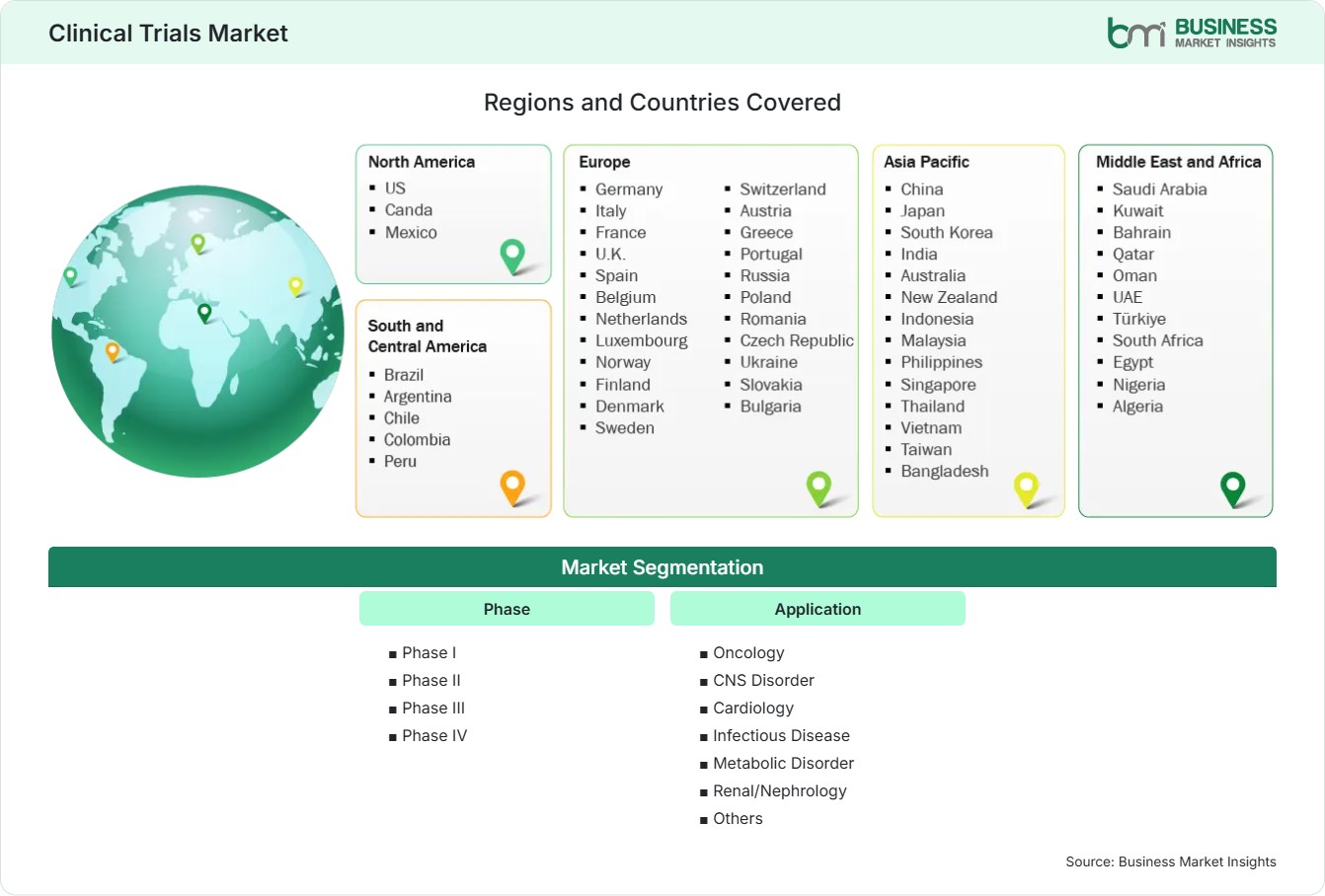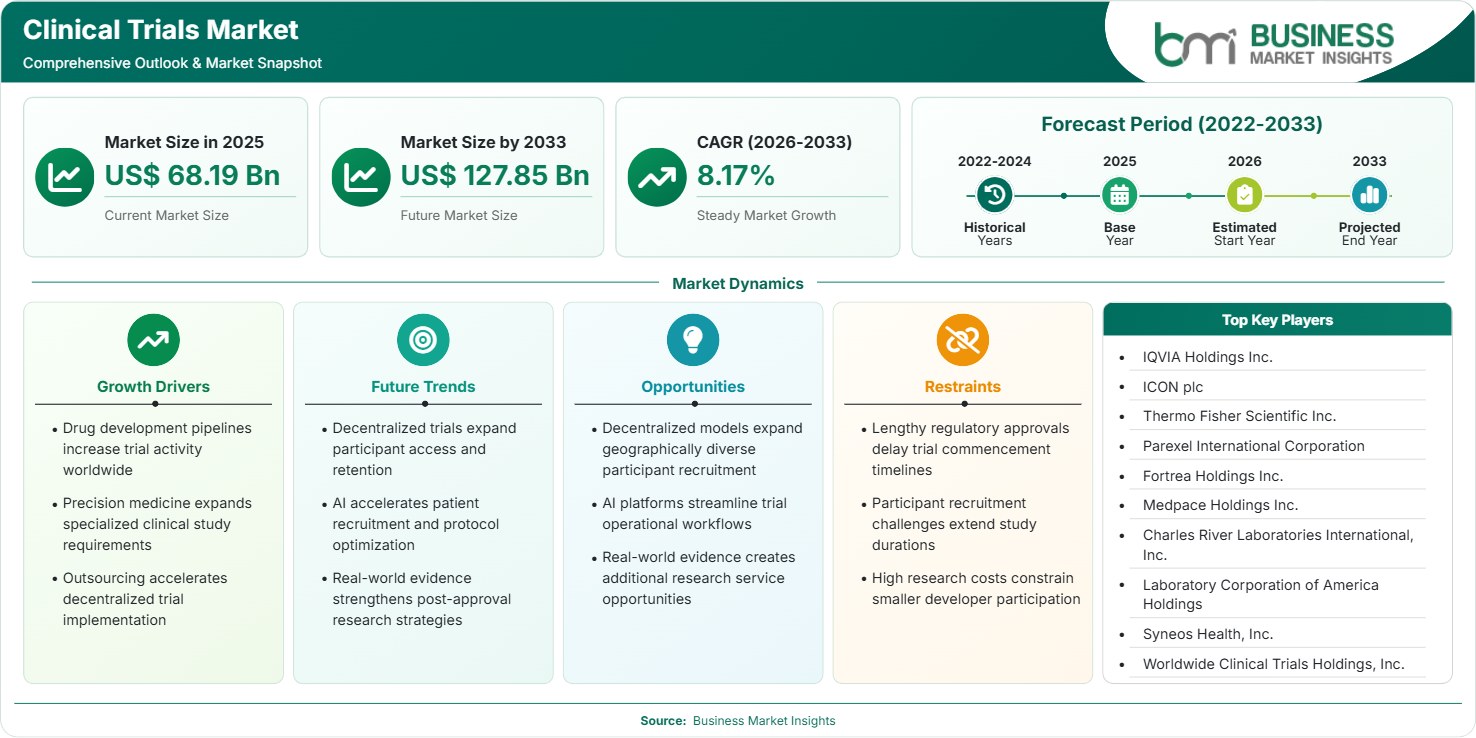
Clinical Trials Market Regional Highlights
North America Clinical Trials Market
North America held a market share of 49%-52% in 2025 and is projected to grow at a 7.0%-7.3% CAGR through 2033. North America is blessed with well-developed biopharmaceutical pipelines, highly evolved CROs, academic research hubs, clinical research facilities, and a high rate of technology adoption. The US Clinical Trials Market is the most prominent, while Canada and Mexico contribute through targeted research, patient sourcing, and cost-effective approaches. Demand in the region is driven by the regulatory framework governing decentralized components and the need for representative trial participants.
- Mature CRO ecosystems support large multinational studies, while specialized providers increasingly differentiate through therapeutic expertise, patient access, technology platforms, and operational efficiency.
- Biotechnology companies are expanding outsourcing relationships to manage development complexity without building equivalent internal infrastructure, supporting demand for integrated clinical development services.
- Oncology remains a major activity center, with precision medicine, biomarker testing, immunotherapy, and rare cancer programs generating complex recruitment and data-management requirements.
- Decentralized elements are becoming increasingly practical as telehealth, home visits, remote data capture, and connected devices become embedded within conventional trial designs.
- North American sponsors increasingly prioritize speed, data quality, patient diversity, and protocol feasibility when selecting clinical research partners.
US Clinical Trials Market
The US accounted for around 78%-82% of North America's market revenue in 2025 and is forecast to grow at a CAGR of 7.1%-7.5% from 2026 - 2033. The dominance of the USA is attributed to numerous sponsors, investigators, research hospitals, and regulatory influence.
- The US benefits from strong early-stage biotechnology activity, creating recurring demand for Phase I services, protocol development, patient screening, and specialized clinical pharmacology.
- Regulatory requirements increasingly emphasize representative enrollment, encouraging sponsors to broaden recruitment strategies across demographic and geographic populations.
- Digital clinical research adoption is expanding through remote visits, electronic outcomes, wearable technologies, and centralized monitoring models.
- Large oncology pipelines support high-value late-stage programs requiring biomarker testing, imaging, safety monitoring, and sophisticated statistical capabilities.
Europe Clinical Trials Market
Europe is expected to account for 22%-25% of market share in 2025 and is projected to grow at a CAGR of 7.8%-8.2% between 2023 and 2033 in the Clinical Trials Market. Germany has been the largest national market in Europe, driven by research infrastructure, whereas the UK is a favorable destination for growth due to its life sciences competencies. Other major countries such as France, Italy, Spain, Scandinavia, and Central Europe also contribute to the clinical trial investigator base and patient pool. The region benefits from regulatory harmonization, increased R&D investment, the adoption of personalized medicine, and the adoption of decentralized trials.
- Germany maintains a strong position because of established university hospitals, specialist investigators, pharmaceutical research capabilities, and sophisticated clinical research organizations.
- The UK provides an attractive development environment through its research institutions, specialized trial networks, and strong concentration of biotechnology and pharmaceutical companies.
- European sponsors increasingly integrate digital biomarkers, remote monitoring, artificial intelligence, and patient engagement tools into study execution.
- Cross-border studies remain strategically important, although sponsors increasingly evaluate single-country designs where recruitment speed and operational simplicity provide advantages.
- Regulatory modernization and personalized medicine programs continue creating opportunities for technology-enabled research and specialized CRO services.
Asia Pacific Clinical Trials Market
The Asia Pacific had around 19%–22% share of the Clinical Trials Market in 2025, and the region will grow at an 8.5%–8.9% CAGR, becoming the fastest-growing region for clinical trials. China is dominating the regional market, whereas Australia represents the high-growth market. Countries such as India, Japan, South Korea, and Southeast Asia are developing their research capabilities by building investigator networks and investing in biotechnology and infrastructure.
- China provides substantial patient access and expanding clinical infrastructure, although sponsors increasingly evaluate regulatory alignment and multinational evidence requirements when designing programs.
- India offers cost-efficient research capabilities, a large treatment population, growing CRO capacity, and expanding biotechnology activity across multiple therapeutic areas.
- Japan contributes advanced medical infrastructure and sophisticated investigators, particularly in oncology, CNS disorders, regenerative medicine, and specialized pharmaceutical research.
- Australia offers strong early-phase capabilities, established regulatory processes, and favorable conditions for rapid recruitment, making it one of the region's high-growth markets.
- Southeast Asian countries are gaining attention for patient diversity and developing clinical research ecosystems, particularly for multinational studies requiring broader regional representation.
Rest of World Clinical Trials Market
Rest of World represented approximately 5%–8% share in 2025 and is projected to advance at an 8.0%–8.6% CAGR in the Clinical Trials Market through 2033. South and Central America benefit from improving research networks and expanding pharmaceutical participation, with Brazil and Mexico providing important investigator and patient pools. Middle Eastern markets are strengthening specialist healthcare infrastructure and research capacity, particularly in oncology and rare disease programs.
Gulf countries have been creating an environment that enables them to develop extremely advanced health care systems and biomedical research through infrastructure development. The Republic of South Africa remains a very important region for conducting clinical research, as it can recruit patients from diverse demographics. Sponsors increasingly assess these markets as complementary recruitment locations rather than standalone development hubs.
- Brazil benefits from its large population, established research centers, and increasing participation in multinational therapeutic programs across oncology and infectious diseases.
- Mexico offers geographic proximity to US sponsors, expanding clinical research infrastructure, and opportunities to improve recruitment efficiency for multinational programs.
- Gulf markets are investing in specialized hospitals, digital health infrastructure, and research capabilities, creating opportunities for advanced and precision medicine trials.
- South Africa provides diverse participant populations and established investigator capabilities relevant to infectious disease, oncology, and other therapeutic research.
- Regional CRO partnerships can reduce entry barriers by providing localized regulatory knowledge, site relationships, patient access, and operational management.