
Clinical Chemistry Market Outlook: Size, Share, Trends, Growth Analysis, Competitive Landscape & Forecast, 2026-2033

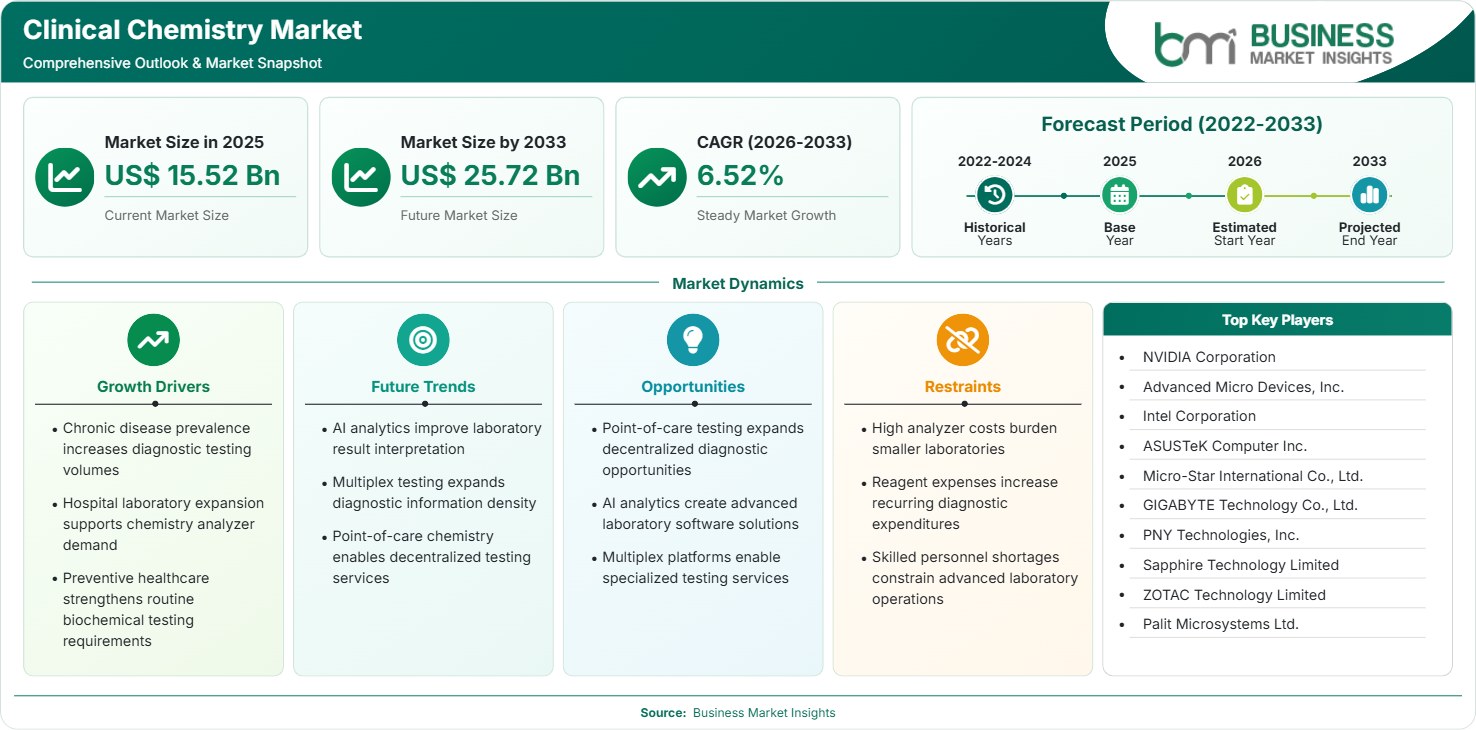
The Clinical Chemistry Market size was valued at US$ 15.52 Billion in 2025 and is projected to reach US$ 25.72 Billion by 2033, growing at a CAGR of 6.52% during 2026–2033. Rising prevalence of chronic diseases, expanding diagnostic testing volumes, adoption of automation, preventive healthcare initiatives, and growing demand for laboratory efficiency create significant opportunities across hospitals, laboratories, and decentralized testing environments.

Report Coverage
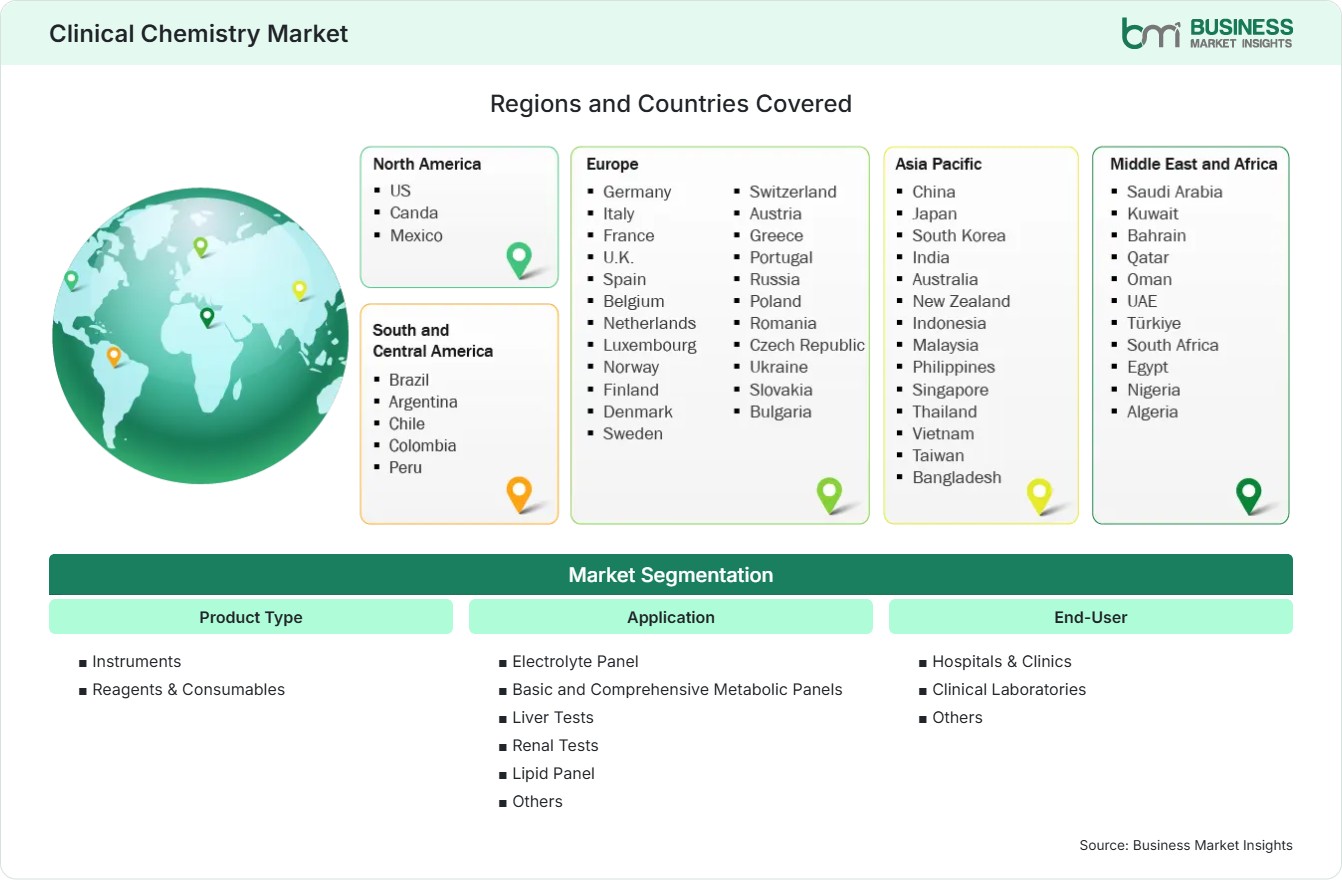
  • Product Type: Instruments, Reagents & Consumables
  • Application: Electrolyte Panel, Basic and Comprehensive Metabolic Panels, Liver Tests, Renal Tests, Lipid Panel, Others
  • End-User: Hospitals & Clinics, Clinical Laboratories, Others
US$ 15.52 Bn Market size in 2025
US$ 25.72 Bn Market Size by 2033
6.52% CAGR, 2026 - 2033
2026-2033 Forecast Period

AI Overview

Clinical Chemistry Market Summary

  • North America Region: North America holds a market share of 37%–40% in 2025, growing at a CAGR of 5.8%–6.3% during 2026–2033, driven by advanced laboratory infrastructure, high testing volumes, reimbursement support, and increasing requirements for chronic disease monitoring. The US benefits from large diagnostic networks, strong automation adoption, and expanding preventive screening programs, advancing at a CAGR of 5.9%–6.4%.
  • Fastest Growing Region: Asia Pacific holds a market share of 25%–28% in 2025, growing with a CAGR of 7.4%–8.0% during 2026–2033, driven by healthcare modernization, laboratory expansion, rising healthcare spending, improving diagnostic accessibility, and increasing chronic disease burdens across emerging economies.
  • Leading Segment: Reagents & Consumables hold a market share of 62%–66% in 2025, growing at a CAGR of 6.8%–7.3% during 2026–2033, supported by recurring testing demand, large installed bases, increasing disease-screening volumes, and continuous laboratory workflow requirements.
  • High Growth Segment: Clinical Laboratories account for 38%–42% of demand in 2025 and are projected to grow at a CAGR of 7.0%–7.6%, driven by outsourcing trends, adoption of high-throughput testing, automation investments, and increasing diagnostic workloads.
  • Key Market Opportunity: Expansion of integrated laboratory automation ecosystems, AI-assisted quality control systems, remote diagnostics connectivity, and preventive screening programs creates new revenue streams for technology providers and testing service organizations globally.
  • Major Market Players: F. Hoffmann-La Roche Ltd., Abbott Laboratories, Siemens Healthineers AG, Beckman Coulter, Inc., Sysmex Corporation, Thermo Fisher Scientific Inc., HORIBA, Ltd., Randox Laboratories Ltd., Shenzhen Mindray Bio-Medical Electronics Co., Ltd., and QuidelOrtho Corporation.
Strategic Insights

Clinical Chemistry Market: Strategic Insights

Clinical Chemistry Market Strategic Framework
FREE PDF
Request your free sample
Request free sample
Stakeholder View

Key Takeaways

  • The value chain is increasingly focused on reagent use, making revenue from consumables more resilient than revenue from capital equipment sales during periods of economic fluctuation.
  • As healthcare systems focus on preventive care and the management of chronic diseases, there are promising opportunities for growth in metabolic panels, lipid testing, and renal diagnostics.
  • Innovation is now moving toward automated analyzers that are connected, feature AI-powered quality monitoring, offer improved throughput, and require less laboratory intervention.
  • Asia Pacific has the greatest investment potential, as the expansion of healthcare infrastructure and improved accessibility of diagnostic services continue to drive demand.
  • The company's strategic acquisitions, partnerships, and consolidation of its laboratory network are helping to strengthen its market position and expand its geographic reach and product range.
  • Healthcare providers are now making sustainability initiatives—such as those aimed at reducing reagent waste, using energy-efficient analyzers, and improving workflow management- important considerations when carrying out procurement.
Geographic Outlook

Clinical Chemistry Market Regional Highlights

North America Clinical Chemistry Market

North America accounted for 37%–40% of global revenue in 2025 and is expected to expand at a CAGR of 5.8%–6.3% through 2033. The region benefits from highly developed laboratory infrastructure, strong healthcare expenditure, and widespread adoption of automated diagnostic systems. The Clinical Chemistry Market share remains supported by large testing volumes associated with diabetes, cardiovascular diseases, obesity, and aging populations.

  • The fact that metabolic disorders are common continues to drive greater demand for routine biochemical testing in hospitals and laboratory chains.
  • Investing in laboratory automation leads to shorter turnaround times, better consistency, and more effective quality control.
  • Initiatives aimed at value-based healthcare promote early diagnosis and disease monitoring through comprehensive chemistry testing.
  • The integration of digital technology between analyzers and laboratory information systems improves workflow efficiency and reporting capabilities.

US Clinical Chemistry Market

The United States represented approximately 78%–82% of North American Clinical Chemistry Market revenue in 2025 and is projected to grow at a CAGR of 5.9%–6.4% through 2033. Demand is supported by extensive diagnostic infrastructure, preventive healthcare programs, and increasing chronic disease screening requirements. Large reference laboratory networks, reimbursement support, and continuous investments in automation strengthen adoption.

  • Greater attention to preventive healthcare leads to increased use of metabolic, lipid, liver, and kidney testing panels.
  • Large providers of laboratory services are still expanding their high-throughput facilities to meet the growing demand for diagnostic testing.
  • The increasing number of older people necessitates regular monitoring of chronic and age-related conditions.
  • Investing in connected laboratory systems leads to better operational processes and improves data-driven clinical decision-making.

Europe Clinical Chemistry Market

Europe commanded 27%–30% of global Clinical Chemistry Market revenue in 2025 and is forecast to grow at a CAGR of 5.6%–6.1% through 2033. Strong public healthcare systems, established laboratory networks, and widespread preventive screening programs support demand. Germany leads regional adoption with an estimated growth of 5.8%–6.3%, while Eastern European healthcare modernization supports broader expansion.

  • Germany remains the largest national market due to its well-developed laboratory infrastructure and high levels of diagnostic spending.
  • Spain and Poland are seeing their adoption rise as a result of upgrades and modernization initiatives in their healthcare infrastructure.
  • Public screening programs lead to higher testing volumes linked to the management of chronic diseases.
  • The trend towards laboratory consolidation is increasing demand for centralized and automated chemistry testing systems.

Asia Pacific Clinical Chemistry Market

Asia Pacific generated 25%–28% of global revenue in 2025 and is expected to record the fastest CAGR of 7.4%–8.0% through 2033. The region benefits from expanding healthcare access, rising income levels, growing insurance coverage, and increasing investments in diagnostic infrastructure. Strong Clinical Chemistry Market growth is driven by increasing disease burden, urbanization, and public health initiatives supporting early diagnosis and preventive care.

  • China continues to expand its laboratory capacity by modernizing hospitals and implementing initiatives to digitize healthcare.
  • The demand for testing in India is increasing rapidly due to improved healthcare accessibility and the rising prevalence of chronic diseases.
  • The countries of Southeast Asia are increasingly turning to automated analyzers to enhance efficiency and diagnostic quality.
  • There are opportunities to invest in private healthcare services regarding advanced laboratory solutions within urban healthcare networks.

Rest of World Clinical Chemistry Market

The Rest of World region accounted for 7%–10% of global Clinical Chemistry Market revenue in 2025 and is expected to expand at a CAGR of 6.3%–6.9% through 2033. South and Central America benefit from expanding private healthcare services and laboratory investments.

In the Middle East and in Africa, there is a gradual acceptance being promoted by strategies aimed at modernizing healthcare, wider access to diagnostic services, and increased investment in hospital infrastructure; Brazil is still the largest market in the region, whereas the countries of the Gulf Cooperation Council are showing higher rates of technology adoption.

  • Brazil has gained from the expansion of its private diagnostic service networks and from rising awareness of preventive healthcare.
  • Mexico achieves stable growth by modernizing its laboratories and investing in its healthcare infrastructure.
  • Saudi Arabia shows strong growth. Healthcare transformation and digital projects support this progress.
  • South Africa remains a significant market in Africa due to the relatively advanced state of its healthcare and laboratory facilities.
Global Market Geography
FREE PDF
Request your free sample
Request free sample
Segment Analysis

Clinical Chemistry Market Segmentation

Product Type

Product Type represented a critical industry segment where Reagents & Consumables captured 62%–66% share in 2025 and are projected to grow at 6.8%–7.3% CAGR. The recurring nature of diagnostic testing, continuous laboratory operations, and expanding disease screening volumes support segment expansion. The Clinical Chemistry Market scope continues to broaden as laboratories prioritize reliable, standardized consumable supply chains.

  • Instruments: Automated analyzers increasingly incorporate connectivity, workflow optimization, and higher-throughput capabilities, enabling laboratories to manage increasing testing volumes while improving operational efficiency and analytical consistency.
  • Reagents & Consumables: Recurring testing requirements, quality assurance protocols, and increasing disease screening activities continue to support strong demand across healthcare institutions and diagnostic laboratories globally.

Application

Application demand is shaped by preventive healthcare initiatives, chronic disease monitoring requirements, and increasing diagnostic test utilization. Metabolic and electrolyte testing remain foundational diagnostic procedures across healthcare environments. Expanding physician awareness and population health management strategies contribute to sustained utilization. The Clinical Chemistry Market trends indicate increasing adoption of comprehensive testing panels supporting early detection and treatment monitoring.

  • Electrolyte Panel: Routine assessment of sodium, potassium, chloride, and related markers remains essential for managing hydration imbalances and critical care conditions.
  • Basic and Comprehensive Metabolic Panels: These tests support broad patient evaluation, preventive healthcare screening, and chronic disease monitoring across diverse medical settings.
  • Liver Tests: Rising prevalence of liver disease and growing awareness of hepatic health are driving increased utilization of liver function assessments.
  • Renal Tests: Kidney disease monitoring and chronic care management programs continue to expand demand for renal function testing worldwide.
  • Lipid Panel: Cardiovascular risk assessment initiatives and preventive healthcare programs sustain strong adoption among healthcare providers globally.

End-User

End-user demand reflects evolving healthcare delivery models and increasing diagnostic outsourcing trends. Clinical Laboratories accounted for approximately 38%–42% Clinical Chemistry Market share in 2025 and are expected to grow at a CAGR of 7.0%–7.6% through 2033. High testing volume requirements, automation investments, and operational efficiency objectives continue to support expansion across independent and reference diagnostic facilities.

  • Hospitals & Clinics: These facilities rely on chemical diagnostics for patient assessment, treatment planning, disease monitoring, and emergency medical decision-making.
  • Clinical Laboratories: Expanding testing workloads, centralized operations, and high-throughput automation technologies continue driving substantial adoption among laboratory service providers.
Market Forces

Clinical Chemistry Market Dynamics

Key Market Drivers

Rising Burden of Chronic and Metabolic Diseases

The growing incidence of diabetes, cardiovascular disorders, obesity, chronic kidney disease, and liver dysfunction is still expanding the number of people who can be tested. Clinical chemistry tests are used as a main method for monitoring the biomarkers linked to these conditions and have therefore led to continuous demand in both hospitals and laboratories. Global health agencies have stated that non-communicable diseases account for a major share of healthcare spending and patient monitoring. Since healthcare systems are placing greater importance on early diagnosis and on preventive measures, regular biochemical evaluations have become a standard part of clinical practice.

Expansion of Laboratory Automation and Digital Integration

More laboratories are investing in automated analyzers that offer greater throughput, improved accuracy, and reduced need for manual handling. By automating processes, operational efficiency is achieved by reducing turnaround times, minimizing human error, and improving consistency in sample processing. When these analyzers are linked with laboratory information systems, it becomes possible to manage the workflow from a central location, monitor quality, and quickly report the results. Large diagnostic service companies are still consolidating their testing volumes into automated facilities to optimize their cost structures and maintain high service quality. As a result, the use of advanced instruments and the consumption of reagents increase.

Growth in Preventive Healthcare and Routine Screening Programs

Governments, insurance companies, and healthcare providers are now more than ever encouraging the use of preventive medicine measures, designed to detect disease before complications occur. As part of their annual health checkups, routine tests such as metabolic panels, lipid panels, electrolyte measurements, and liver function tests are commonly performed. The focus on early intervention has led to more frequent testing among both high-risk groups and healthy individuals. Corporate wellness initiatives, the expansion of insurance coverage, and increased awareness of health issues all contribute to the greater use of these tests. Moreover, because the population is getting older, there is a need for continuous supervision of chronic illnesses, which in turn leads to steady demand in the various diagnostic sectors.

Key Market Opportunities

AI-Enabled Diagnostic Workflow Optimization

Artificial intelligence is creating opportunities to enhance laboratory operations through predictive maintenance, intelligent quality control, automated validation, and workflow optimization. AI-assisted systems can identify anomalies, support decision-making, and reduce laboratory inefficiencies. As testing volumes rise, diagnostic providers increasingly seek technologies that enhance productivity without a proportionate expansion of the workforce. Vendors integrating advanced analytics with chemistry analyzers are positioned to differentiate offerings and strengthen customer retention. Clinical Chemistry Market Forecasts indicate growing industry interest in connected laboratory ecosystems where data intelligence improves clinical performance, operational efficiency, and utilization rates across healthcare environments in both mature and developing regions.

Healthcare Infrastructure Expansion in Emerging Markets

Investment in hospitals, laboratories, diagnostic chains and programmes aimed at improving healthcare access is still being made by emerging economies. The growing levels of insurance coverage, urbanization, and healthcare spending are leading to increased use of diagnostic tests. In Asia, in Latin America and in certain areas of the Middle East, governments are giving priority to the modernization of laboratory infrastructure and to raising quality standards. To meet these opportunities international manufacturers are expanding their distribution partnerships and setting up local production facilities. Because of the growing number of people in the middle class and greater awareness of diseases there is increasing uptake of preventive testing.

Development of High-Value Specialty Chemistry Assays

Manufacturers are placing greater emphasis on advanced chemistry assays since they give clinical insights that go beyond those available through standard testing. Biomarkers that are specialized for assessing cardiovascular risk, evaluating metabolic health, monitoring the progression of liver disease, and keeping an eye on kidney conditions provide a greater value to healthcare providers. The move towards personalized medicine and precision healthcare is helping to promote the use of more sophisticated diagnostic methods. Companies which develop diverse assay ranges are able to improve their margin situations at the same time as boosting customer loyalty.

Market Restraints and Challenges

High Capital Costs and Slower Technology Adoption

Since advanced chemistry analyzers, automation systems, and laboratory integration platforms require a large initial outlay, the high costs of procurement, installation, and maintenance can hinder healthcare organizations with limited budgets from making purchases. The postponement of replacements and the slow uptake of new technologies reduce opportunities for expansion, especially in smaller hospitals and laboratories located in developing countries. Financial limitations might lead healthcare providers to keep using outdated systems even after they should have been retired. Moreover, the pressure to obtain reimbursement can influence how healthcare providers prioritize their capital expenditures.

Regulatory Complexity and Longer Commercialization Cycles

Clinical diagnostic products must meet strict regulatory requirements for safety, analytical performance, manufacturing quality, and post-market monitoring. Since regulatory frameworks vary from country to country, the complexity of compliance and the amount of documentation that manufacturers must produce increases. As a result, the process of obtaining product approvals, the development of geographic expansion strategies, and the timing of commercialization may be delayed, leading to higher operational costs and a postponement of revenue generation. Furthermore, regulatory updates mean that companies must keep on investing in their quality systems and validation procedures.

Company Analysis

Competitive Landscape

The competitive environment remains moderately consolidated, with leading participants focusing on innovation, automation, menu expansion, and geographic expansion. Continuous investments in laboratory connectivity, digital solutions, and workflow optimization are shaping the Clinical Chemistry Market analysis and competitive positioning strategies

Company Name

Overview

Products and Services relevant to this market

F. Hoffmann-La Roche Ltd.

Global diagnostics leader with extensive laboratory solutions portfolio and strong presence across clinical laboratory environments worldwide.

Clinical chemistry analyzers, reagents, laboratory automation systems, diagnostic software, and integrated workflow management solutions.

Abbott Laboratories

Major healthcare company offering diversified diagnostic technologies and broad global distribution capabilities.

Clinical chemistry testing systems, reagents, immunochemistry solutions, laboratory informatics, and diagnostic support services.

Siemens Healthineers AG

Leading medical technology provider focused on diagnostic efficiency and laboratory productivity enhancement.

Automated chemistry analyzers, diagnostic reagents, laboratory automation platforms, and digital healthcare solutions.

Beckman Coulter, Inc.

Established diagnostics company serving hospitals and reference laboratories through comprehensive testing technologies.

Chemistry analyzers, consumables, laboratory automation products, workflow software, and support services.

Sysmex Corporation

Diagnostic specialist recognized for innovation in laboratory testing and analytical technologies.

Clinical laboratory instruments, chemistry testing solutions, reagents, quality control materials, and laboratory connectivity tools.

Thermo Fisher Scientific Inc.

Global life sciences enterprise with broad laboratory technology offerings and strong industry reach.

Diagnostic reagents, laboratory instruments, consumables, analytical systems, and workflow-support solutions.

HORIBA, Ltd.

Technology company serving clinical laboratories through advanced analytical and diagnostic instrumentation.

Clinical chemistry analyzers, analytical systems, reagents, maintenance services, and laboratory solutions.

Randox Laboratories Ltd.

Diagnostics-focused organization known for assay innovation and laboratory testing capabilities.

Chemistry reagents, quality control materials, automated analyzers, and diagnostic testing solutions.

Shenzhen Mindray Bio-Medical Electronics Co., Ltd.

Fast-growing healthcare technology company expanding diagnostic offerings globally.

Clinical chemistry systems, reagents, automation platforms, laboratory solutions, and technical support services.

QuidelOrtho Corporation

Global diagnostics provider emphasizing laboratory testing excellence and clinical efficiency.

Clinical chemistry products, reagents, integrated laboratory systems, diagnostics services, and workflow solutions.

Trust & Transparency

Research Methodology

The market analysis combines proprietary research with secondary data from government agencies, company disclosures, regulatory filings, industry databases and expert interviews. Market estimates are validated through data triangulation, cross-market benchmarking and analyst review.

View Full Research Methodology

Questions Answered

Frequently Asked Questions

Why is a Clinical Chemistry Market Report important for stakeholders?

A Clinical Chemistry Market Report helps manufacturers, investors, healthcare providers, and distributors evaluate demand trends, competitive positioning, growth opportunities, technology developments, and strategic expansion priorities.

Which region offers the strongest long-term expansion potential?

Asia Pacific presents compelling long-term opportunities due to healthcare infrastructure investments, expanding diagnostic access, rising healthcare expenditures, and increasing chronic disease screening initiatives.

How are laboratories improving operational efficiency?

Laboratories are adopting automation, integrated software platforms, digital reporting systems, and connected analyzers to reduce turnaround times, increase throughput, and strengthen quality management performance.

What application area generates the largest testing volume?

Basic and comprehensive metabolic panels generate substantial testing demand because they support routine health assessment, chronic disease monitoring, and preventive screening initiatives across hospitals and laboratories.

What factors are driving demand for clinical chemistry testing?

Increasing chronic disease prevalence, preventive healthcare programs, aging populations, laboratory automation adoption, and growing awareness of early disease detection are expanding testing requirements across healthcare systems worldwide.

Access the Full Clinical Chemistry Market Report

Get segment-level forecasts, regional estimates, competitive benchmarking, company profiles and downloadable Excel datasets.

Access the full Clinical Chemistry Market Report
350 pages PDF & Excel | 2026-09-23
Similar Research

Related Market Reports