Market Summary
Executive Summary and Global Market Analysis
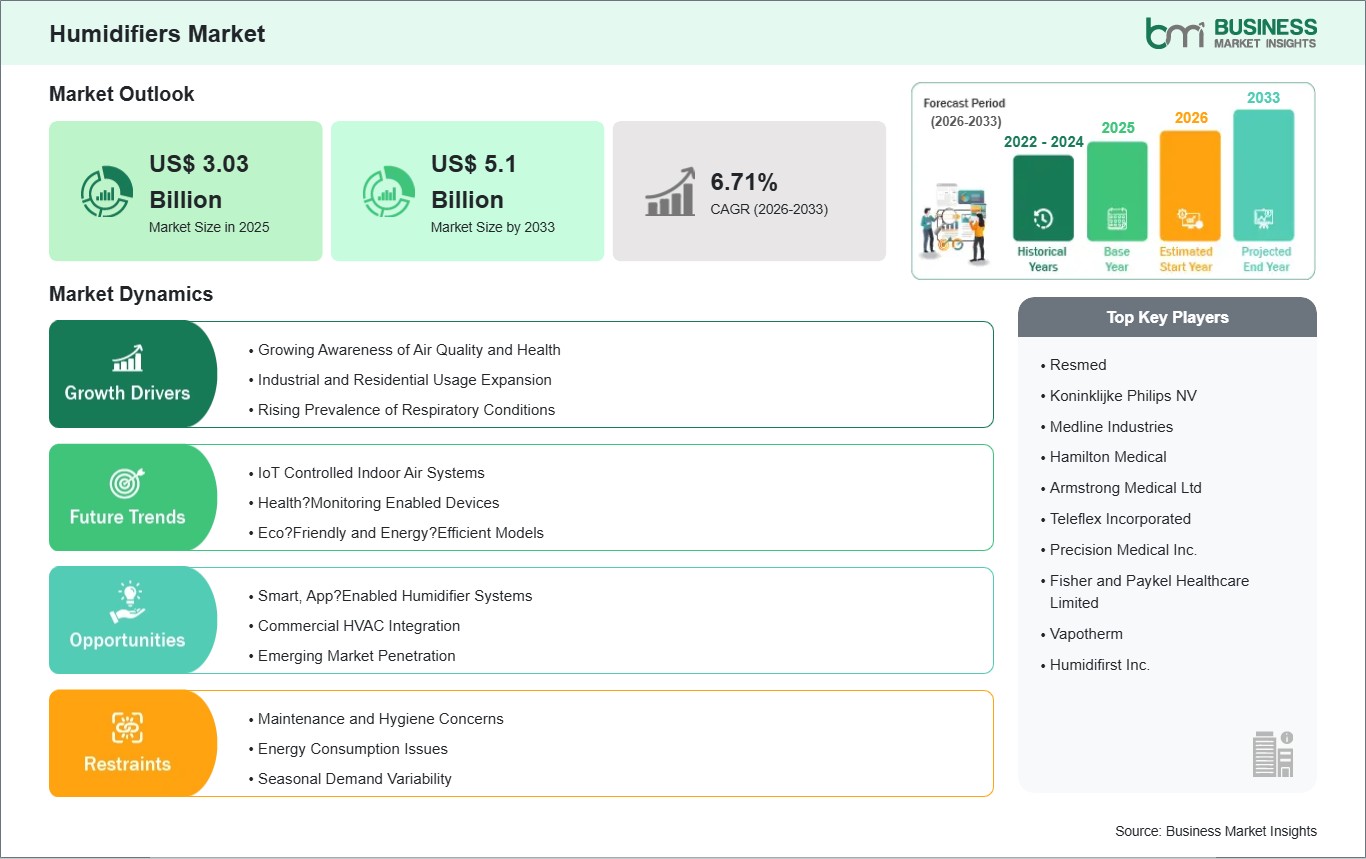
Humidifiers are devices that are meant for the purpose of adding moisture to the air indoors in order to keep the humidity at the right level, which in turn makes the place more comfortable to stay in and also prevents the occurrence of the problems that dry air creates, like dry skin, sinus congestion, respiratory discomfort, and static electricity. They are also found in large numbers in different places like the home, office, hospital, and industry, for the purpose of improving air quality and promoting health and wellness.
The global humidifiers market is gradually growing due to the increasing consciousness of air quality in the indoor health aspect, through technological advancements, and the greater acceptance of smart and energy-efficient models. North America is the leading region at present due to the health consciousness of people and the availability of a good healthcare infrastructure, while the Asia-Pacific is coming up fast due to urbanization and increasing consumer spending on this category. Household uses account for the largest part of global sales, with portable humidifiers winning the favor of the modern consumers who are also attracted by the smart connectivity features. The trends in the market include technology innovation, better online distribution, and the use of humidity sensors coupled with IoT control. On the downside, there are some problems like maintenance issues and intense competition, but the overall market of humidifiers remains positive with new applications and constant demand from all over the world.
Segment Analysis
Humidifiers Market Segmentation
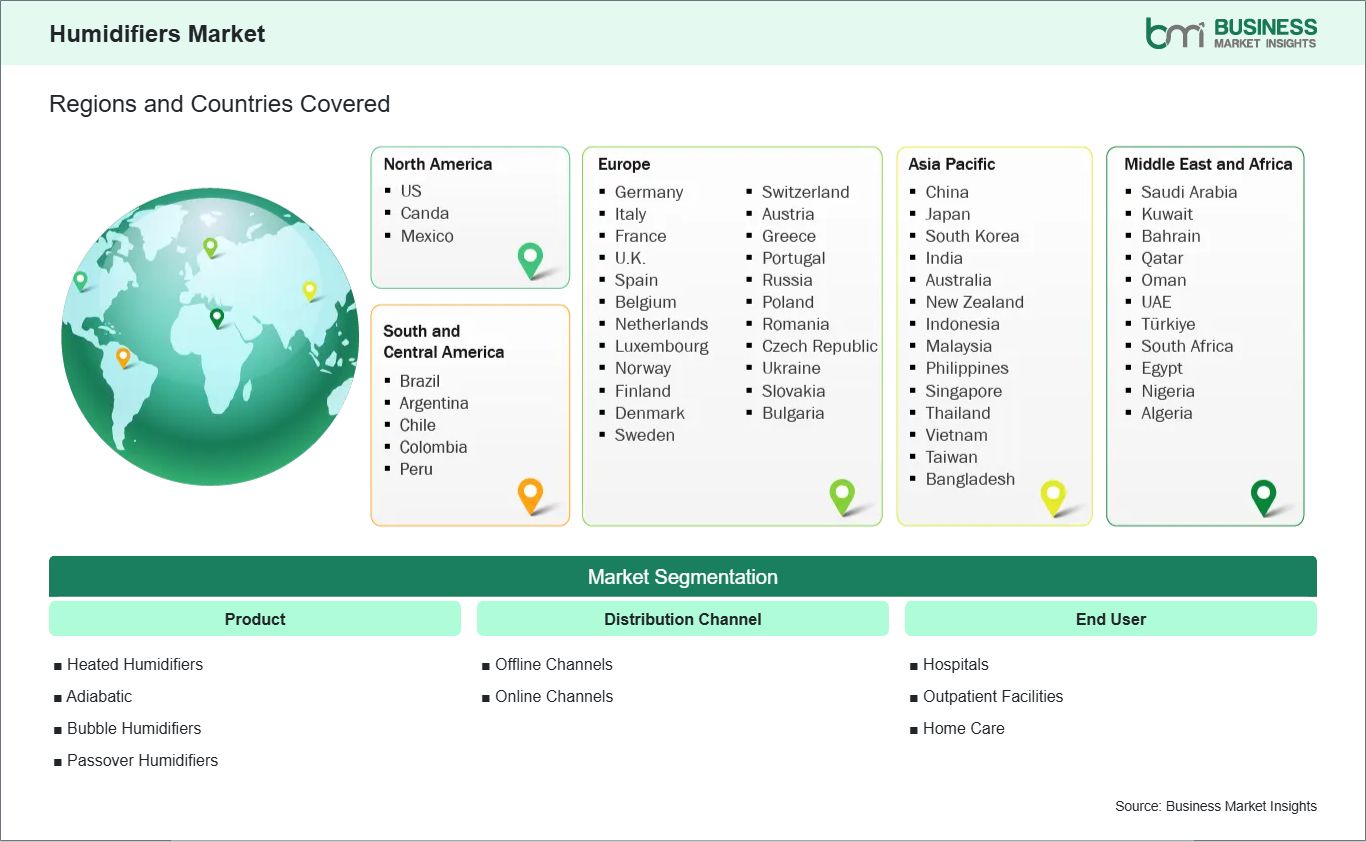
Key segments that contributed to the derivation of the humidifiers market analysis are product, distribution channel, and end user.
- By product, the market is categorized into heated humidifiers, adiabatic, bubble humidifiers, passover humidifiers. The heated humidifiers segment held the largest share of the market in 2025.
- By distribution channel, the market is bifurcated into offline channels, online channels. The offline channels segment held a larger share of the market in 2025.
- By end user, the humidifiers market is segmented into hospitals, outpatient facilities, home care. The hospitals segment dominated the market in 2025.
Market Forces
Humidifiers Market Drivers and Opportunities
Increasing Awareness of Indoor Air Quality
One of the main factors behind the increase in the global humidifiers market is the rising awareness of indoor air quality (IAQ) and its influence on health, comfort, and well-being. Besides, within just a few years, institutions have joined together with consumers in recognizing that dry indoor air is the main reason for respiratory discomfort, allergies, and even irritation of mucous membranes. Therefore, the latter has been caused by the increased air humidity, which has even reached the point where, in certain areas, industrially humidified air cannot be detected anymore. Positive trends such as this are reflected in the recent industry research stating that about two-thirds (65%) of consumers put air quality as their priority, and that this fact is leading to the purchasing of humidifiers for both residential and commercial sites. Health institutions, workspaces, and living areas have become more aware of the importance of keeping humidity at a constant level and using it as one of the health preventive measures, particularly in polluted towns and winter months when indoor air is very dry. Additionally, the linking up of humidifiers with air quality detection and smart HVAC systems is creating a big impact in the market, as users are looking for more controlled and healthier indoor environments.
Technological Advancements and Smart Integration
One of the major factors that could shape the future of the humidifiers market is the technological progress and the incorporation of smart connectivity, which is already affected by the merging of IoT, AI, and the customers' demand for home appliances that are interconnected. IoT-enabled humidifiers, with such features as Wi-Fi control, mobile-app monitoring, automatic humidity regulation, and predictive maintenance, are not only altering the product offerings but also changing consumer expectations. The companies that come up with the latest technologies in smart sensors and AI algorithms will be able to offer personalized humidity control, real-time air quality feedback, and easy integration with other smart home ecosystems — thus creating value propositions that are more attractive to tech-savvy consumers. The latest innovations comprise the products made for remote operation via mobile apps and the ones that work with voice assistants, which is a factor that has already expanded the market from just humidification to wellness solutions that are connected. On top of that, energy-efficient and multifunctional humidifiers that merge purification or UV-C sterilization are becoming more popular as they not only provide cross-category appeal but also bring in new revenue streams for the market players.
Size and Share Analysis
Humidifiers Market Size and Share Analysis
By product, the humidifiers market is categorized into heated humidifiers, adiabatic, bubble humidifiers, passover humidifiers. The heated humidifiers segment held the largest share of the market in 2025. The heated humidifiers segment leads the product category globally, holding the largest revenue share among options like adiabatic, bubble, and passover humidifiers. This leadership is mainly because heated models deliver precise, controlled humidity and temperature levels—critical in medical and clinical settings, particularly for respiratory therapy and ICU use. Their advanced sensors and feedback systems ensure consistent performance and reduce risks such as airway complications, making them highly preferred in hospitals and specialty care facilities. Their broader applicability in both healthcare and premium residential markets further reinforces their dominance.
By distribution channel, the market is bifurcated into offline channels, online channels. The offline channels segment held a larger share of the market in 2025. Offline distribution channels, including specialty stores, electronics outlets, and authorized dealers, remain the predominant avenue for humidifier sales globally. Customers often prefer in-store purchases for high-value appliances like humidifiers because they can physically inspect products, receive expert advice, and access immediate after-sales support. This tactile experience builds trust, particularly in regions with lower e-commerce penetration or among less tech-savvy consumers. Although online sales are rapidly growing due to convenience, competitive pricing, and broader product availability, offline remains dominant in overall revenue and consumer preference.
By end user, the humidifiers market is segmented into hospitals, outpatient facilities, home care. The hospitals segment dominated the market in 2025. Hospitals are the largest end-user segment for humidifiers globally, driven by their essential role in clinical environments. They use humidifiers extensively in critical care areas, operating rooms, and respiratory therapy units where precise humidity control is vital for patient comfort, infection prevention, and recovery. Investments in healthcare infrastructure and rising awareness of indoor environmental quality further boost usage in hospital settings. While outpatient and home care sectors are growing, the volume and consistency of demand from hospitals place them at the forefront of end-user adoption.
Report Coverage
Humidifiers Market Report Coverage and Deliverables
The " Humidifiers Market Size and Forecast (2022–2033)" report provides a detailed analysis of the market covering below areas:
- Humidifiers market size and forecast at global, regional, and country levels for all the key market segments covered under the scope
- Humidifiers market trends, as well as market dynamics such as drivers, restraints, and key opportunities
- Humidifiers market analysis covering key market trends, global and regional framework, major players, regulations, and recent market developments
- Industry landscape and competition analysis covering market concentration, heat map analysis, prominent players, and recent developments for the humidifiers market
- Detailed company profiles, including SWOT analysis
Geographic Insights
Humidifiers Market Geographic Insights
The geographical scope of the humidifiers market report is divided into five regions: North America, Asia Pacific, Europe, Middle East & Africa, and South & Central America. The humidifiers market in Asia Pacific is expected to grow significantly during the forecast period.
The Asia-Pacific humidifiers market is segmented into China, Japan, South Korea, India, Australia, New Zealand, Indonesia, Malaysia, the Philippines, Singapore, Thailand, Vietnam, Taiwan, Bangladesh, and the Rest of Asia. The Asia-Pacific humidifiers market is experiencing robust growth, due to rapid urbanization along with rising pollution levels in such major economies as China, India, Japan, and South Korea, which are causing health concerns and therefore encouraging more households and institutions to invest in indoor air quality solutions, including humidifiers. The increasing amount of outdoor air pollution is the major reason why humidifying the air is becoming a necessity for the well-being and comfort of breathing in densely populated urban areas.
Besides that, the rise of the middle class and increasing incomes have resulted in consumers' preferences being directed towards wellness products and smart home gadgets. In particular, smart consumers from East Asia are already using the technologically advanced humidifiers that can be connected to the apps, have sensors and controls, because of the convenience that they offer. Lastly, the health care sector is expanding, and the awareness of respiratory health is increasing in hospitals and care facilities, where demand is rising due to the incidence of allergies and respiratory diseases.
Industry Activity
Recent Developments
The humidifiers market is evaluated by gathering qualitative and quantitative data post primary and secondary research, which includes important corporate publications, association data, and databases. A few of the key developments in the humidifiers market are:
- In February 2023, DRI-STEEM Corporation (DriSteem), the leading manufacturer of humidification, evaporative cooling, and water treatment products, announced the addition of Adiatec ultrasonic humidifiers to its evaporative cooling and humidification product line. The DriSteem Adiatec ultrasonic humidifier uses high-frequency oscillating piezoelectric transducers to agitate water, causing it to develop into very small droplets of mist. This fine mist is carried out of the unit through the air flow generated in an air handler or integrated fans.
- In August 2024, Fisher and Paykel Healthcare Corp launched the F&P my820 System in the United States. The my820 is the company’s latest respiratory humidifier for home mechanical ventilation. The system provides heated humidification during the delivery of invasive ventilation, noninvasive ventilation, and humidified high-flow therapies for adult and pediatric patients.
Trust & Transparency
Research Methodology
The market analysis combines proprietary research with secondary data from government agencies, company disclosures, regulatory filings, industry databases and expert interviews. Market estimates are validated through data triangulation, cross-market benchmarking and analyst
review.
View Full Research Methodology
Key Sources Referred:
World Health Organization (WHO)
European Centre for Disease Prevention and Control
Centers for Disease Control and Prevention (CDC)
UNICEF Data
Environmental Protection Agency
Company websites
Company annual reports
Company investor presentations