
Gaming GPU Market Outlook: Size, Share, Trends, Growth Analysis, Competitive Landscape & Forecast, 2026-2033

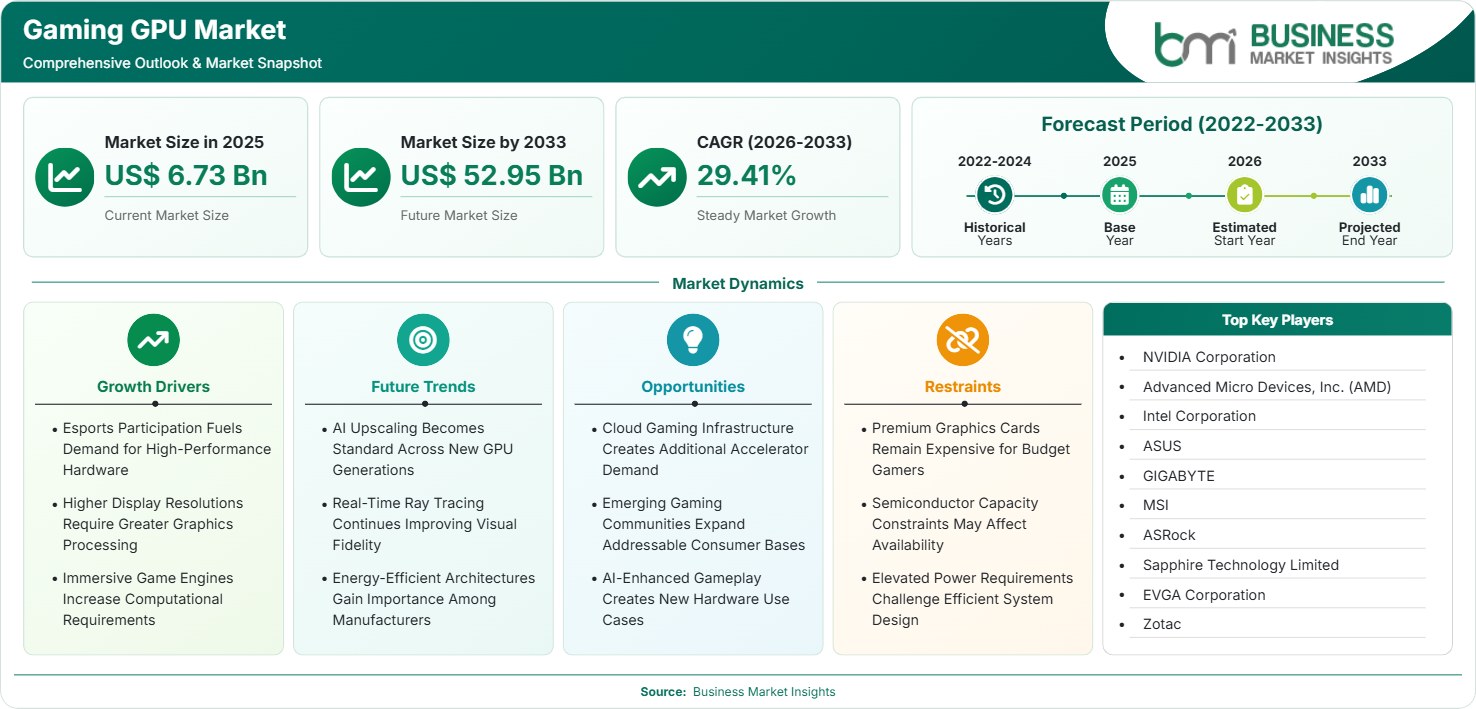
The Gaming GPU Market size was valued at US$ 6.73 billion in 2025 and is projected to reach US$ 52.95 billion by 2033, growing at a CAGR of 29.41% during 2026–2033. Rising esports participation, higher display resolutions, increasingly demanding game engines, cloud gaming infrastructure, and AI-enhanced gameplay are creating substantial opportunities across the graphics hardware ecosystem.

Report Coverage
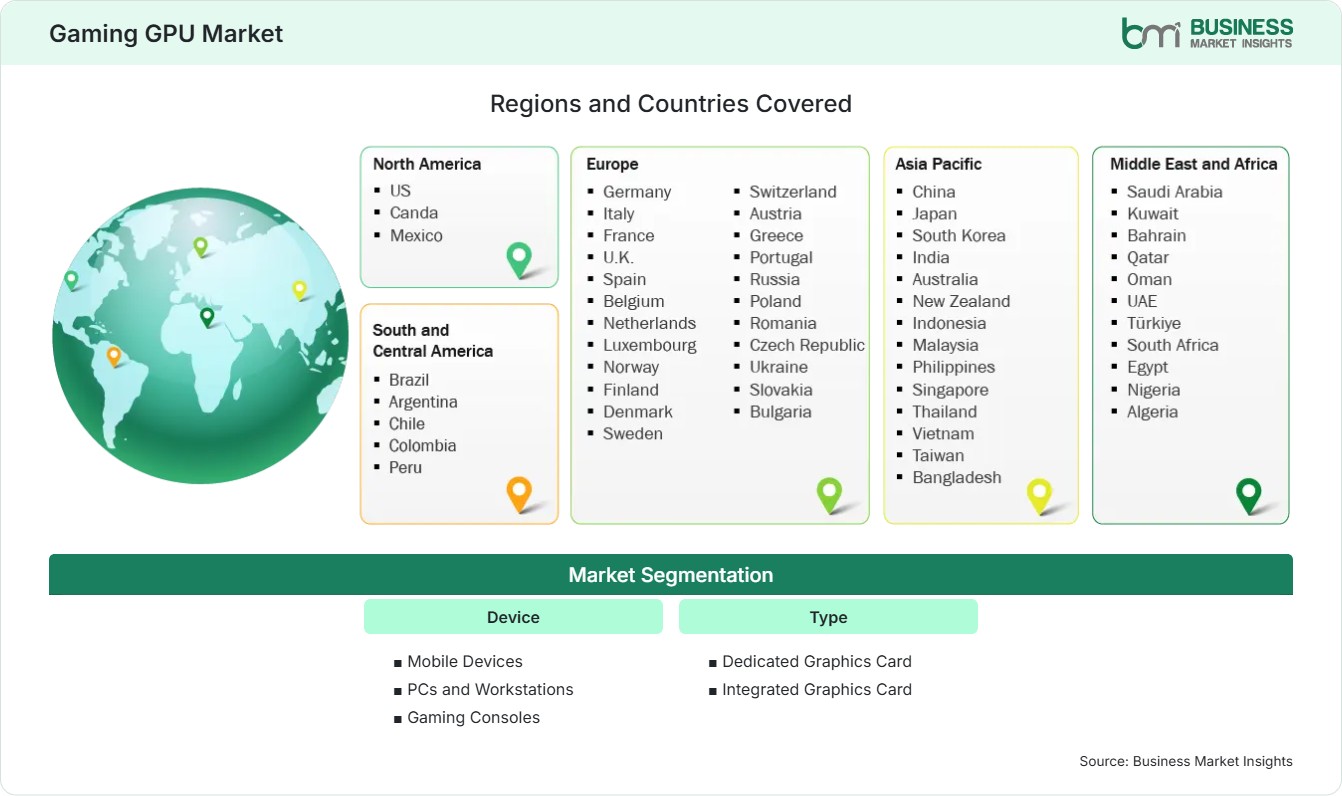
  • Device: Mobile Devices, PCs and Workstations, Gaming Consoles
  • Type: Dedicated Graphics Card, Integrated Graphics Card
US$ 6.73 Bn Market size in 2025
US$ 52.95 Bn Market Size by 2033
29.41% CAGR, 2026 - 2033
2026-2033 Forecast Period

01 AI Overview

Gaming GPU Market Summary

  • North America Region: North America holds an estimated 31%–34% Gaming GPU Market share in 2025 and is projected to expand at a CAGR of 27.5%–29.5% during 2026–2033, supported by mature PC gaming, esports ecosystems, premium hardware adoption, and strong developer activity. The U.S. represents the dominant regional market, supported by established gaming communities, high-performance PC demand, and advanced graphics software ecosystems, with growth estimated at 28.0%–30.0% through 2033.
  • Fastest Growing Region: Asia Pacific accounts for approximately 38%–41% share in 2025 and is projected to register a CAGR of 31.0%–33.5% during 2026–2033, driven by expanding gaming populations, mobile and PC gaming adoption, esports development, rising disposable incomes, and accelerating demand for high-resolution interactive entertainment across major digital economies.
  • Leading Segment: PCs and Workstations represent approximately 52%–55% share in 2025 and are projected to expand at a CAGR of 28.5%–30.5%, supported by competitive gaming, creator workloads, advanced game engines, higher refresh rates, and consumer demand for dedicated graphics performance across gaming-oriented computing platforms.
  • High Growth Segment: Dedicated Graphics Card represents approximately 67%–70% share in 2025 and is projected to record a CAGR of 30.5%–32.5%, supported by increasingly demanding games, ray tracing, high-resolution displays, AI-assisted rendering, competitive gaming, and consumer preference for upgradeable performance-oriented hardware.
  • Key Market Opportunity: AI-assisted rendering, cloud gaming, advanced ray tracing, higher-resolution displays, and growing esports participation are expanding GPU performance requirements, creating opportunities for differentiated architectures, efficient thermal designs, and premium graphics products.
  • Major Market Players: NVIDIA Corporation, Advanced Micro Devices, Inc. (AMD), Intel Corporation, ASUSTeK COMPUTER INC., GIGABYTE Technology Co., Ltd., Micro-Star International Co., Ltd., ASRock Inc., Sapphire Technology Limited, EVGA Corporation, and ZOTAC Technology Limited.
02 Strategic Insights

Gaming GPU Market: Strategic Insights

Gaming GPU Market Strategic Framework
FREE PDF
Request your free sample
Request free sample
03 Stakeholder View

Key Takeaways

  • Graphics Performance has become a key factor of competitiveness, due to the fact that the modern generation of games requires complex graphic processing, high-res textures, lighting, and computational tasks.
  • PCs and Workstations represent an attractive market opportunity, since gamers, participants of electronic sports, live-streamers, and content creators tend to prefer upgradability and higher frame rates in their hardware.
  • The graphics card plays a key role in gaming, since it allows users to utilize more computing power and RAM in comparison with standard solutions.
  • Asia Pacific provides a compelling expansion opportunity as gaming communities, esports participation, digital entertainment consumption, and hardware accessibility continue broadening across major emerging markets.
  • Competitive pressure is expanding from the silicon itself all the way out to the boards themselves, cooling apparatuses, memory setups, drivers, and even relationships with gaming software developers.
  • AI-based rendering introduces another dimension of product differentiation through which manufacturers can boost visuals and performance without the heavy computing loads required by more sophisticated game environments.
04 Geographic Outlook

Gaming GPU Market Regional Highlights

North America Gaming GPU Market

North America accounts for approximately 31%–34% Gaming GPU Market share in 2025 and is projected to register a CAGR of 27.5%–29.5% during 2026–2033. The region capitalizes on its strong gaming communities, active esports, high-end PC ownership, advanced developer ecosystems, and availability of high-performance hardware. Demand is driven by gamers, content creators, and professionals who have the need for heavy graphics processing. While the US is the key driver of the region, there are also significant contributions coming from Canada.

  • Enthusiast PC gamers continue prioritizing premium graphics hardware capable of supporting high refresh rates, advanced lighting, ray tracing, and demanding game engines across competitive and immersive gaming environments.
  • Established esports ecosystems encourage frequent hardware upgrades because competitive players value consistent frame rates, low latency, high-resolution displays, and graphics performance capable of supporting demanding tournament environments.
  • Content creators and streamers increasingly combine gaming and production workloads, creating demand for graphics processors capable of handling rendering, video production, streaming, and gaming simultaneously.
  • Premium hardware retailers and established online channels provide broad access to graphics cards, gaming systems, accessories, and component upgrades, supporting continued penetration across enthusiast consumer segments.

US Gaming GPU Market

The U.S. represents approximately 82%–85% of North American Gaming GPU Market revenue and is projected to grow at a CAGR of 28.0%–30.0% during 2026–2033. Strong gaming participation, established esports communities, advanced game development, high-performance computing demand, and widespread adoption of premium gaming systems support sustained expansion. Demand is particularly strong among enthusiasts, streamers, competitive gamers, and creators requiring high graphics throughput.

  • Advanced gaming communities support demand for premium graphics cards as consumers increasingly seek high frame rates, enhanced visual fidelity, and hardware compatibility with demanding game releases.
  • Game developers continue pushing graphical boundaries through increasingly sophisticated environments, creating sustained demand for graphics processors with greater computational capacity and advanced rendering capabilities.
  • Streaming and content creation encourage multifunctional hardware purchases because users increasingly require graphics performance for simultaneous gameplay, recording, broadcasting, editing, and visual production workflows.

Europe Gaming GPU Market

Europe represents approximately 24%–27% gaming GPU market share in 2025 and is projected to expand at a CAGR of 27.0%–29.0% during 2026–2033. Germany, the United Kingdom, and France remain important markets supported by established gaming communities, esports activity, PC ownership, and digital entertainment consumption. Poland and Spain offer attractive growth potential as gaming participation and competitive gaming ecosystems expand. Hardware demand increasingly reflects higher-resolution displays, advanced rendering capabilities, and performance requirements from sophisticated game engines.

  • Germany remains a major European gaming hardware market, supported by established PC gaming communities, strong consumer electronics distribution, and demand for high-performance gaming components.
  • The United Kingdom benefits from an established esports and gaming ecosystem, supporting demand for dedicated graphics products among competitive players, streamers, enthusiasts, and content creators.
  • France continues expanding gaming participation, while increasing adoption of immersive titles supports demand for hardware capable of delivering improved graphical performance and higher frame rates.
  • Poland and Spain provide attractive growth opportunities as competitive gaming, digital entertainment, and consumer interest in gaming-oriented PCs continue expanding across younger demographic groups.

Asia Pacific Gaming GPU Market

Asia Pacific accounts for approximately 38%–41% Gaming GPU Market share in 2025 and is projected to register the fastest CAGR of 31.0%–33.5% during 2026–2033. China, Japan, South Korea, and India represent major demand centers, while Southeast Asian markets provide additional growth potential. Expanding gaming communities, esports participation, internet accessibility, rising incomes, and broader availability of gaming-oriented hardware are strengthening regional demand across enthusiast and mainstream consumer groups.

  • China remains a major graphics hardware market because of its large gaming population, established PC ecosystem, competitive gaming activity, and extensive digital entertainment industry.
  • South Korea maintains strong demand through mature esports participation and gaming culture, supporting continued interest in high-performance systems designed for competitive titles and streaming.
  • India represents a high-growth opportunity as gaming participation, digital entertainment consumption, consumer electronics accessibility, and gaming-oriented PC adoption expand across urban and emerging markets.
  • Japan combines established gaming culture with advanced consumer electronics capabilities, creating continued demand for graphics solutions supporting premium gaming, creative applications, and visually intensive entertainment.

Rest of World Gaming GPU Market

Rest of World accounts for approximately 7%–10% share in 2025 and is projected to grow at a CAGR of 28.0%–30.5% during 2026–2033. Latin America benefits from expanding gaming communities and digital entertainment adoption, while the Middle East and Africa provide emerging opportunities as connectivity and consumer electronics access improve. Brazil, Mexico, Saudi Arabia, and the United Arab Emirates represent attractive markets, with gaming participation and esports supporting hardware demand.

Latin American demand is increasingly influenced by affordable gaming configurations, esports participation, and online communities, while Middle Eastern markets show stronger opportunities for premium systems and competitive gaming infrastructure. Distribution improvements remain important because pricing, availability, and component accessibility can materially influence adoption across developing markets.

  • Brazil leads regional demand through a large gaming community, expanding esports participation, and increasing consumer interest in PC hardware capable of supporting demanding modern games.
  • Mexico offers additional growth potential as digital entertainment expands and consumers increasingly adopt gaming PCs, graphics upgrades, and performance-oriented accessories.
  • Saudi Arabia and the United Arab Emirates provide attractive premium opportunities through investment in gaming ecosystems, esports infrastructure, entertainment development, and high-end consumer technology.
  • Improved online distribution across emerging markets can broaden access to graphics products while enabling manufacturers and retailers to reach consumers beyond established electronics centers.
Global Market Geography
FREE PDF
Request your free sample
Request free sample
05 Segment Analysis

Gaming GPU Market Segmentation

Device

The Device segment remains central to graphics hardware demand as gaming workloads diversify across PCs, workstations, mobile devices, and consoles. It represented approximately 52%–55% share in 2025 and is projected to expand at a CAGR of 28.5%–30.5% during 2026–2033. The Gaming GPU Market scope continues widening as consumers seek improved graphical performance across dedicated gaming systems and increasingly capable portable platforms.

  • Mobile Devices: Gaming-capable smartphones and portable devices increasingly incorporate stronger graphics processing to support richer interactive content, higher visual quality, and demanding mobile game experiences.
  • PCs and Workstations: This category leads demand because enthusiast gamers, streamers, creators, and professional users prioritize upgradeable systems with high graphics throughput and advanced rendering capabilities.
  • Gaming Consoles: Console platforms sustain graphics demand through fixed hardware architectures optimized for consistent gaming performance, high-resolution output, immersive environments, and increasingly sophisticated game engines.

Type

The Type segment is shaped by the balance between performance, cost, power consumption, and device architecture. Dedicated Graphics Card represented approximately 67%–70% share in 2025 and is projected to grow at a CAGR of 30.5%–32.5% during 2026–2033. Rising graphical complexity and AI-assisted rendering continue supporting the Gaming GPU Market trends favoring higher-performance dedicated architectures.

  • Dedicated Graphics Card: Dedicated solutions remain preferred for demanding gaming because separate graphics processors provide greater computational resources, dedicated memory, and stronger performance for high-resolution and advanced rendering workloads.
  • Integrated Graphics Card: Integrated solutions continue serving mainstream and cost-sensitive systems by combining graphics functionality with processors, offering lower system costs, reduced power requirements, and adequate performance for less demanding gaming applications.
06 Market Forces

Gaming GPU Market Dynamics

Key Market Drivers

Esports Participation Fuels Demand for High-Performance Hardware

The demand for high-end graphics hardware is increasing as a result of esports due to the increased focus on frame rates, responsiveness, and visual accuracy that is needed for competitive gaming. Gamers often value their systems based on whether they can maintain high performance while playing games competitively. Competitive games will increasingly require higher graphics processing capabilities as they become more complex. These conditions support Gaming GPU Market growth across dedicated graphics cards and gaming-oriented PCs. Hardware companies have been adapting through better performance architecture, better memory design, cooling mechanisms, and software programming. This upgrade cycle is perpetuated through the development of games that require more sophisticated graphical rendering. Users have an incentive to upgrade their graphics cards because of the increasing sophistication of the games being developed.

Higher Display Resolutions Require Greater Graphics Processing

The transition toward higher display resolutions and refresh rates is increasing graphics processing requirements across premium gaming environments. Higher resolutions in gaming require more rendering resources, as graphics cards must produce more graphical information per second. The need for ultra-wide displays, high-refresh rate gaming monitors, improved lighting, and complex visual effects means that gamers will have an incentive to choose better graphics cards. This is especially true for gamers who use expensive monitors with challenging games. The solution to the problem is being worked on by the graphics card industry through design, memory, and rendering advancements. Developers will have to continue optimizing their games with more advanced display environments in mind.

Immersive Game Engines Increase Computational Requirements

Modern game engines increasingly incorporate detailed environments, dynamic lighting, physics simulation, sophisticated character models, expansive worlds, and advanced rendering techniques. Such characteristics increase the load on graphics processors, thereby spurring their replacement with faster, more powerful units. The real-time rendering process has become an essential distinguishing factor as the gamers have come to expect the visual detail and high frame rate at once. Thus, the software is developed to be compatible with better graphics hardware, creating a feedback loop between game development and hardware improvements. The AI rendering technique may alter this feedback loop significantly.

Key Market Opportunities

Cloud Gaming Infrastructure Creates Additional Accelerator Demand

Cloud gaming presents a possibility in which graphics processing units will be useful in supporting the infrastructure, rather than solely relying on consumer devices. With the development of cloud gaming systems, there is room created for dedicated accelerator arrangements that will be used for performing multiple processes, effective resource management, and maximizing use of resources. This possibility will make the addressable market widen to include gaming infrastructure for data centers as opposed to retail graphics cards. Firms that can increase performance per watt, virtualization capability, and the density of workloads might meet these needs. Consequently, the Gaming GPU Market Forecasts increasingly depend not only on consumer hardware upgrades but also on the development of distributed gaming infrastructure and scalable graphics acceleration models.

Emerging Gaming Communities Expand Addressable Consumer Bases

Gaming participation continues expanding geographically as digital connectivity, smartphones, online communities, and affordable computing broaden access to interactive entertainment. The formation of emerging gaming communities provides an opportunity for manufacturers to create products at various performance and pricing tiers rather than just focusing on high-end enthusiast products. Products targeted at entry-level players can bring people into the world of PC gaming, whereas mid-range products can help players progress towards playing games at higher resolutions and demands.

AI-Enhanced Gameplay Creates New Hardware Use Cases

AI-enhanced gameplay is creating additional use cases for graphics processing as game developers explore intelligent characters, adaptive environments, procedural content, enhanced animation, and improved rendering workflows. AI technology may contribute not only to the growing needs in computational resources in video games but also to the development of methods for efficient visualization. Graphics platforms that are able to manage both standard and AI rendering could become more important in future. The potential is not limited by the process of gaming itself but goes far ahead, including development, asset generation and testing.

Market Restraints and Challenges

Premium Graphics Cards Remain Expensive for Budget Gamers

Premium graphics cards require substantial investment, creating affordability barriers for price-sensitive consumers and limiting adoption among entry-level gaming audiences. Factor: Components that deliver high performance use advanced architecture, large amounts of graphics memory, elaborate cooling technology, and specialized production processes that can drive up their retail cost. Impact: Higher hardware costs may prolong replacement cycles, lead people to keep older systems, and influence purchasing decisions toward midrange or integrated graphics products. Manufacturers thus have a difficult task in trying to balance performance gains against affordable prices. This problem is further accentuated by developments in graphics technologies that raise their BOMs.

Semiconductor Capacity Constraints May Affect Availability

Graphics processors depend on complex semiconductor manufacturing and packaging ecosystems where capacity allocation can influence product availability. Factor: The use of advanced manufacturing capabilities, packaging, memory needs, and focused supply chains can present limitations when there is an unexpected increase in demand or when manufacturing capabilities are distributed unevenly. Impact: Difficulties in availability will lead to delays in product releases, limited retailer stock, increased procurement risk, and consumer decision making regarding purchases. It is, therefore, necessary for manufacturers to plan their semiconductor manufacturing, packaging, memory sourcing, circuit board manufacturing, cooling, and supply chain considerations very well. Resilience in the supply chain is especially critical during periods of rapid adoption or product refresh cycles within the industry.

07 Company Analysis

Competitive Landscape

The competitive environment includes GPU architecture developers, semiconductor manufacturers, graphics-board vendors, and specialized gaming hardware companies. Gaming GPU Market analysis indicates that competitive differentiation increasingly depends on processing performance, graphics memory, energy efficiency, ray tracing capabilities, AI acceleration, driver quality, thermal engineering, and developer support. Leading companies also compete through partnerships with game developers and system manufacturers, creating ecosystems that extend beyond the graphics processor itself.

Company Name

Overview

Products and Services Relevant to this Market

NVIDIA Corporation

Global semiconductor and computing company with a major position in graphics processing and accelerated computing technologies.

Gaming GPUs, graphics architectures, rendering technologies, AI acceleration, software platforms, developer tools, and gaming graphics solutions.

Advanced Micro Devices, Inc. (AMD)

Semiconductor company providing processors and graphics technologies for consumer computing, gaming, and professional applications.

Radeon graphics processors, gaming graphics technologies, rendering software, graphics drivers, and performance-oriented computing solutions.

Intel Corporation

Semiconductor manufacturer developing computing processors and graphics technologies for consumer and professional platforms.

Integrated graphics, dedicated graphics solutions, graphics software, drivers, and computing platforms supporting gaming workloads.

ASUSTeK COMPUTER INC.

Hardware manufacturer offering gaming-focused computing systems, graphics products, components, and accessories across global markets.

Gaming graphics cards, gaming PCs, workstations, cooling solutions, motherboards, and graphics-oriented hardware platforms.

GIGABYTE Technology Co., Ltd.

Technology company specializing in computer hardware, gaming components, graphics products, and performance-oriented systems.

Gaming graphics cards, motherboards, gaming PCs, cooling products, monitors, and supporting graphics hardware components.

Micro-Star International Co., Ltd.

Global hardware manufacturer with an extensive gaming portfolio covering PCs, components, and enthusiast-oriented products.

Gaming graphics cards, gaming desktops, laptops, motherboards, cooling systems, and performance-oriented gaming components.

ASRock Inc.

Computer hardware manufacturer providing components and systems designed for gaming, enthusiast computing, and professional applications.

Graphics cards, motherboards, gaming systems, industrial computing products, and graphics-oriented hardware solutions.

Sapphire Technology Limited

Graphics-focused hardware company specializing in products based on leading GPU architectures for gaming and enthusiast markets.

Gaming graphics cards, cooling technologies, graphics accessories, and performance-oriented GPU hardware.

EVGA Corporation

Hardware company historically recognized for graphics products and enthusiast-oriented computer components.

Graphics cards, gaming hardware, power solutions, cooling products, and enthusiast computing components.

ZOTAC Technology Limited

Global technology company focused on graphics hardware, compact computing systems, and gaming-oriented devices.

Gaming graphics cards, mini PCs, graphics accessories, compact gaming systems, and performance-oriented hardware solutions.

10 Trust & Transparency

Research Methodology

The market analysis combines proprietary research with secondary data from government agencies, company disclosures, regulatory filings, industry databases and expert interviews. Market estimates are validated through data triangulation, cross-market benchmarking and analyst review.

View Full Research Methodology

11 Questions Answered

Frequently Asked Questions

What does the Gaming GPU Market Report cover?

The Market Report covers market dynamics, regional opportunities, device and type segmentation, competitive positioning, growth drivers, emerging opportunities, restraints, technology trends, and strategic considerations for industry participants.

How can cloud gaming affect graphics hardware demand?

Cloud gaming can shift part of graphics processing from consumer devices to centralized infrastructure, creating additional requirements for high-density graphics acceleration, efficient resource allocation, and scalable gaming workloads.

Why are dedicated graphics cards gaining importance?

Dedicated graphics cards provide greater processing resources and dedicated memory, making them better suited to high-resolution gaming, advanced rendering, ray tracing, AI-assisted workloads, and demanding modern game engines.

Which device category represents the leading opportunity?

PCs and Workstations represent the leading device opportunity because enthusiasts, competitive gamers, streamers, and creators value upgradeability and graphics performance for demanding workloads.

What is driving the Gaming GPU Market?

Demand is primarily supported by esports participation, higher display resolutions, increasingly sophisticated game engines, rising demand for high frame rates, content creation, streaming, and growing adoption of dedicated graphics hardware.

Access the Full Gaming GPU Market Report

Get segment-level forecasts, regional estimates, competitive benchmarking, company profiles and downloadable Excel datasets.

Access the full Gaming GPU Market Report
350 pages PDF & Excel | 2026-08-19