
Graphic Processing Unit (GPU) Market Outlook: Size, Share, Trends, Growth Analysis, Competitive Landscape & Forecast, 2026-2033

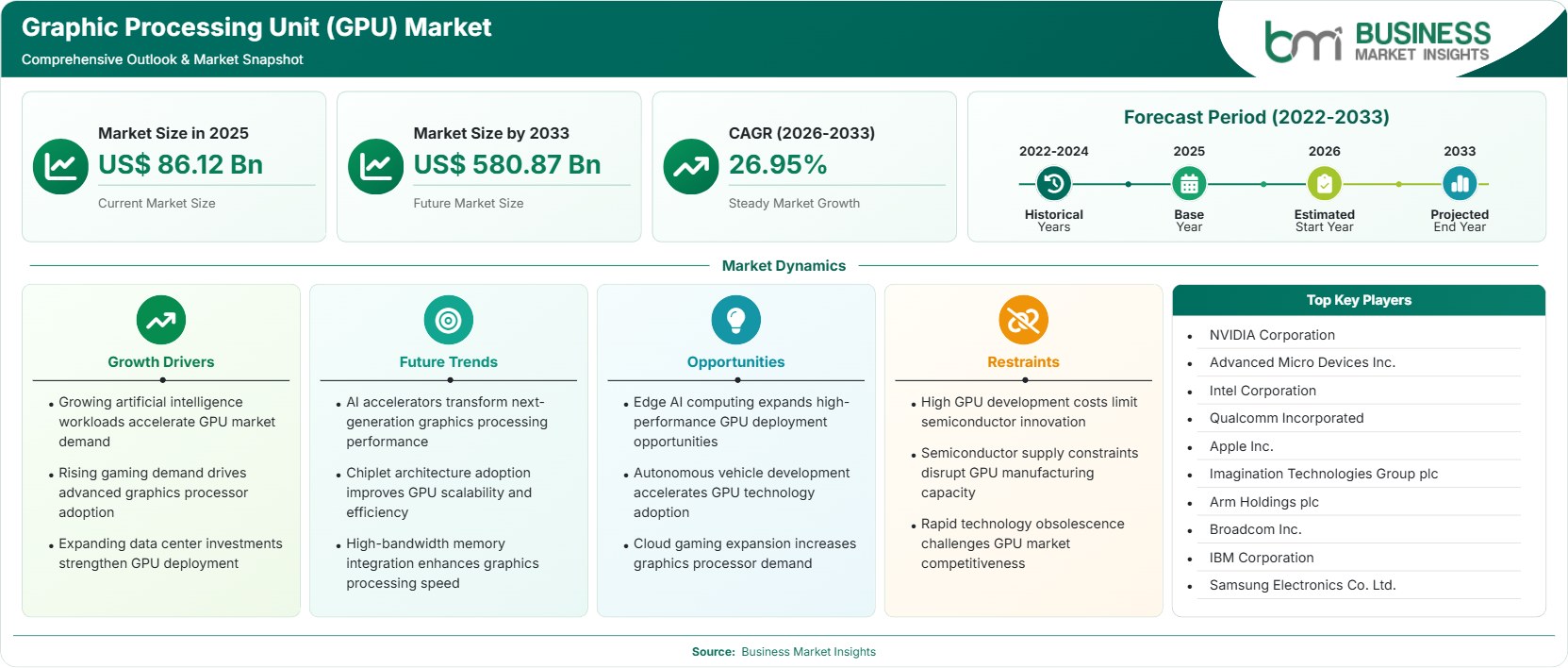
The Graphic Processing Unit (GPU) Market size was valued at US$ 86.12 billion in 2025 and is projected to reach US$ 580.87 billion by 2033, growing at a CAGR of 26.95% during 2026–2033. Rapid artificial intelligence deployment, accelerating high-performance computing investments, and expanding cloud infrastructure are transforming GPU demand worldwide. Increasing enterprise digitalization, next-generation gaming platforms, and intelligent edge computing continue creating substantial opportunities across multiple industries.

Report Coverage
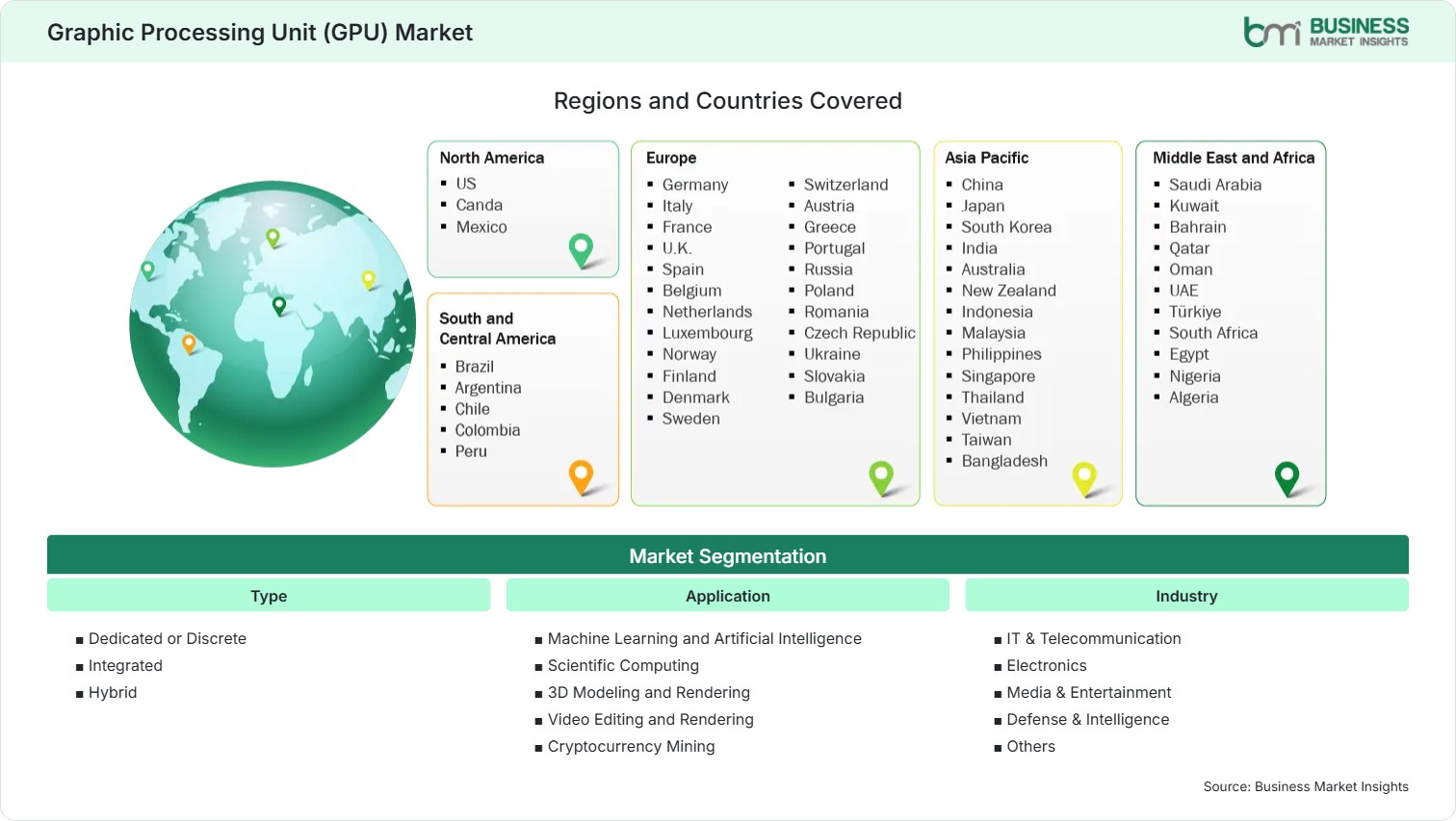
  • Type: Dedicated or Discrete, Integrated, Hybrid
  • Application: Machine Learning and Artificial Intelligence, Scientific Computing, 3D Modeling and Rendering, Video Editing and Rendering, Cryptocurrency Mining
  • Industry: IT & Telecommunication, Electronics, Media & Entertainment, Defense & Intelligence, Others
US$ 86.12 Bn Market size in 2025
US$ 580.87 Bn Market Size by 2033
26.95% CAGR, 2026 - 2033
2026-2033 Forecast Period

01 AI Overview

Graphic Processing Unit (GPU) Market Summary

  • North America Region: North America accounted for 38%–41% of global revenue in 2025 and is projected to expand at a CAGR of 25.8%–26.6% during 2026–2033. Strong semiconductor innovation, hyperscale cloud investments, AI infrastructure deployment, and advanced computing capabilities support regional leadership. The United States contributes approximately 86%–89% of regional revenue and is expected to grow at a CAGR of 26.0%–26.8%, driven by AI accelerators, cloud computing expansion, and enterprise technology investments.
  • Fastest Growing Region: Asia Pacific represented 29%–32% of global revenue in 2025 and is forecast to register the fastest CAGR of 28.4%–29.2% supported by semiconductor manufacturing expansion, artificial intelligence adoption, gaming demand, and hyperscale data center investments.
  • Leading Segment: Dedicated or Discrete accounted for 58%–61% of total revenue in 2025 and is projected to expand at a CAGR of 27.3%–28.0% because of increasing deployment across gaming, artificial intelligence, scientific computing, and cloud infrastructure.
  • High Growth Segment: Machine Learning and Artificial Intelligence represented 31%–34% of market revenue in 2025 and is expected to record a CAGR of 29.2%–30.0% supported by enterprise AI deployment, generative AI models, and accelerated computing workloads.
  • Key Market Opportunity: Rapid AI infrastructure investments, cloud gaming expansion, autonomous technologies, and edge computing continue creating significant opportunities for next-generation graphics processors.
  • Major Market Players: NVIDIA Corporation, Advanced Micro Devices Inc., Intel Corporation, Qualcomm Incorporated, Apple Inc., Imagination Technologies Group plc, Arm Holdings plc, Broadcom Inc., IBM Corporation, Samsung Electronics Co. Ltd.
02 Strategic Insights

Graphic Processing Unit (GPU) Market: Strategic Insights

graphic-processing-unit-gpu-market-market-strategic-framework
FREE PDF
Request your free sample
Request free sample
03 Stakeholder View

Key Takeaways

1. Semiconductor ecosystems are rapidly shifting toward accelerated computing architectures that combine GPUs, AI accelerators, high-bandwidth memory, and cloud infrastructure for enterprise-scale workloads.

2. The strongest Graphic Processing Unit (GPU) Market Growth opportunities are emerging from artificial intelligence infrastructure, cloud computing, autonomous systems, and hyperscale data center expansion.

3. Technology innovation increasingly focuses on advanced semiconductor manufacturing, chiplet architectures, energy-efficient processing, AI optimization, and heterogeneous computing platforms.

4. Asia Pacific offers substantial long-term investment potential through semiconductor manufacturing expansion, government technology initiatives, cloud infrastructure development, and increasing enterprise digitalization.

5. Strategic collaborations between semiconductor manufacturers, hyperscale cloud providers, software developers, and AI companies continue strengthening competitive market positioning.

6. Companies investing in next-generation GPU architectures, software ecosystems, and advanced manufacturing technologies are expected to maintain competitive leadership.

04 Geographic Outlook

Graphic Processing Unit (GPU) Market Regional Highlights

North America Graphic Processing Unit (GPU) Market

North America accounted for 38%–41% of global revenue in 2025 and is projected to grow at a CAGR of 25.8%–26.6% through 2033. Strong semiconductor research, AI investments, cloud infrastructure, and advanced computing capabilities continue supporting regional leadership. The Graphic Processing Unit (GPU) Market Share remains supported by expanding hyperscale data centers, enterprise AI adoption, and continuous innovation across semiconductor technologies.

  • The United States maintains regional dominance through leading semiconductor companies, artificial intelligence investments, and advanced cloud computing infrastructure.
  • Canada continues expanding GPU adoption through research computing, artificial intelligence initiatives, and enterprise cloud modernization programs.
  • Cloud service providers continue investing heavily in GPU clusters supporting artificial intelligence, machine learning, and high-performance enterprise computing.
  • Government investments in defense technologies, scientific research, and digital innovation continue strengthening long-term demand for advanced graphics processors.

US Graphic Processing Unit (GPU) Market

The United States represented approximately 86%–89% of North American revenue in 2025 and is expected to expand at a CAGR of 26.0%–26.8% during the forecast period. Growing investments in hyperscale cloud infrastructure, enterprise AI deployment, semiconductor innovation, and advanced computing technologies continue supporting sustained market expansion.

  • Artificial intelligence infrastructure investments continue accelerating demand for high-performance GPU platforms across enterprise and cloud environments.
  • Technology companies increasingly deploy GPU-enabled computing resources supporting generative AI, analytics, scientific computing, and digital transformation.
  • Research institutions and defense organizations continue expanding accelerated computing capabilities for simulation, modeling, and national technology initiatives.

Europe Graphic Processing Unit (GPU) Market

Europe accounted for 22%–25% of global revenue in 2025 and is projected to expand at a CAGR of 25.2%–26.0% during 2026–2033. Strong investment in artificial intelligence, semiconductor research, high-performance computing infrastructure, and digital transformation initiatives continues supporting regional growth. Germany remains the leading market, while the United Kingdom is projected to register the fastest regional expansion with a CAGR of 26.2%–27.0% through increasing AI adoption and cloud computing investments.

  • Germany continues leading regional demand through advanced manufacturing, automotive engineering, industrial automation, and scientific computing initiatives.
  • The United Kingdom strengthens GPU deployment through artificial intelligence research, financial technology innovation, and enterprise cloud transformation.
  • France continues expanding high-performance computing capabilities across aerospace, defense, healthcare, and public research organizations.
  • European semiconductor investments continue improving regional computing capabilities while strengthening AI infrastructure development.
  • Increasing enterprise adoption of accelerated computing platforms supports long-term graphics processor demand across multiple industries.

Asia Pacific Graphic Processing Unit (GPU) Market

Asia Pacific represented 29%–32% of global revenue in 2025 and is forecast to register the highest CAGR of 28.4%–29.2% during the forecast period. Rapid semiconductor manufacturing expansion, artificial intelligence investments, gaming industry growth, and hyperscale cloud infrastructure continue supporting regional leadership. China accounts for the largest regional market, while India is expected to achieve the fastest growth with a CAGR of 29.5%–30.3% through expanding digital infrastructure and enterprise AI adoption.

  • China continues strengthening semiconductor manufacturing capacity while expanding artificial intelligence infrastructure and cloud computing investments.
  • India demonstrates strong demand through digital transformation, enterprise cloud adoption, startup innovation, and expanding AI application development.
  • Japan continues investing in semiconductor innovation, robotics, automotive computing, and advanced manufacturing technologies.
  • South Korea strengthens GPU demand through memory semiconductor leadership, electronics manufacturing, and artificial intelligence development.
  • Regional cloud providers continue expanding GPU infrastructure supporting enterprise computing, machine learning, and generative AI workloads.

Rest of World Graphic Processing Unit (GPU) Market

The Rest of World accounted for 8%–10% of global revenue in 2025 and is projected to expand at a CAGR of 26.0%–26.8% during the forecast period. South & Central America together with the Middle East & Africa continue benefiting from digital transformation, cloud infrastructure investments, enterprise modernization, and growing adoption of artificial intelligence technologies.

Government digital initiatives and increasing investment in enterprise computing infrastructure continue creating favorable long-term growth opportunities across emerging economies.

  • Brazil leads South & Central America through expanding cloud infrastructure, financial technology investments, and enterprise digital transformation.
  • The United Arab Emirates continues strengthening GPU demand through artificial intelligence strategies, smart city projects, and hyperscale data center investments.
  • Saudi Arabia supports market expansion through national digital transformation initiatives, cloud computing investments, and enterprise modernization.
  • South Africa continues adopting accelerated computing technologies across financial services, telecommunications, and scientific research institutions.
  • Global semiconductor companies continue strengthening regional partnerships to improve graphics processor accessibility and enterprise deployment.
global-market-geography
FREE PDF
Request your free sample
Request free sample
05 Segment Analysis

Graphic Processing Unit (GPU) Market Segmentation

Type

The Type segment accounted for 60%–63% of total market revenue in 2025 and is projected to grow at a CAGR of 27.0%–27.8% during 2026–2033. Continuous innovation in graphics architectures, artificial intelligence acceleration, and high-performance computing continues supporting strong adoption across enterprise and consumer markets. The Graphic Processing Unit (GPU) Market Scope continues expanding as manufacturers introduce increasingly efficient and powerful graphics processors.

  • Dedicated or Discrete: Dedicated or discrete GPUs dominate high-performance applications including gaming, artificial intelligence, scientific research, cloud computing, and advanced visualization workloads.
  • Integrated: Integrated GPUs provide energy-efficient graphics performance for personal computing, business applications, mobile devices, and mainstream consumer electronics.
  • Hybrid: Hybrid GPU architectures combine integrated and dedicated processing capabilities to improve performance, flexibility, and energy efficiency across computing platforms.

Application

The Application segment represented 44%–47% of market revenue in 2025 and is expected to expand at a CAGR of 27.5%–28.3% during the forecast period. Accelerated computing demand across artificial intelligence, scientific research, media production, and enterprise analytics continues driving application expansion. The Graphic Processing Unit (GPU) Market Trends indicate increasing deployment across both commercial and research-intensive workloads.

  • Machine Learning and Artificial Intelligence: AI applications increasingly rely on GPUs for training, inference, deep learning, natural language processing, and generative artificial intelligence models.
  • Scientific Computing: Scientific computing utilizes GPU acceleration for simulation, climate modeling, engineering analysis, pharmaceutical research, and academic supercomputing.
  • 3D Modeling and Rendering: Professional design, architecture, engineering, animation, and product development applications increasingly require advanced graphics processing performance.
  • Video Editing and Rendering: Media professionals utilize GPUs to accelerate video production, visual effects, content creation, and real-time rendering workflows.
  • Cryptocurrency Mining: Cryptocurrency mining continues utilizing specialized GPU platforms where digital asset economics and computing efficiency support commercial mining operations.

Industry

The Industry segment accounted for 36%–39% of global revenue in 2025 and is projected to expand at a CAGR of 26.8%–27.6% during the forecast period. Accelerated enterprise digital transformation, cloud computing investments, and AI deployment continue strengthening graphics processor adoption across multiple industries.

  • IT & Telecommunication: Technology companies deploy GPUs for cloud infrastructure, artificial intelligence, networking optimization, and enterprise computing services.
  • Electronics: Consumer electronics manufacturers integrate advanced graphics processors into computing devices, mobile platforms, gaming systems, and intelligent products.
  • Media & Entertainment: Content creators increasingly utilize GPUs for animation, video production, rendering, visual effects, and immersive digital experiences.
  • Defense & Intelligence: Defense organizations deploy GPU-enabled systems for surveillance, simulation, cybersecurity, autonomous platforms, and intelligence analytics.
06 Market Forces

Graphic Processing Unit (GPU) Market Dynamics

Key Market Drivers

Growing artificial intelligence workloads accelerate GPU market demand

Fast-paced development of generative artificial intelligence, large language models, and deep learning technologies has led to an unprecedented increase in the demand for powerful graphics processing units. The business sector, as well as the academic community, are making significant investments into GPU hardware that can be used to speed up AI model training and inference processes. Higher utilization of accelerated computing solutions in various fields, such as healthcare, finance, manufacturing, autonomous vehicles, and scientific research, is expected to support further demand for GPUs.

Rising gaming demand drives advanced graphics processor adoption

The increasing global gaming industry keeps fueling the need for ever more powerful graphics processors that enable realistic graphics rendering, ray tracing, VR gaming, and high refresh rate gaming. The growth of the eSports industry, game streaming, gaming content creation, and immersive entertainment services is motivating gamers and PC gaming hardware producers to make investments in high-end GPUs. Innovation in gaming software and graphic engines helps increase replacement demand for performance graphics processors.

Expanding data center investments strengthen GPU deployment

The major global cloud computing services companies are continuing to expand their hyperscale data centers to cater to artificial intelligence, analytics, cloud computing, and digital transformation of enterprises. Graphics processor acceleration has become vital in providing capabilities to process parallel computing workloads, machine learning operations, scientific computing, and enterprise-level analytics. Investments in cloud infrastructure and accelerated computing clusters have facilitated the deployment of graphics processors.

Key Market Opportunities

Edge AI computing expands high-performance GPU deployment opportunities

As the usage of edge computing continues to increase, artificial intelligence processing gets to happen closer to the data sources. As a result, this improves efficiency and helps decrease latency. Various sectors such as the manufacturing sector, healthcare, telecoms, retail, and transportation have begun using GPU-based edge computing devices that help with intelligent automation, predictive maintenance, computer vision, and real-time analysis.

Autonomous vehicle development accelerates GPU technology adoption

The implementation of autonomous driving solutions needs considerable computing capability, including perception, navigation, object detection, sensor fusion, and decisions in real-time. Vehicle OEMs and technology firms are actively adding advanced GPU technology to autonomous driving systems, advanced driver assistance systems, and intelligent vehicles. Growing interest in connected mobility solutions and software-defined vehicles is anticipated to boost demand for automotive-grade graphics processor technologies.

Cloud gaming expansion increases graphics processor demand

The cloud gaming platform has revolutionized the industry by providing access to high-performing games using only affordable cloud infrastructure. The service providers have kept upgrading their GPU-based cloud technology to provide the best possible gaming experience for their consumers. The continuous upgrades in the internet bandwidths, the expansion of 5G networks, and the increasing use of subscription-based gaming is helping the GPUs used in cloud gaming.

Market Restraints and Challenges

High GPU development costs limit semiconductor innovation

Factor: Advanced semiconductor process technologies, sophisticated chip architectures, high-bandwidth memory integration, and extensive research investments significantly increase graphics processor development costs.

Impact: Rising development expenditures create financial challenges for semiconductor manufacturers, extend product commercialization timelines, and increase barriers for new market entrants. Companies continue investing heavily in advanced manufacturing technologies to maintain competitive product performance despite increasing capital requirements.

Semiconductor supply constraints disrupt GPU manufacturing capacity

Factor: Supply chain disruptions involving semiconductor fabrication, advanced packaging, substrate availability, and critical electronic components continue affecting production planning.

Impact: Manufacturing constraints can delay product deliveries, increase procurement costs, reduce inventory availability, and influence pricing across commercial and consumer GPU markets. Semiconductor companies continue diversifying production partnerships and strengthening supply chain resilience to improve long-term manufacturing stability.

07 Company Analysis

Competitive Landscape

The competitive landscape is characterized by continuous semiconductor innovation, artificial intelligence optimization, cloud ecosystem partnerships, and advanced graphics architecture development. The Graphic Processing Unit (GPU) Market Analysis indicates that leading companies are expanding investments in accelerated computing, AI software ecosystems, advanced manufacturing technologies, and enterprise GPU platforms to strengthen global competitiveness.

Company Name

Overview

Products and Services relevant to this market

NVIDIA Corporation

Global leader in accelerated computing and graphics processor technologies.

AI GPUs, gaming GPUs, data center accelerators, workstation graphics, networking, and AI software platforms.

Advanced Micro Devices Inc.

Semiconductor company developing high-performance computing and graphics solutions.

Radeon GPUs, Instinct accelerators, gaming graphics processors, AI computing, and enterprise GPU platforms.

Intel Corporation

Global semiconductor manufacturer offering processors and graphics technologies.

Arc graphics, integrated GPUs, AI accelerators, data center computing, and high-performance graphics solutions.

Qualcomm Incorporated

Wireless technology company developing advanced mobile computing platforms.

Mobile GPUs, Snapdragon graphics technologies, AI computing platforms, and automotive processing solutions.

Apple Inc.

Technology company designing integrated graphics processors for consumer devices.

Integrated GPU architectures, Mac graphics technologies, AI processing, and high-performance computing platforms.

Imagination Technologies Group plc

Semiconductor IP company specializing in graphics processing technologies.

GPU intellectual property, embedded graphics processors, AI acceleration, and mobile graphics technologies.

Arm Holdings plc

Semiconductor IP provider supporting energy-efficient computing architectures.

Mali GPUs, graphics IP, embedded processing technologies, and AI computing solutions.

Broadcom Inc.

Global semiconductor company serving enterprise networking and infrastructure markets.

Infrastructure semiconductors, data center technologies, connectivity solutions, and enterprise computing components.

IBM Corporation

Enterprise technology company investing in artificial intelligence and accelerated computing.

AI infrastructure, hybrid cloud solutions, enterprise computing, analytics, and research computing technologies.

Samsung Electronics Co. Ltd.

Global electronics manufacturer developing semiconductor and advanced computing technologies.

Mobile processors, integrated graphics technologies, semiconductor manufacturing, and AI-enabled computing platforms.


10 Trust & Transparency

Research Methodology

The market analysis combines proprietary research with secondary data from government agencies, company disclosures, regulatory filings, industry databases and expert interviews. Market estimates are validated through data triangulation, cross-market benchmarking and analyst review.

View Full Research Methodology

11 Questions Answered

Frequently Asked Questions

How do market forecasts support strategic planning?

Graphic Processing Unit (GPU) Market Forecasts help semiconductor companies, investors, cloud providers, and enterprise customers evaluate future demand, investment priorities, technology adoption trends, and long-term business strategies.

What does a market report include?

A Graphic Processing Unit (GPU) Market Report provides detailed insights covering market size, regional outlook, competitive landscape, technology developments, segmentation analysis, growth drivers, opportunities, challenges, and future industry outlook.

Which region offers the strongest investment opportunity?

Asia Pacific is expected to provide the strongest long-term opportunity owing to rapid semiconductor manufacturing expansion, cloud infrastructure investments, enterprise digitalization, and increasing artificial intelligence adoption.

Why are dedicated GPUs leading the market?

Dedicated or Discrete GPUs deliver significantly higher computing performance than integrated solutions, making them the preferred choice for gaming, artificial intelligence, scientific computing, professional visualization, and high-performance enterprise workloads.

Which application segment is expected to experience the highest growth?

Machine Learning and Artificial Intelligence is projected to register the fastest expansion due to increasing adoption of generative AI, deep learning, enterprise automation, scientific computing, and accelerated cloud infrastructure investments.

Access the Full Graphic Processing Unit (GPU) Market Report

Get segment-level forecasts, regional estimates, competitive benchmarking, company profiles and downloadable Excel datasets.

Access the full Graphic Processing Unit (GPU) Market Report
350 pages PDF & Excel | 2026-08-04