Market Summary
Executive Summary and Global Market Analysis
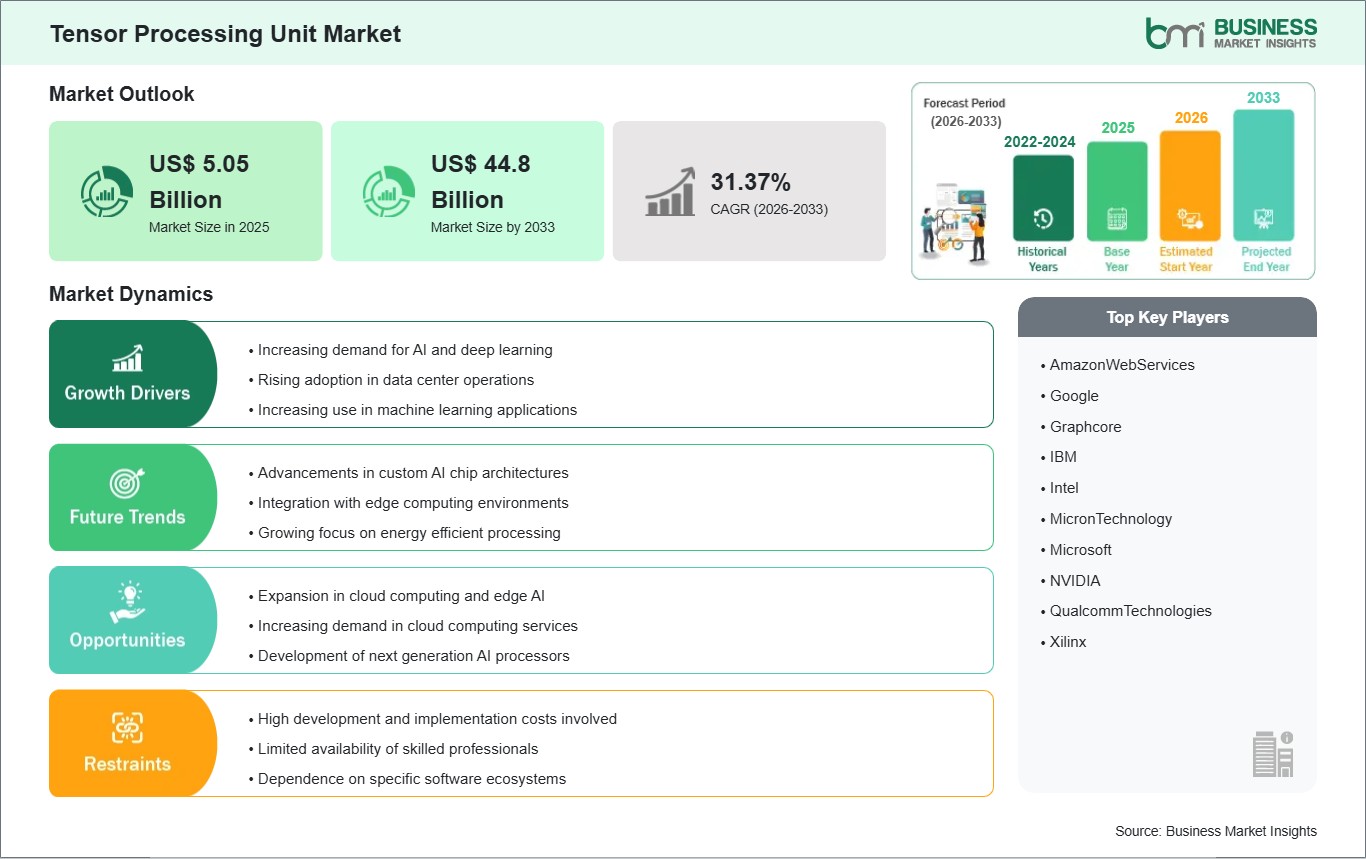
The TPU marketplace worldwide is on the rise as companies continue to require dedicated hardware to speed up their artificial intelligence (AI) and machine learning (ML) workloads. TPUs are designed specifically for tensor computing, which allows businesses to train and run models more quickly and perform real-time AI tasks than they could with traditional CPUs or GPUs. Companies in sectors such as cloud computing, self-driving cars, hospitals, banks, and robotics are using TPUs to improve their operational efficiency, cut down on lag times, and accelerate the performance of AI-based applications.
In addition, advances in TPU architecture (higher matrix multiplication throughput, low-precision calculations, and power-efficient designs) will improve their scalability and cost-effectiveness. These devices also provide support for the integration of AI frameworks and cloud-based platforms, which will allow enterprises to use TPUs for distributed training and edge inference in large-scale deployments of machine learning models and data-driven decisions. Emerging variants of TPUs have also been developed to meet the needs of specific domains (e.g., natural language processing, computer vision, and predictive analytics), providing organizations with the opportunity to obtain distinct performance gains.
However, organizations must be aware of concerns with hardware and software compatibility, cooling requirements, and upfront capital expenditures when planning to use TPUs to support enterprise-level and/or research-level workloads. To sum up, TPUs are becoming increasingly popular due to the convergence of AI advancements, the growth of the cloud, and the demand for high-performance computing, making TPUs an essential component in organizations that wish to accelerate their AI workloads.
Segment Analysis
Tensor Processing Unit Market Segmentation
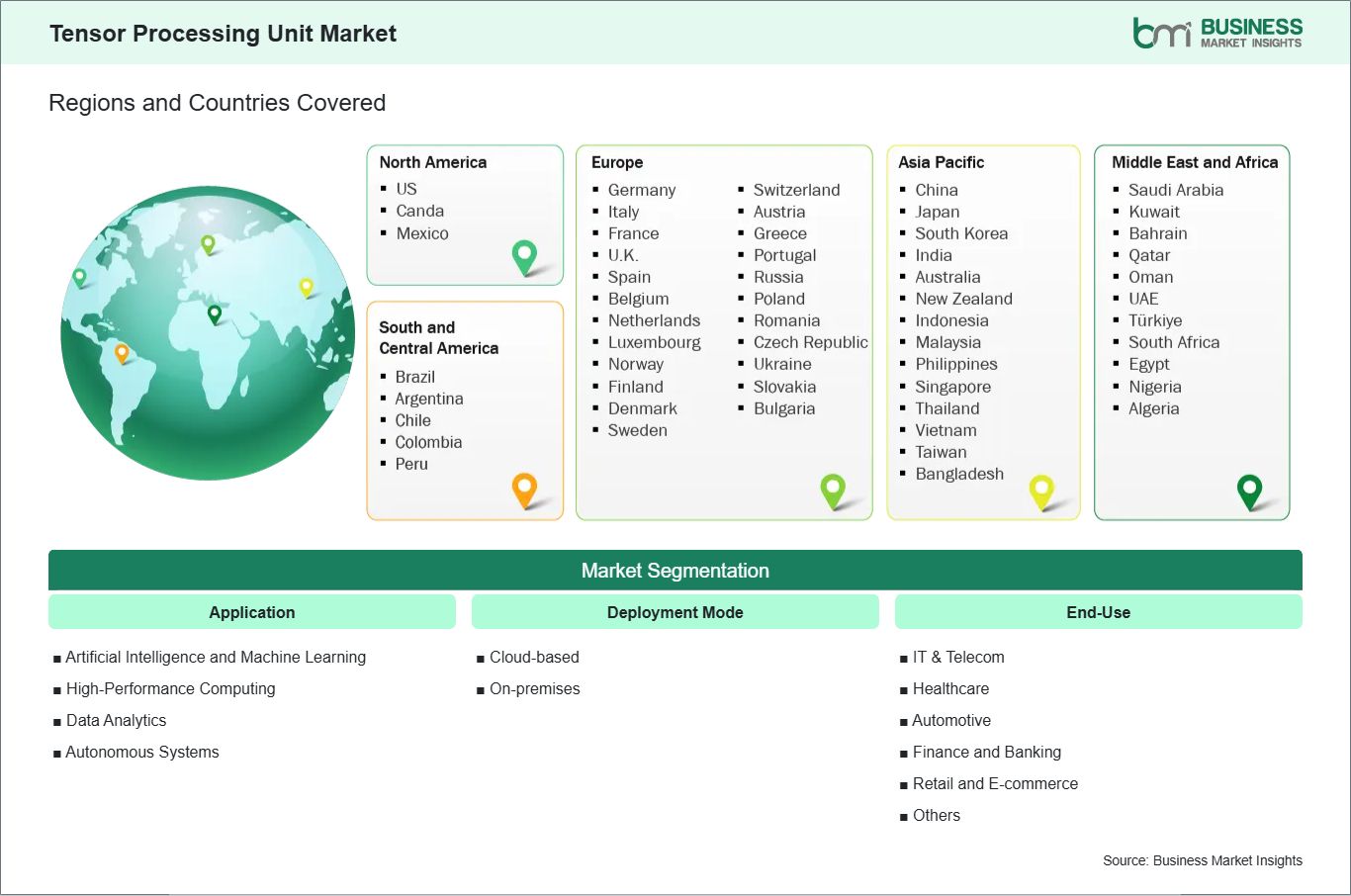
Key segments that contributed to the derivation of the tensor processing unit market analysis are application, deployment mode, and end‑use.
- Application, the tensor processing unit market is segmented into artificial intelligence and machine learning, high‑performance computing, data analytics, and autonomous systems. The artificial intelligence and machine learning segment dominated the market in 2025.
- Deployment Mode, the tensor processing unit market is categorized into cloud‑based and on‑premises. The cloud‑based segment dominated the market in 2025.
- End‑Use, the tensor processing unit market is classified into IT and Telecom, healthcare, automotive, finance and banking, retail and e‑commerce, and others. The IT and Telecom segment dominated the market in 2025.
Market Forces
Tensor Processing Unit Market Drivers and Opportunities
Increasing demand for AI and deep learning
The global TPU market is being driven by the rising demand for AI and deep learning applications across industries. Enterprises and research organizations require high-performance hardware to train complex neural networks and accelerate AI model inference. TPUs provide specialized architecture optimized for matrix computations, enabling faster processing of large-scale AI workloads compared to traditional CPUs or GPUs. Advances in deep learning models, including computer vision, natural language processing, and recommendation systems, are creating increased requirements for TPU deployment.
Organizations are leveraging these processors to improve accuracy, reduce training times, and enable real-time AI capabilities for applications such as autonomous systems, virtual assistants, and intelligent analytics platforms. The growing adoption of AI across sectors such as healthcare, finance, manufacturing, and robotics further fuels market growth. As AI models continue to increase in complexity and computational demand, TPUs are becoming critical infrastructure for organizations seeking efficient and scalable deep learning performance worldwide.
Expansion in cloud computing and edge AI
The global TPU market is also expanding due to growth in cloud computing and edge AI applications. Cloud service providers are integrating TPUs into their AI offerings, enabling organizations to access high-performance compute resources on demand without heavy capital investment. This allows scalable model training, large-scale inference, and deployment of AI-powered services. Edge AI is driving further adoption, as TPUs are increasingly embedded into devices and edge hardware to enable real-time decision-making close to data sources. This reduces latency, improves privacy, and supports autonomous systems, industrial IoT, and smart devices that require local intelligence without relying entirely on cloud processing. The combination of cloud and edge TPU deployments is facilitating hybrid AI strategies, optimizing both cost and performance. As organizations across industries seek to enhance AI capabilities while maintaining efficiency, demand for versatile and high-performance TPU solutions is expected to grow strongly worldwide.
Size and Share Analysis
Tensor Processing Unit Market Size and Share Analysis
The Tensor Processing Unit Market demonstrates robust growth, with size and share analysis highlighting evolving trends and competitive dynamics among key players. The report examines subsegments categorized within application, deployment mode, and end‑use, offering insights into their contribution to overall market performance.
By Application, the artificial intelligence and machine learning subsegment dominated the market in 2023, driven by the rising adoption of AI across industries and the need for high‑performance hardware for deep learning training and inference.
Based on Deployment Mode, the cloud‑based subsegment dominated the market in 2023, owing to its flexibility, scalability, and cost‑effectiveness, which enables organizations to access TPU capabilities without extensive on‑site infrastructure.
On the Basis of End‑Use, the IT & Telecom subsegment dominated the market in 2023, propelled by the sector’s heavy reliance on AI‑driven solutions to enhance network performance, predictive maintenance, and customer experience.
Report Coverage
Tensor Processing Unit Market Report Coverage and Deliverables
The "Tensor Processing Unit Market Size and Forecast (2022 - 2033)" report provides a detailed analysis of the market covering below areas:
- Tensor Processing Unit Market size and forecast at global, regional, and country levels for all the key market segments covered under the scope
- Tensor Processing Unit Market trends, as well as drivers, restraints, and opportunities
- Tensor Processing Unit Market analysis covering key trends, global and regional framework, major players, regulations, and recent developments
- Industry landscape and competition analysis covering market concentration, heat map analysis, prominent players, and recent developments for the Tensor Processing Unit Market
- Detailed company profiles, including SWOT analysis
Geographic Insights
Tensor Processing Unit Market Geographic Insights
The geographical scope of the Tensor Processing Unit Market report is divided into North America, Asia Pacific, Europe, Middle East & Africa, and South & Central America. North America held the largest share in 2025.
Regional adoption of tensor processing units varies according to technological infrastructure, AI ecosystem maturity, and enterprise adoption trends. North America is a leading region, driven by robust cloud computing infrastructure, widespread AI research, and early adoption of high-performance computing for enterprise and academic applications. TPUs are increasingly deployed in large-scale AI model training and real-time inference for autonomous systems, healthcare analytics, and fintech applications. Europe focuses on integrating TPUs into industrial AI, robotics, and research laboratories, emphasizing energy-efficient deployment and compliance with environmental and data governance standards.
Asia Pacific demonstrates rapid growth due to expanding cloud service adoption, industrial automation, and AI-driven consumer electronics; local data centers and edge computing deployments are accelerating TPU utilization for AI-powered devices and services.
Middle East & Africa is gradually adopting TPUs in smart city initiatives, energy management, and defense applications, with emphasis on cloud-integrated and scalable solutions. South & Central America is leveraging TPUs for research, financial analytics, and emerging AI startups, often deploying cost-effective cloud-based TPU services to overcome infrastructure limitations. Across all regions, factors such as digital maturity, AI adoption strategies, and computational infrastructure availability shape TPU deployment patterns, highlighting their strategic importance in accelerating AI innovation and operational efficiency globally.
Industry Activity
Recent Developments
The Tensor Processing Unit Market is evaluated by gathering qualitative and quantitative data post primary and secondary research, which includes important corporate publications, association data, and databases. A few of the key developments in the spatial light Modulator market are:
- In October 2025, Google Cloud and Anthropic announced that Anthropic signed a major agreement to expand its use of Google’s Tensor Processing Units (TPUs), giving the AI company access to up to one million TPUs and over a gigawatt of compute capacity by 2026 to support training and deployment of its large AI models.
- In November 2025, Alphabet’s Google announced that it was making its most advanced TPU the seventh‑generation “Ironwood” chip widely available to customers, aiming to attract AI developers and enterprises with enhanced performance for both training and inference workloads.
Trust & Transparency
Research Methodology
The market analysis combines proprietary research with secondary data from government agencies, company disclosures, regulatory filings, industry databases and expert interviews. Market estimates are validated through data triangulation, cross-market benchmarking and analyst
review.
View Full Research Methodology
Key Sources Referred:
International Electrotechnical Commission Institute of Electrical and Electronics Engineers International Organization for Standardization Bureau of Indian Standards Central Electricity Authority Ministry of Power Indian Electrical and Electronics Manufacturers' Association European Committee for Electrotechnical Standardization VDE Association for Electrical Electronic & Information Technologies Company Websites Company Annual Reports Company Investor Presentation