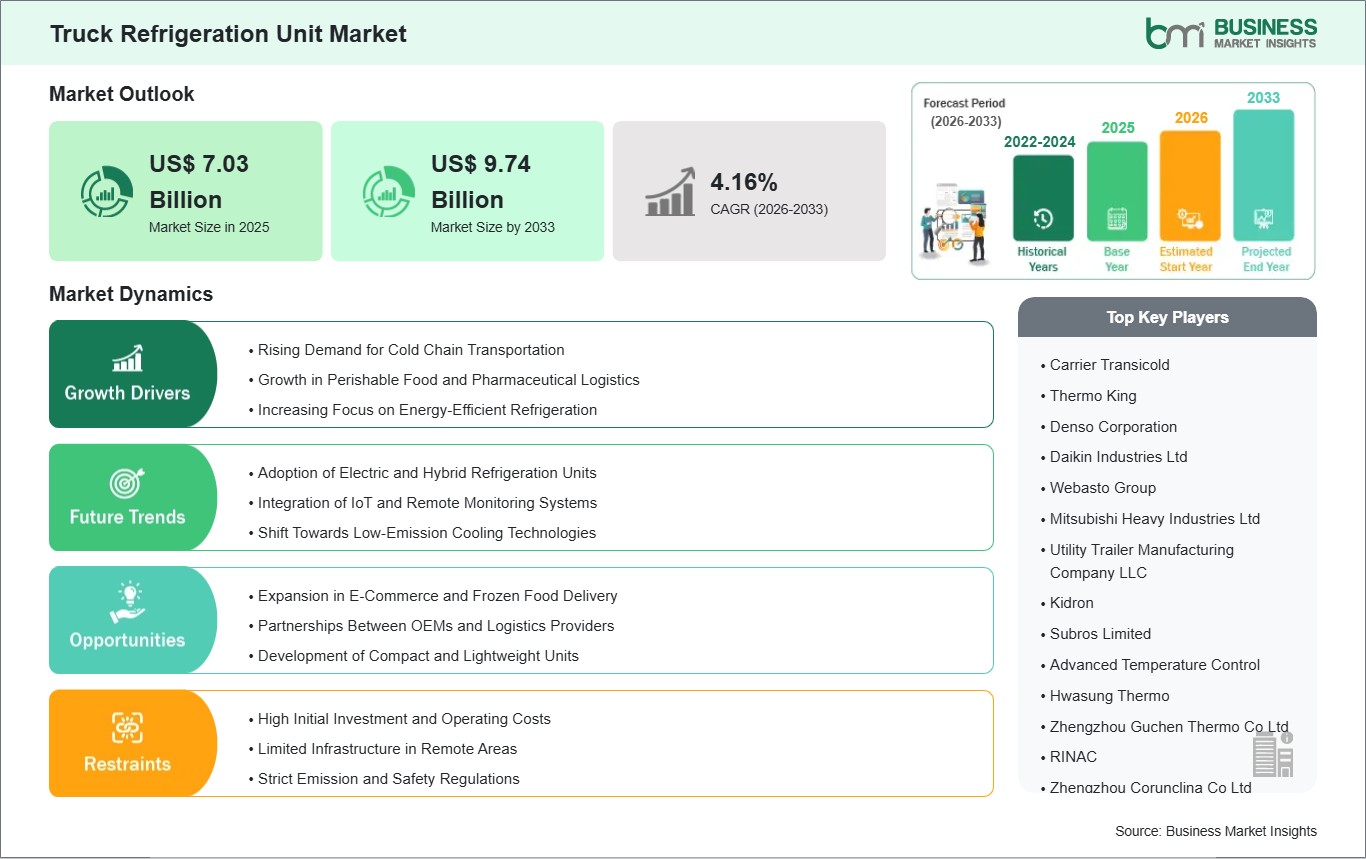
The Truck Refrigeration Unit Market size is expected to reach US$ 9.74 billion by 2033 from US$ 7.03 billion in 2025. The market is estimated to record a CAGR of 4.16% from 2026 to 2033.
The global truck refrigeration unit market focuses on technologies that keep perishable goods at the right temperature during transport. These units are vital for keeping food like dairy, meat, seafood, fruits, vegetables, and pharmaceuticals safe and fresh throughout the supply chain. As supply chains have grown more complex and spread out, the need for dependable mobile refrigeration has increased. Truck refrigeration units assist in ensuring that the cold chain requirements are met throughout the journey, right from the source to the final delivery. This ensures that the regulatory requirements are met, and the customers are satisfied with the quality of the products.
The demand for fresh and frozen foods has increased in cities due to increased urbanization and changes in food habits, especially in regions with a large middle-class population. E-commerce growth, especially in terms of the delivery of groceries, has made refrigerated transport services even more crucial. The stringent rules and regulations regarding food safety and temperature control have forced companies in the logistics industry to make use of advanced technology in refrigeration. Features such as automatic temperature control, energy-saving compressors, and telematics integration are being introduced, which are expected to make the services efficient and reduce costs.
The initial investment in such advanced equipment has been a problem for small transport companies. The environmental concerns regarding refrigerant emissions are leading companies towards eco-friendly options, which is a problem for companies, as it is difficult for them to cope with such concerns. Another problem is maintaining the equipment in extreme temperatures, which calls for innovation.

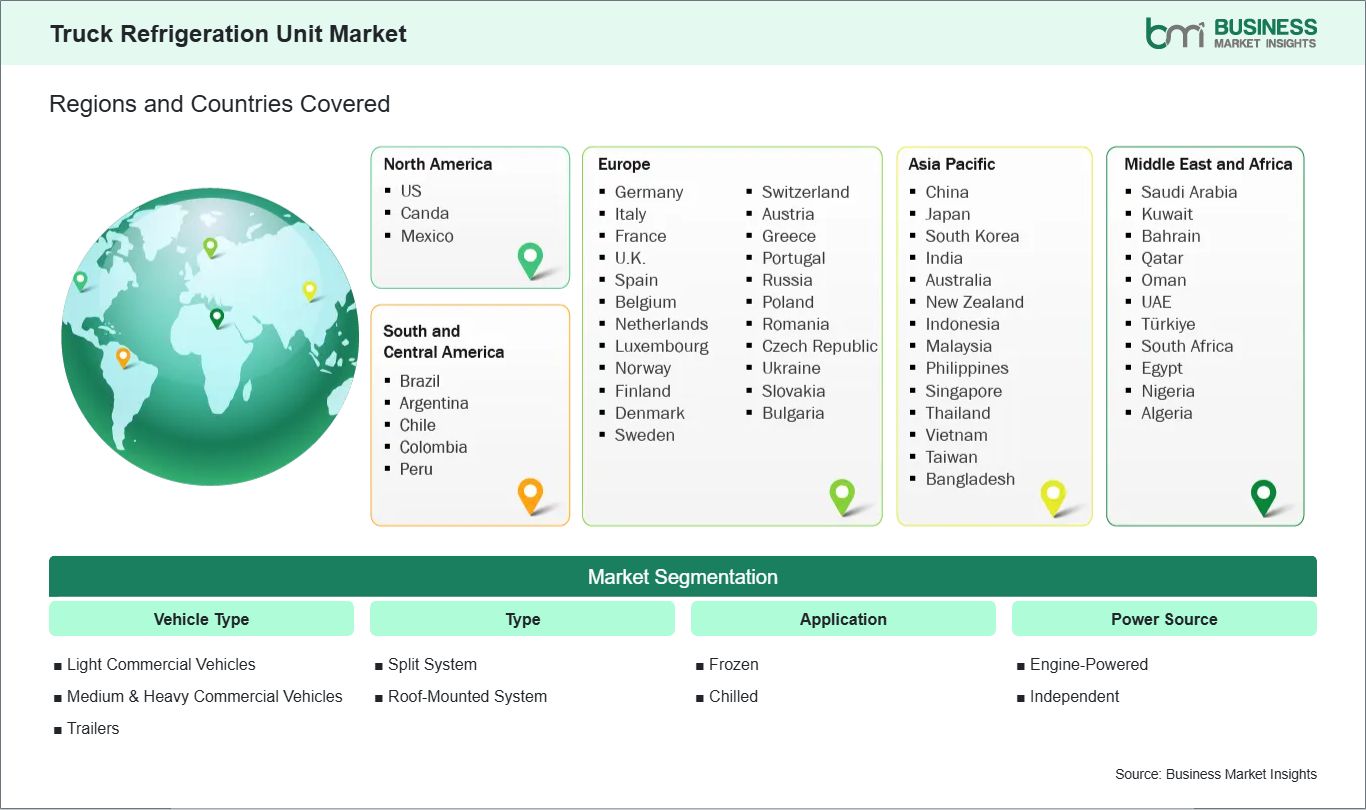
Key segments that contributed to the derivation of the truck refrigeration unit market analysis are vehicle type, type, application, power source, operation, and end-use industry.
The global truck refrigeration unit market is experiencing significant growth due to the increasing need for efficient cold chain transportation. Fresh produce, pharmaceuticals, and perishable food products require consistent temperature-controlled logistics to maintain quality and safety. In North America, the expanding pharmaceutical sector and stricter regulatory requirements for temperature-sensitive shipments are driving investments in advanced refrigeration units for trucks, ensuring compliance and reducing spoilage risks.
Agricultural and food processing industries are also contributing to demand. Europe’s well-developed food export infrastructure relies heavily on temperature-controlled transport to deliver dairy, meat, and fruits to regional and international markets. Reliable TRUs help reduce losses during transit and maintain freshness, which is crucial for both domestic supply chains and export operations. Manufacturers are responding by offering more fuel-efficient, low-emission units that support sustainable logistics practices.
Additionally, developing regions are increasingly adopting cold chain solutions as urbanization and infrastructure development improve. In Latin America and Southeast Asia, rising urban populations and growing retail networks require expanded refrigerated transport to connect farms and processing centers with end consumers. This trend underscores the TRU market’s role in enabling efficient cold chain logistics globally, creating sustained opportunities for equipment providers and service operators.
The surge in e-commerce and online food delivery is further driving demand for truck refrigeration units. Consumers increasingly expect fresh and frozen products delivered reliably to their doorstep, prompting logistics companies to expand fleets equipped with advanced TRUs. In the United States, grocery and meal kit delivery services are leveraging refrigerated trucks to maintain product quality during last-mile delivery, ensuring customer satisfaction and minimizing returns.
In Europe, the frozen food sector has experienced notable growth, with retailers relying on efficient refrigerated transport to maintain consistent temperatures throughout distribution networks. Truck refrigeration units with precise temperature controls help maintain product integrity while supporting the expansion of multi-channel distribution models, including both retail stores and direct-to-consumer deliveries.
Emerging markets are also contributing to this trend as e-commerce platforms expand. In Asia-Pacific, increasing adoption of online grocery services and frozen food delivery has led logistics providers to invest in TRUs capable of meeting high-volume, temperature-sensitive transport demands. The growth of urban centers and the need for reliable delivery infrastructure are pushing innovation in refrigeration technologies, such as energy-efficient units and connected monitoring systems, making TRUs a vital component in the global e-commerce-driven cold chain ecosystem.
The truck refrigeration unit market is experiencing steady growth, with market size and share analysis reflecting evolving treatment preferences and competitive dynamics among key players. The report evaluates important subsegments categorized within vehicle type, type, application, power source, operation, and end-use industry, highlighting their respective contributions to overall market performance.
By vehicle type, the Light Commercial Vehicles subsegment dominated the Truck Refrigeration Unit market in 2025. Light commercial vehicles are widely used for last-mile deliveries and perishable goods transport, driving their strong adoption.
Based on type, the Roof‑Mounted System subsegment dominated the Truck Refrigeration Unit market in 2025. Roof-mounted systems offer efficient cooling, space optimization, and easy installation, supporting widespread use in commercial fleets.
In terms of application, the Chilled subsegment dominated the Truck Refrigeration Unit market in 2025. Chilled transport maintains product freshness for perishable goods, ensuring quality and reducing spoilage, reinforcing strong demand.
On the basis of power source, the Engine‑Powered subsegment dominated the Truck Refrigeration Unit market in 2025. Engine-powered units provide reliable cooling during transit without the need for external power, driving their widespread adoption.
By mode of operation, the Single Temperature subsegment dominated the Truck Refrigeration Unit market in 2025. Single temperature systems simplify operation, reduce energy consumption, and meet the needs of standard chilled or frozen transport, supporting their leading position.
Based on end-use industry, the Food & Beverage subsegment dominated the Truck Refrigeration Unit market in 2025. The food and beverage sector requires consistent temperature control to ensure product safety and quality, driving the dominance of this segment.
| Report Attribute | Details |
|---|---|
| Market size in 2025 | US$ 7.03 Billion |
| Market Size by 2033 | US$ 9.74 Billion |
| Global CAGR (2026 - 2033) | 4.16% |
| Historical Data | 2022-2024 |
| Forecast period | 2026-2033 |
| Segments Covered | By Vehicle Type
|
|
Regions and Countries Covered
| |
| North America | US, Canada, Mexico |
| Europe | Belgium, Austria, Finland, Denmark, Greece, Poland, Romania, Russia, Ukraine, Czech Republic, Slovakia, Bulgaria, Italy, Luxembourg, Germany, Switzerland, France, Netherlands, Norway, Portugal, Spain, Sweden, United Kingdom |
| Asia-Pacific | Australia, China, India, Japan, South Korea, Indonesia, Malaysia, Philippines, Singapore, Thailand, Vietnam, Bangladesh, New Zealand, Taiwan |
| South and Central America | Brazil, Argentina, Peru, Chile, Colombia |
| Middle East and Africa | Bahrain, Kuwait, Oman, Qatar, Saudi Arabia, United Arab Emirates, Turkiye, South Africa, Egypt, Algeria, Nigeria |
| Market leaders and key company profiles |
|
The "Truck Refrigeration Unit Market Size and Forecast (2022 - 2033)" report provides a detailed analysis of the market covering below areas:
The geographical scope of the Truck Refrigeration Unit market report is divided into five regions: North America, Asia Pacific, Europe, Middle East & Africa, and South & Central America. The Truck Refrigeration Unit market in North America is expected to grow during the forecast period.
North America is the highest contributing region for the global truck refrigeration unit market, thanks to the highly developed infrastructure for logistics and cold chain management. The region has highly developed food distribution networks and strong regulatory environments for ensuring food safety and traceability. This has led to the development of a highly conducive environment for truck refrigeration unit applications.
Various players, including retail, manufacturing, and logistics providers, use truck refrigeration units to ensure product integrity from manufacturing facilities through distribution centers and finally to retail and food service outlets. The region has highly developed cold chain management, with sophisticated temperature management and monitoring systems. North America’s leadership is also fueled by innovation. The refrigeration industry in North America is shifting focus to energy-saving, eco-friendly, and more connected refrigeration solutions. Smart refrigeration solutions that connect refrigeration equipment with fleet management solutions are becoming more popular. These solutions enable fleet owners to monitor refrigeration equipment, fuel consumption, and maintenance requirements in real-time, thereby improving efficiencies in long-haul and short-haul refrigerated transport.
Environmental regulations play an important role in the development of refrigerants with low GWP and in the implementation of stricter emissions regulations. The need to adopt eco-friendly technologies has become a priority, and manufacturers are striving hard to deliver the next-generation refrigeration units. Although it has become a challenge for small fleets in terms of higher procurement and maintenance costs, large-scale logistics operators in North America have invested heavily in modern refrigeration equipment to gain competitive advantages.
The region has a high demand for chilled and frozen foods, along with an existing infrastructure for cold chain services, which makes it a leading player in the global truck refrigeration unit market.

The truck refrigeration unit market is evaluated by gathering qualitative and quantitative data post primary and secondary research, which includes important corporate publications, association data, and databases. A few of the key developments in the truck refrigeration unit market are:
The Truck Refrigeration Unit Market is valued at US$ 7.03 Billion in 2025, it is projected to reach US$ 9.74 Billion by 2033.
As per our report Truck Refrigeration Unit Market, the market size is valued at US$ 7.03 Billion in 2025, projecting it to reach US$ 9.74 Billion by 2033. This translates to a CAGR of approximately 4.16% during the forecast period.
The Truck Refrigeration Unit Market report typically cover these key segments-
The historic period, base year, and forecast period can vary slightly depending on the specific market research report. However, for the Truck Refrigeration Unit Market report:
The Truck Refrigeration Unit Market is populated by several key players, each contributing to its growth and innovation. Some of the major players include:
The Truck Refrigeration Unit Market report is valuable for diverse stakeholders, including:
Essentially, anyone involved in or considering involvement in the Truck Refrigeration Unit Market value chain can benefit from the information contained in a comprehensive market report.
Please tell us your area of interest
(Market Segments/ Regions and Countries/ Companies)