Market Summary
Executive Summary and Global Market Analysis
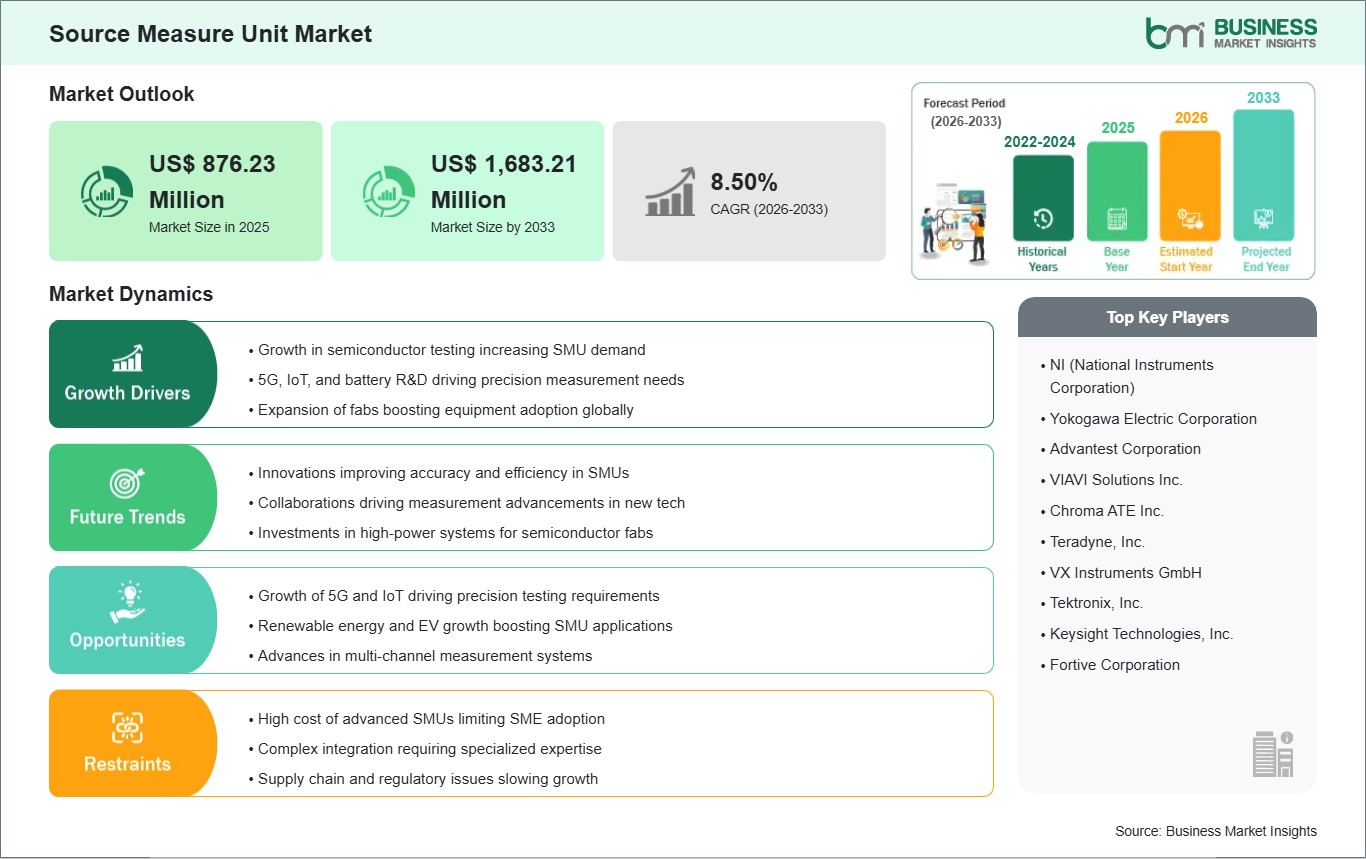
A Source Measure Unit (SMU) is a high-precision instrument that integrates the capabilities of a programmable DC power supply, a digital multimeter (DMM), a current source, and an electronic load into a single, tightly synchronized device. These technologies deliver significant economic and technical value by enabling the rapid characterization of next-generation semiconductors, offering high-throughput testing solutions for photovoltaic cells, and ensuring the battery efficiency of ultra-low-power IoT devices. Market expansion in 2026 is primarily attributed to the rising global demand for Wide Bandgap (WBG) semiconductors like SiC and GaN, the rapid electrification of the automotive industry, and the massive deployment of 5G and 6G infrastructure.
However, several challenges can restrain market growth: high initial procurement costs, particularly for multi-channel precision units that can cost tens of thousands of dollars, can limit adoption among startups and academic research labs. Stringent technical hurdles, such as the need for ultra-low noise floors and femto-ampere measurement sensitivity, lengthen the time-to-market for new hardware and increase engineering overhead. Additionally, the industry faces constraints due to interoperability issues and software complexity, where a lack of standardized communication protocols across different manufacturers can complicate the integration of SMUs into larger automated test equipment (ATE) environments.
Despite these hurdles, the market holds immense opportunities in the universal mandate for green energy and carbon neutrality and the accelerating deployment of perovskite solar cell research. The expansion of quantum computing and nanotechnology characterization and the development of compact, portable SMUs for field-based diagnostic testing are expected to create significant opportunities for market growth.
Segment Analysis
Source Measure Unit Market Segmentation
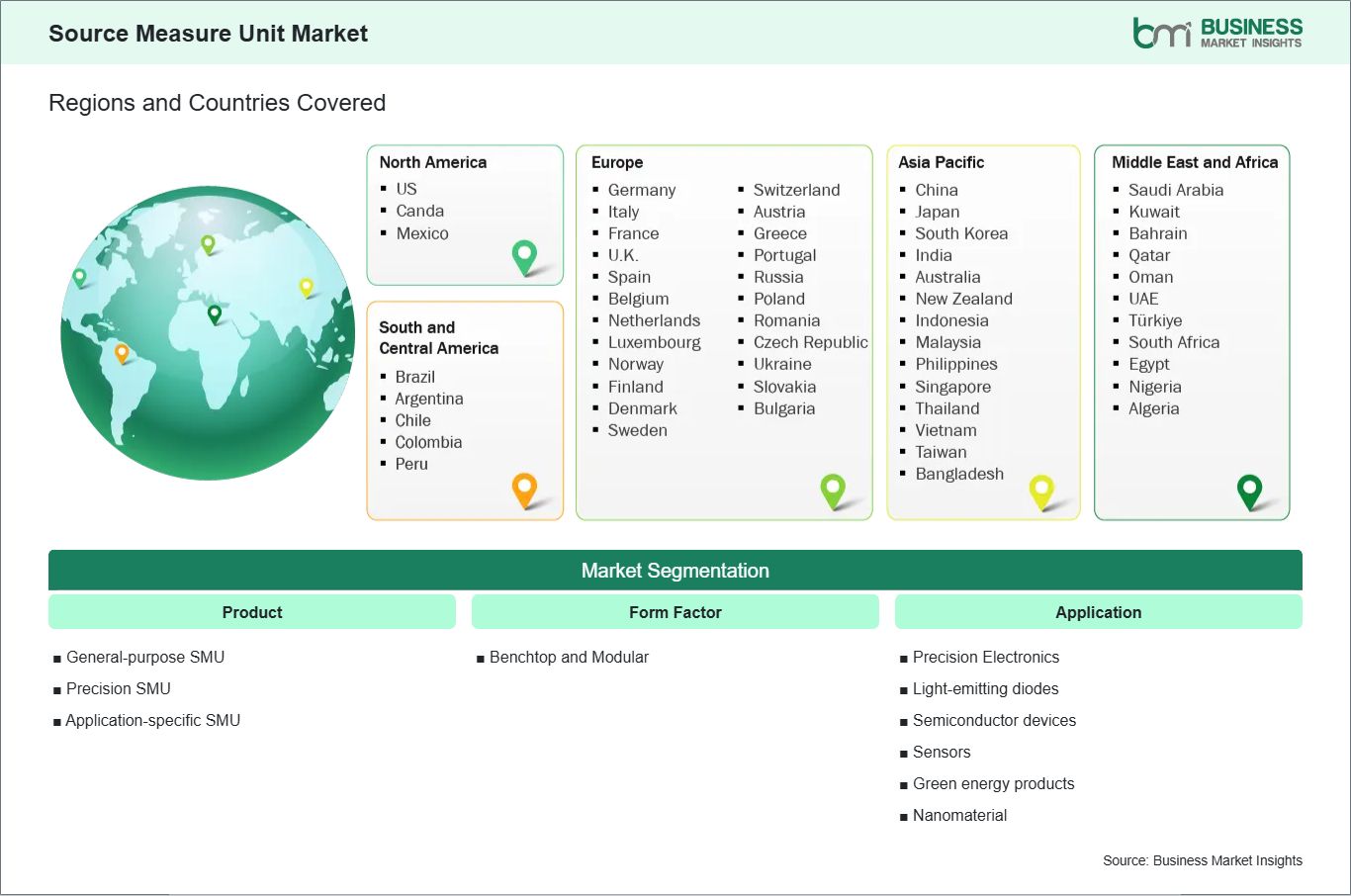
Key segments that contributed to the derivation of the Source Measure Unit market analysis are product, form factor, and application.
- By Product, the market is segmented into General-purpose SMU, Precision SMU, and Application-specific SMU.
- By Form Factor, the market is divided into Benchtop and Modular.
- By Application, the market is categorized into Precision Electronics, Light-emitting diodes, Semiconductor devices, Sensors, Green energy products, and Nanomaterial.
Market Forces
Source Measure Unit Market Drivers and Opportunities
Advancing Semiconductor Innovation and High-Precision Testing Mandates
The primary driver for the Source Measure Unit (SMU) Market is the accelerating complexity of semiconductor device architectures and the subsequent requirement for high-precision, synchronized testing. As the industry moves toward sub-5nm process nodes and integrates advanced materials like Gallium Nitride (GaN) and Silicon Carbide (SiC), traditional, multi-instrument test setups are becoming inadequate due to synchronization errors and excessive cabling. SMUs have become non-discretionary because they combine a high-precision power source with an accurate measurement instrument in a single, tightly synchronized unit, significantly reducing the cost of ownership and the risk of measurement noise. This demand is further amplified by the rapid expansion of the Electric Vehicle (EV) and Renewable Energy sectors, where SMUs are essential for validating the performance and safety of battery management systems, solar cells, and power MOSFETs. Together, these cross-industry mandates for extreme accuracy and accelerated time-to-market ensure a robust and high-velocity growth path for both benchtop and modular SMU configurations through 2026.
AI-Integrated Test Automation and 5G Infrastructure Scaling
A significant high-value opportunity lies in the convergence of Source Measure Units with AI-driven analytics and autonomous test sequencing. By integrating machine learning algorithms directly into the test workflow, manufacturers can achieve real-time "pass/fail" diagnostics and predictive yield analysis, identifying component defects weeks before they impact the final assembly. There is also a major growth frontier in the scaling of 5G and 6G telecommunications infrastructure. The deployment of massive MIMO and beamforming technologies necessitates multi-channel SMU systems that can characterize complex RF front-end modules and high-speed communication chips with sub-microampere precision. Furthermore, the rise of Nanotechnology and Quantum Computing presents a lucrative opportunity for ultra-low-noise SMUs capable of detailed material characterization at the atomic level. Manufacturers who focus on modular PXI/LXI architectures, allowing for "plug-and-play" scalability in automated test equipment (ATE) environments, and those developing software-defined SMU platforms with cloud-based data sharing are positioned to lead the most profitable segments of the global electronic test landscape.
Size and Share Analysis
Source Measure Unit Market Size and Share Analysis
The Source Measure Unit market demonstrates steady growth, with size and share analysis revealing evolving trends and competitive positioning among key players. The report further examines subsegments categorized within are product, form factor, and application, offering insights into their contribution to overall market performance.
Based on product, the Precision SMU subsegment holds a significant market share, favored for its ability to handle extremely low-level measurements in the picoampere and nanovolt ranges. Precision SMUs are indispensable for the Nanomaterial and Semiconductor devices sectors, where they are used to characterize the electrical properties of carbon nanotubes and next-generation transistors. A notable trend in 2026 is the rising adoption of Application-specific SMUs, which are tailored for high-volume testing of Light-emitting diodes (LEDs) and mobile wireless modules. These units allow manufacturers to optimize their test throughput by focusing on the specific voltage and current ranges required for high-speed production lines, reducing overall test cycle times.
Report Coverage
Source Measure Unit Market Report Coverage and Deliverables
The "Source Measure Unit Market Size and Forecast (2022 - 2033)" report provides a detailed analysis of the market covering below areas:
- Source Measure Unit market size and forecast at global, regional, and country levels for all the key market segments covered under the scope
- Source Measure Unit market trends, as well as market dynamics such as drivers, restraints, and key opportunities
- Source Measure Unit market analysis covering key market trends, global and regional framework, major players, regulations, and recent market developments
- Industry landscape and competition analysis covering market concentration, heat map analysis, prominent players, and recent developments for the Source Measure Unit market
- Detailed company profiles, including SWOT analysis
Geographic Insights
Source Measure Unit Market Geographic Insights
The geographical scope of the Source Measure Unit market report is divided into five regions: North America, Asia Pacific, Europe, Middle East and Africa, and South and Central America.
The Asia-Pacific Source Measure Unit Market is segmented into China, Japan, South Korea, India, Australia, New Zealand, Indonesia, Malaysia, the Philippines, Singapore, Thailand, Vietnam, Taiwan, Bangladesh, and the Rest of Asia. This region is emerging as the fastest-growing market globally. The expansion is primarily fueled by the rapid rollout of 5G networks and the proliferation of IoT-connected devices, which require high-precision characterization of low-power semiconductor components. China and India lead the regional growth, supported by aggressive government incentives for domestic chip manufacturing and the expansion of the consumer electronics sector, necessitating flexible and scalable modular SMU solutions.
Growth is further bolstered by a significant shift toward automated test equipment (ATE) among manufacturers looking to enhance production throughput while maintaining sub-millivolt accuracy. The integration of multi-channel SMUs into cloud-based diagnostic platforms, alongside the rising demand for efficient battery testing in the burgeoning regional EV market, solidifies Asia-Pacific as a critical hub for innovation and the future scaling of the Source Measure Unit industry.
Industry Activity
Recent Developments
The Source Measure Unit market is evaluated by gathering qualitative and quantitative data post primary and secondary research, which includes important corporate publications, association data, and databases. A few of the key developments in the Source Measure Unit market are:
- In September 2025, Tektronix launched the MP5000 Series modular precision test system, combining precision Source Measure Units (SMUs) and programmable power supplies within a compact 1U mainframe. The system supports high channel density, scalability, and automation, enabling multi-site validation and high-volume production testing with minimal downtime. This launch enhances flexibility and efficiency in precision test and measurement, strengthening innovation in the modular SMU market.
- In December 2025, esz AG calibration and metrology and Vektrex Electronic Systems announced a strategic partnership to provide authorized calibration services for Vektrex precision DC and pulse Source Measure Units (SMUs) across Europe. Under the agreement, esz AG will deliver ISO/IEC 17025 - compliant calibration and certification, reducing downtime, logistics costs, and service lead times for European customers. This partnership strengthens the SMU service ecosystem, supporting reliable testing and characterization of LED, laser, and semiconductor devices.
Trust & Transparency
Research Methodology
The market analysis combines proprietary research with secondary data from government agencies, company disclosures, regulatory filings, industry databases and expert interviews. Market estimates are validated through data triangulation, cross-market benchmarking and analyst
review.
View Full Research Methodology
Key Sources Referred:
World Bank - Global Trade Indicators World Trade Organization (WTO) International Monetary Fund (IMF) International Trade Administration (ITA) Company Websites Company Annual Reports Company Investor Presentations