Market Summary
Executive Summary and Global Market Analysis
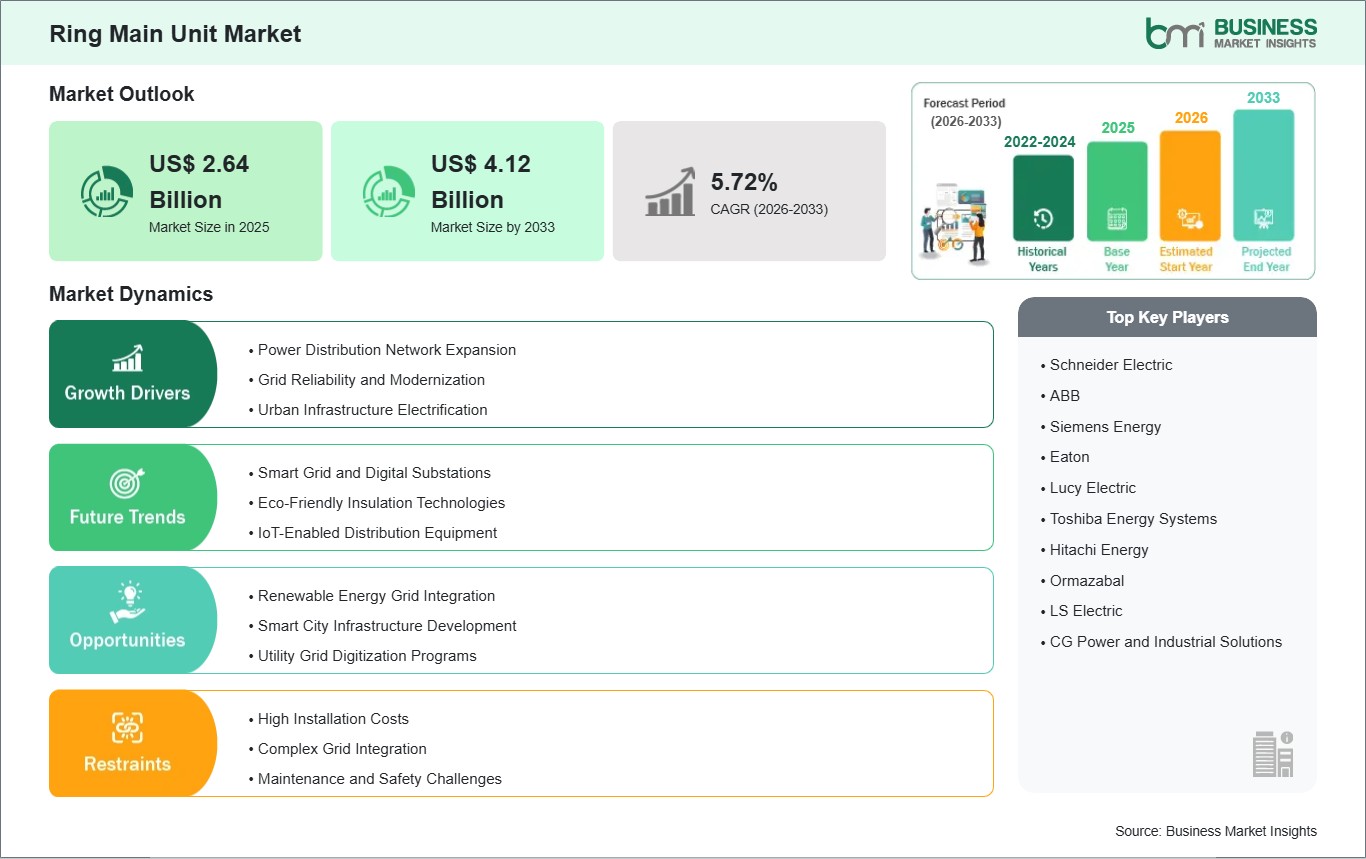
The global ring main unit (RMU) market is defined by the accelerating modernization of power distribution systems, increasing grid reliability requirements, and growing integration of renewable energy sources. RMUs—compact, modular switchgear assemblies used in medium-voltage distribution networks—enable safe sectionalizing, fault isolation, and improved network flexibility. As utilities and industrial users seek to reduce downtime, improve power quality, and support decentralized generation, RMUs are being adopted to replace antiquated switchgear and extend the lifecycle of distribution networks.
Key drivers include government programs focused on grid resilience, smart grid rollouts, and infrastructure spending that prioritizes automation, remote monitoring, and network segmentation. In developing regions, rural electrification and urban expansion projects are increasing demand for robust distribution equipment that can operate reliably in diverse environmental conditions.
Commercial strategies increasingly emphasize packaged solutions that integrate sensors, communication modules, and protective relays, enabling real-time asset monitoring and predictive maintenance. Manufacturers are also investing in enhanced safety features, eco-friendly insulating mediums, and designs that meet international standardization benchmarks.
Regulatory frameworks and grid codes in mature markets like Europe and North America are pushing towards higher performance, interoperability, and lifecycle cost optimization, further accelerating RMU adoption.
Segment Analysis
Ring Main Unit Market Segmentation
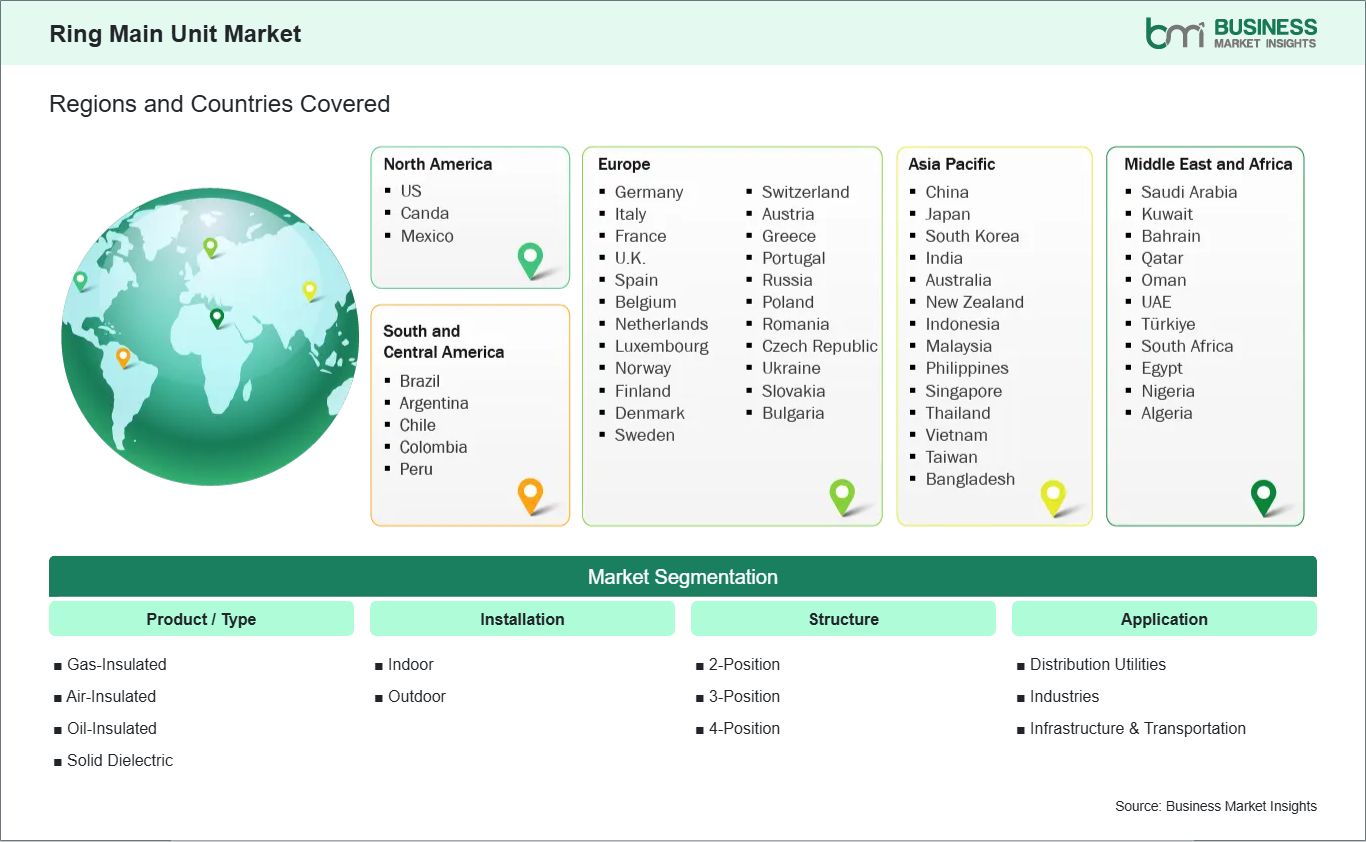
Key segments that contributed to the derivation of the ring main unit market analysis are product/type, installation, structure, application, and voltage rating.
- By type, the ring main unit market is segmented into gas-insulated, air-insulated, oil-insulated, solid dielectric. The gas-insulated subsegment dominated the market in 2025.
- By installation, the ring main unit market is segmented into indoor, outdoor. The outdoor subsegment dominated the market in 2025.
- By structure, the ring main unit market is segmented into 2-position, 3-position, 4-position. The 3-position subsegment dominated the market in 2025.
- In terms of application, the ring main unit market is segmented into distribution utilities, industries, infrastructure & transportation. The distribution utilities subsegment dominated the market in 2025.
- By voltage rating, the ring main unit market is segmented into up to 15 kV, 16–25 kV, above 25 kV. The 16–25 kV subsegment dominated the market in 2025.
Market Forces
Ring Main Unit Market Drivers and Opportunities
Expansion of Power Distribution Networks and Reliability Requirements
The primary driver of growth in the ring main unit market is the expansion and modernization of electricity distribution networks worldwide. Utilities are focusing on strengthening grid reliability and minimizing outages as electricity consumption continues to rise across residential, commercial, and industrial sectors. Ring main units enable utilities to operate distribution networks in loop configurations that improve system flexibility and fault isolation.
Urban infrastructure projects and smart city initiatives are increasing the demand for compact and automated switchgear equipment capable of supporting dense electricity distribution networks. RMUs help utilities reduce manual intervention during switching operations while ensuring reliable power delivery.
The growth of distributed energy resources such as rooftop solar and microgrids also requires advanced distribution control solutions. RMUs equipped with protection and monitoring capabilities help utilities manage bidirectional power flows while maintaining system stability.
Smart Grid Development and Renewable Integration Opportunities
The global transition toward smart grids presents significant opportunities for RMU manufacturers. Smart distribution networks require intelligent switching devices capable of real-time monitoring, automated fault isolation, and communication with distribution management systems.
Advanced RMUs equipped with sensors, communication interfaces, and digital monitoring systems enable utilities to detect faults rapidly and reconfigure network feeders automatically. These capabilities improve grid resilience and reduce outage durations.
Additionally, renewable energy integration is increasing the complexity of distribution networks. RMUs help utilities maintain operational stability by enabling flexible feeder configurations and sectional isolation when renewable generation fluctuates.
Size and Share Analysis
Ring Main Unit Market Size and Share Analysis
The Ring Main Unit Market demonstrates steady growth, with size and share analysis highlighting evolving trends and competitive dynamics among key players. The report examines subsegments categorized within product/type, installation, structure, application, and voltage rating.
By type, the gas-insulated subsegment dominated the market in 2025 driven by its compact design, high reliability, and suitability for urban power distribution networks.
Based on installation, the outdoor subsegment dominated the market in 2025 driven by widespread deployment across utility feeder networks and industrial power systems.
In terms of structure, the 3-position subsegment dominated the market in 2025 driven by its operational flexibility and cost-effectiveness for medium-voltage distribution applications.
By application, the distribution utilities subsegment dominated the market in 2025 driven by large-scale grid modernization initiatives worldwide.
By voltage rating, the 16–25 kV subsegment dominated the market in 2025 driven by its alignment with the majority of medium-voltage distribution networks globally.
Report Coverage
Ring Main Unit Market Report Coverage and Deliverables
The "Ring Main Unit Market Size and Forecast (2022 - 2033)" report provides a detailed analysis of the market covering below areas:
- Ring Main Unit Market size and forecast at global, regional, and country levels for all the key market segments covered under the scope
- Ring Main Unit Market trends, as well as drivers, restraints, and opportunities
- Ring Main Unit Market analysis covering key trends, global and regional framework, major players, regulations, and recent developments
- Industry landscape and competition analysis covering market concentration, heat map analysis, prominent players, and recent developments
- Detailed company profiles including SWOT analysis
Geographic Insights
Ring Main Unit Market Geographic Insights
The geographical scope of the Ring Main Unit Market report is divided into North America, Asia Pacific, Europe, Middle East & Africa, and South & Central America. North America held the largest share in 2025.
North America held a significant share due to robust investments in electricity infrastructure, grid reliability mandates, and modernization initiatives across aging distribution systems.
Asia Pacific is projected to record the highest CAGR during the forecast period driven by rapid urbanization, industrialization, and government-supported electrification programs in countries including China and India.
Europe demonstrates strong demand for RMUs due to smart grid investments and stringent grid reliability standards across major economies such as Germany, the UK, and France.
Middle East & Africa and South & Central America are witnessing gradual adoption supported by power infrastructure expansion and international funding programs for grid modernization.
Industry Activity
Recent Developments
The Ring Main Unit Market is evaluated by gathering qualitative and quantitative data post primary and secondary research, which includes important corporate publications, association data, and databases. A few of the key developments in the ring main unit market are:
- In November 2025, Schneider Electric introduced a new line of compact, IoT‑enabled Ring Main Units (RMUs) tailored for smart distribution networks. These RMUs integrate advanced sensors and connectivity features, enabling utilities to monitor performance in real time and carry out predictive maintenance. The compact design makes them ideal for urban environments where space is limited, while the IoT capabilities align with the growing demand for digital substations and smart city infrastructure. This launch reinforced Schneider’s strategy of combining energy efficiency with digital innovation in medium‑voltage distribution.
- In August 2025, ABB Ltd. unveiled its next‑generation gas‑insulated RMUs, emphasizing enhanced safety and remote control functionality. The new units feature advanced arc‑resistant designs to protect operators and ensure reliability in critical applications. With integrated digital interfaces, utilities can remotely monitor and control operations, improving flexibility and reducing downtime. ABB’s focus on modularity also allows these RMUs to be adapted to diverse industrial and utility environments.
Trust & Transparency
Research Methodology
The market analysis combines proprietary research with secondary data from government agencies, company disclosures, regulatory filings, industry databases and expert interviews. Market estimates are validated through data triangulation, cross-market benchmarking and analyst
review.
View Full Research Methodology
Key Sources Referred:
International Energy Agency (IEA)International Electrotechnical Commission (IEC)Institute of Electrical and Electronics Engineers (IEEE)United Nations Economic Commission for Europe (UNECE)World Bank