Market Summary
Executive Summary and Global Market Analysis
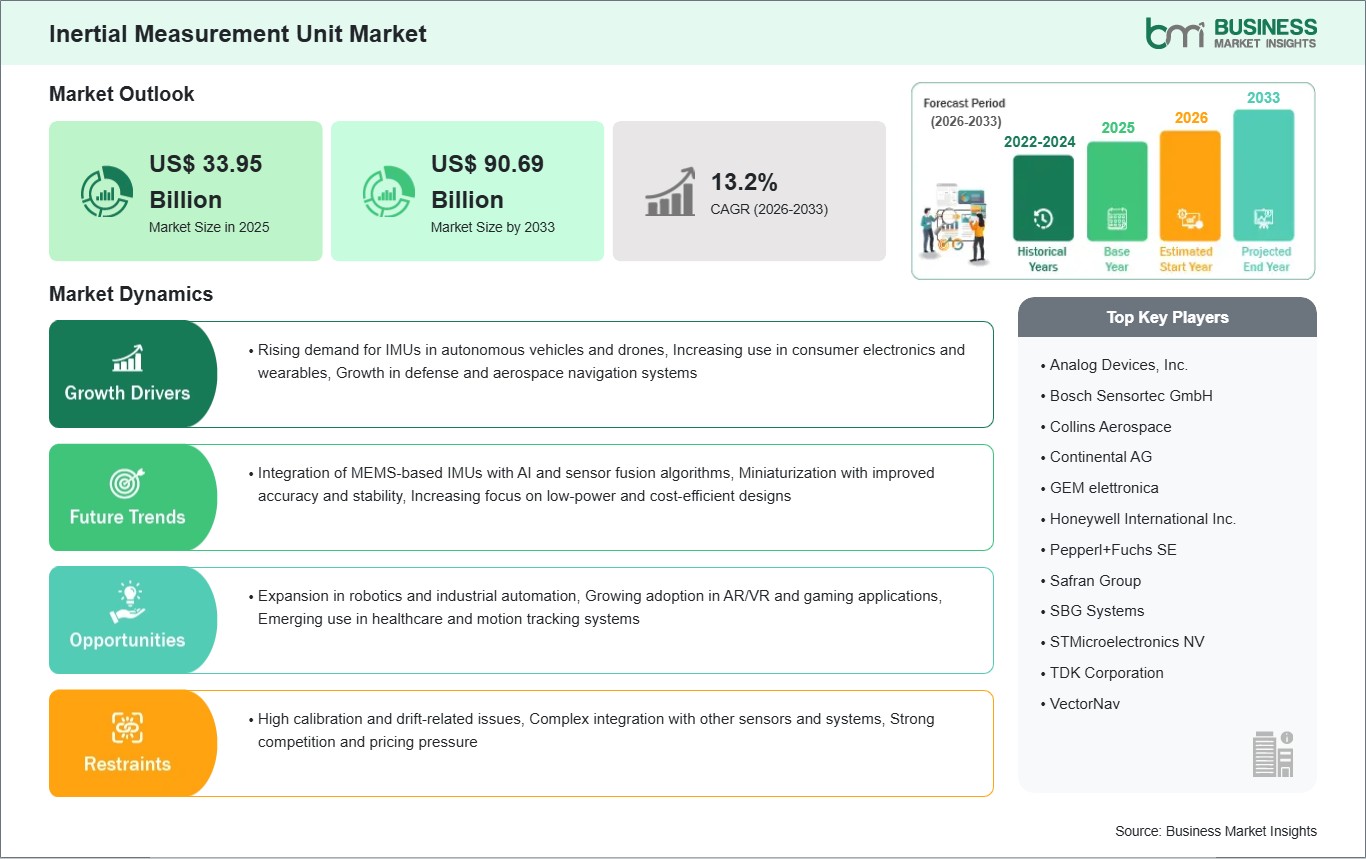
Inertial Measurement Units (IMUs) are self-contained electronic devices engineered to detect and quantify an object`s specific force, angular rate, and orientation relative to an inertial frame of reference. These units typically integrate a triad of accelerometers and a triad of gyroscopes, often supplemented by a magnetometer to provide a comprehensive nine-axis motion profile. Market progression is fundamentally propelled by the modernization of global defense hardware and the surging demand for unmanned aerial vehicles (UAVs). Furthermore, the rapid miniaturization of high-precision sensors for autonomous automotive platforms and consumer-grade augmented reality (AR) hardware serves as a primary catalyst for sustained demand.
However, several factors may restrain market progression. The technical challenge of cumulative bias drift, where small measurement errors accumulate over time, remains a significant hurdle for long-duration missions without external correction. Regulatory and export restrictions, such as ITAR in the United States, can limit the cross-border distribution of tactical and space-grade units. Additionally, the industry faces challenges related to high production costs for radiation-hardened and high-stability sensors, as well as the scarcity of specialized semiconductors required for advanced signal processing in extreme environments.
Despite these hurdles, the market holds significant opportunities in the emergence of Quantum IMUs (Cold-Atom Sensors), which offer unprecedented stability and resistance to jamming. The rise of 5G-enabled sensor fusion for industrial robotics and the expansion of NewSpace satellite constellations requiring low-cost, high-reliability navigation are expected to support long-term development. Manufacturers are also finding growth potential in the commercial maritime sector, specifically for dynamic positioning systems in offshore energy exploration.
Segment Analysis
Inertial Measurement Unit Market Segmentation
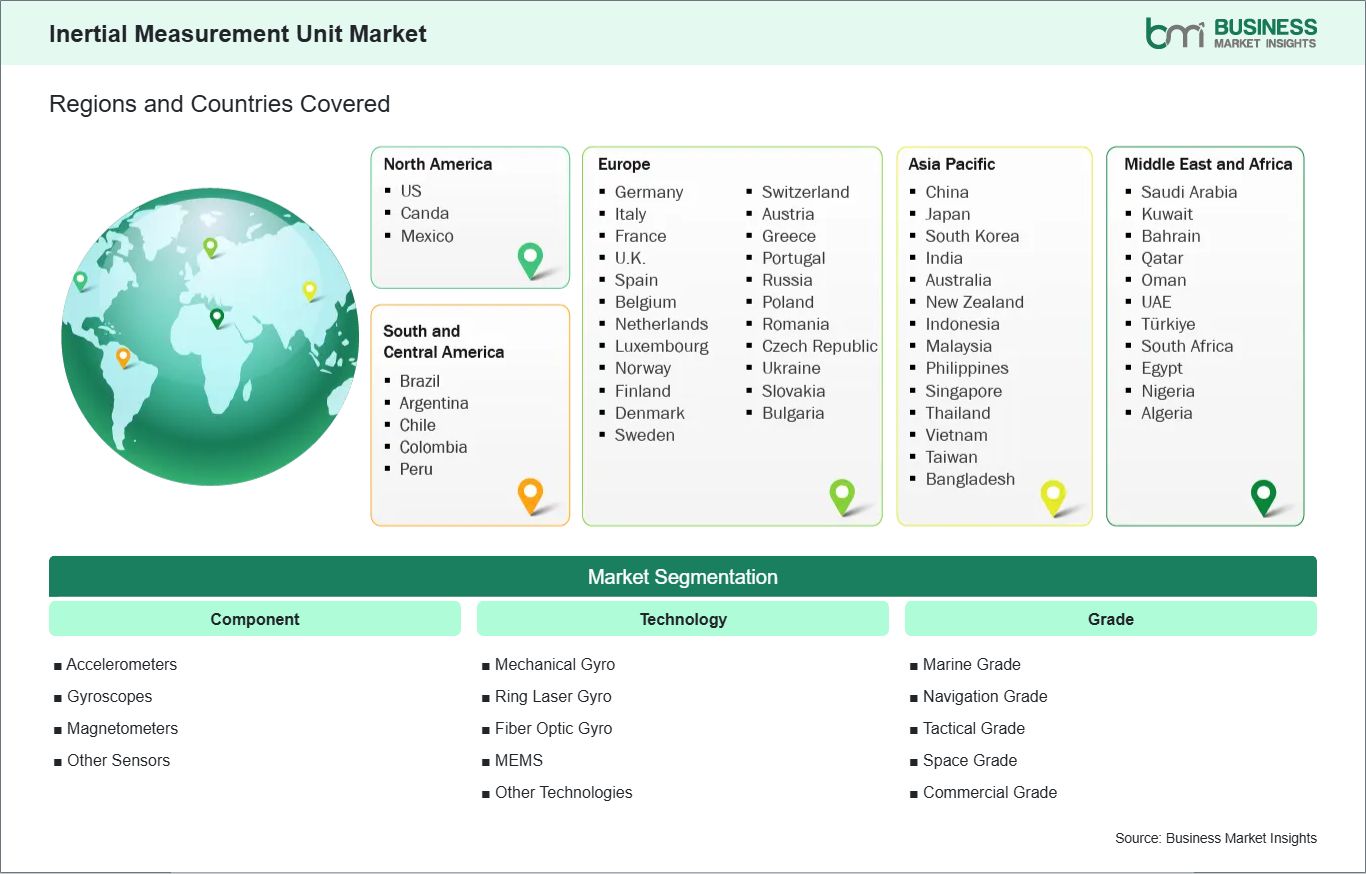
Key segments that contributed to the derivation of the Inertial Measurement Unit market analysis are component, technology, grade, platform, and end user.
- By Component, the market is segmented into Accelerometers, Gyroscopes, Magnetometers, and Other sensors.
- By Technology, the market is divided into Mechanical Gyro, Ring Laser Gyro, Fiber Optic Gyro, MEMs, and Others.
- By Grade, the market is categorized into Marine Grade, Navigation Grade, Tactical Grade, Space Grade, and Commercial Grade.
- By Platform, the market is segmented into Aircraft, Missiles, Satellites/Space Vehicles, Marine Vessels, Military Vehicles, Unmanned Aerial Vehicles (UAVs), Unmanned Ground Vehicles (UGVs), Unmanned Marine Vehicles (UMVs), Consumer Electronics, Automotive, and Advanced Air Mobility.
- By End User, the market is divided into Aerospace and Defense and Commercial.
Market Forces
Inertial Measurement Unit Market Drivers and Opportunities
Surge in Autonomous Mobility and High-Volume Consumer Demand
The primary driver for the Inertial Measurement Unit Market is the systemic global requirement for accurate navigation and stabilization in environments where traditional GPS signals are unreliable or unavailable. The Rapid Advancement of Autonomous and Connected Vehicles acts as a foundational catalyst, as IMUs provide the critical ground truth for vehicle orientation and motion, serving as a non-discretionary safety layer when visual sensors or LiDAR are obscured by weather or complex terrain. This momentum is further propelled by High-Volume Production and Shipment of Advanced Smartphones and Wearables; these devices increasingly rely on sophisticated IMUs for features ranging from augmented reality (AR) and gaming to biometric fitness tracking and personal navigation. In the technological sphere, the Expansion of the Global Unmanned Aerial Vehicle (UAV) and Drone Sector serves as a vital driver, as the proliferation of both commercial delivery drones and military surveillance platforms requires lightweight, high-reliability units for flight stabilization and precision maneuvering. Furthermore, the Modernization of Defense and Aerospace Infrastructure is compelling investments in tactical-grade IMUs for guided munitions, missiles, and space launch vehicles, where maintaining precise trajectory in signal-denied environments is paramount. Together, these factors, automotive autonomy, consumer electronics growth, and defense modernization, ensure a robust and essential growth path for the global Inertial Measurement Unit Market.
AI-Native Sensor Fusion and the Rise of Immersive Digital Realities
A significant high-value opportunity lies in the convergence of IMU Hardware with Edge-AI Processing and Digital Twin Architectures. Next-generation Intelligent IMUs with Built-in AI Algorithms are being developed to perform real-time data fusion and adaptive calibration, which significantly reduces gyroscope drift and enhances the accuracy of long-term motion tracking. There is also a major growth frontier in the development of Sophisticated Sensors for Augmented and Virtual Reality (AR/VR); as the demand for immersive gaming and enterprise simulation expands, the requirement for ultra-low latency IMUs that can synchronize head and limb movements with virtual environments is accelerating. Furthermore, the expansion of Inertial Navigation for Industrial Robotics and Automation presents a lucrative opportunity, as cobots and automated guided vehicles (AGVs) in smart factories require precise spatial awareness to operate safely alongside human workers. Beyond terrestrial applications, the rise of Space-Grade IMUs for Small Satellite Constellations offers a unique frontier, providing the necessary guidance for Earth observation and global telecommunications networks. Manufacturers who focus on Sub-Degree-Per-Hour Bias Stability and those pioneering Quantum-Enhanced Inertial Sensors are positioned to lead the global Inertial Measurement Unit Market.
Size and Share Analysis
Inertial Measurement Unit Market Size and Share Analysis
Inertial Measurement Unit Market Size and Share Analysis
The Inertial Measurement Unit market demonstrates steady growth, with size and share analysis revealing evolving trends and competitive positioning among key players. The report examines subsegments categorized within component, technology, grade, platform, and end user, offering insights into their contribution to overall market performance.
Based on component, the Gyroscopes subsegment holds the primary market presence within the IMU market, accounting for the largest share of total value. Their critical role in measuring angular velocity and orientation makes them indispensable across navigation, aerospace, robotics, and consumer electronics. Gyroscopes provide the foundational data required for stability and directional accuracy, ensuring reliable performance in both dynamic and static environments. Their precision and durability have positioned them as the backbone of motion sensing technology. As industries increasingly demand advanced navigation and control systems, the gyroscopes subsegment continues to anchor growth and maintain its dominant influence.
Report Coverage
Inertial Measurement Unit Market Report Coverage and Deliverables
The "Inertial Measurement Unit Market Size and Forecast (2022 - 2033)" report provides a detailed analysis of the market covering below areas:
- Market size and forecast at global, regional, and country levels for all market segments covered under the scope
- Market trends, as well as drivers, restraints, and opportunities
- Market analysis covering key trends, global and regional framework, major players, and recent developments
- Market concentration, heat map analysis, prominent players, and recent developments
- Detailed company profiles, including SWOT analysis
Geographic Insights
Inertial Measurement Unit Market Geographic Insights
The geographical scope of the Inertial Measurement Unit market report is divided into five regions: North America, Asia Pacific, Europe, Middle East & Africa, and South & Central America.
North America maintains the preeminent market position, supported by substantial defense budgets and a mature aerospace industry that prioritizes high-precision navigation and guidance systems. Asia Pacific is identified as the fastest-growing region, propelled by the massive production of consumer electronics and the rapid expansion of autonomous vehicle initiatives across major manufacturing hubs. Europe represents a sophisticated market characterized by rigorous safety standards and the integration of advanced inertial sensors within the high-end automotive and industrial robotics sectors.
The Asia-Pacific Inertial Measurement Unit Market serves as a vital engine for global industry growth, driven by the concentration of semiconductor and electronics manufacturing in China, Japan, and South Korea. These nations are leading the transition toward MEMS-based (Micro-Electro-Mechanical Systems) integration in smartphones, wearables, and commercial drones. India is witnessing a notable expansion, marked by significant investments in domestic space exploration and the modernization of military hardware. The region benefits from a burgeoning middle class and an increasing institutional focus on Smart Factory initiatives that rely on precise motion sensing and robotic automation.
Industry Activity
Recent Developments
The Inertial Measurement Unit market is evaluated by gathering qualitative and quantitative data post primary and secondary research, which includes important corporate publications, association data, and databases. A few of the key developments in the Inertial Measurement Unit market are:
- In April 2025, Thales announced a next-generation TopAxyz IMU combining 3-axis Ring Laser Gyro and MEMS accelerometers for resilient navigation. The unit is 20% smaller, 10% lighter, and has lower power, maintaining best-in-class performance for civil and military applications. First customer deliveries are expected in early p 2026, supporting large-scale production and enhanced navigation reliability under GPS-jamming conditions.
- In May 2025, Epson launched volume production of the M-G355QDG0 functional safety IMU, compliant with IEC 61508 SIL1 standards. The one-inch IMU is designed for navigation systems, unmanned vehicles, and industrial equipment, offering high stability, precision, and reliability. This launch expands Epson`s IMU lineup, supporting industrial applications that demand functionally safe inertial sensing.
Trust & Transparency
Research Methodology
The market analysis combines proprietary research with secondary data from government agencies, company disclosures, regulatory filings, industry databases and expert interviews. Market estimates are validated through data triangulation, cross-market benchmarking and analyst
review.
View Full Research Methodology
Key Sources Referred:
World Bank & Global Trade IndicatorsWorld Trade Organization (WTO)(International Monetary Fund )IMFInternational Trade Administration (ITA)Company websiteCompany annual reportsCompany investor presentations