Market Summary
Executive Summary and Global Market Analysis
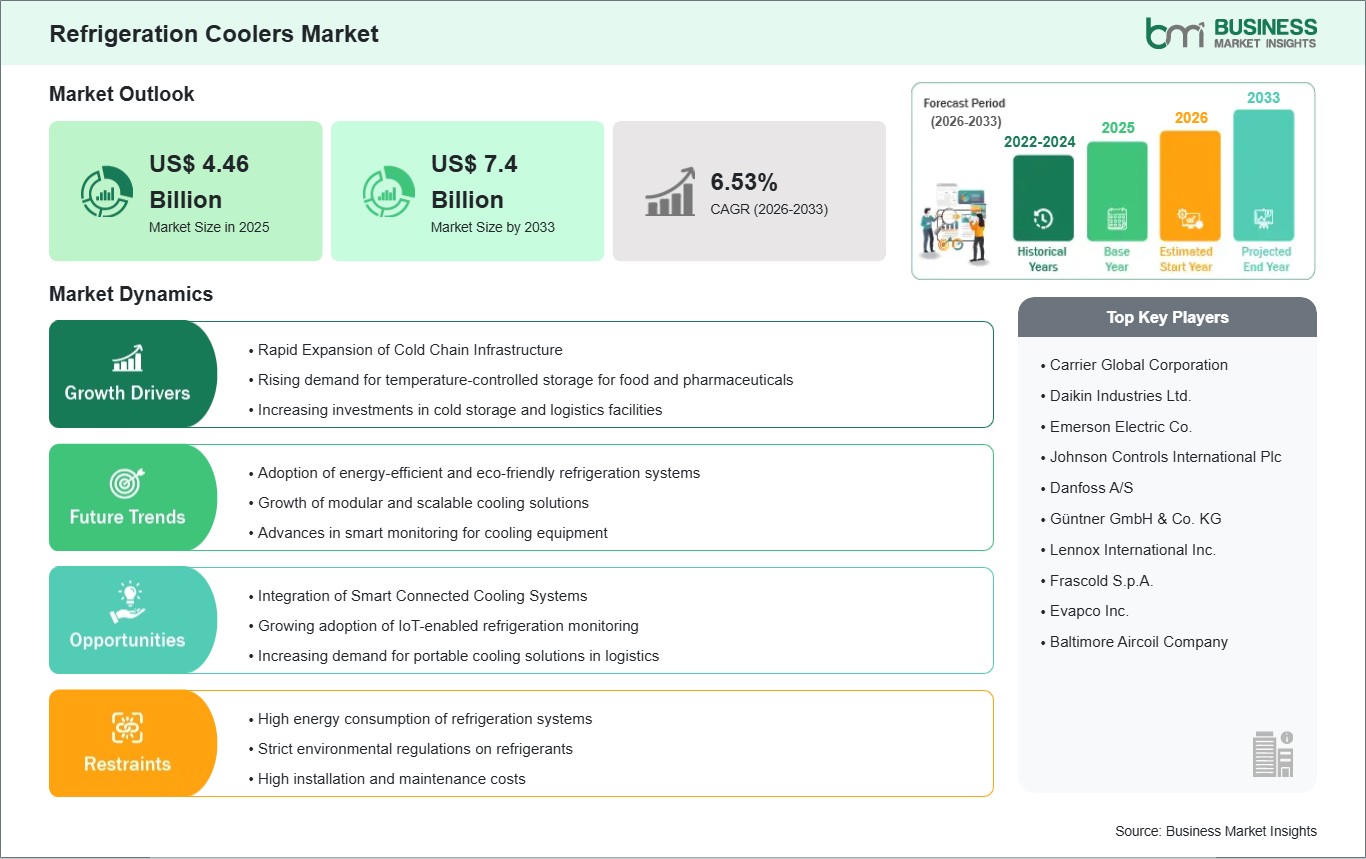
The global refrigeration coolers market is experiencing strong growth as businesses across end-use industries invest in advanced cooling solutions to meet rising demand for temperature-controlled storage, display, and transport of perishable goods. Refrigeration coolers — including compressors, condensers, evaporators, and air coolers — are core components of cold chain systems used extensively in food & beverage processing, retail outlets, healthcare and pharmaceutical storage, and logistics & warehousing.
Emphasis on food safety, quality preservation, and compliance with regulatory standards drives equipment upgrades to efficient, reliable coolers capable of long-term performance and lower operating costs. Smart, modular, and scalable solutions with real-time monitoring are gaining traction, while Asia-Pacific remains a high-growth market due to industrial expansion and cold supply chain deployment.
Segment Analysis
Refrigeration Coolers Market Segmentation
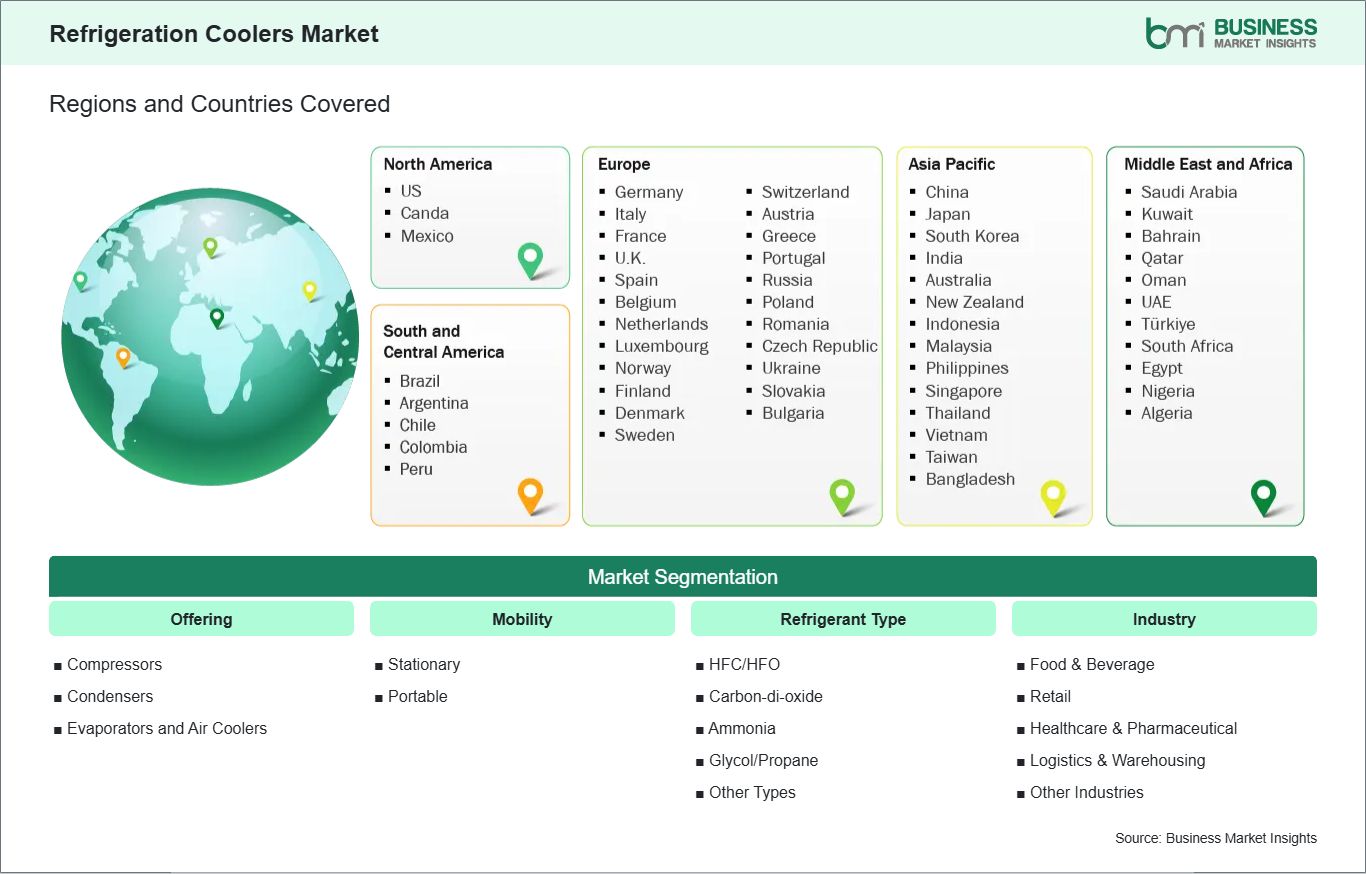
Key segments that contributed to the derivation of refrigeration coolers market analysis include offering, mobility, refrigerant type, and industry.
- By Offering, Compressors, Condensers, Evaporators and Air Coolers. Evaporators & Air Coolers dominated in 2025.
- By Mobility, Stationary, Portable. Stationary dominated in 2025.
- By Refrigerant Type, HFC/HFO, CO₂, Ammonia, Glycol/Propane, Others. HFC/HFO dominated in 2025.
- By Industry, Food & Beverage, Retail, Healthcare & Pharmaceutical, Logistics & Warehousing, Other Industries. Food & Beverage dominated in 2025.
Market Forces
Refrigeration Coolers Market Drivers and Opportunities
Rapid Expansion Of Cold Chain Infrastructure
Growth is driven by expanding cold chain infrastructure worldwide. Rising demand for fresh/frozen foods, retail, and e-commerce penetration encourages investment in advanced refrigeration coolers to mitigate spoilage, preserve quality, and maintain food safety. Healthcare and pharmaceutical sectors require precise temperature control for vaccines, medicines, and biologics. Environmental regulations and efficiency standards, especially in the EU and North America, are phasing down high-GWP refrigerants, prompting development of eco-friendly solutions using CO₂, ammonia, and propane.
Integration Of Smart, Connected Cooling Systems
IoT-enabled smart coolers with remote monitoring, predictive maintenance, and analytics present opportunities to optimize energy use and compliance. Portable coolers for transportation/logistics add growth potential. Adoption of natural refrigerants under regulatory pressure drives innovation in energy-efficient, sustainable cooling technologies. Strategic partnerships with logistics providers, healthcare distributors, and retail chains enhance market penetration across industries.
Size and Share Analysis
Refrigeration Coolers Market Size and Share Analysis
The Refrigration Coolers Market demonstrates steady growth, with size and share analysis highlighting evolving trends and competitive dynamics among key players. The report examines subsegments categorized within product, usability, and application, offering insights into their contribution to overall market performance.
By Offering, the evaporators and air coolers subsegment dominated the market in 2025, driven by widespread use for internal air distribution and temperature uniformity.
By Mobility, the stationary subsegment dominated the market in 2025, driven by its extensive use in fixed retail and industrial environments.
By Refrigerant Type, the HFC/HFO subsegment dominated the market in 2025, driven by established prevalence and supply chain maturity.
By Industry, the food & beverage subsegment dominated the market in 2025, driven by demand for fresh and frozen food storage and display infrastructure.
Report Coverage
Refrigeration Coolers Market Report Coverage and Deliverables
The "Refrigration Coolers Market Size and Forecast (2022 - 2033)" report provides a detailed analysis of the market covering below areas:
- Refrigration Coolers Market size and forecast at global, regional, and country levels for all the key market segments covered under the scope
- Refrigration Coolers Market trends, as well as drivers, restraints, and opportunities
- Refrigration Coolers Market analysis covering key trends, global and regional framework, major players, regulations, and recent developments
- Industry landscape and competition analysis covering market concentration, heat map analysis, prominent players, and recent developments for the Refrigration Coolers Market
- Detailed company profiles, including SWOT analysis
Geographic Insights
Refrigeration Coolers Market Geographic Insights
The geographical scope of the Refrigration Coolers Market report is divided into North America, Asia Pacific, Europe, Middle East & Africa, and South & Central America. North America held the largest share in 2025.
North America held significant share in 2025 due to advanced retail infrastructure, strong cold chain logistics networks, and stringent food safety and energy efficiency regulations. Widespread adoption of energy‑efficient refrigeration standards and government initiatives to reduce GWP emissions are influencing rapid equipment modernization.
Europe follows closely, supported by strong regulatory frameworks promoting eco‑friendly refrigerants and energy‑efficient cooling solutions. Countries such as Germany, the UK, and France are proactive in implementing green refrigeration mandates, driving demand for low‑GWP refrigeration coolers compatible with CO₂ and natural refrigerants.
Asia Pacific is forecast to witness the fastest growth rate over the outlook period due to rapid urbanization, expanding food retail chains, booming e‑commerce logistics, and increased healthcare infrastructure investment. Nations such as China, India, Japan, and South Korea are scaling cold chain infrastructure to support perishable goods storage and distribution, creating robust demand for commercial and industrial refrigeration units.
Middle East & Africa and South & Central America demonstrate steady growth as food & beverage consumption rises, and cold storage facilities expand to meet supply chain needs. Emerging logistics hubs in these regions are focusing on modern refrigeration technologies to ensure product quality in hot climates and remote areas.
Industry Activity
Recent Developments
The Refrigration Coolers Market is evaluated by gathering qualitative and quantitative data post primary and secondary research, which includes important corporate publications, association data, and databases. A few of the key developments in the refrigration coolers market are:
- In March 2026, Heatcraft, a U.S. manufacturer owned by Lennox International, introduced a 90 bar CO₂ low‑profile cooler and a 15 HP CO₂ condensing unit at the AHR Expo 2026 in Las Vegas. The products are designed for walk‑in coolers and industrial refrigeration applications and support expanded training programs at Heatcraft’s Georgia facility covering CO₂ systems and certification courses for technicians.
- In October 2025, Frascold to showcase sustainable compressor technologies at Refrigera 2025. Frascold announced participation in Refrigera 2025 (5 - 7 Nov) in Bologna, Italy, where it will present new semi‑hermetic piston and screw compressors for refrigeration and air conditioning. Showcased technologies include ATEX‑HT series and CO₂ Two‑Stage range, highlighting the company’s push toward natural refrigerants and decarbonisation across cold chain systems.
Trust & Transparency
Research Methodology
The market analysis combines proprietary research with secondary data from government agencies, company disclosures, regulatory filings, industry databases and expert interviews. Market estimates are validated through data triangulation, cross-market benchmarking and analyst
review.
View Full Research Methodology
Key Sources Referred:
International Electrotechnical Commission (IEC)International Organization for Standardization (ISO)American Society of Heating, Refrigerating and Air-Conditioning Engineers (ASHRAE)United Nations Environment Programme (UNEP)Environmental Protection Agency (EPA)European Environment Agency (EEA)