Market Summary
Executive Summary and Global Market Analysis
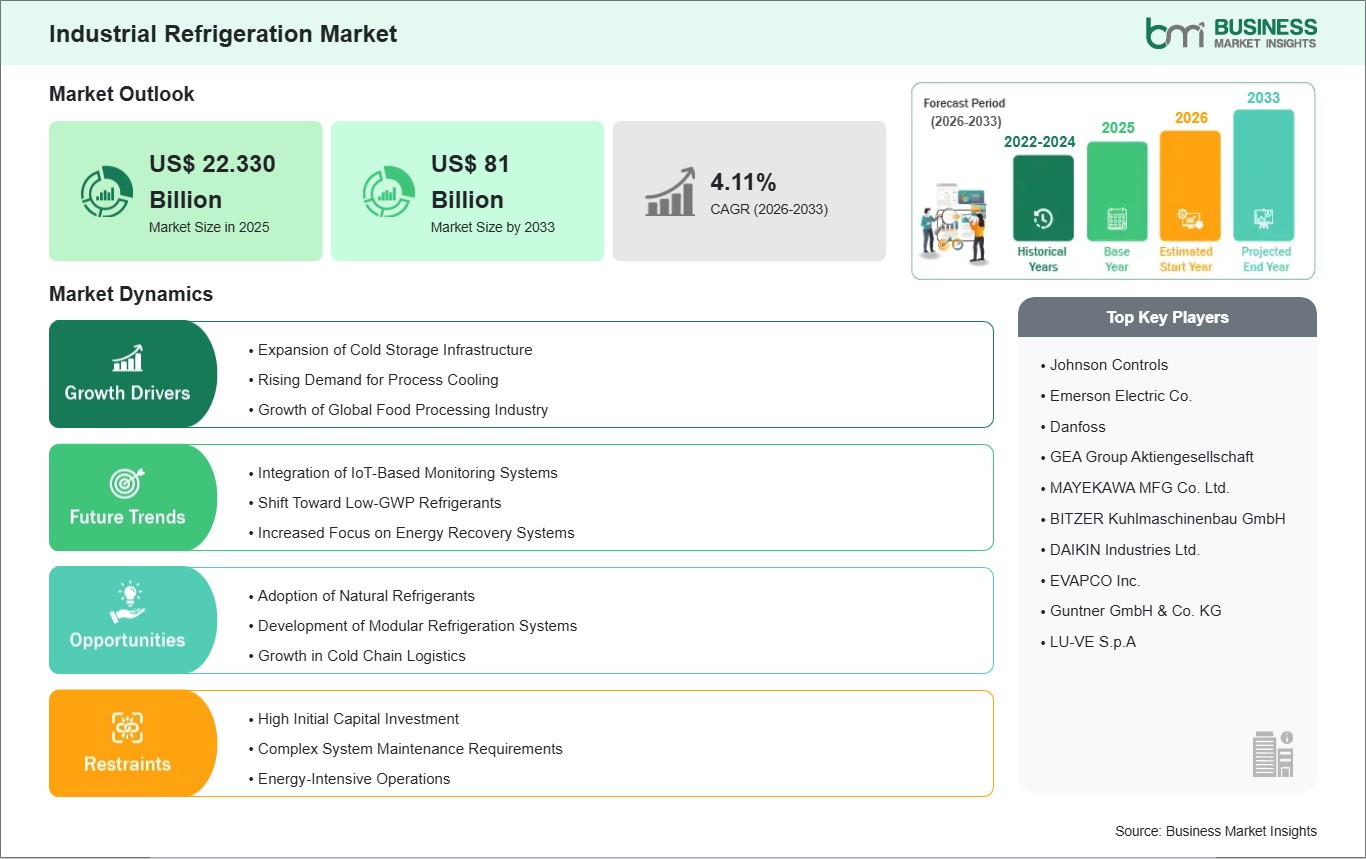
The global industrial refrigeration market is experiencing consistent growth, propelled by the expansion of the cold chain logistics sector, stringent food safety regulations, and increasing demand from processing industries. Industrial refrigeration systems are critical for preserving perishable goods, maintaining precise temperatures in chemical processes, and supporting large-scale storage and distribution networks.
Key drivers include the rapid growth of the organized food retail and processing sector, which demands reliable and efficient cold storage, and the global pharmaceutical industry's need for temperature-controlled supply chains. Furthermore, the enforcement of international environmental regulations, such as the Kigali Amendment, is accelerating the transition to low-GWP (Global Warming Potential) refrigerants. The market faces challenges such as high initial capital investment, complex system maintenance, and the ongoing phasedown of hydrofluorocarbon (HFC) refrigerants. However, significant opportunities are emerging from technological advancements in energy-efficient compressors and heat exchangers, the integration of IoT for predictive maintenance, and the rising demand for natural refrigerant-based systems in sustainable cold chain infrastructure.
Segment Analysis
Industrial Refrigeration Market Segmentation
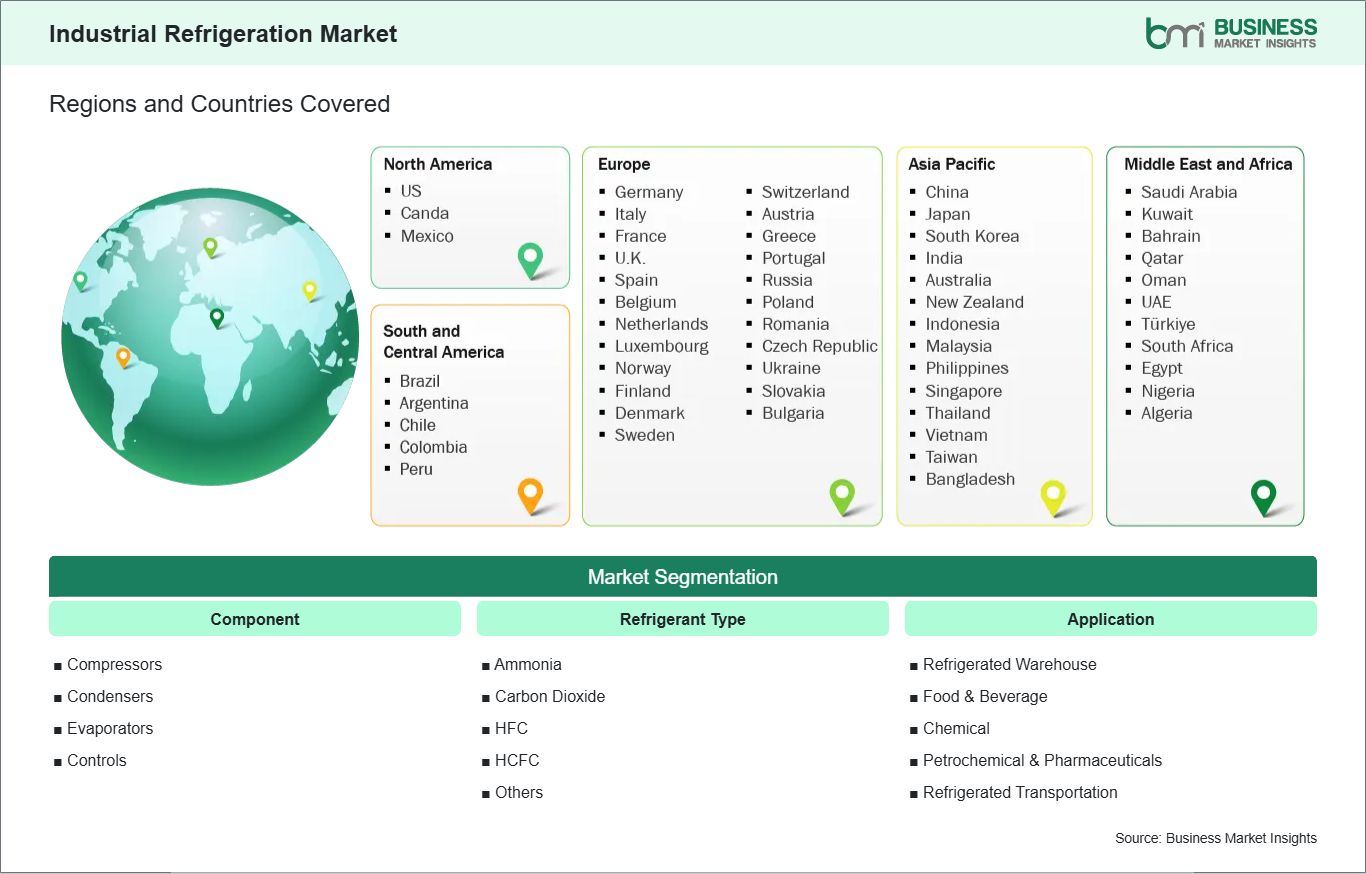
Key segments that contributed to the derivation of the industrial refrigeration market analysis are component, refrigerant type, and application.
- By component, the industrial refrigeration market is segmented into compressors, condensers, evaporators, and controls. The compressors segment dominated the market in 2024.
- By refrigerant type, the market is classified into ammonia, carbon dioxide, HFC, HCFC, and others. The ammonia segment held the largest share in the industrial refrigeration market in 2024.
- By application, the market includes refrigerated warehouse, food & beverage, chemical, petrochemical & pharmaceuticals, and refrigerated transportation. The food & beverage segment held the largest share in the industrial refrigeration market in 2024.
Market Forces
Industrial Refrigeration Market Drivers and Opportunities
Expansion of Cold Chain Logistics and Food Safety Standards
The relentless global expansion of cold chain logistics, driven by rising consumer demand for perishable foods, pharmaceuticals, and vaccines, represents a primary growth engine for the industrial refrigeration market. Stringent international food safety standards and regulations mandate consistent temperature control from production to point-of-sale, necessitating robust refrigeration systems in processing plants, distribution centers, and refrigerated transportation. The growth of e-commerce grocery delivery and the globalization of food supply chains further amplify this demand. This trend is not only increasing the volume of new system installations but also driving the modernization and expansion of existing refrigerated warehouse and transport fleets, creating sustained, long-term demand for efficient and reliable industrial refrigeration solutions across the entire value chain.
Transition to Natural and Low-GWP Refrigerants
The global push for environmental sustainability and regulatory compliance is creating a substantial opportunity centered on the transition away from synthetic, high-GWP refrigerants. International agreements like the Kigali Amendment to the Montreal Protocol are mandating the phasedown of HFCs, compelling industries to adopt eco-friendly alternatives. This regulatory shift is accelerating investment in systems designed for natural refrigerants such as ammonia (R717) and carbon dioxide (R744), which have minimal ozone depletion and global warming impact. This transition drives demand for new, specially engineered components, system retrofits, and entirely new installations. It fosters innovation in system design for safety and efficiency, opens new service and maintenance revenue streams, and allows technology leaders to capture market share by offering future-proof, compliant, and sustainable refrigeration solutions.
Size and Share Analysis
Industrial Refrigeration Market Size and Share Analysis
Based on component, the industrial refrigeration market is segmented into compressors, condensers, evaporators, and controls. Compressors lead the segment as they are the core energy-consuming component of any refrigeration cycle, with continuous innovation focused on improving their efficiency, variable-speed operation, and reliability across diverse industrial applications.
Based on refrigerant type, the market is classified into ammonia, carbon dioxide, HFC, HCFC, and others. Ammonia remains the dominant refrigerant for large-scale industrial applications due to its superior thermodynamic properties, zero ODP (Ozone Depletion Potential), and low cost, though carbon dioxide systems are experiencing faster growth driven by sustainability mandates in commercial and sub-industrial applications.
By application, the market includes refrigerated warehouse, food & beverage, chemical, petrochemical & pharmaceuticals, and refrigerated transportation. The food & beverage sector continues to be the largest segment, fueled by global population growth and changing consumption patterns. The chemical & pharmaceutical segment is also significant, requiring highly precise and reliable temperature control for production and storage processes.
Report Coverage
Industrial Refrigeration Market Report Coverage and Deliverables
The Industrial Refrigeration Market Size and Forecast (2022–2033) report provides a detailed analysis of the market covering below areas:
- Industrial Refrigeration Market size and forecast at global, regional, and country levels for all the key market segments covered under the scope
- Industrial Refrigeration Market trends, as well as market dynamics such as drivers, restraints, and key opportunities
- Industrial Refrigeration Market analysis covering key market trends, global and regional framework, major players, regulations, and recent market developments
- Industry landscape and competition analysis covering market concentration, heat map analysis, prominent players, and recent developments for the industrial refrigeration market
- Detailed company profiles, including SWOT analysis
Geographic Insights
Industrial Refrigeration Market Geographic Insights
The Asia-Pacific region is the largest and fastest-growing market for industrial refrigeration, driven by its rapidly expanding food processing sector, massive investments in cold storage infrastructure, and growing pharmaceutical manufacturing. Countries such as China, India, Japan, and Southeast Asian nations are witnessing booming demand for refrigerated warehouses and transportation to support domestic consumption and agricultural exports, supported by government initiatives to reduce food waste and improve food security.
North America remains a mature yet technologically advanced market, characterized by stringent FDA and USDA regulations that mandate high standards for food safety and cold chain integrity. The United States and Canada have well-established, large-scale cold storage networks. They are early adopters of energy-efficient and natural refrigerant technologies, driven by sustainability goals and the need to modernize aging infrastructure.
Europe represents a highly regulated and innovation-focused market, where strict environmental directives like the F-Gas Regulation are accelerating the shift to low-GWP refrigerants. Germany, France, the United Kingdom, and Italy lead the region with advanced food & beverage and pharmaceutical industries that demand precise, reliable, and eco-friendly refrigeration solutions, fostering a strong market for system upgrades and new sustainable installations.
Industry Activity
Recent Developments
The Industrial Refrigeration Market is evaluated by gathering qualitative and quantitative data post primary and secondary research, which includes important corporate publications, association data, and databases. A few of the key developments in the industrial refrigeration market are:
- In July 2025, Robertshaw, a global leader in the design and manufacture of industrial control products and systems, and a recognized technology leader in thermal and flow control solutions, announced the launch of its 2025 Ranco® commercial refrigeration line. This upgraded line—featuring important new products and enhancements to existing ones—continues the legacy of innovation from the Ranco business, which was founded in 1913.
- In September 2024, Carrier Transicold announced the commercial launch of a new version of its Vector® HE 19 unit at IAA Transportation 2024 in Hanover, Germany. Featuring a new refrigerant with low global warming potential (GWP) and compatible with hydrogenated vegetable oil (HVO) biofuel or B100 biofuel, this refrigeration solution for semi-trailers has been designed to significantly reduce carbon dioxide (CO2) emissions while maintaining exceptional performance. Carrier Transicold is part of Carrier Global Corporation (NYSE: CARR), a global leader in intelligent climate and energy solutions.
Trust & Transparency
Research Methodology
The market analysis combines proprietary research with secondary data from government agencies, company disclosures, regulatory filings, industry databases and expert interviews. Market estimates are validated through data triangulation, cross-market benchmarking and analyst
review.
View Full Research Methodology
Key Sources Referred:
World Bank – Global Trade Indicators
World Trade Organization (WTO)
(International Monetary Fund )IMF
International Trade Administration (ITA)
Company website
Company annual reports
Company investor presentations