
Fuel Cell Market Outlook: Size, Share, Trends, Growth Analysis, Competitive Landscape & Forecast, 2026-2033

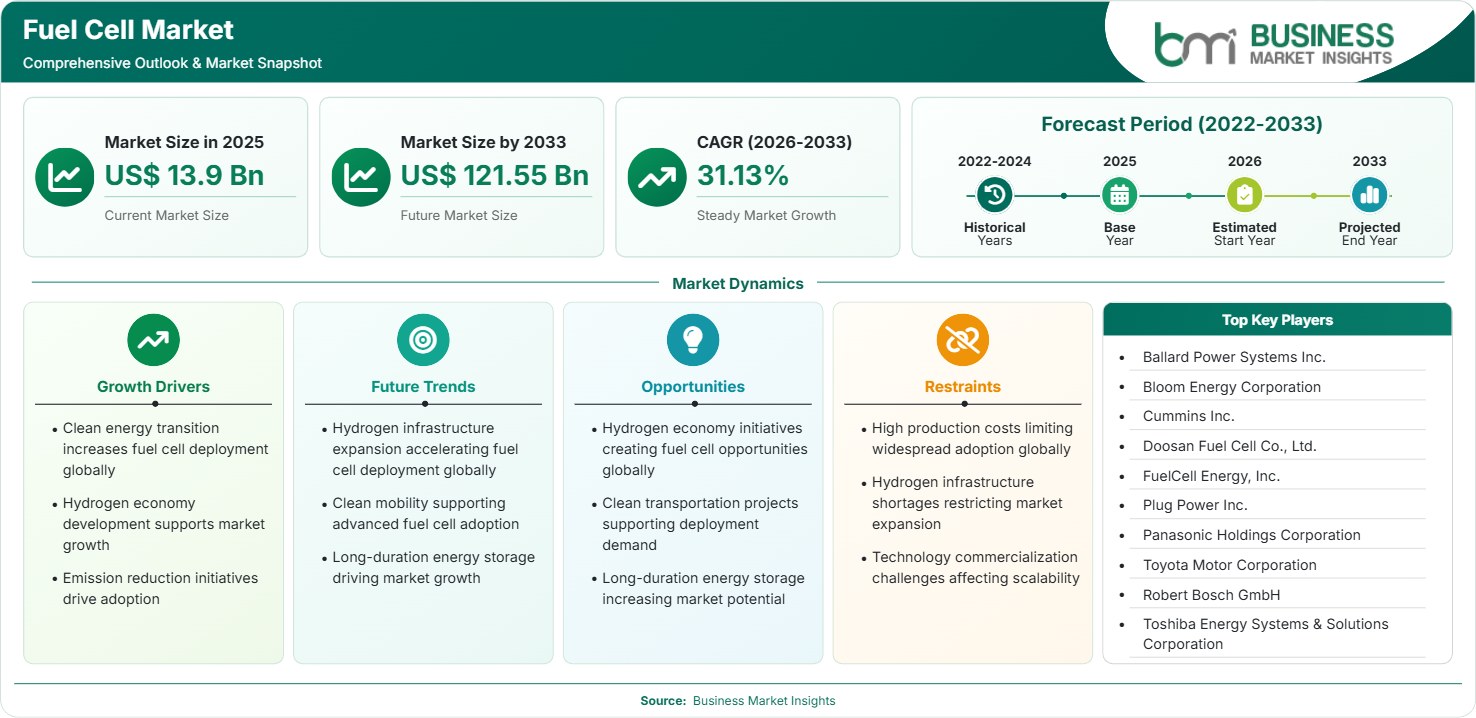
The Fuel Cell Market size was valued at US$ 13.9 Billion in 2025 and is projected to reach US$ 121.55 Billion by 2033, growing at a CAGR of 31.13% during 2026–2033, driven by hydrogen adoption, transport electrification, distributed power demand, data centers, and decarbonization investment.

Report Coverage
  • Type: Proton Exchange Membrane Fuel Cell, Solid Oxide Fuel Cell, Phosphoric Acid Fuel Cell, Others
  • Application: Transport, Stationary, Portable
US$ 13.9 Bn Market size in 2025
US$ 121.55 Bn Market Size by 2033
31.13% CAGR, 2026 - 2033
2026-2033 Forecast Period

AI Overview

Fuel Cell Market Summary

  • North America: holds a market share of 20%–24% in 2025, growing with a CAGR of 29%–33%, influenced by hydrogen infrastructure, stationary generation, data centers, fleet electrification, federal incentives, and industrial decarbonization opportunities. The US remains the regional anchor as utilities, technology providers, and fleet operators expand commercial fuel-cell deployments across transportation and distributed power.
  • Fastest Growing Region: Asia Pacific holds a market share of 55%–61% in 2025, growing with a CAGR of 32%–36%, supported by hydrogen mobility programs, domestic manufacturing, urban air-quality initiatives, heavy-duty transport, distributed generation, and expanding industrial applications.
  • Leading Segment: Proton Exchange Membrane Fuel Cell holds market share of 62%–67% in 2025, growing with a CAGR of 31%–34%, supported by rapid-response characteristics, vehicle integration, heavy-duty mobility, buses, commercial fleets, backup systems, and improving stack durability.
  • High Growth Segment: Stationary applications hold a market share of 22%–27% in 2025, growing with a CAGR of 34%–38%, driven by data-center power requirements, microgrids, backup generation, distributed electricity, resilience investments, and demand for low-emission continuous power.
  • Key Market Opportunity: Rising electricity demand from data centers creates an opportunity for modular fuel-cell systems that deliver firm onsite power while reducing grid dependence, improving resilience, and supporting corporate decarbonization objectives.
  • Major Market Players: Ballard Power Systems Inc.; Bloom Energy Corporation; Cummins Inc.; Doosan Fuel Cell Co., Ltd.; FuelCell Energy, Inc.; Plug Power Inc.; Panasonic Holdings Corporation; Toyota Motor Corporation; Robert Bosch GmbH; Toshiba Energy Systems & Solutions Corporation.
Strategic Insights

Fuel Cell Market: Strategic Insights

Fuel Cell Market Strategic Framework
FREE PDF
Request your free sample
Request free sample
Stakeholder View

Key Takeaways

  • The value chain is growing more integrated, with stack developers, suppliers of membranes and catalysts, hydrogen producers, vehicle manufacturers, utilities, operators of the infrastructure, and energy-service companies taking part in more shared commercial projects.
  • Stationary systems provide a particularly strong potential for gain since data centers, industrial sites, telecommunications infrastructure, microgrids, and other important facilities are looking for reliable on-site generation that can function independently of electricity grids, which are becoming increasingly constrained.
  • Research and development are aiming at achieving higher power density, using less platinum-group metal, extending stack life, improving thermal management, simplifying the balance-of-plant design, and developing standardized modular systems that are capable of being used in a number of operating environments.
  • Asia Pacific has the most extensive manufacturing and deployment ecosystem, whereas North America presents attractive commercial opportunities in the areas of distributed power, hydrogen mobility, backup generation, and data-center infrastructure.
  • There is an increasing focus on strategic consolidation, which involves combining fuel-cell technology with energy-as-a-service, hydrogen generation, power management, and project development capabilities to create revenue streams that recur rather than relying just on the sale of equipment.
  • The degree to which a company has a competitive advantage is now more based on total cost of ownership, service capability, the availability of hydrogen, project financing, and system reliability than just on stack efficiency.
Geographic Outlook

Fuel Cell Market Regional Highlights

North America Fuel Cell Market

North America holds a 20%–24% Fuel Cell Market share in 2025 and is projected to expand at a 29%–33% CAGR through 2033. The region benefits from hydrogen incentives, distributed generation demand, commercial vehicle programs, and data-center electricity requirements. The US represents the largest regional market, supported by industrial decarbonization initiatives and private investment.

  • The development of data centers is leading to a demand for on-site generation since delays in connecting to the grid and increasing electricity loads are pushing the use of modular alternatives that have a predictable power output.
  • Heavy-duty transport continues to have strategic importance since, for certain routes, long operating cycles and the need to carry heavy loads can make rapid refueling more advantageous than using large battery packs.
  • Incentives for the production of hydrogen can improve the economic viability of projects, even though final deployment will depend on the availability of infrastructure, the permitting process, storage facilities, and the cost of delivered hydrogen.
  • Canada has available opportunities in the areas of buses, mining, remote power, and clean hydrogen projects, especially in cases where renewable electricity can enable competitive hydrogen production.

US Fuel Cell Market

The US represents approximately 14%–17% of the global Fuel Cell Market revenue in 2025 and is expected to grow at a 30%–34% CAGR through 2033. Demand is supported by hydrogen production incentives, data-center expansion, backup-power requirements, industrial resilience, and clean-energy procurement.

  • Operators of data centers are considering the use of fuel cells as a means of generating power on-site since the growing demand for computing power is exceeding the rate at which conventional grid infrastructure can be expanded.
  • California is still a strategic market when it comes to mobility, whereas Texas offers a highly attractive opportunity in the area of stationary power due to its industrial activity, huge electricity demand, and plentiful energy resources.
  • Even though qualification, project timing, and policy implementation are still important factors from a commercial point of view, federal incentives help improve the economics of producing low-emission hydrogen.

Europe Fuel Cell Market

Europe accounts for a 10%–14% Fuel Cell Market share in 2025 and is projected to record a 27%–31% CAGR through 2033. Germany leads regional industrial deployment, while France, the United Kingdom, Italy, and the Netherlands support emerging mobility and stationary applications.

  • Germany has an industrial demand for hydrogen, along with mobility initiatives, developments in electrolyzers, and engineering expertise, which together form a comprehensive setting for the deployment of fuel cells and the manufacturing of their components.
  • Because of public sector programs aimed at decarbonization, France has potential in the areas of buses, commercial vehicles, distributed power, and hydrogen infrastructure.
  • The United Kingdom has growth potential in the areas of backup power, heavy-duty mobility, distributed generation, and energy-service models since fuel cells are able to provide reliable, low-emission electricity.
  • As the standards for procurement become more demanding, European manufacturers are placing greater emphasis on system efficiency, the use of recyclable materials, durability, and lifecycle economics.

Asia Pacific Fuel Cell Market

Asia Pacific commands a 55%–61% Fuel Cell Market share in 2025 and is projected to grow at a 32%–36% CAGR through 2033, making it the leading regional market. Japan and South Korea provide mature policy and manufacturing ecosystems, while China supplies substantial vehicle and component capacity.

  • China gains the advantages of large-scale manufacturing, the rollout of commercial vehicles, demonstrations involving hydrogen, and support from regional governments, even though the infrastructure economics vary from province to province.
  • Japan is still advancing its use of hydrogen in residential, mobility, and industrial sectors, due to ongoing national programs and the availability of existing technology providers.
  • South Korea has expertise in the manufacturing of fuel cells and is involved in the deployment of stationary fuel cell systems, as well as in hydrogen mobility and utility-scale projects.
  • India offers a long-term opportunity in the areas of heavy transport, backup power, distributed generation, and industrial applications as the hydrogen infrastructure evolves.

Rest of World Fuel Cell Market

South and Central America represent an emerging opportunity supported by renewable-energy resources, mining activity, logistics requirements, and potential green-hydrogen exports. Brazil provides the largest regional opportunity, while Chile offers strong Fuel Cell Market potential for hydrogen-linked industrial applications.

  • The fact that Chile has a renewable-resource base offers opportunities for producing hydrogen and for using it in fuel-cell applications in the fields of mining, logistics, and remote industrial operations.
  • Because domestic investment in clean energy is growing, Brazil has a range of opportunities available in the area of buses, in distributed generation, in industrial power, and in the development of renewable hydrogen.
  • Fuel cell technology can be combined with large-scale hydrogen initiatives, industrial plants, ports, and robust power infrastructure in the Gulf economies.
  • There is potential in South Africa for mining, for heavy mobility, for backup generation, and for hydrogen-linked industrial applications, since fuel cells can meet the need for power in remote areas.
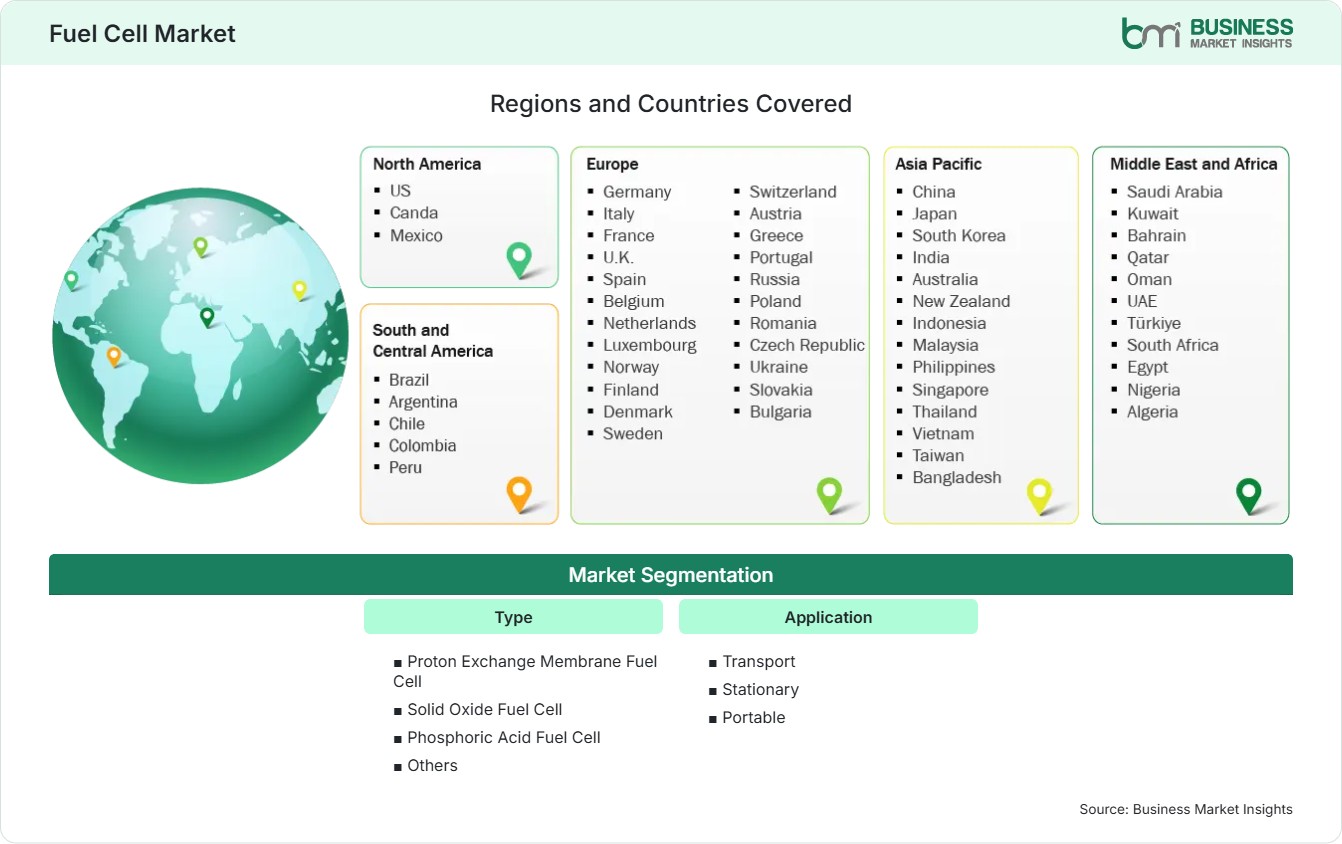
Global Market Geography
FREE PDF
Request your free sample
Request free sample
Segment Analysis

Fuel Cell Market Segmentation

Type

The Type segment is led by PEMFC, which represents a 62%–67% Fuel Cell Market share in 2025 and is projected to grow at a 31%–34% CAGR through 2033. Demand is supported by transportation, rapid-response power, modular systems, and commercial fleet deployment, while SOFC and PAFC address stationary requirements.

  • Proton Exchange Membrane Fuel Cell: PEMFC systems benefit from high power density, rapid startup, and suitability for mobility, backup generation, forklifts, buses, trucks, and distributed applications requiring responsive electricity.
  • Solid Oxide Fuel Cell: SOFC technology supports stationary generation through high electrical efficiency, fuel flexibility, and continuous operation, making it relevant for commercial facilities, microgrids, data centers, and industrial customers.
  • Phosphoric Acid Fuel Cell: PAFC systems serve established stationary-power applications where continuous electricity and heat production support commercial facilities, utilities, and distributed-energy installations seeking dependable long-duration operation.

Application

Transport remains the largest application category, while stationary systems represent the high-growth opportunity with a 22%–27% Fuel Cell Market share in 2025 and a 34%–38% CAGR through 2033. Portable systems address specialized requirements where quiet operation, long runtime, and mobility provide advantages over conventional generators.

  • Transport: Fuel cells support buses, trucks, commercial vehicles, material-handling equipment, marine systems, and selected passenger vehicles where rapid refueling and long operating ranges can provide operational advantages.
  • Stationary: Stationary deployments address distributed generation, backup power, microgrids, data centers, telecom infrastructure, commercial buildings, and industrial sites requiring reliable electricity with lower local emissions.
  • Portable: Portable systems serve remote equipment, emergency power, field operations, temporary installations, and specialized electronics where low noise, extended runtime, and compact power generation improve operational flexibility.
Market Forces

Fuel Cell Market Dynamics

Key Market Drivers

Hydrogen mobility and heavy-duty fleet electrification

Fuel cell technology usage has become more dependent on factors that characterize the economics of heavy-duty transport, such as long distances traveled and sensitivity of load, which makes fast refueling more important. According to IEA estimates, heavy trucks are the sole rapidly growing category of road traffic for fuel cell electric cars, while China accounts for close to 95% of the world’s commercial fuel cell vehicle fleet. Fuel Cell Market trends also reflect greater attention to total operating cost, refueling time, vehicle uptime, and fleet-level hydrogen procurement.

Rising demand for resilient distributed electricity

The rising power demand from data centers, industries, healthcare facilities, telecommunications systems, and critical installations has increased the importance of dependable on-site power generation. Fuel cells enable uninterrupted power production without using combustion on-site, which makes them a viable option in instances where reliability and reduced emissions are key considerations. Fuel cell technology can be used to develop power modules that scale up in tandem with the customer load. Fuel Cell Market growth consequently extends beyond transportation into energy infrastructure.

Policy support and hydrogen ecosystem development

Hydrogen policy will be one of the main drivers as hydrogen is integral to fuel cell costs. According to the International Energy Agency’s Hydrogen Tracker, there are over 1,000 hydrogen policies enacted or under development since 2020. National hydrogen programs across the world, including Asia, North America, and Europe, are driving production, infrastructure, mobility, and industry. Fuel Cell Market trends are therefore influenced by the pace at which policy commitments become funded projects and operating assets. Improved hydrogen availability can lower utilization risk for fleet operators and stationary customers. In parallel, government-backed demonstration programs create early demand that helps suppliers improve manufacturing scale.

Key Market Opportunities

Fuel cells for AI data-center power infrastructure

Artificial intelligence is creating an unusually rapid demand for electricity-intensive computing facilities, creating a new commercial opportunity for on-site fuel-cell generation. Data centers require high availability, predictable power, and scalable capacity, while grid connections can face lengthy permitting and infrastructure constraints. Fuel cells can operate as primary or supplemental generation and can be deployed modularly as capacity requirements increase. Recent agreements involving Bloom Energy demonstrate how large technology companies are evaluating multi-gigawatt fuel-cell capacity for AI and cloud infrastructure. Fuel Cell Market Forecasts, therefore, increasingly depend on whether data-center developers adopt fuel cells beyond demonstration projects.

Energy-as-a-service and distributed generation models

The commercialization of fuel cells can be sped up if customers buy reliable electricity instead of having to purchase the equipment itself. By adopting an energy-as-a-service approach, customers reduce the amount of capital needed up front and pass on to specialized companies the responsibilities involved in operation, maintenance, fuel management, and ensuring system performance. This kind of arrangement is especially suitable for data centers, commercial buildings, construction sites, events, telecommunication networks, and remote infrastructure. The fact that Ballard has integrated GeoPura enhances the argument for combining its fuel-cell hardware with hydrogen genset leasing and service options. Likewise, similar models could develop in the case of stationary systems, since in those cases, customers place greater importance on continuous operation and on having predictable energy costs than on owning the assets.

Hydrogen ecosystem integration across industrial clusters

It is possible to bring together hydrogen production, storage, transport, and fuel-cell usage in concentrated, geographically based projects. Refineries, the chemicals industry, the steel sector, ports, logistics hubs, and heavy transport fleets could make use of the same hydrogen infrastructure, thus avoiding the need for duplicate investments. The International Energy Agency states that the refining and chemical industries are still the main consumers of low-emissions hydrogen, which means there is a potential for close linkage between the supply of industrial hydrogen and fuel-cell applications. Projects could therefore incorporate stationary power generation, fleet refueling, backup power, and industrial hydrogen consumption. This approach might enhance the way in which the infrastructure is used since various customers take up hydrogen at different times and with different operating patterns.

Market Restraints and Challenges

Hydrogen cost and infrastructure availability

The cost of delivering hydrogen continues to be strongly influenced by the production method, the price of electricity, transportation, storage, compression, the rate at which it is used, and the level of development of the regional infrastructure. When the supply of hydrogen is unreliable or its price is considerably higher than that of other energy sources, fuel-cell systems cannot achieve favorable operating economics. As a result, fleet operators and stationary customers might delay their purchases until the fueling networks have reached a sufficient level of density and supply contracts offer stable pricing. This issue has a particular impact on emerging markets, where hydrogen infrastructure must be established before demand is sufficient.

High system costs and competing technologies

Fuel-cell systems still face cost challenges related to stacks, catalysts, membranes, hydrogen storage, balance-of-plant equipment, controls, and specialized maintenance. Since battery-electric systems, conventional generators, grid power, and other distributed energy technologies are competing for the same customer budgets, customers assess fuel cells based on their total cost of ownership rather than just their environmental advantages, especially when hydrogen prices and usage rates are uncertain. As a result, technology suppliers need to enhance the durability, power density, manufacturing efficiency, service intervals, and component standardization of their products.

Company Analysis

Competitive Landscape

Fuel Cell Market analysis indicates that competition is increasingly moving from individual stack performance toward complete system economics, service capability, manufacturing scale, application specialization, and ecosystem integration. Major suppliers are pursuing differentiated strategies across mobility, stationary power, distributed generation, hydrogen infrastructure, and long-term service contracts.

Company Name

Overview

Products and Services relevant to this market

Ballard Power Systems Inc.

Canadian fuel-cell technology company focused strongly on commercial mobility and stationary applications, with extensive experience in heavy-duty deployments.

PEM fuel-cell engines and modules for buses, trucks, rail, marine applications, backup power, stationary generation, and hydrogen gensets.

Bloom Energy Corporation

US-based energy technology company specializing in solid-oxide fuel-cell systems and distributed electricity generation for large commercial customers.

Solid-oxide fuel-cell platforms, onsite power systems, energy infrastructure, monitoring, service, and solutions for data centers and commercial facilities.

Cummins Inc.

Global powertrain and energy technology company with fuel-cell capabilities spanning commercial transportation and stationary applications.

Hydrogen fuel-cell powertrains, integrated power solutions, engines, controls, infrastructure technologies, and service capabilities for commercial users.

Doosan Fuel Cell Co., Ltd.

South Korean fuel-cell manufacturer focused primarily on stationary electricity generation and distributed energy applications.

Stationary fuel-cell systems, power-generation platforms, hydrogen-energy solutions, maintenance, and integrated distributed-generation services.

FuelCell Energy, Inc.

US technology provider specializing in stationary fuel-cell generation and utility-scale distributed-energy projects.

Carbonate fuel-cell systems, distributed generation, microgrids, utility projects, hydrogen production integration, service, and power-generation solutions.

Plug Power Inc.

Hydrogen and fuel-cell solutions company serving material handling, mobility, stationary power, and hydrogen infrastructure markets.

PEM fuel-cell systems, electrolyzers, hydrogen generation, storage, fueling infrastructure, material-handling solutions, and stationary power systems.

Panasonic Holdings Corporation

Diversified Japanese technology group with fuel-cell systems supporting distributed and residential energy applications.

Hydrogen fuel-cell cogeneration systems, distributed power solutions, energy-management technologies, and related residential and commercial energy products.

Toyota Motor Corporation

Automotive manufacturer with extensive investment in hydrogen mobility and fuel-cell vehicle technology for passenger and commercial applications.

Fuel-cell systems, hydrogen-powered vehicles, commercial mobility platforms, powertrain technologies, and hydrogen ecosystem initiatives.

Robert Bosch GmbH

Global engineering and technology company developing hydrogen and fuel-cell technologies for mobility and energy applications.

Fuel-cell powertrain components, stack technologies, automotive systems, engineering solutions, and hydrogen-related technology platforms.

Toshiba Energy Systems & Solutions Corporation

Japanese energy technology provider developing hydrogen and fuel-cell solutions for distributed and resilient power applications.

Hydrogen energy systems, fuel-cell technologies, distributed power, energy management, hydrogen integration, and stationary power solutions.

Trust & Transparency

Research Methodology

The market analysis combines proprietary research with secondary data from government agencies, company disclosures, regulatory filings, industry databases and expert interviews. Market estimates are validated through data triangulation, cross-market benchmarking and analyst review.

View Full Research Methodology

Questions Answered

Frequently Asked Questions

What should investors evaluate when assessing fuel-cell projects?

Investors should assess stack durability, hydrogen cost, utilization rate, project financing, customer credit quality, service requirements, competing technologies, infrastructure availability, policy support, manufacturing scale, and total cost of ownership. Long-term service revenue and recurring energy contracts can materially improve project economics.

How important is hydrogen infrastructure to commercialization?

The Fuel Cell Market Report highlights that Hydrogen infrastructure is fundamental because fuel-cell economics depend on reliable access to competitively priced hydrogen. Production, storage, transportation, compression, and fueling infrastructure must develop alongside end-use applications. Industrial clusters and fleet corridors can reduce infrastructure utilization risk by concentrating demand.

Which fuel-cell technology has the broadest application base?

PEMFC technology has the broadest application base because its power density, rapid response, and relatively compact architecture support vehicles, forklifts, backup systems, and selected stationary applications. SOFC and PAFC technologies remain particularly relevant for continuous stationary electricity generation.

Why are stationary applications becoming strategically important?

Stationary systems can address rising electricity demand, grid constraints, backup requirements, and corporate decarbonization objectives. Their modular architecture also allows customers to add generation capacity as electricity loads increase, making them relevant for data centers, industrial facilities, telecom infrastructure, and critical operations.

What is driving fuel-cell adoption beyond passenger vehicles?

Demand is broadening toward heavy-duty trucks, buses, distributed generation, data centers, backup power, microgrids, material-handling equipment, remote infrastructure, and industrial facilities. These applications can place greater value on rapid refueling, continuous operation, resilience, and low local emissions than passenger-car markets.

Access the Full Fuel Cell Market Report

Get segment-level forecasts, regional estimates, competitive benchmarking, company profiles and downloadable Excel datasets.

Access the full Fuel Cell Market Report
350 pages PDF & Excel | 2026-10-22
Similar Research

Related Market Reports