
Tandem Solar Cell Market Size, Share, Trends & Forecast Report, 2026–2033

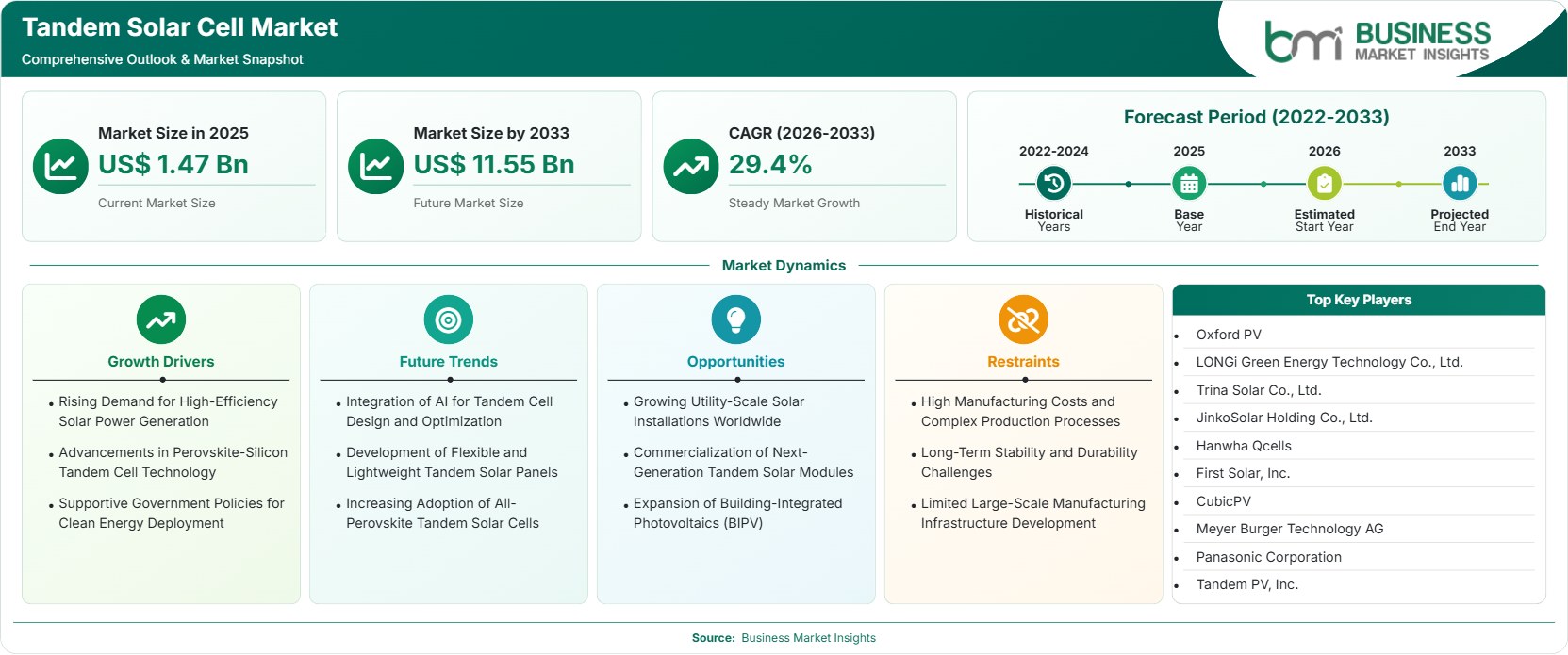
The Tandem Solar Cell Market size was valued at US$ 1.47 billion in 2025 and is projected to reach US$ 11.55 billion by 2033, growing at a CAGR of US$ 29.39% during 2026–2033, driven by demand for higher photovoltaic efficiency, advanced perovskite integration, and opportunities in utility-scale solar deployment, lightweight modules, and next-generation energy applications.

Report Coverage
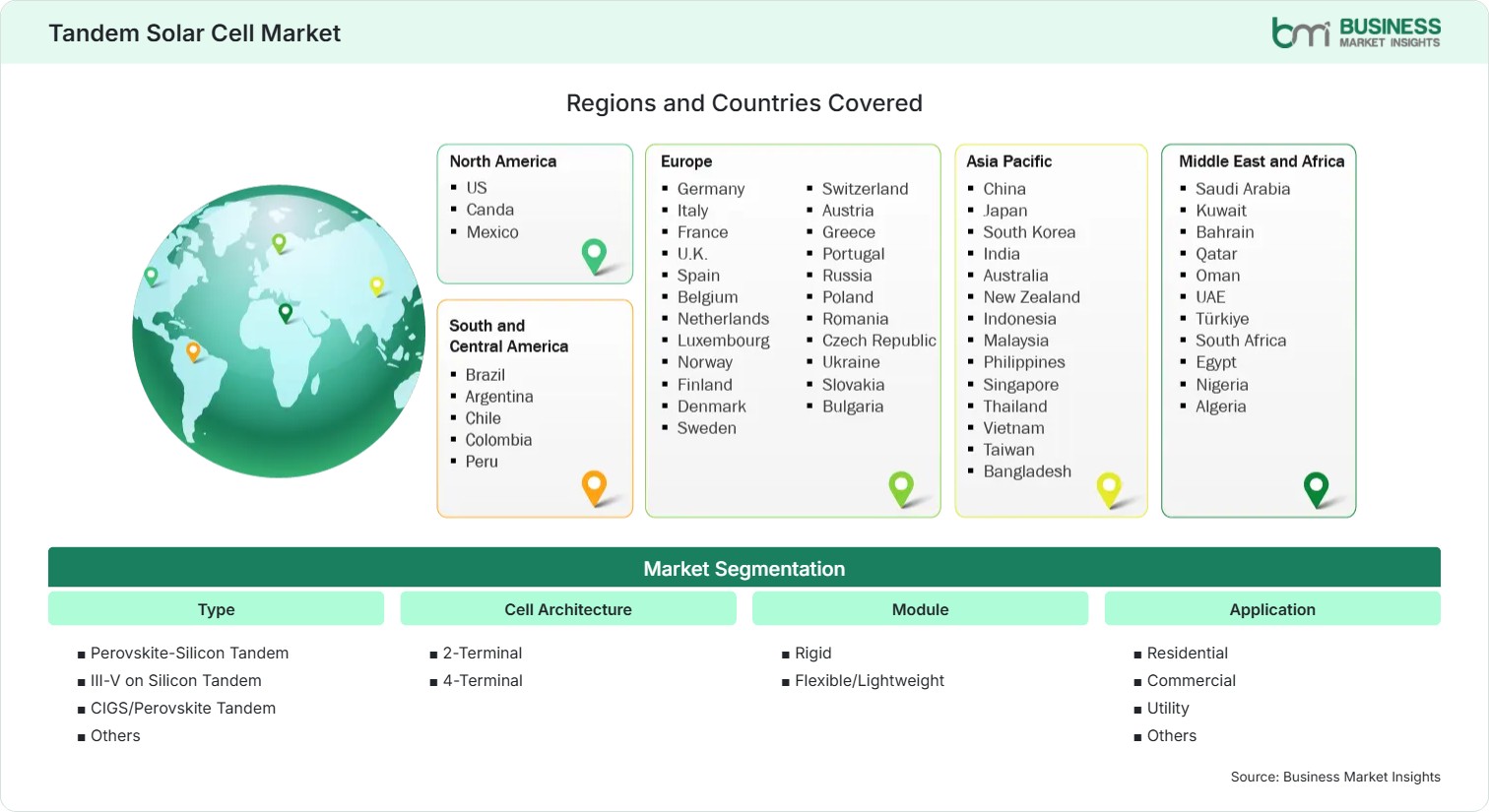
  • Type: Perovskite-Silicon Tandem, III-V on Silicon Tandem, CIGS/Perovskite Tandem, Others
  • Cell Architecture: 2-Terminal, 4-Terminal
  • Module: Rigid, Flexible/Lightweight
  • Application: Residential, Commercial, Utility, Others
US$ 1.47 Bn Market size in 2025
US$ 11.55 Bn Market Size by 2033
29.4% CAGR, 2026 - 2033
2026-2033 Forecast Period

01 AI Overview

Tandem Solar Cell Market Summary

  • North America Region: North America holds a 22%–25% share in 2025, growing with a CAGR of 30%–32% influenced by federal clean energy programs, advanced research ecosystems, and commercialization opportunities. The US Tandem Solar Cell market analysis indicates a 31%–33% CAGR during 2026–2033, supported by domestic solar manufacturing investments and innovation funding.
  • Fastest Growing Region: Asia Pacific holds a 38%–41% share in 2025, growing with a CAGR of 32%–34% driven by large-scale photovoltaic manufacturing, expanding renewable capacity additions, government incentives, and increasing adoption of high-efficiency solar technologies across emerging economies.
  • Leading Segment: Perovskite-Silicon Tandem holds a 58%–61% share in 2025, growing with a CAGR of 31%–33% due to efficiency advantages, established silicon supply chains, and accelerated commercialization efforts by leading photovoltaic technology developers.
  • High Growth Segment: Flexible/Lightweight modules hold a 18%–21% share in 2025, growing with a CAGR of 34%–36% supported by portable energy applications, building-integrated photovoltaics, and demand for adaptable solar solutions across commercial environments.
  • Key Market Opportunity: The market opportunity centers on scaling tandem solar manufacturing, reducing production costs, improving module durability, and enabling wider deployment across utility, commercial, and emerging distributed energy applications.
  • Major Market Players: Oxford PV, LONGi Green Energy Technology Co., Ltd., Trina Solar Co., Ltd., JinkoSolar Holding Co., Ltd., Hanwha Qcells, First Solar, Inc., CubicPV, Meyer Burger Technology AG, Panasonic Corporation, Tandem PV, Inc.
02 Strategic Insights

Tandem Solar Cell Market: Strategic Insights

Tandem Solar Cell Market Strategic Framework
FREE PDF
Request your free sample
Request free sample
03 Stakeholder View

Key Takeaways

  • The value chain is evolving from laboratory-scale innovation toward commercial manufacturing, with material suppliers, photovoltaic manufacturers, research institutions, and module integrators forming a connected ecosystem focused on scalable tandem production.
  • Utility-scale applications represent a major growth pathway as developers seek higher power output from limited land availability, while commercial and building-integrated applications create additional opportunities for lightweight and flexible tandem solutions.
  • Innovation priorities are shifting toward improved perovskite stability, advanced encapsulation methods, scalable deposition techniques, and optimized cell architectures designed to increase efficiency while reducing manufacturing complexity.
  • Asia Pacific presents a strong investment opportunity due to concentrated solar manufacturing capacity, expanding renewable energy targets, and increasing government support for advanced photovoltaic technology adoption.
  • Investment activity is moving toward strategic partnerships, technology licensing agreements, and commercialization funding as established solar manufacturers collaborate with specialized tandem technology companies to accelerate market entry.
  • Supply chain localization is becoming increasingly important as manufacturers evaluate regional production strategies to strengthen resilience, reduce logistics risks, and meet growing demand for domestically produced clean energy technologies.
04 Geographic Outlook

Tandem Solar Cell Market Regional Highlights

North America Tandem Solar Cell Market

North America accounted for a 22%–25% share in 2025 and is projected to expand at a CAGR of 30%–32% during 2026–2033. The region benefits from advanced photovoltaic research, federal renewable energy incentives, and growing domestic manufacturing initiatives. The Tandem Solar Cell market share is strengthened by technology developers and utility-scale project demand.

  • The United States supports regional expansion through research funding, manufacturing incentives, and partnerships between solar innovators and established photovoltaic companies developing commercial tandem solutions.
  • Canada contributes through renewable energy programs and increasing interest in high-efficiency solar installations, particularly for commercial facilities and remote energy applications requiring improved power generation.
  • North American manufacturers are prioritizing pilot production facilities, improving material integration processes, and developing scalable manufacturing approaches to reduce costs associated with tandem photovoltaic deployment.
  • Investment activity is increasing across advanced solar technologies as companies seek competitive advantages through higher conversion efficiency and differentiated module designs for future renewable energy markets.

US Tandem Solar Cell Market

The US represented a 20%–23% share in 2025 and is expected to register a CAGR of 31%–33% between 2026–2033. The country remains a central innovation hub due to research capabilities, clean energy policies, and commercialization efforts. The Tandem Solar Cell market share reflects strong demand from technology developers and utility-scale solar operators.

  • The Inflation Reduction Act supports domestic solar manufacturing investments, encouraging companies to establish advanced photovoltaic production capabilities and strengthen local supply chains.
  • Research institutions and private enterprises are collaborating to improve tandem efficiency, durability, and manufacturing scalability for future commercial deployment.
  • Utility developers are evaluating higher-efficiency modules to maximize electricity output from constrained land areas and improve project economics.
  • Growing venture investment in solar innovation is accelerating commercialization pathways for emerging tandem technologies across multiple applications.

Europe Tandem Solar Cell Market

Europe captured a 27%–30% share in 2025 and is projected to grow at a CAGR of 29%–31% during 2026–2033. The region maintains a strong position due to renewable energy commitments, advanced research infrastructure, and sustainability regulations. Germany leads adoption, while the United Kingdom and Switzerland demonstrate higher growth potential through technology commercialization.

  • Germany remains a major contributor through photovoltaic research excellence, industrial expertise, and increasing demand for efficient solar solutions across commercial and utility applications.
  • The United Kingdom shows strong technology momentum through perovskite solar innovation, academic partnerships, and commercialization initiatives supporting next-generation photovoltaic systems.
  • Switzerland contributes through specialized solar technology development, advanced research capabilities, and companies focused on improving tandem module performance.
  • European manufacturers are investing in clean energy supply chains to reduce dependence on imported photovoltaic technologies and strengthen regional production capacity.

Asia Pacific Tandem Solar Cell Market

Asia Pacific held a 38%–41% share in 2025 and is expected to expand at a CAGR of 32%–34% from 2026–2033. The region dominates manufacturing capacity and benefits from large-scale solar deployment. China leads the market, while India, Japan, and South Korea provide additional growth opportunities through renewable energy investments.

  • China maintains leadership through extensive photovoltaic manufacturing infrastructure, strong supply chains, and continuous investments in advanced solar technology commercialization.
  • India is emerging as a high-growth Tandem Solar Cell market with expanding solar capacity targets, domestic manufacturing policies, and increasing adoption of efficient photovoltaic solutions.
  • Japan and South Korea continue developing advanced solar technologies through corporate research programs and government-supported renewable energy initiatives.
  • Asia Pacific companies are focusing on production scale, cost optimization, and technology improvements to accelerate tandem solar commercialization.

Rest of World Tandem Solar Cell Market

Rest of World accounted for a 7%–10% share in 2025 and is projected to achieve a CAGR of 25%–28% during 2026–2033. South and Central America are adopting advanced solar technologies through renewable expansion, while the Middle East and Africa are exploring high-efficiency modules for large-scale solar projects.

  • Brazil and Chile are expanding solar capacity through favorable renewable resources, creating opportunities for advanced photovoltaic technologies in utility-scale developments.
  • Middle Eastern countries are investing in large solar projects where higher efficiency modules can improve generation capacity and optimize land utilization.
  • African markets are exploring distributed and utility solar solutions to address energy access challenges and support sustainable development initiatives.
  • Regional adoption remains dependent on infrastructure development, financing availability, and partnerships with global photovoltaic technology providers.
Global Market Geography
FREE PDF
Request your free sample
Request free sample
05 Segment Analysis

Tandem Solar Cell Market Segmentation

Type

Type segment accounted for a 2025 of the market share distribution led by Perovskite-Silicon Tandem at 58%–61%, with the segment expanding at a CAGR of 31%–33% through 2034. The Tandem Solar Cell market scope is influenced by efficiency improvements, established silicon manufacturing ecosystems, and commercialization efforts. Different tandem configurations support varied performance requirements across utility, commercial, and specialized solar applications.

  • Perovskite-Silicon Tandem: This configuration combines mature silicon technology with perovskite layers, enabling higher efficiency potential and supporting commercialization by leading photovoltaic manufacturers worldwide.
  • III-V on Silicon Tandem: These cells offer exceptional efficiency characteristics by integrating high-performance semiconductor materials with silicon platforms for specialized applications requiring maximum power output.
  • CIGS/Perovskite Tandem: This architecture combines thin-film technologies with perovskite materials, creating opportunities for lightweight applications and flexible photovoltaic designs.

Cell Architecture

Cell Architecture segment continues evolving as manufacturers evaluate configurations that balance efficiency, complexity, and manufacturing costs. The 2-Terminal (2T) architecture accounted for 62%–65% share in 2025 and is projected to grow at a CAGR of 30%–32% through 2034 due to simpler integration pathways and commercial scalability.

  • 2-Terminal (2T): This architecture enables compact tandem cell designs with simplified electrical connections, supporting scalable manufacturing approaches and integration with existing photovoltaic production lines.
  • 4-Terminal (4T): This configuration provides design flexibility by allowing independent optimization of cell layers, benefiting research applications and specialized high-efficiency solar systems.

Module

Module segment reflects increasing demand for adaptable solar solutions across diverse applications. Rigid modules held a 79%–82% share in 2025 and are expected to grow at a CAGR of 28%–30% through 2034, supported by utility and commercial solar deployment. The Tandem Solar Cell market trends indicate rising interest in lightweight alternatives.

  • Rigid: Rigid modules remain preferred for large-scale installations due to structural durability, established deployment practices, and compatibility with conventional solar mounting systems.
  • Flexible/Lightweight: Flexible modules are gaining attention for portable applications, curved surfaces, building integration, and locations requiring reduced structural loading requirements.

Application

Application segment demonstrates broad adoption potential across residential, commercial, utility, and emerging solar uses. Utility applications represented 52%–55% share in 2025 and are forecast to expand at a CAGR of 30%–32% through 2034 due to demand for higher electricity generation efficiency and optimized land use.

  • Residential: Residential adoption is supported by consumer interest in efficient rooftop systems, space optimization, and improved energy generation from limited installation areas.
  • Commercial: Commercial facilities are adopting advanced photovoltaic solutions to reduce electricity costs, meet sustainability targets, and improve building energy performance.
  • Utility: Utility-scale projects are integrating higher-efficiency modules to maximize output, improve project economics, and support large renewable power generation goals.
06 Market Forces

Tandem Solar Cell Market Dynamics

Key Market Drivers

Rising Demand for High-Efficiency Solar Power Generation

Growing electricity consumption, land constraints for renewable projects, and the need for higher energy yield per installation area are driving demand for advanced photovoltaic technologies. The International Energy Agency reported that global solar photovoltaic capacity additions surpassed 400 GW in 2023, creating demand for improved efficiency solutions. The Tandem Solar Cell market growth is supported by developers seeking enhanced power output, while Tandem Solar Cell trends reflect increasing adoption of multi-junction architectures capable of exceeding conventional silicon efficiency limits. Utility-scale developers, commercial users, and distributed energy providers are evaluating these technologies to optimize long-term project performance.

Advancements in Perovskite-Silicon Tandem Cell Technology

Advancements in perovskite-silicon tandem technology are improving commercialization prospects through higher conversion efficiency, material optimization, while Tandem Solar Cell Market trends continue reflecting improved manufacturing compatibility. Research institutions and solar companies are focusing on scalable deposition techniques, enhanced encapsulation methods, and improved operational stability. The Tandem Solar Cell trends indicate increasing collaboration between technology developers and established photovoltaic manufacturers to transition from laboratory-scale demonstrations to commercial production. These developments are strengthening the market position of tandem architectures by addressing efficiency limitations associated with conventional single-junction solar cells.

Supportive Government Policies for Clean Energy Deployment

Government policies supporting renewable energy expansion are accelerating investments in advanced photovoltaic technologies across major solar markets. Various incentives for manufacturing within the nation, the development of energy infrastructure, and research projects have led businesses to develop innovative ways to utilize solar power. The US, Europe, China, Japan, and South Korea are adopting policies to build a renewable energy value chain while reducing dependence on traditional energy sources. Such regulatory frameworks facilitate the commercialization of technology by fostering a better investment environment and manufacturing capacity.

Key Market Opportunities

Growing Utility-Scale Solar Installations Worldwide

Expansion of utility-scale solar installations is creating opportunities for tandem photovoltaic technologies due to the requirement for improved energy output from limited land resources. Developers are increasingly considering higher-efficiency modules to enhance project economics and optimize electricity generation. Large solar farms across emerging and developed markets provide a strong deployment pathway for tandem technologies, particularly where land availability and grid efficiency are critical factors. Tandem Solar Cell Market forecasts indicate increasing opportunities as renewable energy developers evaluate advanced modules for future large-scale projects.

Commercialization of Next-Generation Tandem Solar Modules

Commercialization of next-generation tandem modules represents a major opportunity as companies move toward pilot manufacturing and commercial deployment. Technology providers are investing in process optimization, reliability improvements, and cost reduction strategies to achieve broader Tandem Solar Cell market acceptance. Partnerships between photovoltaic manufacturers, research organizations, and material suppliers are supporting faster product development cycles. As production methods mature, tandem modules could expand beyond research applications into mainstream residential, commercial, and utility markets requiring higher efficiency and improved energy density.

Expansion of Building-Integrated Photovoltaics (BIPV)

Building-integrated photovoltaics are creating new opportunities for tandem solar adoption through applications in façades, rooftops, windows, and architectural structures. Urban development trends are increasing demand for lightweight and adaptable energy solutions were traditional solar installations face space limitations. Flexible and efficient tandem modules can support sustainable building designs while contributing to decentralized energy generation. Increasing focus on green buildings, energy-efficient infrastructure, and carbon reduction targets is expected to encourage wider integration of advanced photovoltaic technologies, while Tandem Solar Cell Market forecasts continue indicating stronger adoption across commercial and residential construction projects.

Market Restraints and Challenges

High Manufacturing Costs and Complex Production Processes

Factor: Advanced materials, specialized manufacturing equipment, and additional processing requirements increase production costs compared with conventional silicon photovoltaic modules. Impact: Higher production costs might hinder the widespread adoption of the technology due to their impact on pricing and the technology's scalability for use in the solar industry. There is a need for improved efficiency in the production process and for the optimization of materials and processes to enable mass manufacturing. The intricacy of layering different semiconductor layers also demands a robust quality-control system and expertise.

Long-Term Stability and Durability Challenges

Factor: Perovskite materials face durability concerns related to moisture exposure, temperature variation, and long-term operational stability under outdoor conditions. Impact: Reliability issues may affect consumer confidence, financial considerations, and the acceptance of utility-scale projects by developers who need long service lives. These manufacturers are solving this problem using innovations in encapsulation, testing, and materials science. Consistency and longevity are very important for the wider adoption of technology since solar projects often require decades of reliable performance.

07 Company Analysis

Competitive Landscape

The Tandem Solar Cell analysis indicates a competitive environment shaped by established photovoltaic manufacturers, specialized technology developers, and research-driven companies. Tandem Solar Cell Market participants are focusing on efficiency improvements, commercialization partnerships, scalable production, and differentiated module designs to strengthen their positions.

Company Name

Overview

Products and Services relevant to this market

Oxford PV

UK-based solar technology company specializing in perovskite tandem photovoltaic innovation.

Develops perovskite-silicon tandem solar cells and commercial module technologies for high efficiency.

LONGi Green Energy Technology Co., Ltd.

Chinese photovoltaic leader focused on advanced solar manufacturing and technology development.

Produces high-efficiency silicon wafers, cells, modules, and tandem solar research solutions.

Trina Solar Co., Ltd.

Global solar manufacturer developing advanced photovoltaic products and research platforms.

Provides solar modules, intelligent energy solutions, and tandem photovoltaic technology development.

JinkoSolar Holding Co., Ltd.

Major solar manufacturer with global production and innovation capabilities.

Offers photovoltaic modules, solar systems, and advanced cell technology solutions.

Hanwha Qcells

South Korean renewable energy company focused on solar technology and manufacturing.

Develops solar cells, modules, and next-generation photovoltaic technology solutions.

First Solar, Inc.

US-based photovoltaic manufacturer specializing in thin-film solar technology.

Provides advanced thin-film modules and research activities supporting solar innovation.

CubicPV

US solar technology company developing advanced photovoltaic manufacturing solutions.

Focuses on tandem-compatible materials, silicon technologies, and solar manufacturing platforms.

Meyer Burger Technology AG

Swiss solar technology company specializing in high-performance photovoltaic equipment.

Develops solar cells, modules, and manufacturing technologies for premium photovoltaic applications.

Panasonic Corporation

Japanese technology company involved in energy and photovoltaic solutions.

Provides solar technologies, energy solutions, and photovoltaic research capabilities.

Tandem PV, Inc.

US company focused on commercializing perovskite tandem solar technology.

Develops perovskite tandem modules designed for scalable solar applications.

08 Industry Activity

Recent Developments

May 2025

Hanwha Solutions Qcells Division achieved a key stability milestone for its perovskite-silicon tandem solar modules by completing stress testing aligned with IEC and UL certification standards. The achievement supports Qcells’ pathway toward commercializing tandem modules for large-scale solar applications.

April 2025

Oxford PV entered into a landmark perovskite PV patent licensing agreement with Trina Solar, allowing Trina Solar to manufacture and sell perovskite-based photovoltaic products in China. The collaboration supports the commercialization and scaling of perovskite-silicon tandem solar technology by combining Oxford PV’s tandem technology IP with Trina Solar’s large-scale PV manufacturing capabilities.

March 2025

Tandem PV raised $50 million through Series A funding and debt financing to accelerate commercialization of its perovskite solar panels and support construction of a commercial-scale U.S. manufacturing facility. The funding is aimed at scaling production of high-efficiency perovskite tandem solar modules.

June 2024

LONGi Green Energy Technology Co., Ltd. announced a world-record 34.6% efficiency for a silicon-perovskite tandem solar cell, certified by the European Solar Test Installation (ESTI). The company also reported a 30.1% efficiency record for a commercial M6 wafer-sized silicon-perovskite tandem cell certified by Fraunhofer ISE, demonstrating progress toward industrial-scale tandem PV development.

10 Trust & Transparency

Research Methodology

The market analysis combines proprietary research with secondary data from government agencies, company disclosures, regulatory filings, industry databases and expert interviews. Market estimates are validated through data triangulation, cross-market benchmarking and analyst review.

View Full Research Methodology

11 Questions Answered

Frequently Asked Questions

What does the Tandem Solar Cell Market Report indicate about future industry direction?

The Market Report highlights increasing focus on efficiency improvements, manufacturing scale-up, regional supply chain development, and integration of advanced photovoltaic technologies into broader renewable energy systems.

What role do research partnerships play in advancing tandem photovoltaic technologies?

Research partnerships between universities, manufacturers, and technology developers accelerate material innovation, reliability testing, production optimization, and commercialization pathways for emerging tandem photovoltaic architectures.

Which applications are likely to benefit most from tandem solar deployment?

Utility-scale solar farms, space-constrained commercial buildings, and building-integrated photovoltaic systems are expected to benefit from higher power output per area, enabling improved energy generation where installation space is limited.

How do tandem solar technologies compare with conventional silicon photovoltaic modules?

Tandem technologies aim to achieve higher conversion efficiencies by combining different semiconductor materials, allowing better utilization of sunlight compared with single-junction silicon modules. Their commercial competitiveness depends on cost reduction and durability improvements.

What factors determine the commercial adoption rate of tandem photovoltaic technologies?

Commercial adoption depends on module efficiency gains, manufacturing costs, operational stability, supply chain maturity, and the ability of manufacturers to scale production while maintaining reliability standards required by utility and commercial buyers.

Access the Full Tandem Solar Cell Market Report

Get segment-level forecasts, regional estimates, competitive benchmarking, company profiles and downloadable Excel datasets.

Access the full Tandem Solar Cell Market Report
350 pages PDF & Excel | 2026-07-28