Free Space Optics (FSO) Communication Market Regional Highlights
North America Free Space Optics (FSO) Communication Market
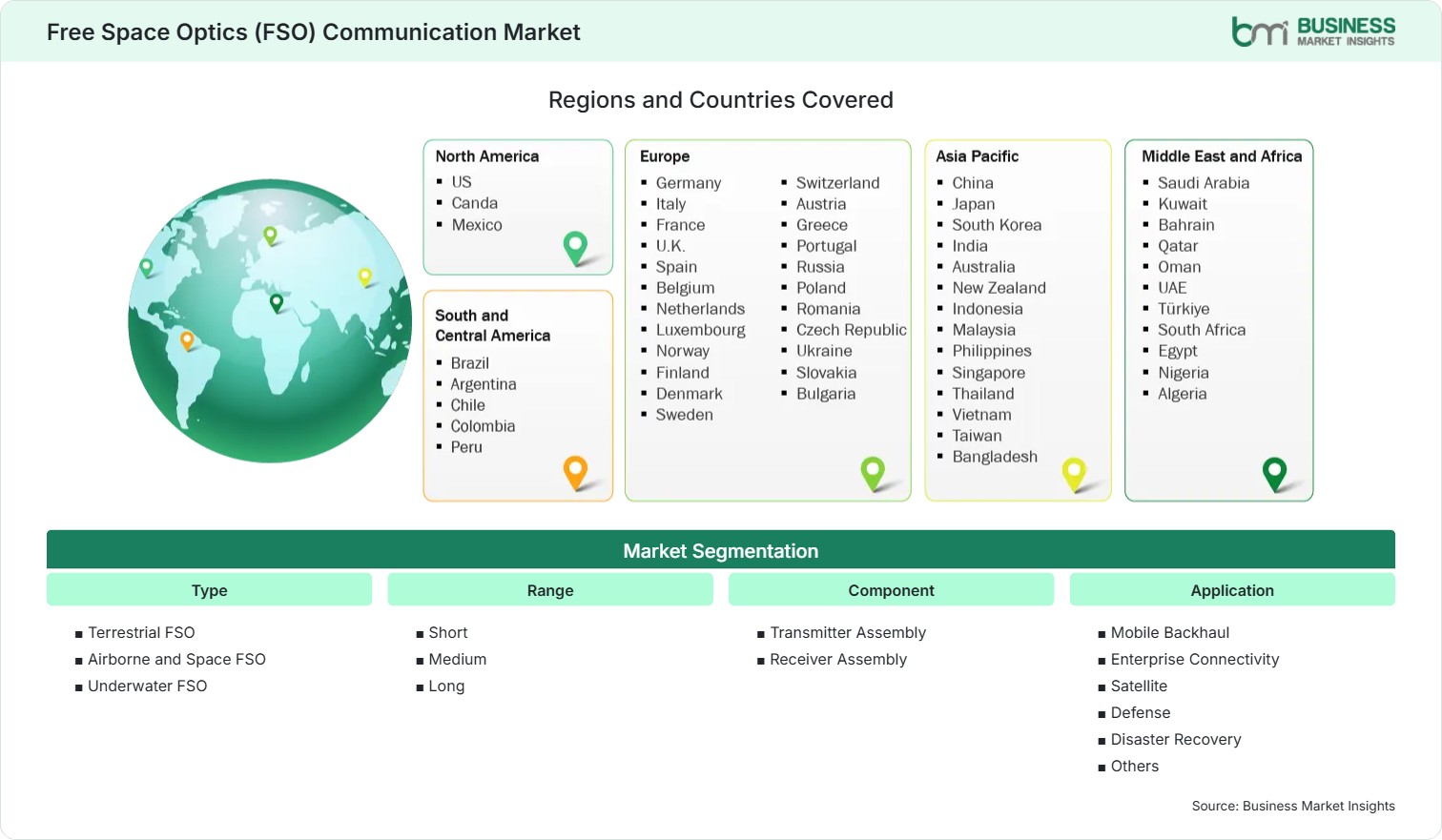
North America held a 45%–48% Free Space Optics (FSO) Communication Market share in 2025 and is projected to expand at a 14.5%–16.5% CAGR through 2033. The region benefits from defense modernization, satellite communications, advanced photonics research, and demand for resilient high-capacity links. The U.S. remains the principal contributor, supported by government-funded optical communications programs and defense applications. Canada adds specialist capabilities through optical networking developers and satellite technology. Strong domestic aerospace and defense ecosystems provide commercialization pathways for terrestrial, airborne, and space-based systems, reinforcing regional leadership across multiple applications.
- Defense agencies increasingly evaluate FSO for high-bandwidth tactical networking where narrow optical beams can reduce interception risks and avoid congested RF spectrum.
- Satellite operators and space agencies are accelerating optical communications adoption to manage rising data volumes and improve inter-satellite and space-to-ground connectivity.
- Enterprise and telecom deployments remain relevant where fiber installation is expensive, delayed, or impractical, particularly across campuses, metropolitan corridors, and temporary infrastructure.
- Optical ground stations are gaining attention as satellite constellations require scalable architectures for high-throughput downlinks and data relay services.
US Free Space Optics (FSO) Communication Market
The U.S. accounted for an estimated 37%–40% of the regional Free Space Optics (FSO) Communication Market share in 2025 and is expected to grow at a 14.8%–16.8% CAGR through 2033. Federal defense programs, aerospace research, satellite communications, and resilient networking initiatives underpin demand. The country's extensive photonics ecosystem supports innovation in optical terminals, tracking, adaptive optics, and secure links. Defense demonstrations increasingly validate operational use cases, while commercial satellite programs create additional demand for high-capacity optical communications infrastructure across space and ground networks.
- U.S. defense modernization supports adoption of FSO links for tactical command posts, mobile networks, and spectrum-independent communications in contested electromagnetic environments.
- NASA optical communications demonstrations continue establishing technical confidence in high-rate laser transmission, strengthening the broader ecosystem for commercial space communications and related technologies.
- Commercial operators are evaluating optical ground stations and inter-satellite links as satellite data volumes increase and conventional RF spectrum becomes increasingly constrained.
Europe Free Space Optics (FSO) Communication Market
Europe represented a 20%–23% Free Space Optics (FSO) Communication Market share in 2025 and is forecast to grow at a 15.5%–18.0% CAGR through 2033. Germany and the U.K. remain leading contributors through aerospace, defense, and photonics capabilities, while France is emerging strongly through optical ground station development. Germany is estimated at a 16.0%–18.5% CAGR, France at 18.0%–21.0%, and the U.K. at 14.5%–17.0%. ESA-backed optical infrastructure initiatives are strengthening regional commercialization and interoperability across terrestrial and space applications.
- ESA's HydRON initiative is advancing high-throughput optical networking concepts that connect orbital layers, creating demand for interoperable terminals and supporting infrastructure.
- France is strengthening its position through optical ground station technologies designed to mitigate atmospheric turbulence and support high-rate satellite-to-ground communication.
- Germany benefits from established aerospace and photonics expertise, supporting development of airborne and space optical communication terminals for emerging satellite networks.
- The U.K. provides opportunities across defense communications, satellite technology, and secure networking, supported by established aerospace and telecommunications research capabilities.
Asia Pacific Free Space Optics (FSO) Communication Market
Asia Pacific held a 16%–19% Free Space Optics (FSO) Communication Market share in 2025 and is projected to achieve an 18.0%–21.0% CAGR through 2033, making it the fastest-growing region. China, Japan, South Korea, India, and Australia offer diverse opportunities across telecom, satellite, defense, and disaster recovery. Japan is estimated at a 17.5%–20.0% CAGR, India at 20.0%–23.0%, and China at 18.0%–21.0%. NEC's 2025 demonstration of FSO communication over more than 10 km highlights regional progress in long-distance terrestrial optical links.
- Japan is advancing long-distance terrestrial optical communications, with technology development targeting improved tracking, miniaturization, disaster recovery, and secure national infrastructure applications.
- India presents strong potential from telecom expansion, smart-city initiatives, defense modernization, and the need for high-capacity links across challenging deployment environments.
- China and South Korea offer opportunities through advanced telecommunications, satellite programs, electronics manufacturing, and investment in next-generation connectivity infrastructure.
- Australia provides a strategic environment for optical ground stations and satellite communications, particularly where geographic scale increases the value of high-capacity wireless links.
Rest of World Free Space Optics (FSO) Communication Market
South and Central America represented a 5%–7% share of the Free Space Optics (FSO) Communication Market in 2025 and are projected to expand at a 15.0%–18.0% CAGR through 2033. Brazil and Mexico lead regional opportunities through telecommunications, enterprise connectivity, and infrastructure modernization. Brazil is estimated at an 16.0%–19.0% CAGR, supported by geographic scale and connectivity requirements. Mexico benefits from proximity to North American technology ecosystems and expanding digital infrastructure investment.
The Middle East and Africa accounted for a 7%–9% share in 2025 and is expected to grow at a 16.0%–19.0% CAGR. The UAE, Saudi Arabia, and South Africa represent leading opportunities, while the UAE is estimated at a 18.0%–21.0% CAGR. Smart-city programs, defense requirements, remote connectivity, and disaster-resilient networks support adoption.
- Brazil's geographic diversity creates opportunities for FSO as a rapid-deployment alternative where terrestrial fiber construction faces cost or logistical constraints.
- Mexico can benefit from cross-border technology transfer and enterprise connectivity requirements linked to industrial, logistics, and telecommunications expansion.
- Gulf countries are investing in advanced digital infrastructure and smart-city ecosystems, creating potential applications for secure, high-capacity optical connectivity.
- South Africa offers opportunities in enterprise, defense, and remote connectivity applications where line-of-sight optical links can complement conventional network infrastructure.